AWS outage disrupts Coinbase and Robinhood
AWS outage disrupts Coinbase and Robinhood, highlighting risks of centralised cloud reliance.
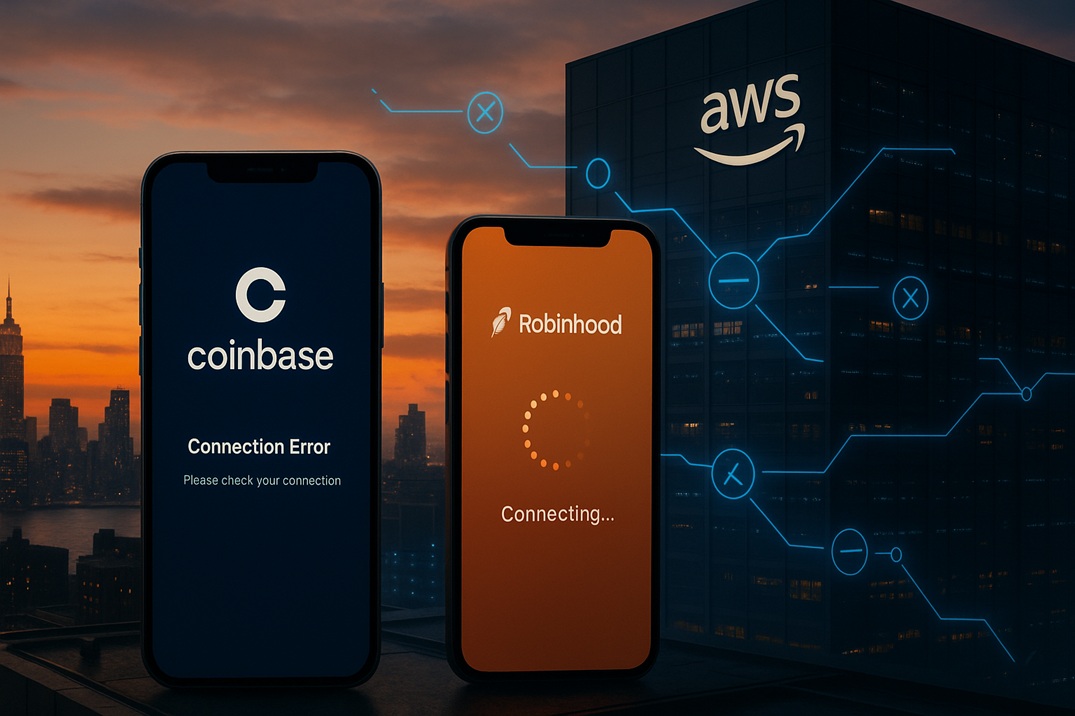
An AWS outage disrupts Coinbase and Robinhood, highlighting the risks of centralised cloud reliance. On October 20, 2025, a significant AWS disruption in the US-EAST-1 region caused widespread outages across major platforms. This incident highlights the vulnerabilities inherent in relying on centralised cloud providers for critical financial infrastructure.
Someone said GLOBAL AWS OUTAGE? Because it seems like everything is down.
Major AWS outage disrupts several services like Amazon, Alexa, Snapchat, Fortnite, Perplexity, Airtable, MyFitnessPal, Canva, and McDonald’s app due to high error rates and latencies. AWS is investigating;… pic.twitter.com/RbYXGUGENe
— Hackmanac (@H4ckmanac) October 20, 2025
AWS Outage Impact on Financial Services
The AWS outage, which began around 5:00 AM EDT, led to increased error rates and connectivity failures, affecting over 500 companies globally. Major centralised crypto platforms like Coinbase and Robinhood were severely impacted. Coinbase, the third-largest centralised exchange by volume, experienced complete mobile app downtime, preventing users from logging in, placing orders, or withdrawing funds. Similarly, Robinhood users faced trading execution delays and API failures, disrupting both stock and crypto trading.
AWS confirmed issues with services like DynamoDB and DNS resolutions, which cascaded across its infrastructure. By mid-morning, AWS reported “early signs of recovery,” with full mitigation by 10:00 AM EDT. User complaints peaked at tens of thousands on platforms like Downdetector.
Lessons from the AWS Outage
This outage is the second major AWS incident in six months, following a similar event in April 2025. The recurring issues in the US-EAST-1 region, AWS’s oldest and most utilised, highlight the risks of centralisation. AWS powers about 33% of the global cloud market, making it a backbone for high-volume platforms like Coinbase and Robinhood.
We’re aware many users are currently unable to access Coinbase due to an AWS outage.
Our team is working on the issue and we’ll provide updates here. All funds are safe.
— Coinbase Support (@CoinbaseSupport) October 20, 2025
The irony of decentralised cryptocurrencies relying heavily on centralised cloud providers is not lost. When AWS falters, it creates single points of failure, halting billions in transactions and eroding user trust. Companies are urged to adopt multi-cloud strategies or implement DNS fallbacks to mitigate such risks.
Economically, outages like this can cost the U.S. economy up to $150 million per hour in lost productivity and revenue. For crypto, frequent access issues could deter retail investors, especially amid recent market crashes.
Projects like Vanar Chain’s Neutron, Internet Computer, and Filecoin offer decentralised solutions. These alternatives provide on-chain storage and computing, avoiding regional bottlenecks. As regulatory scrutiny increases, companies may face redundancy requirements to ensure resilience.
Investors can consider diversifying holdings across exchanges and consider self-custody to avoid “trapped” funds scenarios. This outage serves as a wake-up call to build more robust, fault-tolerant systems in a cloud-dependent world.
Financial advice disclaimer: This article is for informational purposes only and should not be considered financial advice.
View our Exploit Tracker.
From the YFarmX archive · originally published on the previous site