Cardano disruption explained: the library bug impact
On 21 November, a malformed delegation transaction turned an obscure library bug into the most visible cardano disruption the network has seen.

On 21 November, a malformed delegation transaction turned an obscure library bug into the most visible cardano disruption the network has seen. For roughly half a day, Cardano ran two parallel histories, exchanges paused flows, and ADA sold off, before consensus quietly reconverged on a single canonical chain with no user funds lost.
Timeline: from malformed tx to discarded fork
The incident began around 08:00 UTC, when a specially crafted delegation to the “Rats” stake pool hit mainnet. Newer node versions (10.1.4+ in most reports) hit a deserialisation edge case while hashing the transaction and effectively wedged themselves, continuing to extend a “poisoned” ledger. Older nodes rejected the malformed transaction entirely and kept building a “healthy” chain. For several hours, block production ran below capacity while exchanges and wallets throttled or paused ADA deposits and withdrawals as a precaution.
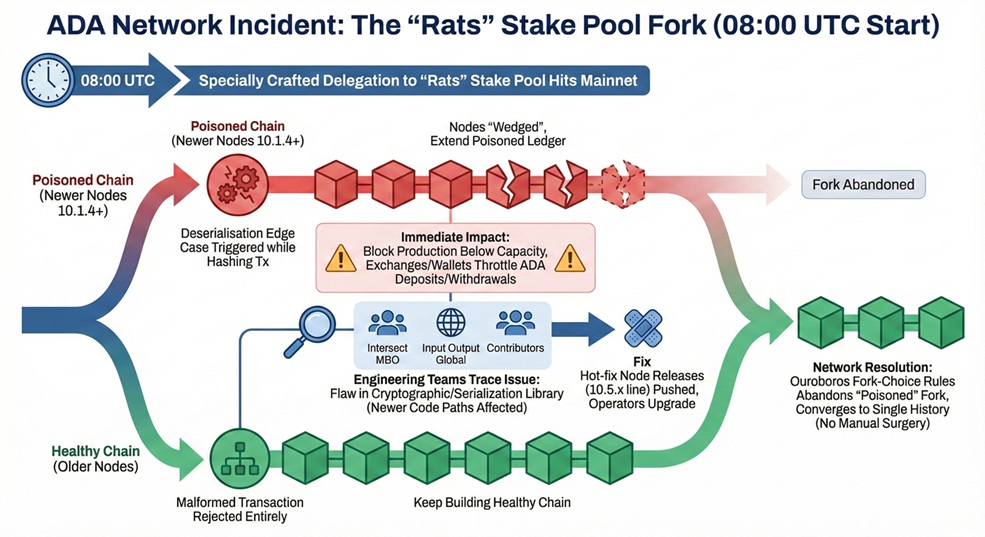
Engineering teams from Intersect MBO, Input Output Global and other contributors traced the issue to a long-standing flaw in an underlying cryptographic/serialisation library that newer code paths exercised, but older ones did not. Hot-fix node releases in the 10.5.x line were pushed, and stake pool operators began upgrading. As more stake moved onto patched nodes following the healthy chain, Ouroboros’ normal fork-choice rules did the rest: the “poisoned” fork, which had accumulated hundreds of blocks, was abandoned, and the network converged back to a single history without any manual ledger surgery.
Inside the cardano disruption: what actually broke
Ouroboros assumes that a super-majority of stake is running compatible validation rules. The malformed delegation transaction exploited exactly where that assumption was thinnest: a new, post-Chang code path that only updated nodes used. Those nodes treated the transaction as sufficiently well-formed to enter a bad state; older nodes, taking a different route through the library, rejected it and continued as normal.
From the user perspective, this showed up as slow or missing confirmations rather than a dramatic “network down” banner. Under the hood, monitoring tools and operator dashboards were showing two incompatible tips racing for dominance, with disagreement on height and density between node cohorts. Once patched binaries rolled out and enough stake migrated, the honest chain had the clear majority, and the weaker fork simply lost the fight.
Attack, experiment, or something in between?
Initial commentary from Charles Hoskinson cast the event as a targeted attack, noting that a similar malformed delegation had been fired on a testnet shortly beforehand and that the mainnet hit arrived into a jittery macro market. Later reporting added nuance: the wallet behind the transaction was linked to a participant from the Incentivised Testnet era, and an X user known as “Homer J” publicly claimed responsibility, saying they were trying to reproduce an old “toxic” transaction using AI-generated instructions rather than seeking financial gain. U.S. law-enforcement agencies, including the FBI, have reportedly been notified, so the episode is still being treated as a potential cyber incident.
Update https://t.co/48YGQbF05R
— Charles Hoskinson (@IOHK_Charles) November 21, 2025
In engineering terms, the attacker’s intent is almost beside the point. The incident demonstrates that a single, carefully constructed transaction can drive a wedge between different client versions if there is any divergence in how they exercise shared libraries. That is not a protocol-level failure, but it is a reminder of how much real economic value now rests on implementation details and testing discipline.
Impact: users, markets, governance
For day-to-day holders, the immediate impact of the cardano disruption was largely nuisance: stuck deposits on exchanges, slower withdrawals, failed swaps and block-explorer charts that looked wrong for a few hours. ADA dropped sharply on the day (mid-single to low-double-digit percentage losses depending on the venue) as headlines framed the incident as a “chain split” and several major exchanges temporarily disabled ADA flows. Because the healthy chain never stopped, no user balances needed to be manually corrected; once the fork resolved, wallets and dApps simply reflected the canonical history.
For infrastructure and governance, the implications are sharper. The episode exposed gaps between testnet and mainnet behaviour, raised questions about how aggressively new node versions should be pushed, and is likely to accelerate work on differential testing, fuzzing, and more formalised bug-bounty processes around core libraries. It also, somewhat awkwardly, validated one of Cardano’s core talking points: diversity matters. The fact that a sizeable minority of stake was still running older, stricter code is precisely what kept a clean chain alive long enough for patched nodes to rejoin it.
What this episode tells us about resilience
The incident looks like an unscheduled resilience drill. A latent bug dating back years was flushed into the open. Incident-response channels across Intersect, IOG, exchanges and stake pool operators were stressed but held. The network converged in under a day, with no fund loss and a clear to-do list for testing and governance ahead of the next upgrade cycle.
For a project that prides itself on formal methods and cautious change, that mix of humility and survivability is the real outcome. Cardano now has a concrete example of how its stack behaves under real adversarial conditions, rather than in lab simulations. The rational move from here is to treat this fork as baseline threat modelling, not a freak accident, and harden the ecosystem so the next cleverly malformed transaction has fewer places to hide.
Disclaimer
This article is for information purposes only and does not constitute investment, legal or tax advice. Always do your own research.
From the YFarmX archive · originally published on the previous site