Cardano Unreal Engine 5 Integration Revolutionises Gaming
Cardano Unreal Engine 5 integration transforms Web3 gaming with $ADA and NFT functionalities.
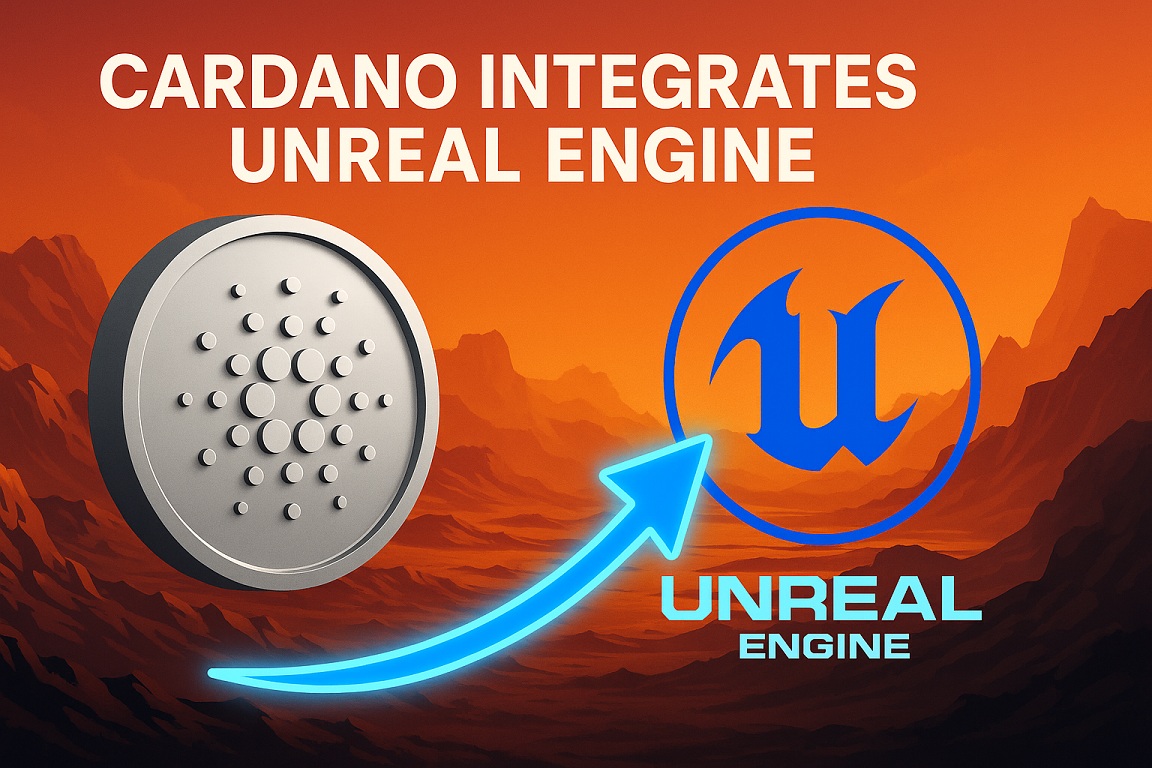
Cardano Unreal Engine 5 integration cements a major advance in the gaming industry. The recent announcement reveals that Cardano’s $ADA and native assets are now integrated into Unreal Engine 5. This development has the potential to reshape Web3 gaming by providing developers with the tools to create immersive, high-quality games that incorporate cryptocurrency and NFT functionalities seamlessly.
BREAKING NEWS:
CARDANO $ADA GOES LIVE IN UNREAL ENGINE 5😱😱😱
For the first time ever, Cardano $ADA and native assets can move directly inside Unreal Engine 5 @UnrealEngine unlocking massive potential for Web3 gaming, NFTs, and virtual economies.
Is this the moment where… pic.twitter.com/QCfnlFc04X
— Mintern (@MinswapIntern) August 22, 2025
Cardano Unreal Engine 5: A New Era for Gaming
Unreal Engine 5, crafted by Epic Games, stands as one of the most advanced platforms for game development, known for powering AAA titles with its robust tools for creating realistic 3D environments. The integration of Cardano’s blockchain into this engine allows developers to embed $ADA payments, NFT collectibles, and crypto wallets directly into their games. This is made possible through a plug-and-play SDK, which simplifies the process and eliminates the need for extensive coding.
Technical Underpinnings
Cardano’s blockchain infrastructure is renowned for its scalability, security, and sustainability. Utilising a proof-of-stake consensus mechanism called Ouroboros, Cardano is energy-efficient compared to proof-of-work systems like Bitcoin. This makes it particularly suitable for gaming applications where continuous, high-volume transactions are common.
Implications for Web3 Gaming
This development is a significant leap forward for Web3 gaming, a sector aiming to decentralise game economies and enhance player ownership. Traditionally, game assets are controlled by centralised entities, limiting players’ ability to own and trade their in-game items. With Cardano’s integration, players can now own NFTs representing in-game assets, which can be bought, sold, or traded on decentralised marketplaces. This shift towards true digital ownership aligns with the broader vision of a decentralised internet.
Broader Context and Economic Impact
The gaming industry has been increasingly exploring blockchain technology, with platforms like Axie Infinity and The Sandbox demonstrating the potential for virtual economies powered by cryptocurrencies and NFTs. However, these platforms often face challenges related to scalability, user experience, and integration with existing game development tools. Cardano’s integration with Unreal Engine 5 addresses these challenges by offering a seamless solution that maintains high graphical fidelity and performance.
Economically, this integration could spur a new wave of innovation in game development, attracting developers who previously avoided blockchain due to technical complexities. It opens up new revenue streams for game developers through in-game transactions and NFT sales.
Challenges and Future Prospects
Despite the potential, challenges remain. The adoption of blockchain in gaming requires a shift in mindset from both developers and players, who may be wary of cryptocurrency volatility or the environmental impact of blockchain technology. Ensuring the security and privacy of user data within these decentralised systems is crucial, especially as gaming becomes more interconnected with financial systems.
Looking forward, this integration could be a catalyst for further innovations in Web3 gaming. It may encourage other blockchain projects to develop similar plugins for popular game engines, fostering a competitive ecosystem that drives technological advancements. As virtual reality (VR) and augmented reality (AR) technologies continue to evolve, the combination of Cardano’s blockchain with Unreal Engine 5 could pave the way for fully immersive, decentralised metaverse experiences.
Disclaimer: This article is for informational purposes only and does not constitute financial advice.
From the YFarmX archive · originally published on the previous site