Hyperliquid’s POPCAT wipeout: inside the $63m liquidation cascade
On Thursday, Hyperliquid (one of DeFi’s busiest perp venues on its own Layer-1) endured what analysts dubbed “peak degen warfare.”

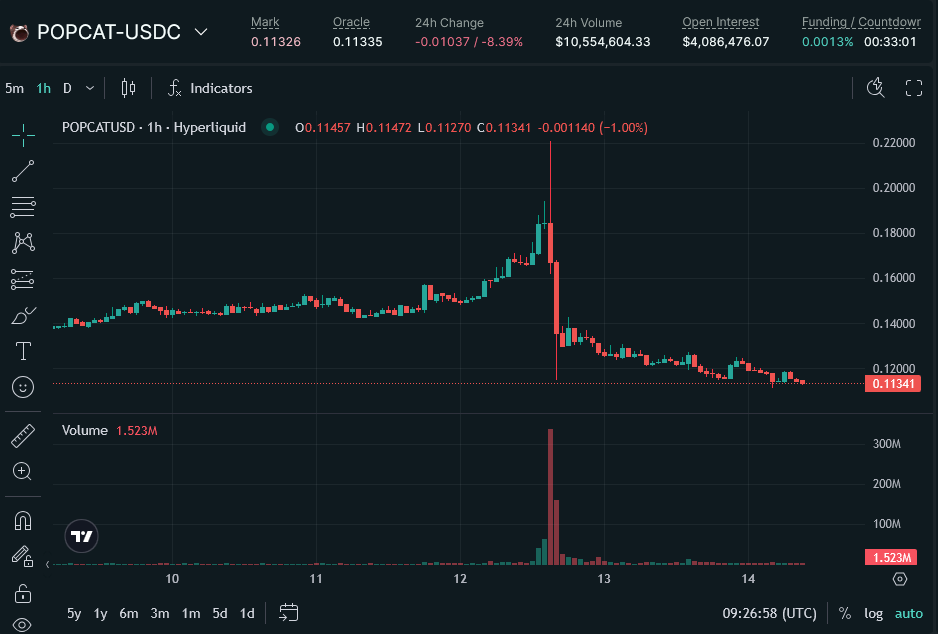
On Thursday, Hyperliquid (one of DeFi’s busiest perp venues on its own Layer-1) endured what analysts dubbed “peak degen warfare.” A single actor engineered a violent collapse in the POPCAT perpetual market, deliberately torching roughly $3 million of their own collateral to force a chain of liquidations. Within minutes, POPCAT perps on Hyperliquid fell about 43% (≈$0.21 → $0.12), triggering ~$63 million of platform-wide liquidations and leaving the protocol’s community backstop, the HLP vault, with ~$4.9 million of bad debt. There was no smart-contract exploit, the damage came from manipulating thin order books and the liquidation pipeline.
What happened
The attacker split ~$3m USDC across 19 wallets, bridged in, and around 13:45 UTC opened aggressively long POPCAT perps (reportedly up to 5× leverage) building $20–30m notional against modest collateral. They then posted an outsized buy wall near $0.21, signalling depth and pulling in copy-cat longs.
About 13 hours ago, someone withdrew $3M USDC from OKX and split it across 19 wallets.
Around 14:45 CET, he started longing millions worth of POPCAT, placing roughly $20M worth of buy orders at $0.21.
The combined long position grew to around $30M across those 19 wallets.…
— MLM (@mlmabc) November 12, 2025
Seconds after momentum crowded in, the wall vanished. With support gone, the book air-gapped, the mark price sliced through maintenance margins, and liquidations fired, first on the attacker (wiping their $3m), then across other over-leveraged longs. Because POPCAT’s depth was wafer-thin, the liquidation engine pushed distressed inventory into HLP, which absorbed losses until the vault crystallised ~$4.9m of bad debt (roughly three months of typical HLP profit).
Why it worked
Three features aligned. First, POPCAT’s low liquidity meant removing a single theatrical wall produced a gap, not a glide. Second, mark/index dynamics on a fast venue let a sharp intra-venue move punch through margins before outside liquidity re-priced. Third, Hyperliquid’s backstop architecture (excellent at shielding users) concentrates tail risk in HLP, making it a visible target when inventory must be socialised during a vacuum.
Immediate impact
- Attacker burned ~$3m; total forced liquidations ~$63m; HLP finished ~$4.9m in bad debt.
- POPCAT perps hit –43% on-venue; spot POPCAT elsewhere dipped ~15–20% before stabilising; HYPE slid 2–3% then recovered.
- POPCAT perps paused briefly; an EmergencyLock paused one bridge route; matching stayed up; normal operations resumed in ~1 hour.
What it wasn’t
This was not a code exploit, a custody failure, or “HYPE longs gone wrong.” Early chatter mislabelled the market; the target was POPCAT perps. Core invariants held, and there was no solvency risk to the exchange.
Hyperliquid’s response
The team contained flow via a temporary bridge lock, briefly paused POPCAT perps, and manually closed inherited positions to cap losses. A full post-mortem is pending at the time of writing, but the incident repeats a familiar pattern from March 2025 (JELLYJELLY) that already nudged the venue toward tighter long-tail parameters. Yesterday’s episode will likely accelerate that shift from “anything goes” to rules that fit liquidity reality.
Design changes to consider
- Dynamic risk brakes – volatility bands, wider maintenance margins, and batch-style liquidation auctions to attract external MM fill.
- Exposure throttles – per-account notional caps and open-interest limits that tighten automatically in thin markets.
- Backstop segmentation – HLP tranches and per-market VaR caps so long-tail assets can’t drain the core pool in a single shock.
- Spoof-costing & surveillance – meaningful costs for rapid add/cancel near top-of-book and automated flags for wall-yank patterns.
 https://app.hyperliquid.xyz/trade/POPCAT
Trader takeaways
Visible support can evaporate when it matters. Leverage plus thin books is combustible; size for gap risk, not just day-to-day volatility. If you must use leverage, prefer deep, multi-venue pairs (BTC/ETH); treat long-tail perps like high-variance bets and price in the chance that a manufactured air-gap will take you out.
The bigger picture
Perp DEXs want the growth that comes with long-tail listings, but backstops make them accountable for tail events. Hyperliquid’s swift containment shows operational maturity and explains its fee dominance, yet “grief trading” remains an adversarial strategy with reputational payoff for attackers and socialised cost for backstops. The next competitive edge won’t be more tickers, it’ll be transparent listing tiers, adaptive brakes, and backstops that take the punch without bleeding out.
Disclosure: This article is for information purposes only and does not constitute investment, trading, legal, or risk-management advice. Perpetual futures are high risk and can result in total loss.
From the YFarmX archive · originally published on the previous site