LangChain Launches Enterprise Agentic AI Platform Built with NVIDIA
LangChain partners with NVIDIA to deliver a production-grade agentic AI development platform, combining LangSmith, Deep Agents, and NVIDIA Agent Toolkit for enterprise-scale deployment.
LangChain has announced a comprehensive integration with NVIDIA to deliver an enterprise-grade agentic AI development platform, combining the agent engineering company’s open-source frameworks with NVIDIA’s full AI stack for production deployment at scale.
The partnership, revealed on 16 March 2026, pairs LangChain’s LangSmith platform and its open-source frameworks, which have surpassed one billion downloads, with NVIDIA Agent Toolkit, Nemotron models, NIM microservices, and Dynamo. LangChain is also joining the Nemotron Coalition, NVIDIA’s initiative to advance frontier open AI models through shared compute and data.
What does the LangChain NVIDIA enterprise platform offer?
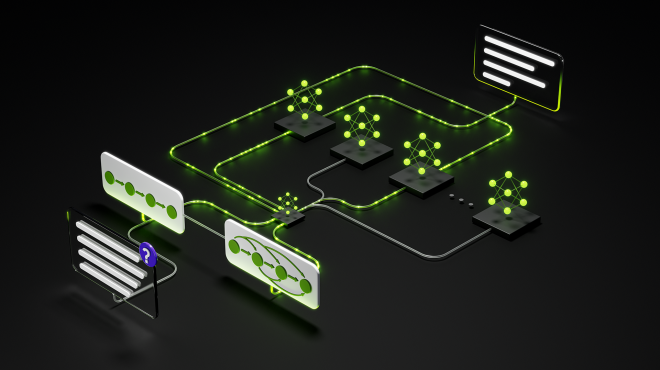
The combined stack targets the months of custom infrastructure work that development teams typically burn before delivering business value. At its core, the platform brings together several components:
- LangGraph for stateful multi-agent orchestration with complex control flows and human-in-the-loop patterns
- Deep Agents , LangChain’s agent harness, adding built-in task planning, sub-agent spawning, long-term memory, and context management
- NVIDIA AI-Q Blueprint , the flagship collaboration result, described as a full production enterprise deep research system that ranks first on deep research benchmarks
- NeMo Agent Toolkit for profiling, evaluation, and MCP/A2A protocol support for composing multi-agent systems
- NVIDIA OpenShell , a secure runtime that sandboxes autonomous, self-evolving agents with policy-based guardrails
 https://www.nvidia.com/en-gb/solutions/ai/
Why this partnership matters for enterprise AI agents
Enterprise AI agent deployment has been bottlenecked by infrastructure complexity. Teams spend months building custom orchestration, monitoring, and security layers before agents ever touch production workloads. The LangChain-NVIDIA integration attempts to compress that timeline by providing a complete stack, from development through deployment and continuous improvement.
The inclusion of OpenShell is notable. Sandboxing self-evolving agents with policy-based guardrails addresses one of the persistent concerns around autonomous AI systems: what happens when agents modify their own behaviour in production. NVIDIA’s approach treats this as a runtime security problem rather than a design-time constraint.
How does this fit the broader AI agent landscape?
The announcement arrives during a week of intense activity in the enterprise AI agent space. NVIDIA’s GTC 2026 conference has produced a string of agent-related launches, and the broader market is moving rapidly from proof-of-concept agent deployments to production-grade infrastructure.
LangChain’s position is distinctive because of its open-source reach. One billion framework downloads is not a vanity metric; it represents a massive developer base already using LangChain tooling. The NVIDIA partnership effectively upgrades that base from community-supported experimentation to enterprise-hardened deployment without forcing a migration to a different stack.
For enterprises evaluating agentic AI platforms, this raises a practical question: build custom infrastructure on top of raw open-source components, or adopt a pre-integrated stack that connects development to production with NVIDIA’s optimisation layer underneath. The answer will depend on how much control an organisation needs versus how quickly it needs agents in production.
This article is for informational purposes only and does not constitute financial, investment, or professional advice.
From the YFarmX archive · originally published on the previous site