Solana Agent Skills Give AI Builders a Cleaner Way to Work With Solana
Solana Agent Skills give AI builders a cleaner way to work with Solana programmes, tokens and developer tooling. Here is what Solana Agent Skills does, why it matters, and what developers should watch next.
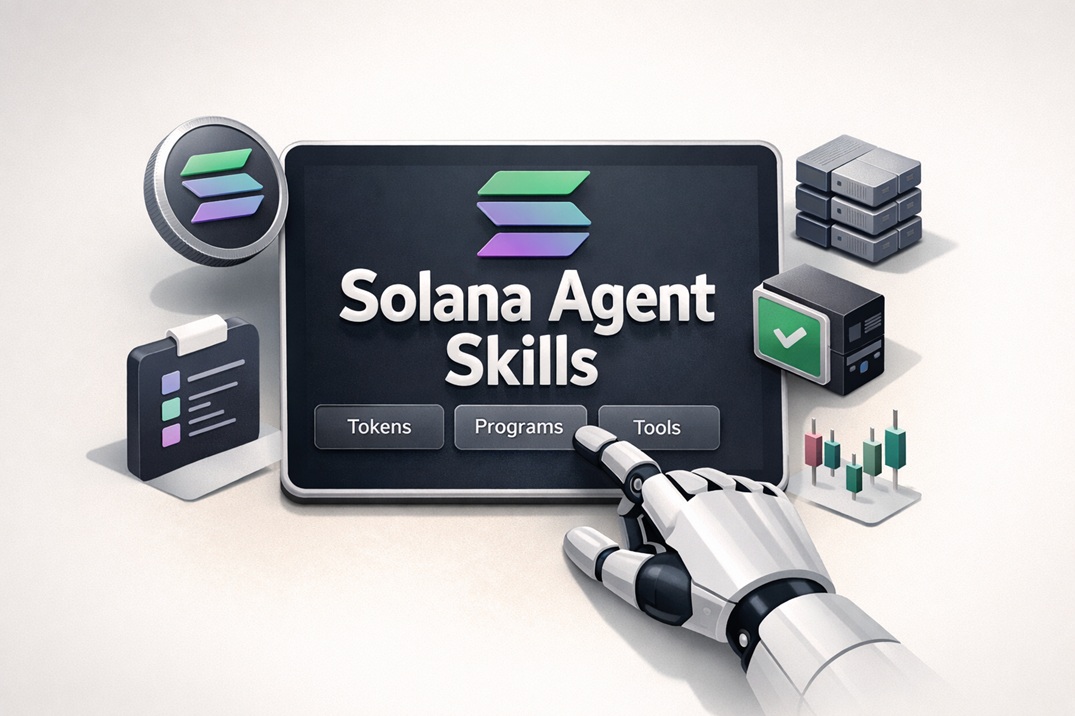
Solana Agent Skills is a new package from the Solana Foundation designed to make it easier for AI tools to work with Solana. The official pitch, is simple enough: pre-built skills that agents can install to interact with Solana programmes, tokens and tooling.
That may sound tidy rather than dramatic, but tidy is the point. Most of the talk around AI agents and crypto has been heavy on promises and light on the awkward business of making systems behave. Solana Agent Skills is an attempt to solve that practical layer first.
Fact box
Project: Solana Agent Skills
Organisation: Solana Foundation
Category: AI tooling / developer infrastructure
Install path: solana-dev-skill on GitHub
Primary source: solana.com/skills
What is Solana Agent Skills?
Solana Agent Skills is a framework for giving AI agents structured context and actions for Solana-related tasks. The package is meant to help agents work with programmes, tokens, developer tools and broader Solana workflows without forcing every builder to improvise the same integration layer from scratch.
There is a one-line install route through the foundation’s GitHub repository.
How Solana Agent Skills Fits into AI
The timing makes sense. AI agents are one of the year’s preferred obsessions, but much of the sector is still fumbling through the basics. It is easy enough to get a model to talk about a wallet or a token. It is rather harder to get it to behave predictably when real tools, on-chain actions and user funds are involved.
That is where Solana Agent Skills becomes more than a neat developer release. It gives builders a cleaner way to define what an agent should know and what it should be allowed to do. If that works, wallets, copilots, trading assistants and internal developer tools all become easier to build, test and audit.
It also tells you something about where Solana thinks the market is going. The chains that attract attention in an agent-heavy environment may not be the ones with the noisiest brand campaigns. They may be the ones that are easiest for machines to understand. That is a less romantic advantage, but usually the more useful sort.
Introducing Solana Agent Skills
Pre-built skills you can drop into AI tools to interact with Solana.
Install in one line and build agents that know Solana. pic.twitter.com/b2gEZA827v
— Solana Foundation (@SolanaFndn) April 3, 2026
How the Solana skills model fits the wider market
There is a broader pattern here. Infrastructure projects are starting to package themselves for machine use as well as human use. Humans can cope with loose edges, missing context and slightly annoying documentation. Agents are less forgiving. They need bounded actions, stable interfaces and enough context not to wander off into expensive nonsense.
Solana is not alone in noticing that shift, but it is moving early enough for the timing to matter. The skills page splits listings between official skills and community skills, and it is careful to warn that community entries are not endorsements or security guarantees. Sensible. Crypto has had enough costly reminders that convenience and safety are not the same thing.
If developers adopt Solana Agent Skills in meaningful numbers, this launch could matter well beyond the initial post. It would suggest Solana is becoming easier to wire into the software layer that is now getting most of the attention from builders and investors alike.
What builders running OpenClaw, Hermes or Claude cowork setups can try next
Developers running agent stacks like OpenClaw, Hermes, or Claude cowork environments can start experimenting with direct integrations rather than treating the tooling as a demo.
A straightforward first step is wiring Solana transaction signing into an agent workflow. In practice this means letting an agent prepare instructions, simulate transactions, and then hand off signing to a wallet or key manager rather than requiring manual CLI steps.
Another useful experiment is embedding Solana developer tooling directly inside an agent pipeline. For example, an OpenClaw workspace can expose RPC calls, transaction simulation, and account inspection as callable tools so an agent can debug contract interactions or automate deployment checks.
Teams building payment or automation flows can also test agent-driven transaction execution. Instead of a script triggered by cron or a backend worker, an agent can decide when to construct and send transactions based on external signals, API data, or monitoring conditions.
The practical signal to watch is whether these integrations begin showing up in real developer workflows: agents submitting transactions, managing program interactions, or coordinating on-chain actions as part of automated pipelines rather than one-off scripts.
This article is for informational purposes only and does not constitute financial or investment advice.
From the YFarmX archive · originally published on the previous site