Moonwell exploit highlights perils of stale oracles
The Moonwell exploit on 4 November 2025 drained roughly $1 million (about 292 ETH) from the multi-chain lending protocol after it relied on a deprecated Chainlink rate feed for the rsETH/wrsETH pair, a case study in the risk of stale oracle data.
The moonwell exploit on 4 November 2025 exposed a quietly lethal risk in DeFi’s plumbing: not faulty code, but complacent data. Roughly $1 million (about 292 ETH) was drained from the multi-chain lending protocol after it relied on a deprecated Chainlink rate feed for the rsETH/wrsETH pair, a market already distorted by the recent Balancer fallout.
Moonwell, which operates across Base, Optimism, Moonbeam and Moonriver and traces its lineage to Compound V2, wasn’t struck through any flaw in Chainlink itself. Instead, it was tripped by an old oracle still reporting prices from a liquidity pool that had long since withered.
Update: @anthiasxyz, the risk manager for all Moonwell Core Markets, has published a report on the governance forum detailing today’s oracle malfunction concerning wrsETH.
To mitigate risks associated with potential over-borrowing by previous wrsETH suppliers, the borrow caps… https://t.co/Oia7XliLg2
— Moonwell (@MoonwellDeFi) November 4, 2025
The Moonwell Exploit and the Oracle Mirage
In DeFi, “trustless” doesn’t always mean “timeless.” The moonwell exploit began when an attacker noticed the rsETH price feed lagging reality by several blocks, and several zeroes. They used that ghost price as collateral, borrowed against it, and walked away before anyone blinked. The protocol’s guardians later described it as an “unintended reliance on outdated market data” — which is a diplomatic way of saying we left the lights on.
While the total loss was modest by 2025 standards, the optics were brutal: a blue-chip oracle, a familiar fork, and a single obsolete feed conspired to produce yet another seven-figure hole.
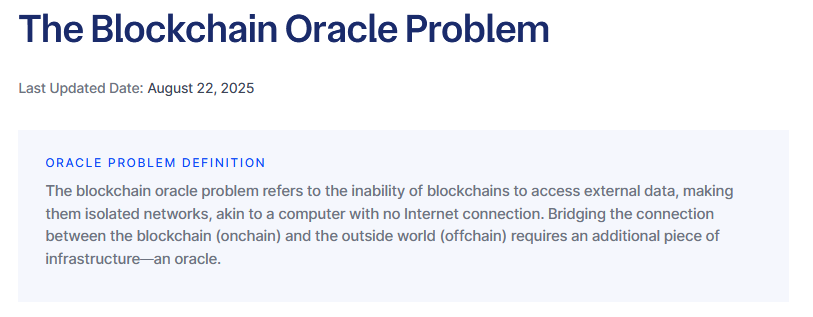 https://chain.link/education-hub/oracle-problem
Oracles, Decay and the Art of Forgetting
The episode underlines a quieter hazard of composable finance: temporal decay. Protocols evolve; oracles don’t always keep up. Developers ship new pools and pairs, while old data feeds linger like broken mirrors in a hallway no one cleans. The moonwell exploit didn’t require genius, just patience, a script, and the ability to read old documentation.
The feed Moonwell was using was deprecated.
Chainlink removed it from the docs and added a warning. Moonwell used it anyway.Feeds are just data, choosing the right one is on the integrator.
The one that Moonwell integrated used Balancer as a source Balancer got exploited… pic.twitter.com/P3qOmyE10B
— Hashed Fate (@HashedFate) November 4, 2025
Chainlink, for its part, was blameless. Its feeds worked exactly as instructed; it was Moonwell’s integration that had fossilised. Still, the incident will feed an uncomfortable question: if decentralisation makes systems permissionless, who’s responsible for remembering to turn things off?
Cleaning the Wires
Post-incident, Moonwell paused affected markets, patched contracts, and began auditing its entire oracle catalogue, a tedious but necessary act of DeFi hygiene. Security firms flagged the exploit as a textbook case of “zombie dependency risk”, when abandoned data sources remain callable long after relevance.
The takeaway is less about villains and more about entropy. In decentralised systems, nothing ever truly breaks; it just keeps running until someone notices.
Disclaimer: This article is for informational purposes only and should not be taken as financial or investment advice.
From the YFarmX archive · originally published on the previous site