
Auto-Deleveraging: If You Didn’t Know, Now You Know
Auto-Deleveraging: Understanding its role in the October 10, 2025 crypto flash crash.
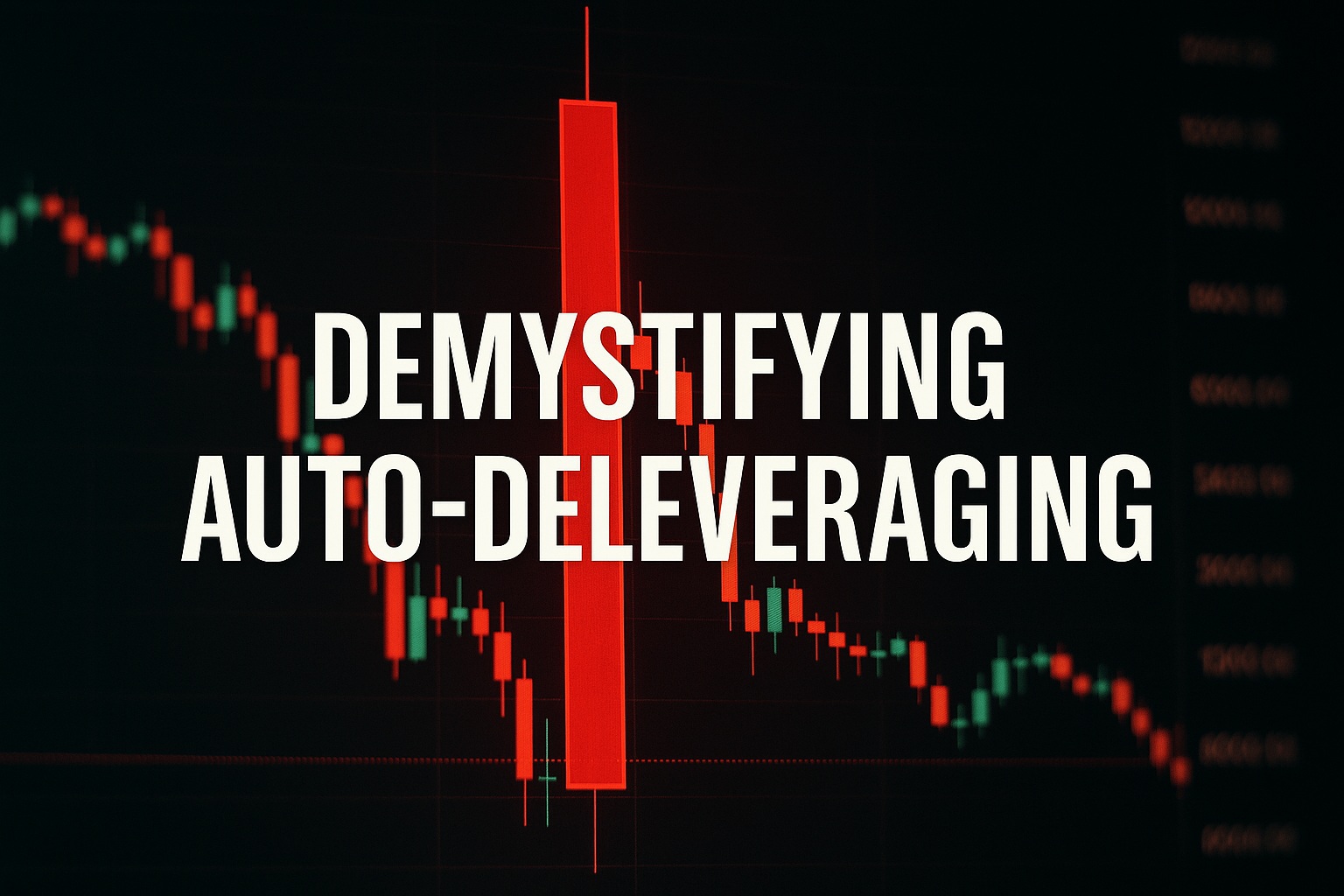
The cryptocurrency market experienced a seismic event on October 10, 2025, when a flash crash obliterated over $19 billion in leveraged positions within a mere few hours. This marked the largest single-day liquidation in crypto history. Auto-Deleveraging took many by surprise.
Understanding Auto-Deleveraging
Auto-Deleveraging (ADL) is a mechanism that forcibly closes positions to maintain market balance. During the crash, ADL was triggered across multiple exchanges, including Bybit, where over 50,000 short positions in BTC perpetual futures were deleveraged, totaling $1.1 billion. This drastic measure became necessary as liquidated long positions overwhelmed the system, leaving no room for traditional market absorption.
“It is impossible to believe that China would have taken such an action, but they have, and the rest is History. Thank you for your attention to this matter!” – President Donald J. Trump pic.twitter.com/Kx6deI2voC
— The White House (@WhiteHouse) October 10, 2025
The crash was initially sparked by escalating U.S.-China trade tensions, with President Trump announcing hefty tariffs on Chinese tech imports. This move sent waves through global markets, including the Nasdaq, which saw a 3.6% decline. The crypto market, already teetering on high leverage, was particularly vulnerable.
The Mechanics of Perpetual Futures and ADL
Perpetual futures contracts, or perps, are derivatives that allow traders to speculate on asset prices without owning the underlying asset. They are inherently a zero-sum game, where gains for one side equate to losses for the other. On October 10, open interest in BTC perps across major exchanges surpassed $30 billion, with longs dominating at 60-70%. As Bitcoin’s price began to slide, these positions hit maintenance margin levels, triggering a cascade of liquidations.
When order books could no longer absorb the volume, exchanges resorted to insurance funds. Hyperliquid’s vault, for instance, absorbed billions in liquidated longs, buying BTC at significant discounts. Yet, when these funds reached capacity, ADL became the last resort.
VIDEO: HYPERLIQUID’S AUTO DELEVERAGE (ADL) FEATURE EXPLAINED pic.twitter.com/6w9QJTeydc
— Spottie 🛜 (@SpottieWiFi) October 11, 2025
A critical view of the ADL feature.
ADL’s role is akin to an overbooked flight – if no volunteers step forward, passengers are involuntarily bumped. This analogy underscores ADL’s necessity in preventing systemic insolvency.
Quantifying the Crash
Breaking down the numbers, Coinglass data reveals that $19 billion was liquidated, with ADL accounting for approximately 15% ($3.65 billion) of resolutions. Bitcoin saw $7.5 billion in liquidations, with 85% being long positions. Ethereum followed with $4.2 billion, while altcoins like Solana and XRP experienced drops of 15-30%.
The crash highlighted the fragility of overleveraged markets, prompting a shift towards risk management and diversification. As markets rebounded by 13% overnight, the event served as a leverage detox, hopefully reinforcing the resilience of the crypto ecosystem.
1/ Since a lot of people are waking up to see their perps positions closed and wondering what the hell “Auto-Deleveraging” means, here’s a quick and dirty primer.
What is ADL? How does it work? And why does it exist? pic.twitter.com/I9MHXVAInd
— Doug Colkitt (@0xdoug) October 11, 2025
🔧 How ADL Works (Technically)
Post-ADL settlement:
The affected trader’s balance and open positions are recalculated, and unrealised PnL is adjusted immediately.
Triggered when insurance fund is depleted:
If the exchange’s insurance fund (vault) cannot cover losses from liquidations, ADL is activated to maintain solvency.
Ranking system determines who gets deleveraged:
Traders are ranked by profitability and leverage – the most profitable and highly leveraged traders are first in line to be auto-deleveraged.
Matched offset liquidation:
The system finds a counterparty with an opposing position (e.g., a profitable short vs. a liquidated long) and automatically reduces their position.
Instant position reduction:
ADL force-closes part or all of a trader’s position at the bankruptcy price of the liquidated trade, not at market price.
No user consent or stop-loss trigger:
It happens automatically – users cannot opt out or intervene once ADL is engaged.
Executed at bankruptcy price:
Ensures the losing side’s losses equal the winning side’s gains, keeping total system balance at zero.
Hedging mechanisms fail before ADL kicks in:
It’s the last resort after all other risk mitigation steps (partial liquidation, insurance fund, liquidation engine) have failed.
Notification and position mark:
Exchanges display an ADL indicator (often a bar or colour code) showing each trader’s likelihood of being deleveraged.
Reduces systemic contagion:
By automatically offsetting positions, ADL prevents cascading insolvencies across correlated markets.
ADL usually occurs during extreme market events, when cascading liquidations outpace liquidity across multiple exchanges, and is a standard fail-safe mechanism outlined in nearly every major exchange’s terms and conditions.
 https://hyperliquid.gitbook.io/hyperliquid-docs/trading/auto-deleveraging
Disclaimer: This article is for informational purposes only and does not constitute financial advice.
From the YFarmX archive · originally published on the previous site