Bitmain investigation: National security concerns
The Bitmain investigation, codenamed Operation Red Sunset, pulls Bitcoin mining hardware into the national security frame. Federal agencies are now treating Chinese-made ASIC rigs as potential vectors for espionage and grid disruption in the United States.
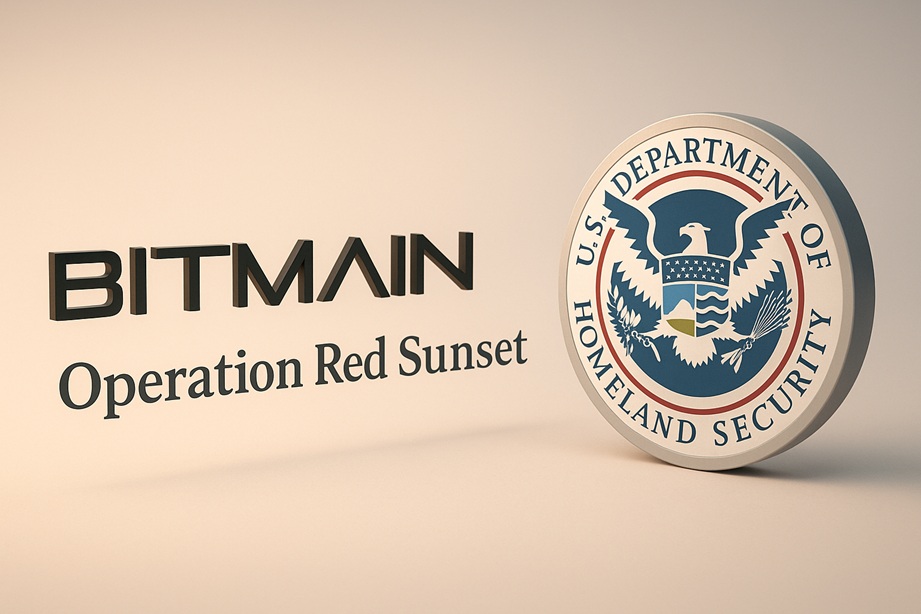
The Bitmain investigation, codenamed Operation Red Sunset, pulls Bitcoin mining hardware into the national security frame. Federal agencies are now treating Chinese-made ASIC rigs as potential vectors for espionage and grid disruption in the United States.
Inside the Bitmain investigation: hardware, grids and geopolitics
Operation Red Sunset is led by the Department of Homeland Security, with parallel workstreams at the National Security Council, CFIUS and the FCC. The core question: could Bitmain’s Antminer rigs, which require constant connectivity for pool coordination and management, be remotely manipulated from China to surveil sensitive sites or deliberately knock parts of the grid offline.
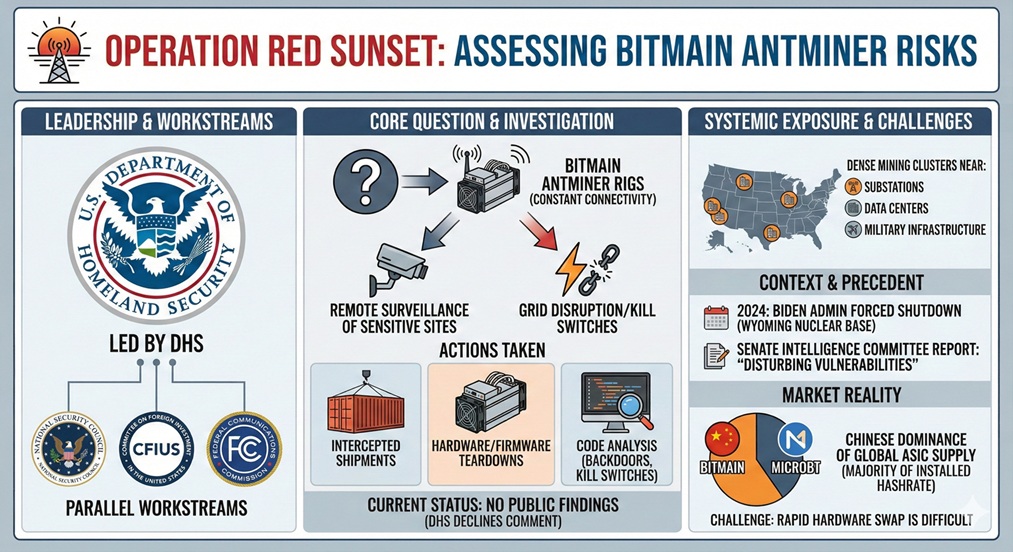
Teams have reportedly intercepted shipments at U.S. ports, torn down hardware and firmware, and run code analysis looking for backdoors, kill switches or undocumented remote-access paths. So far, no findings have been made public, and DHS has declined to comment on interim results. For Washington, the Bitmain investigation is about systemic exposure: dense clusters of power-hungry rigs sited near substations, data centres and, in some cases, military-adjacent infrastructure.
Security concerns were already visible in 2024, when the Biden administration forced the shutdown of a Chinese-linked mining operation near a Wyoming nuclear missile base, explicitly on national security grounds. A subsequent Senate Intelligence Committee report flagged “disturbing vulnerabilities” in foreign-owned mining fleets operating close to critical infrastructure.
Complicating all of this is simple market structure. Bitmain and fellow Chinese manufacturers such as MicroBT still dominate global ASIC supply, accounting for the vast majority of installed Bitcoin hashrate. Swapping out that hardware is not something U.S. miners can do overnight, even if policymakers wanted a fast pivot.
Trump ties, tariffs and denials from Beijing
The political optics are sharper because of the Trump family link. American Bitcoin Corporation, part-owned by Eric Trump and backed by other industry players, has arranged the purchase of tens of thousands of Bitmain rigs on unusually generous financing terms, with repayments structured against pledged Bitcoin rather than upfront cash. That deal now sits squarely in the slipstream of the Bitmain investigation, raising questions about how future security decisions will land on politically connected buyers.
At the same time, Chinese mining manufacturers have been trying to soften their profile in Washington. Bitmain and rivals have explored or launched U.S.-based production to dodge tariffs and show willing on supply-chain localisation, while domestic players such as Block push U.S-designed chips as a sovereign alternative.
Bitmain, for its part, has issued blanket denials. The company says it has “no knowledge” of Operation Red Sunset, insists that any claim of remote control is “unequivocally false”, and frames past FCC detentions as routine radio-frequency checks that turned up nothing. In its telling, its machines meet modern industrial security standards and pose no special threat to the grid.
For now, the Bitmain investigation has produced no public smoking gun. But obvious next steps sit on the table: tighter rules on imports, mandatory audits for large U.S. fleets running Chinese hardware, and more explicit support for non-Chinese ASIC supply. However it ends, the Bitmain investigation will shape how regulators think about “hashrate sovereignty” in an era where Bitcoin mining looks uncomfortably like critical infrastructure.
Disclaimer:
This article is for information purposes only and does not constitute investment, legal, tax, or other professional advice.
From the YFarmX archive · originally published on the previous site