Ethereum’s Fusaka upgrade goes live, bringing PeerDAS to mainnet
Ethereum’s Fusaka hard fork is now live on mainnet, with finality confirmed shortly after the 22:00 GMT slot on 3 December. Client teams report a smooth transition, strong validator participation, and no immediate hiccups, exactly what you want from a major scaling upgrade.

Ethereum’s Fusaka hard fork is now live on mainnet, with finality confirmed shortly after the 22:00 GMT slot on 3 December. Client teams report a smooth transition, strong validator participation, and no immediate hiccups, exactly what you want from a major scaling upgrade.
Fusaka is live on Ethereum mainnet!
– PeerDAS now unlocks 8x data throughput for rollups
– UX improvements via the R1 curve & pre-confirmatons
– Prep for scaling the L1 with gas limit increase & moreCommunity members will continue to monitor for issues over the next 24 hrs.
— Ethereum (@ethereum) December 3, 2025
At the centre of Fusaka is PeerDAS , Ethereum’s new peer-to-peer data-availability sampling scheme. In practical terms, PeerDAS slashes the data each validator has to download and check, cutting bandwidth needs by roughly 85%. That lighter footprint is what lets the network safely carry far more “blob” data for rollups.
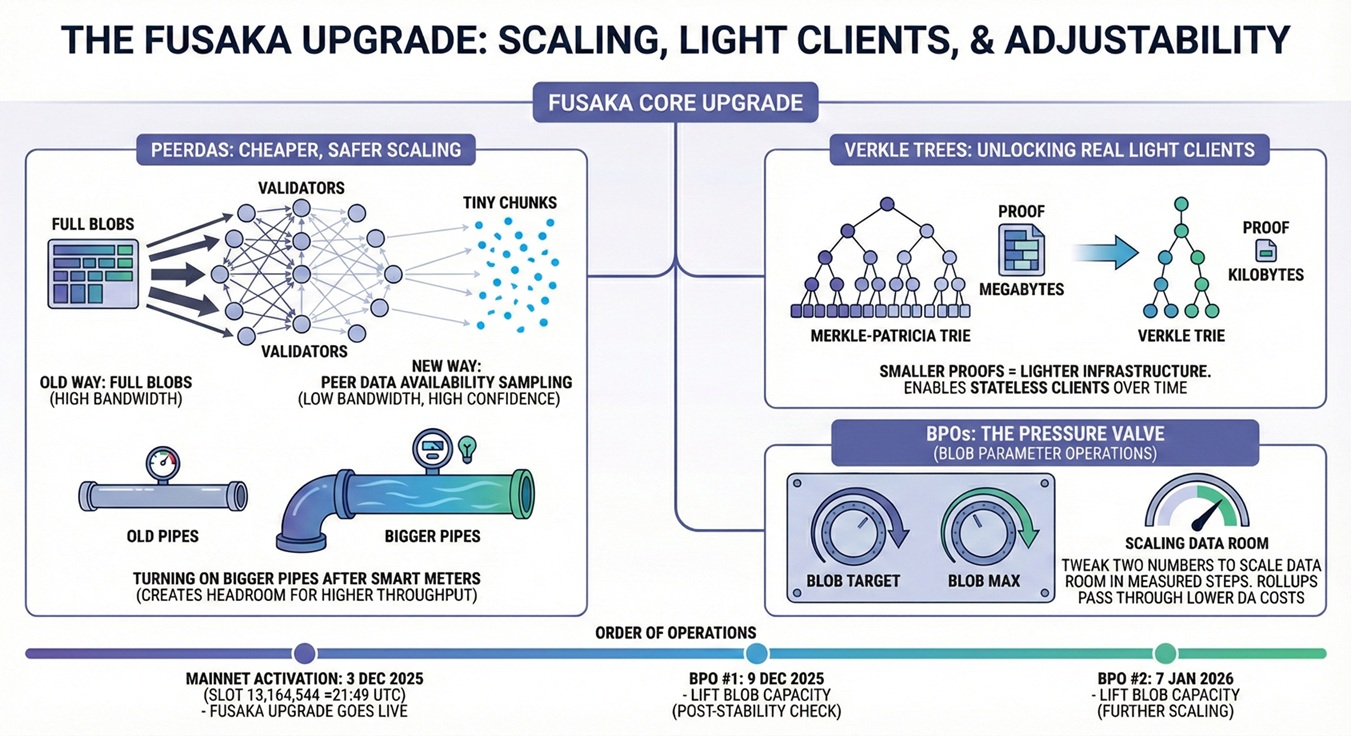 How the Fusaka upgrade works: </ethereums-fusaka-upgrade-goes-live-bringing-peerdas-to-mainnet/>
Alongside PeerDAS, Fusaka doubles blob capacity from 6 to 12 blobs per block and nudges the block gas limit up to 60 million units. Together, those changes give rollups far more room to post calldata and blobs, which is why most L2 teams are already talking about 40-60% lower fees once they update their own stacks.
There is also quieter work in the background. The upgrade ships EVM Object Format (EOF) changes that tidy up contract deployment and execution, making it easier to reason about bytecode and to ship more complex applications without strange edge-cases. The result should be smoother tooling for DeFi, games, and NFT platforms that live on rollups but ultimately settle to Ethereum.
Markets, predictably, are treating Fusaka as a fresh excuse to speculate. ETH rallied into the fork and X is full of “5k when?” posts. For now, though, the story is simpler: PeerDAS is live, blob space has expanded, and the path is open for L2s to push towards six-figure transaction throughput while keeping Ethereum’s security model intact.
As rollups roll out their own PeerDAS-aware upgrades over the coming weeks, users should start to see the effect in the only metric that really matters day to day: cheaper, more reliable transactions.
Disclaimer
This article is for information only and does not constitute investment, legal, or tax advice. Cryptoassets are volatile and high-risk.
From the YFarmX archive · originally published on the previous site