Ethereum’s Fusaka Upgrade locked for 3 December
Ethereum core developers have formally set 3 December 2025 (~21:49 UTC, slot 13,164,544) for mainnet activation of the Fusaka Upgrade, following clean rollouts on all public testnets and a final green light on today’s ACDC call #168.

Ethereum core developers have formally set 3 December 2025 (~21:49 UTC, slot 13,164,544) for mainnet activation of the Fusaka Upgrade, following clean rollouts on all public testnets and a final green light on today’s ACDC call #168. Two rapid-follow Blob Parameter Only (BPO) forks will then ratchet up blob capacity on 9 December and 7 January.
Full October 30th dev call
What the Fusaka Upgrade brings
- PeerDAS makes rollup data cheap and safe to scale. Instead of every validator fetching full blobs, Peer Data Availability Sampling lets them sample tiny chunks and still reach high confidence that data is available. That slashes bandwidth and validator requirements and, crucially, creates headroom for the BPO forks to raise blob throughput without risking the network. Think of it as turning on the bigger pipes after the meters get smarter.
- Verkle trees unlock real light clients. Verkle proofs are far smaller than the current Merkle-Patricia proofs, so state can be verified with kilobytes, not megabytes. Over time, that enables stateless clients and makes running infra lighter, important if you want many more validators and service providers participating.
- BPOs are the pressure valve. Rather than waiting for another big fork, BPOs tweak just two numbers (blob target and blob max) to scale data room in measured steps. Expect rollups to pass through lower DA costs as these dials move.
The order of operations
- Mainnet activation : 3 Dec 2025, at slot 13,164,544 (≈21:49 UTC).
- Follow-ups: BPO #1 on 9 Dec 2025 and BPO #2 on 7 Jan 2026, pre-agreed on core dev calls to lift blob capacity once Fusaka Upgrade proves stable on mainnet.
- Confidence signals: Final testnet (Hoodi) activated 28 Oct and finalised smoothly, which is why core teams felt comfortable locking the date today.
Post-Fusaka
Rollups and appchains
- Cost curve: PeerDAS + BPOs lower the rollup cost base; expect L2s to adjust sequencer pricing and incentives as DA (data availability) becomes cheaper. Cheaper blobs tend to spur throughput-heavy use cases (DEX back-ends, perp venues, onchain games) that were margin-sensitive to data costs.
- Roadmaps: Teams with “post-Dencun” assumptions can bring forward fee-cut milestones. Marketing will likely emphasise effective TPS and time-to-finality improvements as blob room increases.
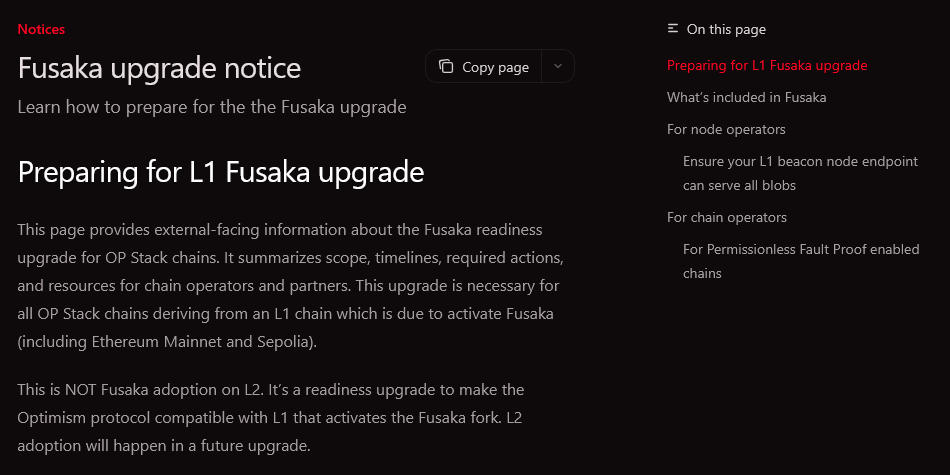 https://docs.optimism.io/notices/fusaka-notice
For node operators and infra
- Client cadence: Release candidates land in early November; upgrade in November and keep dashboards ready for blob metrics after each BPO. Watch mempool/engine logs for DA anomalies and provision a little extra I/O headroom around the first week post-fork.
- Lighter future: Verkle’s longer-term impact is operational, expect easier state proofing and healthier decentralisation as minimum viable hardware trends down.
For exchanges, custodians, and market structure
- Fewer reorg worries on L2 settlement paths: As L2s publish more reliably and cheaply into blobs, operational risk around data availability drops. That reduces the long-tail edge cases that operations teams hate.
- Liquidity migration: When DA gets cheaper, more order-flow tooling shifts up-stack to L2s. Track L2 gas/DA metrics in listing committees and adjust fee tiers where appropriate.
In a nutshell
Dencun gave blobs; Fusaka Upgrade teaches the network to use them efficiently and add more without drama. The near-term prize isn’t vanity TPS; it’s predictable, low L2 fees at scale, so teams can price products confidently instead of budgeting around gas volatility.
What to watch between now and 7 January
- Post-fork blob utilisation: Are blocks routinely hitting the new targets? If not, who isn’t passing DA savings through? (Name and shame chart incoming.)
- Sequencer fee policies: We could see at least one major L2 pre-announce fee cuts pegged to the BPO schedule to win share.
- Client diversity and health: Verkle-related code paths will need battle-testing in the wild; watch client mix and incident reports.
- Bridge patterns: Cheaper DA changes optimal routing for intents-based protocols. Track any shifts in MEV/arb flows onto L2s post-BPO #1.
Disclaimer:
This analysis is informational and not financial, technical, or security advice. Validate against official client release notes and test in staging before upgrading production infrastructure.
More on Ethereum.
From the YFarmX archive · originally published on the previous site