
Telegram Anonymous Numbers, privacy feature or NFT hype?
Telegram Anonymous Numbers are back in the picture – prices are up, supply looks capped, and privacy-minded users are asking whether they’re worth it.
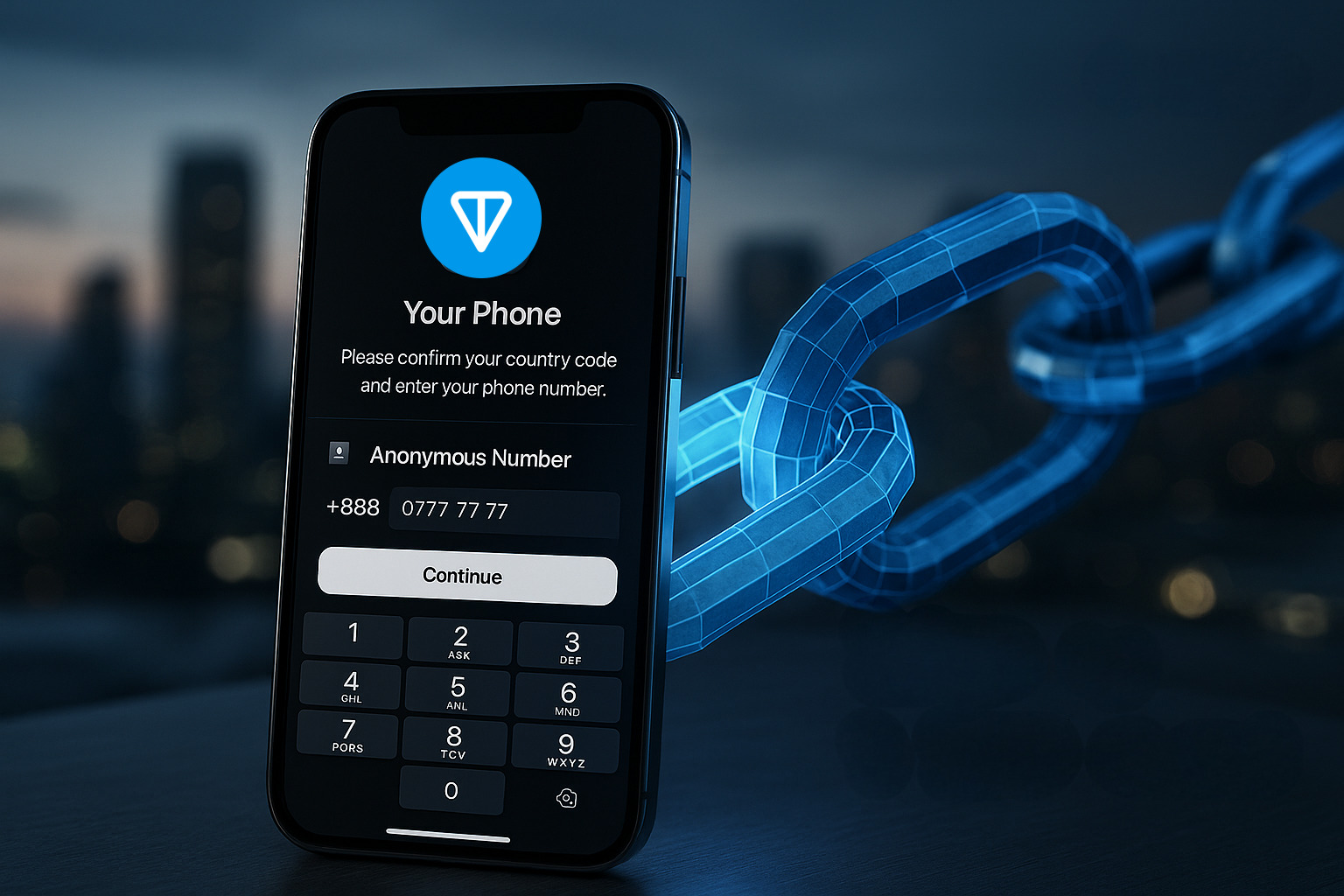
Telegram Anonymous Numbers are back in the picture – prices are up, supply looks capped, and privacy-minded users are asking whether they’re worth it. Introduced in December 2022, the feature lets you create or convert a Telegram account without a SIM card, using a blockchain-issued number bought on Fragment or Market App, Telegram’s marketplaces built on the TON blockchain.
How it works (and what it isn’t)
Instead of typing in a normal mobile number at sign-up, you enter an +888 anonymous number purchased on Fragment. Telegram then verifies ownership via Fragment (you fetch a one-time code tied to the NFT) and finishes account creation. Crucially, these are not normal phone numbers: they’re identifiers used only for Telegram login/verification, not for SMS or calls, and not for registering on other apps.
telegram’s anonymous numbers did a 157x since the original sale 2 years ago
the current mcap of all numbers is 2bn, making them the #2 nft by mcap, just below punks
they outperformed every single nft and most memecoins, did everyone just miss this? pic.twitter.com/nGA5M0IYTx
— 0xngmi is hiring (@0xngmi) August 12, 2025
Anonymous Numbers live on TON as NFTs and are traded on Fragment. Telegram’s own blog frames this as “a new era of privacy,” while TON’s documentation explicitly describes usernames and Anonymous Numbers as NFTs minted and owned on-chain. Fragment itself is the official venue where they’re bought and sold.
Two practical notes: (1) Fragment has been geo-restricted in some locations since launch; and (2) Telegram ended the initial direct issuance run, so buyers now typically acquire numbers on the secondary market from other holders.
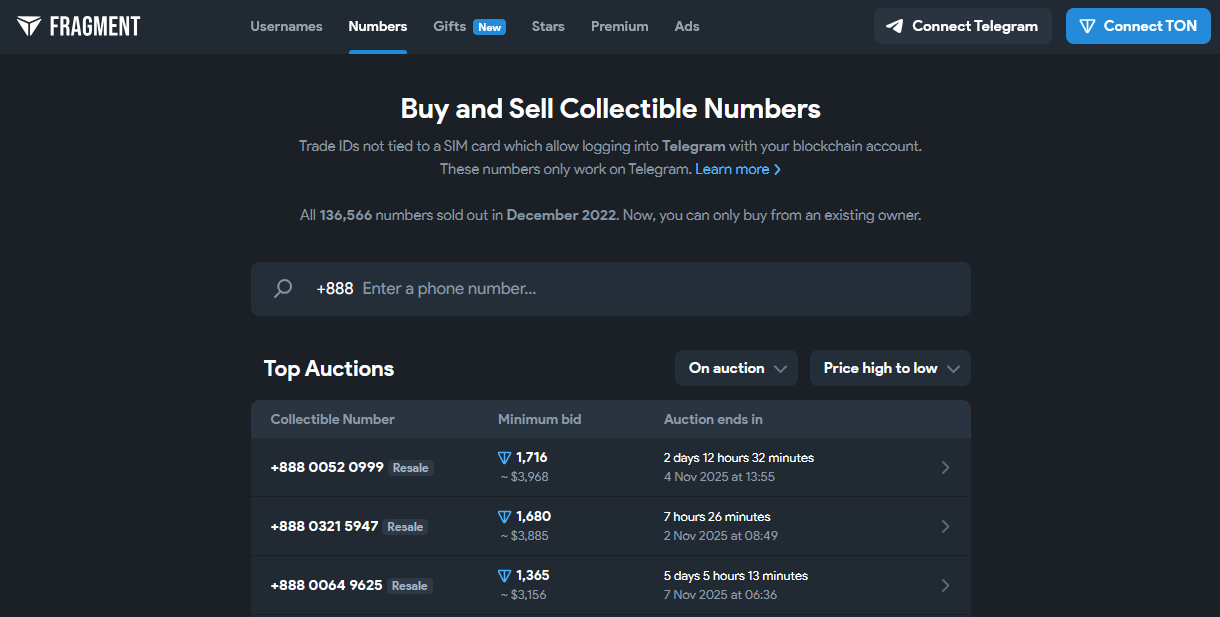
Supply, prices, and the market meta
A widely used community dashboard that tracks Fragment inventory puts current items around ~136k and shows a floor price ≈$2,500 (late 2025 snapshot). That aligns with the public narrative that supply is constrained and pricing has steadily climbed since the 2022 mint. The most eye-catching sale to date remains the +888 8 888 number, which cleared at 300,000 TON shortly after launch. nums888.io+1
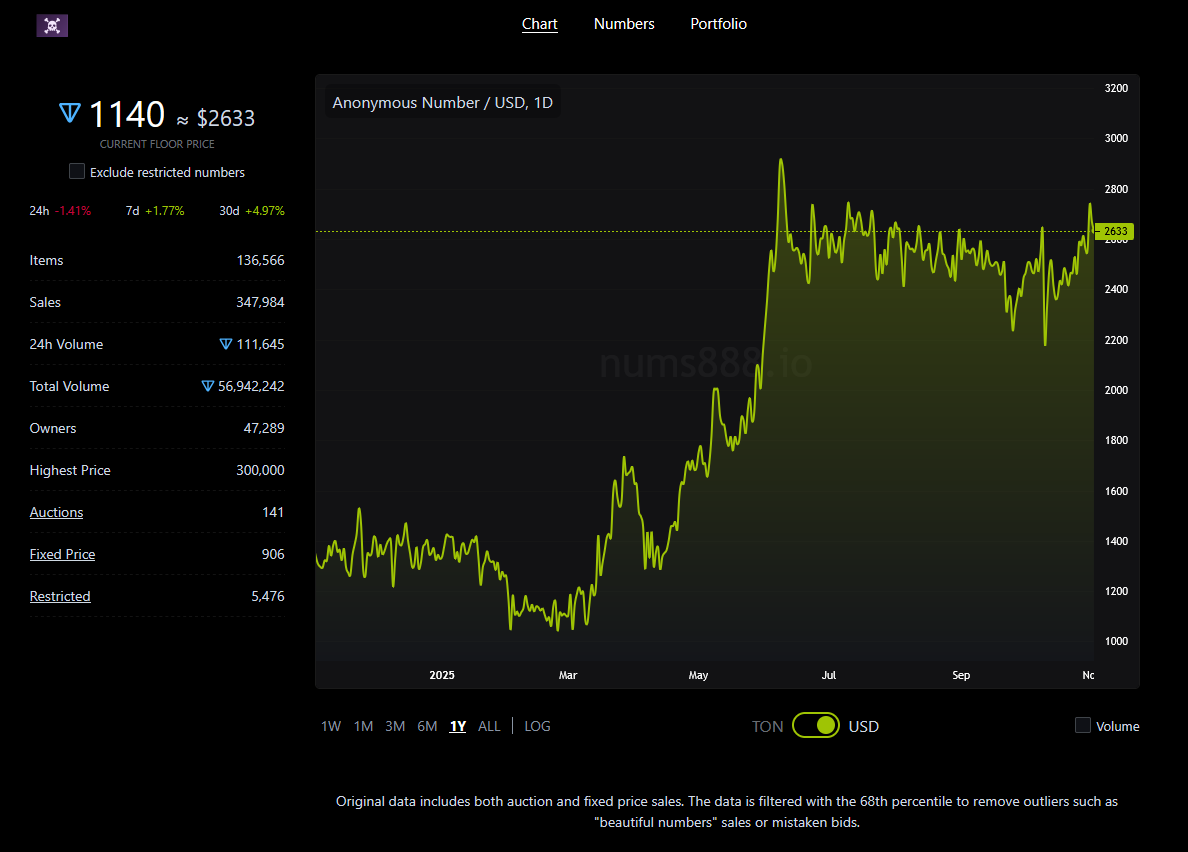
None of this turns Anonymous Numbers into a “must-have investment,” but it does go with the “privacy meta” we are seeing now. It has limited supply, obvious status signalling (vanity patterns), and a clear use-case (SIM-less signup) bundled into an on-chain collectible.
What privacy you gain—and what you don’t
You do gain :
- Carrier detachment. No SIM, no carrier KYC trail tied to your Telegram account.
- Granular in-app privacy. Telegram already lets you hide your number and prevent discovery by phone number; the +888 route means your account never held a conventional number in the first place.
You don’t magically gain :
- Perfect anonymity. Your purchase happens on-chain in TON. If you buy TON on a KYC’d exchange and fund your wallet, you create a trail. Your Fragment address and on-chain activity are public (even if your real-world identity isn’t). That’s a deanonymisation risk if you reuse wallets or move funds through tracked venues.
- End-to-end by default. Regular Telegram chats are cloud-encrypted, not E2E; only Secret Chats are E2E. The anonymous number doesn’t change this model.
- Telephony features. Anonymous Numbers don’t receive SMS or calls. They’re for Telegram only.
you can buy on Telegram’s official platform: https://t.co/6dATh03AwV with KYC & fees.
and on https://t.co/AZIi3TS6xw without KYC & fees.
after you bought, open https://t.co/6dATh03AwV and link the number to your TG account (no KYC needed here) or create a new one.
— altoshi (@stablealt) November 1, 2025
Who is it for?
- Privacy maximalists who want to keep carrier identifiers out of their messaging footprint.
- Journalists/activists operating in sensitive contexts who understand on-chain OPSEC and Telegram’s security model.
- Collectors/brand builders who value vanity patterns for public-facing accounts.
If you simply want separation between personal and work comms, a virtual number or eSIM is cheaper and easier, just remember those remain telco-issued and may be tied to your identity. Anonymous Numbers primarily solve SIM-less Telegram identity, not general telephony or cross-app anonymity.
Bottom line
Telegram Anonymous Numbers deliver a clean, SIM-less path into Telegram with ownership recorded on-chain. They’re elegant for what they are: a privacy-friendly login credential with collectability baked in. But they’re not a silver bullet. Your chat model is unchanged, your wallet hygiene matters, and the market around +888 numbers behaves like any other NFT vertical (scarce, volatile, and hype-sensitive). Treated with that realism, +888 can be a useful tool in a broader privacy stack rather than a magic cloak.
This article is for information only and not financial advice.
From the YFarmX archive · originally published on the previous site