Cocoon: Telegram’s private AI marketplace on TON
The Cocoon Confidential Compute Open Network is Pavel Durov’s attempt to pull AI inference away from hyperscale clouds and into a decentralised, privacy-preserving marketplace.
The Cocoon Confidential Compute Open Network is Pavel Durov’s attempt to pull AI inference away from hyperscale clouds and into a decentralised, privacy-preserving marketplace. Announced at Blockchain Life 2025 in Dubai and built on The Open Network (TON), it pays GPU owners in Toncoin to run encrypted AI workloads while giving Telegram and other clients cheaper, opaque-to-the-provider inference.
How Cocoon Confidential Compute Open Network works
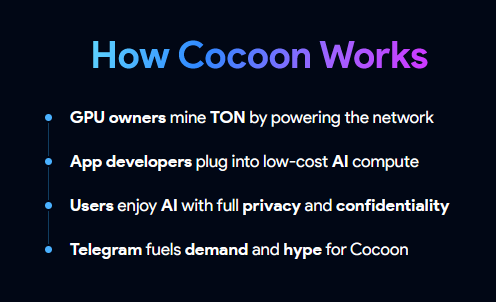
At its core, Cocoon Confidential Compute Open Network is a job market for AI inference. Developers or apps submit requests (text generation, summarisation, translation, image work) via an API. TON smart contracts match those encrypted jobs with available GPU providers, taking into account price and capacity, and settle payments in TON once the work is done.
🣠It happened. Our decentralized confidential compute network, Cocoon, is live. The first AI requests from users are now being processed by Cocoon with 100% confidentiality. GPU owners are already earning TON. https://t.co/jDBwQNutH6 is up.
🦠Centralized compute providers such…
— Pavel Durov (@durov) November 30, 2025
The privacy layer is built on confidential computing. Workloads run inside trusted execution environments on supported hardware, so node operators see neither raw prompts nor outputs. Project materials and Durov’s own description frame this as “private AI” on-chain: the network handles routing and accounting, but only the end user can decrypt results.
From Dubai keynote to live traffic
Durov first floated a decentralised AI initiative at a forum in Kazakhstan in October 2025, tying it to a new AI lab. The full unveiling came later that month in Dubai, where he outlined Cocoon as a TON-native compute network and opened applications for GPU providers and developers. Media reports and TON’s own ecosystem update pointed to a November launch window, with Telegram as the anchor client.
By late November, TON ecosystem briefings were already listing the network as live infrastructure, with Cocoon processing Telegram AI features such as summarisation and message drafting and contributing to an 8% rally in TON.
Telegram, TON and the bid for private AI scale
Telegram is both the showcase and the distribution channel. With more than a billion users and existing AI-style tools in bots and Mini Apps, it can point a meaningful share of its traffic at Cocoon and instantly stress-test the model. Official descriptions emphasise that the same rails are open to third-party developers, who get metered access to GPUs without negotiating separate cloud contracts.
For TON, Cocoon is positioned as an infrastructure play: the network’s sharded design handles job matching and payments, while the AI work happens off-chain in enclaves. Foundation posts pitch this as turning TON into a backbone for decentralised AI applications rather than just another payments chain.
Constraints and open questions
Cocoon leans heavily on specific hardware features, which limits the pool of ideal providers for now. Confidential computing support is still concentrated in newer data-centre CPUs; consumer GPUs and older rigs will need workarounds or offer weaker guarantees.
Regulation is the other obvious friction point. A network that routes anonymous, encrypted workloads across a global fleet of GPUs will attract the same concerns already aimed at privacy coins and mixers, especially if high-risk use cases appear alongside Telegram’s more mainstream traffic. Public remarks from Durov and project-aligned commentators frame Cocoon as a response to “surveillance” AI from Big Tech clouds, but regulators may read the design through a very different lens.
Even so, the direction of travel is clear. Cocoon Confidential Compute Open Network formalises something that has been talked about for years: using token incentives and encrypted execution to turn spare GPUs into a privacy-preserving AI utility, with a consumer app the size of Telegram as the first real stress test.
Disclaimer
This article is for information and education only. It is not investment, legal, tax or financial advice. Always do your own research and consider speaking to a qualified professional before making financial decisions.
From the YFarmX archive · originally published on the previous site