
UAE completes first government payment using Digital Dirham CBDC
The United Arab Emirates has executed its first government-to-government payment using the Digital Dirham, marking the CBDC’s debut in live public-sector operations on 11 November.
The United Arab Emirates has executed its first government-to-government payment using the Digital Dirham, marking the CBDC’s debut in live public-sector operations on 11 November. The Ministry of Finance and Dubai’s Department of Finance processed the transaction in under two minutes via the mBridge platform, in collaboration with the Central Bank of the UAE (CBUAE).
Today, Ministry of Finance & Dubai Finance marked a pivotal milestone in the history of government financial transformation in the UAE, as we executed the first government transaction using the Digital Dirham issued by the Central Bank of the UAE, representing the future of the… pic.twitter.com/gYRiTC1Euh
— Maktoum Bin Mohammed (@MaktoumMohammed) November 11, 2025
Officials confirmed a controlled pilot settlement between federal and local entities, designed to test end-to-end connectivity (from CBDC issuance to final settlement) without commercial exposure. The execution time (sub-two minutes) was highlighted as a proof point for speed and operational readiness.
The transaction is the first real-world step in the UAE’s wholesale CBDC programme, part of the Financial Infrastructure Transformation agenda. By using mBridge, a multi-CBDC rails project, the UAE is positioning for domestic and cross-border CBDC settlements under central-bank control, aiming for lower latency, improved transparency and reduced reliance on intermediaries.
The tech stack
- mBridge (blockchain-enabled government payments).
- Wholesale CBDC (Digital Dirham) integrated with CBUAE systems; initial scope limited to payments only.
- Interoperability with existing financial infrastructure and phased expansion beyond pilots.
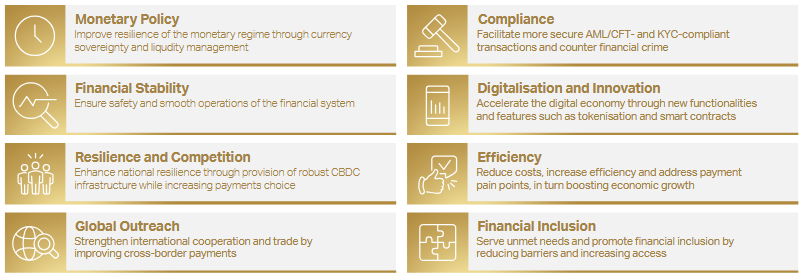 Key Benefits of the Digital Dirham.
Roadmap
The CBUAE’s roadmap targets a phased rollout from Q4 2025, starting with government use cases, then expanding to select private-sector and cross-border flows. This pilot precedes broader adoption and standard-setting across the region’s CBDC initiatives.
The bigger picture
Globally, only a handful of countries have fully launched retail CBDCs; most (including the UAE) remain in pilot or development phases. The UAE’s live test pushes it toward the front of the pack on wholesale CBDC interoperability and real-time public-sector settlement.
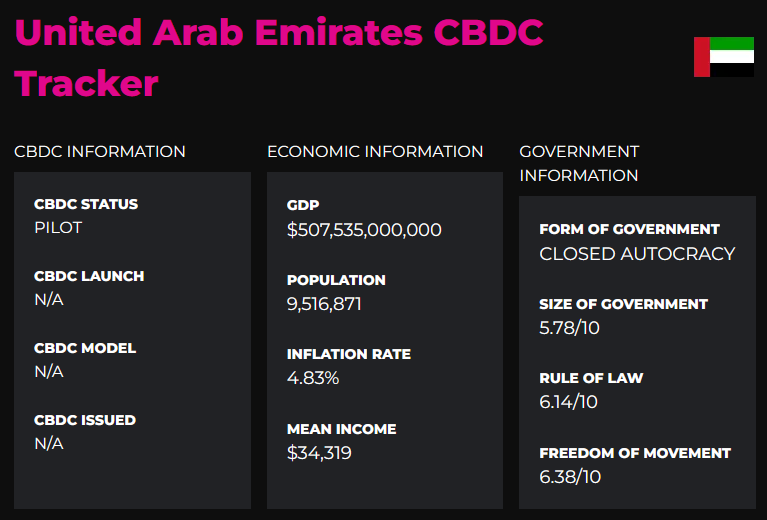 https://cbdctracker.hrf.org/currency/united-arab-emirates
Disclosure: This article is for information purposes only and does not constitute investment, legal, accounting, or tax advice.
From the YFarmX archive · originally published on the previous site