
USDS and USDe Add $5B to Stablecoin Market
Stablecoin market adds $5B as USDS and USDe grow amid federal oversight changes, challenging stablecoin dominance.

The stablecoin ecosystem has seen an inflow of nearly $5 billion in new liquidity over the past week, primarily driven by significant supply increases in Sky’s USDS and Ethena’s USDe. This surge comes as the market adapts to a novel phase of federal oversight, setting the stage for a stiff competition among dollar-pegged tokens.
Market Overview
According to data from DeFiLlama, the stablecoin market cap has reached $266 billion. Tether’s USDT continues to hold sway with a market cap of over $164 billion, constituting more than 61% of the total share. However, underneath the dominance of USDT, a subtle power shift is potentially underway.
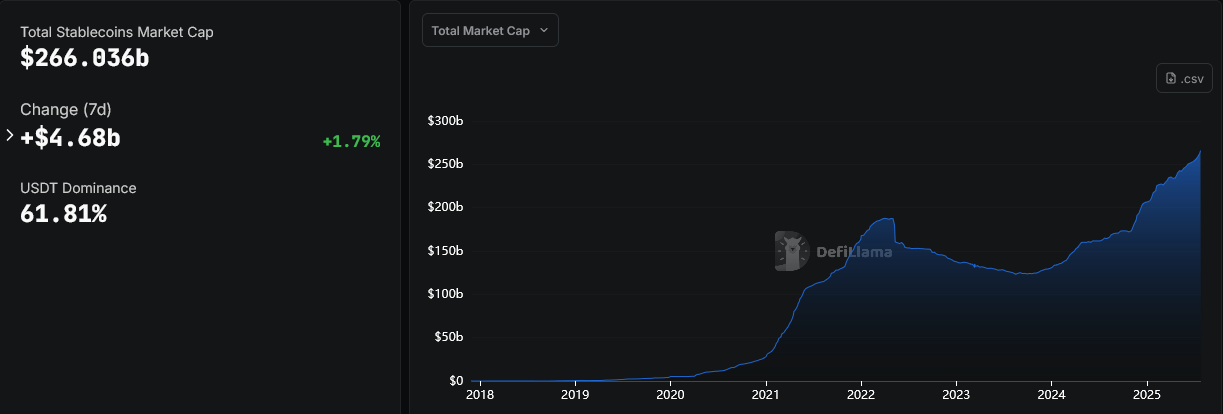
Sky’s USDS and Ethena’s USDe have emerged as the week’s standout performers. USDS increased its supply by $990 million, marking a 24.95% weekly rise to approach a total market cap of $5 billion. Concurrently, USDe issued by Ethena expanded its market footprint by 24.63%, minting 1.43 billion new tokens, elevating its valuation to $7.21 billion.
A New Wave for Upstart Stablecoins
The level of growth observed in USDS and USDe is rare, particularly outside the usual top three stablecoins. Such expansion underscores growing fragmentation within the space, indicating a potential shift in user preference. In contrast, other top-tier stablecoins by market cap experienced declines, making the rise of these newcomers even more significant.
Even PayPal’s PYUSD saw modest expansion, with a 2.98% increase after minting 25.75 million new tokens. It maintains a market cap around $891 million, retaining its place in the top ten while still lagging behind the frontrunners.
Growth. Quarter over quarter. https://t.co/MNTX30xbpB
— Sky (@SkyEcosystem) July 25, 2025
Impact of Regulation
This surge coincides with the implementation of the GENIUS Act, a landmark U.S. legislative move offering a structured regulatory framework for fiat-backed stablecoins. This has invigorated institutional interest, empowered new entrants, and spurred minting across the board.
Whether the GENIUS Act will solidify existing giants like USDT and USDC, or usher in a new class of innovative challengers, remains uncertain. However, what’s clear is that the landscape is anything but static. Such developments evoke speculation about how established players will react to maintain their dominance.
Shift in Market Dynamics
With billions in fresh tokens entering the market and regulatory endorsements paving the way for future growth, stablecoins seems ready to transition from consolidation to more fragmentation. The question remains: will the focus continue on established names, or is the market ripe for a new breed of algorithmically-optimised, yield-oriented, or institutionally-backed stablecoins?
The outcomes over the coming months could well designate the long-term victors in crypto’s most subtly influential sector.
fuck it
saylor mode
— Ethena Labs (@ethena_labs) July 25, 2025
Final Thoughts
For those tracing the trajectories of stablecoins like USDS and USDe, this period marks an essential chapter in the broader story of digital currencies. The latest regulatory changes have not only laid a clearer groundwork for stablecoins but also invigorated them with fresh momentum to challenge the old guard.
Disclaimer
This article reflects the author’s insights and should not be considered as investment advice. Conduct thorough research before making any financial decisions.
From the YFarmX archive · originally published on the previous site