
Cathie Wood cuts BTC Price Target
Ark Invest’s Cathie Wood has shaved $300,000 off her 2030 BTC price target, trimming the bull case from $1.5 million to $1.2 million in a CNBC appearance, and blaming stablecoins for doing the transactional work she once expected from Bitcoin, especially in emerging markets.
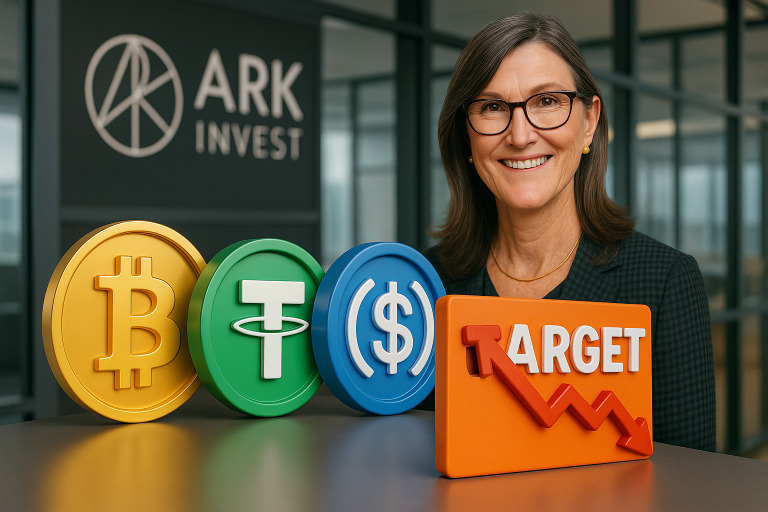
Ark Invest’s Cathie Wood has shaved $300,000 off her 2030 BTC Price Target, trimming the bull-case from $1.5 million to $1.2 million in a fresh CNBC appearance, and blaming one culprit: stablecoins quietly doing the transactional work she once expected from Bitcoin, especially in emerging markets.
What has changed?
- Bullish 2030 target reduced from $1.5m to $1.2m per BTC, still implying a spectacular upside from current levels but conceding ground to stablecoin rails.
- Dollar-pegged tokens now dominate on-chain payments and remittances in weak-currency markets, taking the “everyday money” role out of Bitcoin’s mouth mid-sentence.
- Galaxy slashes its 2025 Bitcoin call from $185,000 to $120,000, framing the pullback as part of a “maturity era” of institutional flows and lower volatility rather than apocalypse.
- Bitcoin recently slipped back towards the $100,000 handle after its October all-time high above $126,000, as froth bled out and forced liquidations reminded everyone this is still leverage country.
Cathie Wood in a fresh CNBC appearance.
Stablecoins take the flows, Bitcoin keeps the altar
Wood’s revision is less a loss of faith than a quiet admission that monetary hierarchy inside crypto has forked.
Stablecoins now own the boring but system-critical plumbing: payroll in Latin America, merchant settlement in Asia, cross-border transfers for SME exporters, and a growing share of bank and Big Tech experiments. They are fast, fiat-aligned, regulatory-friendly enough, and do not terrify CFOs.
Bitcoin, in that world, is not the cashier. It is collateral, treasury asset, macro hedge, political signal. Wood is effectively saying: if stablecoins are the cash, Bitcoin is the vaulted bar. The transaction thesis shrinks; the store-of-value thesis concentrates.
That functional split justifies taking heat out of a headline BTC Price Target without touching the core conviction that sovereign-grade demand, ETF rails and balance-sheet adoption can still drive a multi-x move over the decade.
Reading the new BTC calls
Galaxy’s cut to $120,000 for 2025 isn’t a eulogy; it’s an adult adjustment. Once Bitcoin sits in ETFs, pensions and risk reports, it stops auditioning as a lottery ticket and starts trading like a serious macro asset. Less froth, fewer cartoon tops, same structural bid.

Galaxy’s cut also resets how to read any bold Bitcoin call: not as meme fodder, but as a blunt reveal of the assumptions underneath, flows, rules, stablecoin creep, and how much “digital gold” premium investors still think it deserves once the cash leg is already tokenised.
What this signals (and what it doesn’t)
For Bitcoin:
- The “payments” dream is being outsourced to instruments that look like dollars but move like crypto.
- The “digital gold” thesis is intact, arguably purified. Wood still assumes monumental upside; Galaxy still frames weakness as maturation, not burial.
- Volatility is being civilised at the edges by institutional structure, not abolished.
For stablecoins:
- They are no longer sidekicks. Regulatory frameworks (like the U.S. GENIUS Act), bank-issued tokens, and big tech experiments confirm they are now core settlement infrastructure, not just degen dry powder.
For everyone else:
- Treat blockbuster BTC Price Target headlines as sentiment indicators and scenario ranges, not spreadsheets in stone.
- The more serious the forecaster, the more you should read the footnotes, not the number.
Disclosure: This article is for information only and does not constitute investment, legal, tax, or financial advice. Always do your own research and consider your risk tolerance before allocating capital.
From the YFarmX archive · originally published on the previous site