How privacy coins are reshaping blockchain analytics
For over a decade, the blockchain analytics sector (dominated by heavyweights like Elliptic, TRM Labs and Chainalysis) has thrived on a foundational truth: transparency as the unassailable bedrock of the crypto economy.
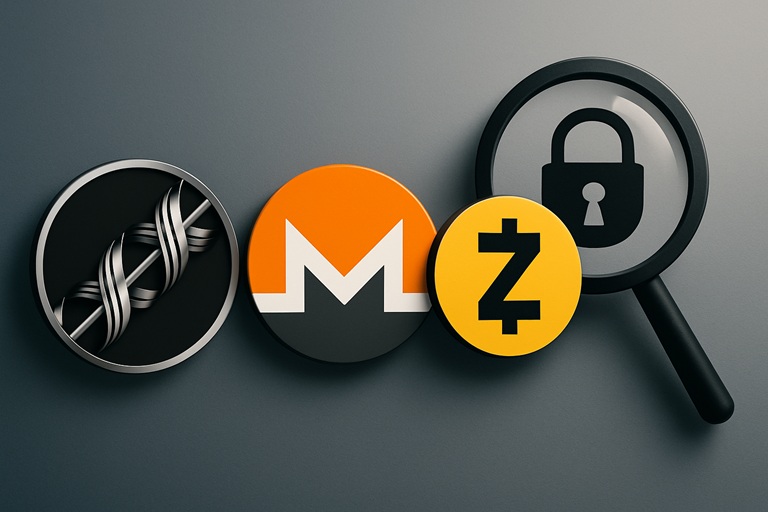
For over a decade, the blockchain analytics sector (dominated by heavyweights like Elliptic, TRM Labs and Chainalysis) has thrived on a foundational truth: transparency as the unassailable bedrock of the crypto economy. These firms transformed immutable ledgers into actionable intelligence, mapping illicit flows for regulators, exchanges and investigators with precision. Yet, as we enter late 2025, that truth is fracturing under the weight of surging privacy innovations, turning the once-predictable terrain into a liminal realm of uncertainty
The catalyst? A privacy coin renaissance that’s not just technical but market-driven. Zcash ($ZEC), once a laggard, has rocketed over 1,000 % since September. The surge has allowed it to eclipse Monero‘s market cap in recent weeks. Investors spooked by looming bans and emboldened by endorsements from major funds are piling in, betting on protocols like Zcash and Railgun ($RAIL) as bulwarks against an increasingly nosy regulatory landscape. What started as esoteric cryptography, ring signatures in Monero, optional shielded pools in Zcash, zero-knowledge cloaks in emerging protocols, has evolved into a full-spectrum challenge.
The Ethereum Foundation even launched a “Privacy Cluster” earlier this year to signal institutional buy-in to zero-knowledge-proof systems that obscure transactions without sacrificing verifiability. These tools don’t just hide data; they probabilistic-ise it, forcing analytics from certainty to calibrated guesswork. A 100 ETH ingress into a privacy layer might mirror a 99.98 ETH egress seconds later (but linking them demands inference, not evidence) eroding the deterministic chains that once powered compliance dashboards.
The Ethereum Foundation is committed to working alongside the ecosystem to make privacy a priority.
Privacy is normal. Privacy is for everyone.https://t.co/xwBT5WvwhJ
— Ethereum Foundation (@ethereumfndn) October 8, 2025
Edges Over Entrails
Analytics firms aren’t capitulating; they’re pivoting, they now detect “perimeter intelligence”. Scanning on-ramps (exchange deposits) and off-ramps (fiat withdrawals) for temporal and volumetric fingerprints that signal obfuscation.
TRM Labs, has doubled down on behavioural heuristics: correlating IP clusters, liquidity spikes and even social-media signals to flag “likely” privacy-laundered flows. Elliptic, meanwhile, submitted targeted recommendations to the US Treasury recently, advocating AI-augmented detection of obfuscation tactics like chain-hopping and privacy-coin swaps (methods that complicate but don’t defeat edge surveillance). In this schema, clients buy not flawless traceability but risk gradients: a 78 % confidence score on a Monero exit might suffice to freeze an account, turning partial blindness into probabilistic profit.
Off-Chain Augmentation
The opacity epidemic has accelerated a broader exodus from on-chain solipsism. Today’s risk-engines weave blockchain shards with a tapestry of exogenous data: KYC dossiers, geolocation signals and open-source intelligence from social media platforms. TRM Labs’ “Signatures” module automatically detects obfuscation techniques across chains and incorporates off-chain graph elements for institutions and locations. Elliptic, for its part, positions its analytics platform as compliance infrastructure for banks and financial institutions and flags that “privacy wallets have overtaken mixers as a preferred laundering avenue”.
This fusion marks a conceptual leap: analytics is no longer ledger-bound cartography but a multidimensional psychology, profiling actors through their digital exhaust. As Chainalysis’s 2025 Global Adoption Index underscores (with India and the U.S. leading crypto uptake) these hybrids are essential for scaling compliance amid 97 countries’ tightened AML regimes. Privacy coins aren’t vanishing; they’re vectoring value into AI-agent ecosystems, requiring analytics to anticipate not just flows but emergent behaviours in a Web3 laced with ‘sentient’ code.
 Blockchain Intelligence Forum 2025
Regulatory Feedback Loop
Paradoxically, the regulatory squeeze (73 exchanges delisting privacy assets this year alone, per one compliance-statistics dataset) fuels the very innovations it seeks to curb. Bans on mixers and scrutiny of Monero have herded liquidity toward peer-to-peer dark-pools and wrapped variants, where data scarcity amplifies analytics demand. Firms like these now scaffold “probabilistic compliance”, certifying institutions as vigilant even in murk. The Treasury’s August call for illicit-finance countermeasures, met by Elliptic’s playbook, exemplifies this: regulators lean on private sector shadows to illuminate their own blind spots, creating a virtuous cycle of innovation and oversight.
And the arms race intensifies. Privacy devs counter with adaptive anonymity-sets, while analytics counters with machine-learning that devours the interstices. It’s the 1990s cryptography wars rebooted for the cryptocurrency age: public, immutable, and monetised. Every improvement in privacy provokes an equal improvement in surveillance analytics. The outcome is unlikely to be victory for either side, but equilibrium: not total concealment, nor panopticon clarity, but a tense detente where users retain agency and enforcers retain plausibility.
Horizons of Bifurcation
By 2030, expect a dual-track crypto cosmos. Transparent behemoths (Bitcoin, Ethereum core, and regulated stablecoins) will anchor institutional corridors under unyielding scrutiny. Privacy lanes, buoyed by the recent rally, will carve niche but vibrant parallel realms: entropy-rich havens for dissidents, DAOs and AI swarms, where enforcement is episodic and compliance actuarial.
Analytics will mirror this schism. One flank sustains forensic mapping for the lit world; the other pioneers “uncertainty underwriting” (selling bespoke models for the unseen, from ransomware risk to agentic privacy-breaches). Philosophically it’s blockchain’s original sin recast: transparency birthed the beast, but privacy restores the rider’s reins. In the ledger of the late-2020s the value lies not in exposure but in the alchemical conversion of opacity into foresight.
Coda: Navigating the New Normal
The ledger endures, but its gaze has softened. Elliptic, TRM and Chainalysis won’t fade; they’ll flourish as opacity oracles, distilling signal from statistical haze. Their deliverables evolve from static maps to dynamic forecasts, barometers for a blockchain where shadows lengthen, yet the economy persists. In today’s privacy surge, uncertainty isn’t the adversary; it’s the asset, and these firms are its foremost valuers.
Read:Zcash’s privacy promise – and the edge where surveillance lives
Disclaimer : This article is for informational and educational purposes only and does not constitute financial, legal or tax advice. The author and YFarmX make no representations as to the accuracy or completeness of the content and accept no liability for any loss arising from reliance on it. Cryptocurrency investments carry high risks, including severe volatility, regulatory changes and potential loss of principal. Always consult a qualified professional before making investment decisions.
From the YFarmX archive · originally published on the previous site