
Quantum Computers Could Crack Encryption Before 2030, Studies Warn
Two new preprint studies from Google Quantum AI and Cornell University suggest quantum computers capable of breaking today’s encryption may arrive far sooner than expected, potentially before the end of this decade.

Two bombshell preprint studies (Google Quantum AI, Cornell University) released at the end of March suggest that quantum computers capable of cracking current encryption systems could arrive much sooner than expected, potentially before the end of this decade. The findings have prompted what researchers are calling “renewed urgency” for quantum-proof encryption.
The Studies
The first study, from Google researchers, and the second from Oratomic, a Caltech spin-off startup in Pasadena, both independently suggest that quantum computers capable of breaking widely-used security technologies may be far closer to reality than the conventional 10-year timeline.
Oratomic’s Breakthrough
Oratomic’s analysis is particularly striking. The team demonstrated a method to dramatically reduce the quantum computing resources needed to crack common security technologies. Their approach (leveraging atom-trapped laser quantum computing combined with recent advances in quantum software and hardware) shows that cracking P-256, a common security-key technology, could require as few as 10,000 qubits.
“I had gone around giving talks saying that you needed millions of qubits” to crack security technology, said Dolev Bluvstein, Oratomic co-founder and study co-author. “We were quite surprised” at how far below the accepted wisdom the estimate fell.
Industry Shockwave
The reaction from the cybersecurity community has been serious.
“It’s a real shock for us too,” said Bas Westerbaan, a mathematician at Cloudflare, which protects roughly one-quarter of the world’s internet traffic. “We are still digesting it, but we are very concerned.”
Scott Aaronson, a quantum-computing researcher at the University of Texas at Austin, described the studies as “Quantum computing bombshells” in an April 1 blog post.
Jintai Ding, a mathematician at Tsinghua University in Beijing, said the findings have prompted “many discussions among people I know, ranging from academics to bankers and to people who care about cryptocurrencies.”
What’s at Risk
Any digital technology that relies on current encryption and authentication methods is potentially vulnerable, including:
- Credit card and payment systems
- Cryptocurrency wallets and blockchain security
- Internet communications (HTTPS/TLS)
- Government and military classified systems
- Healthcare and financial data infrastructure
Broader Applications
Importantly, the techniques described in the Oratomic paper extend beyond cryptography. Jens Eisert, a quantum physicist at the Free University of Berlin, noted that the error-reduction methods “could enable atom-based quantum computers to solve a broad range of problems” including materials science, machine learning, and optimisation.
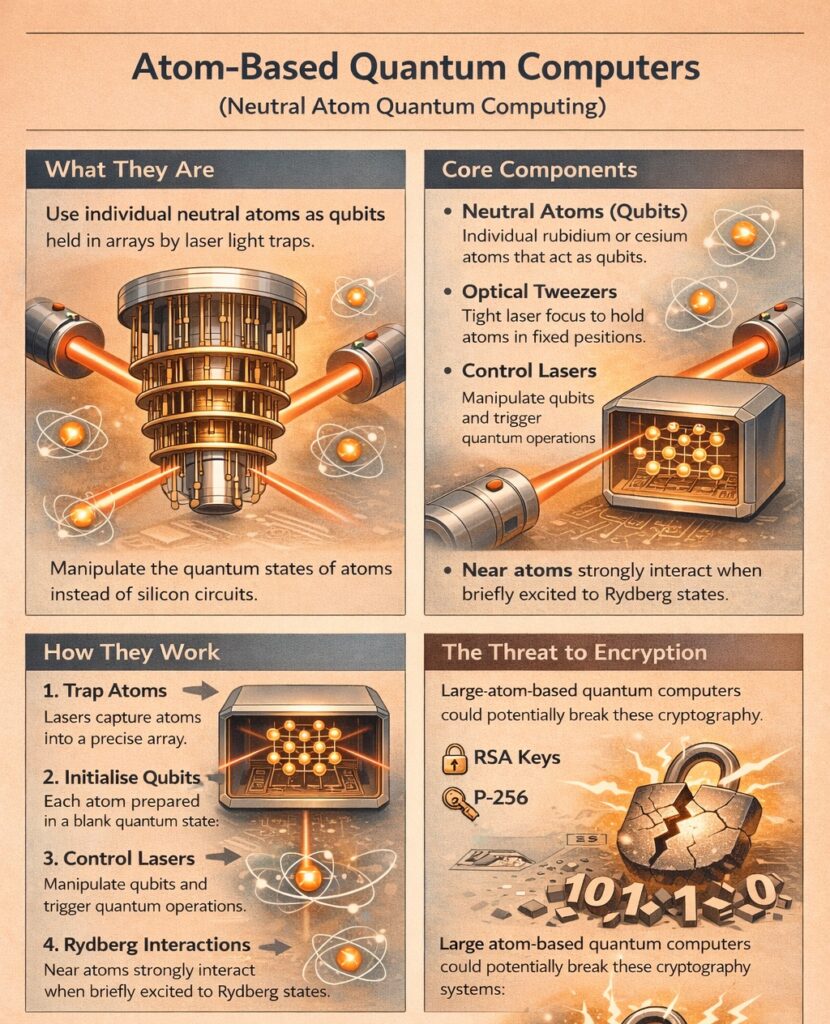

Alexandre Dauphin, a physicist at quantum-computing company Pasqal in Paris, added that “it is exciting to see how these new insights could accelerate applications beyond cryptography, in areas such as materials science, machine learning, and optimisation.”
The Race to Post-Quantum Security
Cloudflare and other cybersecurity companies are now reassessing their timelines to provide protection against quantum hacking. The message is clear: the window for transitioning to post-quantum cryptography is shorter than anyone expected.
Organisations that haven’t already begun planning their migration to quantum-resistant encryption standards need to start now. The quantum threat isn’t a decade away anymore, it may be just years.
From the YFarmX archive · originally published on the previous site