IBM helps create half-Möbius molecule and model it with qubits
Researchers assembled a half-Möbius molecule with scanning probes, then combined quantum and classical calculations to study its electronic structure.

An international team of scientists from IBM, the University of Manchester, Oxford University, ETH Zurich, EPFL, and the University of Regensburg has created and characterised a molecule unlike any previously known, one whose electrons travel through its structure in a corkscrew-like pattern that fundamentally alters its chemical behaviour.
Published in Science, the work represents the first experimental observation of a half-Möbius electronic topology in a single molecule. The molecule, with the formula C₁₃Cl₂, was assembled atom-by-atom at IBM from a custom precursor. To the scientists’ knowledge, a molecule with such topology had never before been synthesised, observed, or even formally predicted.
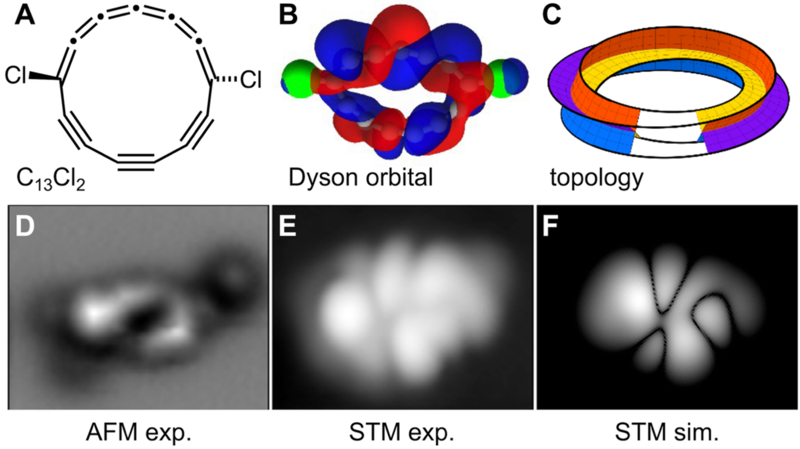 A molecule with half-Möbius topology, University of Oxford – https://www.chem.ox.ac.uk/article/a-molecule-with-half-mobius-topology
Quantum Computing Validates the Discovery
The team studied the molecule’s electronic structure with a workflow combining quantum and classical calculations. Using an IBM quantum computer, the team found helical molecular orbitals for electron attachment, a fingerprint of the half-Möbius topology. The quantum simulations helped reveal the origin of the topology switching, an effect called the helical pseudo-Jahn-Teller effect.
The IBM Research account describes a calculation beyond brute-force classical diagonalisation. Its quantum and classical methods complemented scanning-probe measurements of the molecule.
Two Fronts of Scientific Advance
In IBM’s announcement, research executive Alessandro Curioni described the combination of molecular design, physical assembly and quantum calculation as progress towards Feynman’s vision of simulating quantum physics.
The discovery advances science on two fronts. For chemistry, it demonstrates that electronic topology can be deliberately engineered, not merely found in nature. For quantum computing, it demonstrates how quantum simulation can contribute to a combined experimental and computational chemistry workflow.
Researchers resolved the enantiomeric geometries using Atomic Force Microscopy (AFM) and mapped the helical orbital densities via Scanning Tunneling Microscopy (STM), confirming the quantum simulation predictions with experimental observation.
More here:

Sources
- IBM Research: quantum and classical study of a half-Möbius moleculeresearch.ibm.com
- IBM and university researchers: announcement, 5 March 2026newsroom.ibm.com
From the YFarmX archive · originally published on the previous site