
The hardware bay
The machines of spaceflight.
Ten interactive machines across nine classes of space hardware, drawn live as real geometry. Drag any machine to turn it in every direction, pick another to swap it in, and open its tabs for scale, the real machines of the class, and the live launch board.
Turn the machines
Loading model…
Live 3D is unavailable here, so dragging turns the stills instead
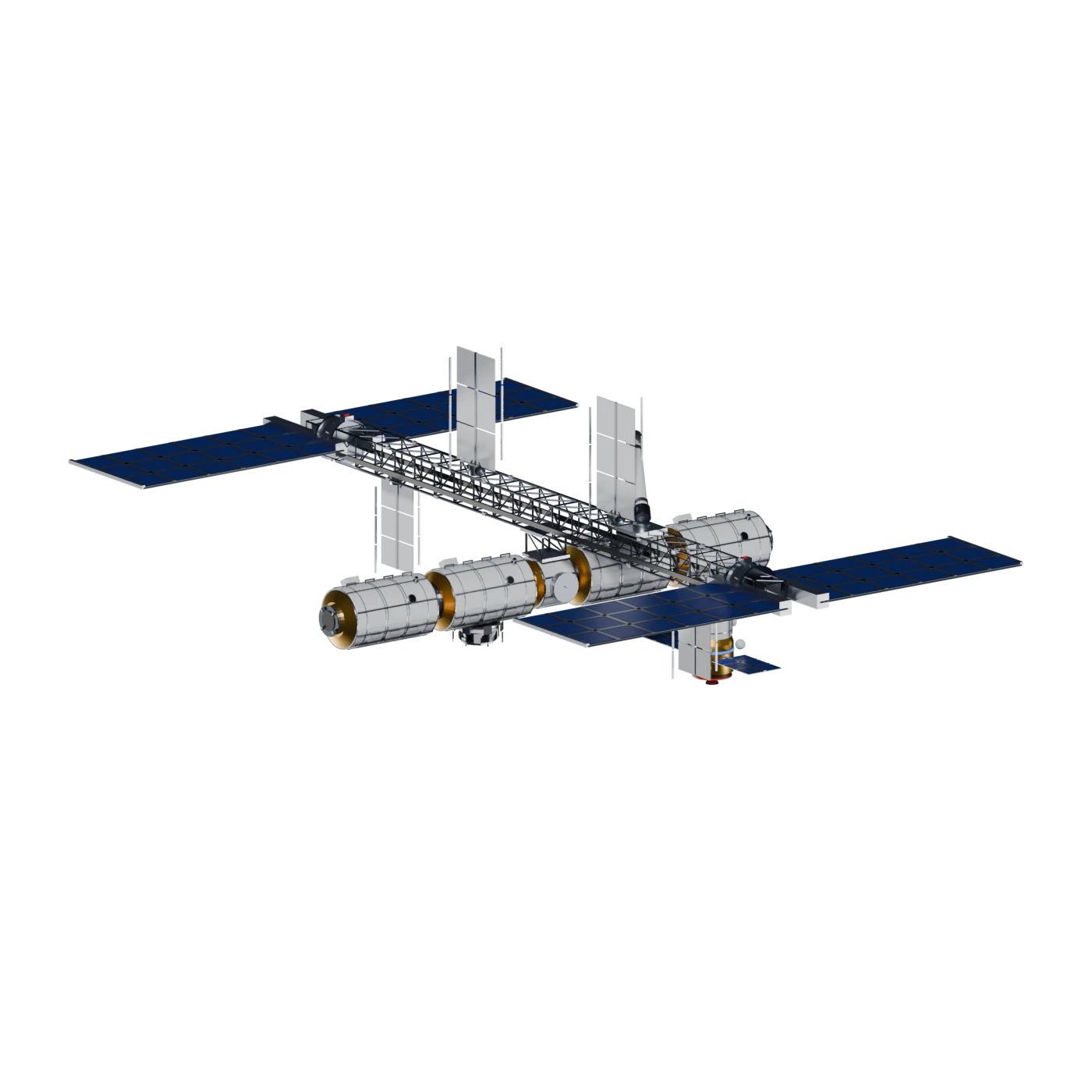
Modular space station
Four pressurised modules on a spine, a 44 m truss carrying four solar wings and radiators, a cupola, a robotic arm and a docked cargo craft.
- Four pressurised modules docked along a spine, a ring, hatch and capture guides at every join
- Rotary joints at the truss ends turn the four solar wings; the radiators stand at right angles so the two never shade each other
- A robotic arm on a mobile base reaches over the spine, and a faceted cupola hangs below
- A visiting cargo craft is docked at the far module's nadir port
- Class
- Stations
- Built scale
- 59 m wing tip to wing tip · 44 m truss
- Where the class lives
- Low Earth orbit, about 400 km up
- Geometry
- 51,080 triangles, modelled as real parts
Flying today: the International Space Station, 109 m end to end, and China's Tiangong. The model is the class, not either of them.
Communications satellite
Foil-wrapped bus, twin deployable arrays and a steerable main dish.
- A foil-wrapped box bus with two solar wings on a single rotation axis
- The steerable main dish points at Earth; two smaller horn feeds sit beside it
- A radiator on the anti-sun face and a station-keeping thruster cluster at the base
- Class
- Satellites
- Built scale
- 4.9 m across the solar wings
- Where the class lives
- Geostationary orbit, 35,786 km up
- Geometry
- 11,260 triangles, modelled as real parts
The class in service: hundreds of communications satellites hold geostationary slots, fleets from Intelsat, SES and Eutelsat among them, the largest spanning over 30 m across their wings. The model is the class, not any of them.
Lunar lander
Two stage crewed lander: gold blanket descent stage on four shock strut legs, pressure cabin and ladder above.
- Gold-blanket descent stage: four tanks in the quadrants, a throttleable engine under the centre
- Four splayed legs on telescoping shock struts, built as real struts, sleeves and ball joints
- The ascent-stage cabin above: canted approach windows, thruster quads, a docking tunnel on the roof
- The ladder down the forward leg is how a crew reaches the surface, and gets back off it
- Class
- Landers
- Built scale
- 9.6 m across the footpads
- Where the class lives
- The lunar surface
- Geometry
- 50,896 triangles, modelled as real parts
The class that has carried crew: Apollo's Lunar Module, six landings from 1969 to 1972. Its successors, SpaceX's Starship HLS and Blue Origin's Blue Moon MK2, are being built for NASA's Artemis programme. The model is the class, not any of them.
On the launch board
tbcChang'e-7 · Long March 5 (Y14)Surface rover
Six wheeled science rover on rocker bogie suspension: camera mast, stowed instrument arm and a radioisotope power unit.
- The rocker-bogie suspension is the signature: real bars on real pivots, not sticks; the linkage is what says rover
- A mast with a stereo camera head, and a robotic arm folded against the front bumper with an instrument turret at its wrist
- A radioisotope power unit with cooling fins on the tail, and a small steerable dish for the link home
- Class
- Rovers
- Built scale
- 3.3 m long, six wheels
- Where the class lives
- Planetary surfaces: Mars, today
- Geometry
- 39,488 triangles, modelled as real parts
Real rovers of the class: NASA's Curiosity and Perseverance, driving on Mars since 2012 and 2021 on exactly this suspension. The model is the class, not either of them.
Space telescope
Eighteen gold hexagons on an open backplane, a secondary on a tripod and a five-layer sunshield below.
- Eighteen gold-coated hexagonal mirror segments: segmentation is what lets a mirror wider than any fairing fold for launch
- A convex secondary held out on a tripod, five and a half metres from the primary
- The five-layer membrane sunshield keeps the optics cold enough to see infrared; the bus and solar array hang on the warm side
- Class
- Telescopes
- Built scale
- 12 m across the sunshield
- Where the class lives
- High orbits and Sun-Earth L2, 1.5 million km out
- Geometry
- 42,464 triangles, modelled as real parts
The class's famous members: Hubble, in orbit since 1990, and the James Webb Space Telescope at L2, whose segmented gold mirror this archetype echoes. The model is the class, not either of them.
Reusable booster
First stage returning from a suborbital flight: legs deployed, grid fins folded and the lower tank darkened by re-entry.
- Four landing legs down and locked, built as real A-frames on pushrods
- Grid fins folded back against the interstage after steering the descent
- Nine engines up inside an open octaweb; the centre engine relights for the landing burn
- The lower third of the tank is darkened by the soot of re-entry
- Class
- Launch vehicles
- Built scale
- 41 m tall · 14 m across the deployed legs
- Where the class lives
- Pad to suborbital ascent and back: a reusable first stage
- Geometry
- 56,732 triangles, modelled as real parts
Flying today: SpaceX's Falcon 9 first stage proved the class, with single boosters past twenty flights, and Blue Origin's New Glenn landed its booster on its second flight in 2025. The model is the class, not either of them.
Two-stage launch vehicle
Full stack in flight configuration: nine first stage engines, a dark interstage and an ogive fairing.
Crew capsule and service module
Blunt-cone capsule on its service module: ablative shield, docking adapter, radiators and one main engine.
Deep-space probe
Foil-wrapped bus, three-metre dish, a nuclear generator on one boom and a magnetometer on the other.
Robotic servicing spacecraft
A servicer bus with two articulated arms reaching past a capture ring, a refuelling nozzle and a stereo inspection camera.
On the launch board
tbcHTV-X2 · H3Illustration · class archetype · real geometry