Orbital intelligence network
Perspective
beyond Earth.
News, analysis and intelligence covering the machines, missions, markets and systems expanding humanity's reach beyond Earth.
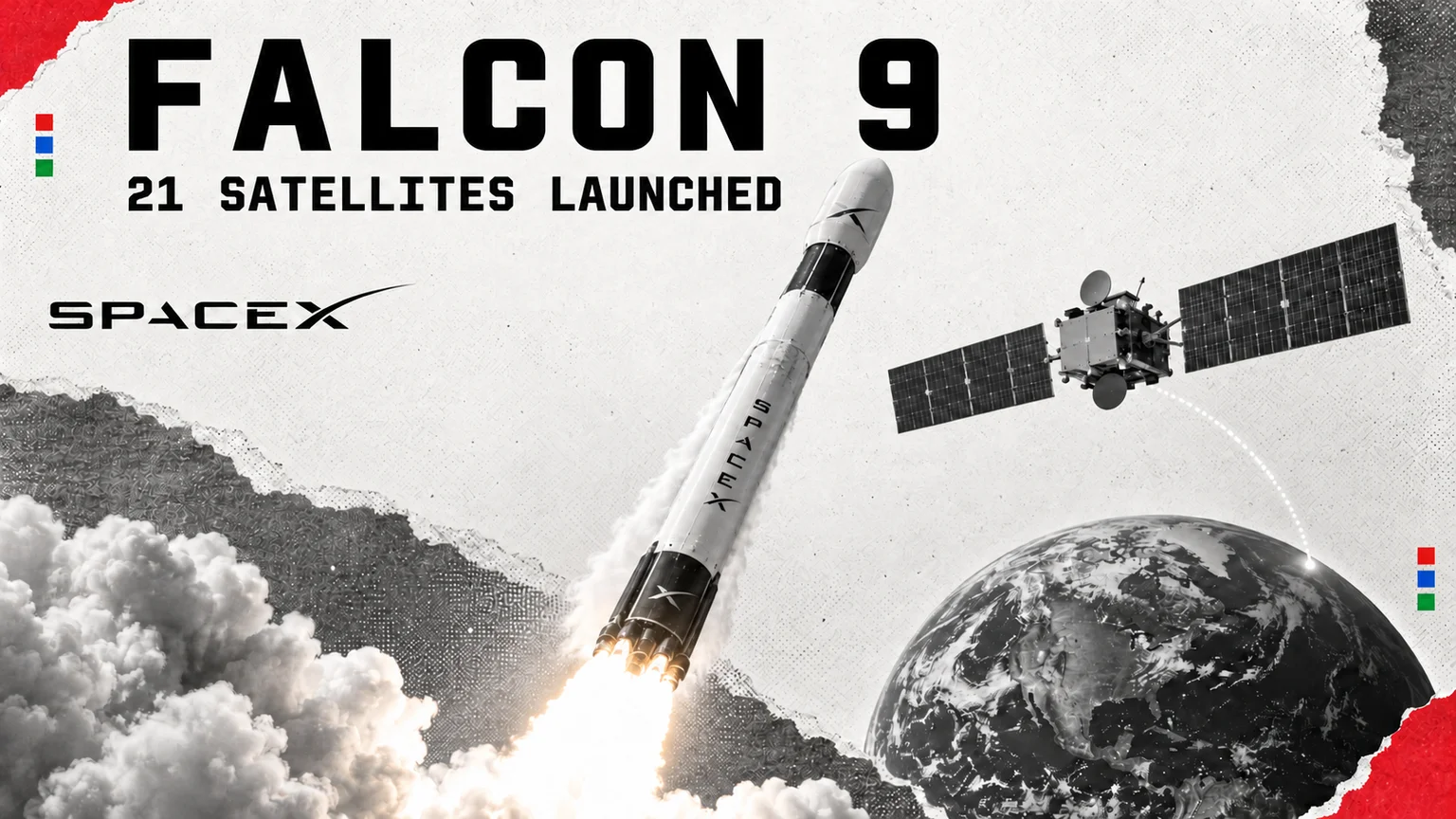
Launch watchTwo Falcon 9s fly 38 minutes apart, from opposite coastsRight now in space
- RKLBRocket Lab$80.25up0.19%
- ASTSAST SpaceMobile$70.98down0.76%
- LUNRIntuitive Machines$19.01up8.26%
- FLYFirefly Aerospace$26.67down0.37%
- PLPlanet Labs$24.69down0.24%
- RDWRedwire$13.58up2.88%
Launch boardOpenCloseEvery window from the provider's own schedule. Next up: VA270 (MTG-I2) · 27 Aug · time tbc.
Mission boardOpenCloseFrom the Martian surface to Mercury orbit, tracked from the operating agencies' own updates.
- nextArtemis programme: Artemis III, scheduled for 2027, a demonstration mission in low Earth orbit to test one or both commercial landers from SpaceX and Blue Origin
- nextEuropa Clipper: Earth gravity assist flyby on 3 December 2026
- nextJUICE (Jupiter Icy Moons Explorer): Earth gravity assist flyby on 12 September 2026
- nextBepiColombo: Mercury orbit insertion on 21 November 2026, with routine science operations beginning in early 2027
- nextChang'e-7: Launch of Chang'e-7 from Wenchang; assembly and testing at the launch site are proceeding to plan (no launch date stated)
Latest
View all Space newsUSSF-366 · SpaceX (for the US Space Force) · SLC-4E, Vandenberg Space Force Base, California
16 Aug · 01:50 UTC
last verified 2026-08-16 · The launch record →
Globalstar 2-R Launch 1 · SpaceX · SLC-40, Cape Canaveral Space Force Station, Florida
16 Aug · 01:12 UTC
last verified 2026-08-16 · The launch record →
Zhongxing-4B (Long March 7A) · CASC / CALT · Wenchang Space Launch Site, Hainan, China
10 Aug · 12:02 UTC
Zhongxing-4B, a communications satellite in the Zhongxing (ChinaSat) series, lost when the rocket failed during first-stage flight. Xinhua's official statement records the 20:02 Beijing time liftoff, 'flight anomalies' and a failed mission, with the cause under analysis; Jonathan's Space Report records the vehicle destroyed during first-stage flight. It is the Long March 7A's second failure, after its maiden flight in March 2020.
last verified 2026-08-14 · The launch record →
Launch watch
Windows, vehicles, outcomes.
Every window from the provider's own schedule, shown in UTC, with the slip risk on every one. A countdown appears only when a time is confirmed.
The launch deskscheduledVA270 (MTG-I2)27 Aug · time tbc
Arianespace · Ariane 62 · Europe's Spaceport (ELA-4), Kourou, French Guiana
Meteosat Third Generation Imager 2 (MTG-I2) weather satellite for EUMETSAT, developed with ESA; Ariane 6's first mission to geostationary transfer orbit
last verified 2026-08-14
scheduledNancy Grace Roman Space Telescope30 Aug · 11:26 UTC
SpaceX (for NASA Launch Services Program) · Falcon Heavy · Launch Complex 39A, Kennedy Space Center, Florida, USA
NASA's wide-field infrared survey observatory for dark energy, exoplanet and infrared astrophysics research
last verified 2026-08-07
scheduledNASA's SpaceX Crew-1312 Sept · time tbc
SpaceX (for NASA Commercial Crew Program) · Falcon 9 / Crew Dragon · Space Launch Complex 40, Cape Canaveral Space Force Station, Florida, USA
13th commercial crew rotation to the ISS, no earlier than 12 September 2026, moved up from November to raise rotation cadence: NASA astronauts Jessica Watkins (commander) and Luke Delaney, CSA astronaut Joshua Kutryk, Roscosmos cosmonaut Sergey Teteryatnikov
last verified 2026-08-07
Mission control
Artemis programme
developmentNASA · Moon
Next: Artemis III, scheduled for 2027, a demonstration mission in low Earth orbit to test one or both commercial landers from SpaceX and Blue Origin
last verified 2026-08-07
Europa Clipper
cruiseNASA · Jupiter (Europa)
Next: Earth gravity assist flyby on 3 December 2026
last verified 2026-08-06
JUICE (Jupiter Icy Moons Explorer)
cruiseESA · Jupiter (Ganymede, Callisto, Europa)
Next: Earth gravity assist flyby on 12 September 2026
last verified 2026-08-06
BepiColombo
cruiseESA / JAXA · Mercury
Next: Mercury orbit insertion on 21 November 2026, with routine science operations beginning in early 2027
last verified 2026-08-06
Chang'e-7
developmentCNSA (China National Space Administration) · Moon (south pole)
Next: Launch of Chang'e-7 from Wenchang; assembly and testing at the launch site are proceeding to plan (no launch date stated)
last verified 2026-08-07
Space intelligence
Understand the systems behind the missions.
The hardware bay
See the machines.

Loading model…
Live 3D is unavailable here, so dragging turns the stills instead
Modular space station
Four pressurised modules on a spine, a 44 m truss carrying four solar wings and radiators, a cupola, a robotic arm and a docked cargo craft.
- Four pressurised modules docked along a spine, a ring, hatch and capture guides at every join
- Rotary joints at the truss ends turn the four solar wings; the radiators stand at right angles so the two never shade each other
- A robotic arm on a mobile base reaches over the spine, and a faceted cupola hangs below
- A visiting cargo craft is docked at the far module's nadir port
- Class
- Stations
- Built scale
- 59 m wing tip to wing tip · 44 m truss
- Where the class lives
- Low Earth orbit, about 400 km up
- Geometry
- 51,080 triangles, modelled as real parts
Flying today: the International Space Station, 109 m end to end, and China's Tiangong. The model is the class, not either of them.
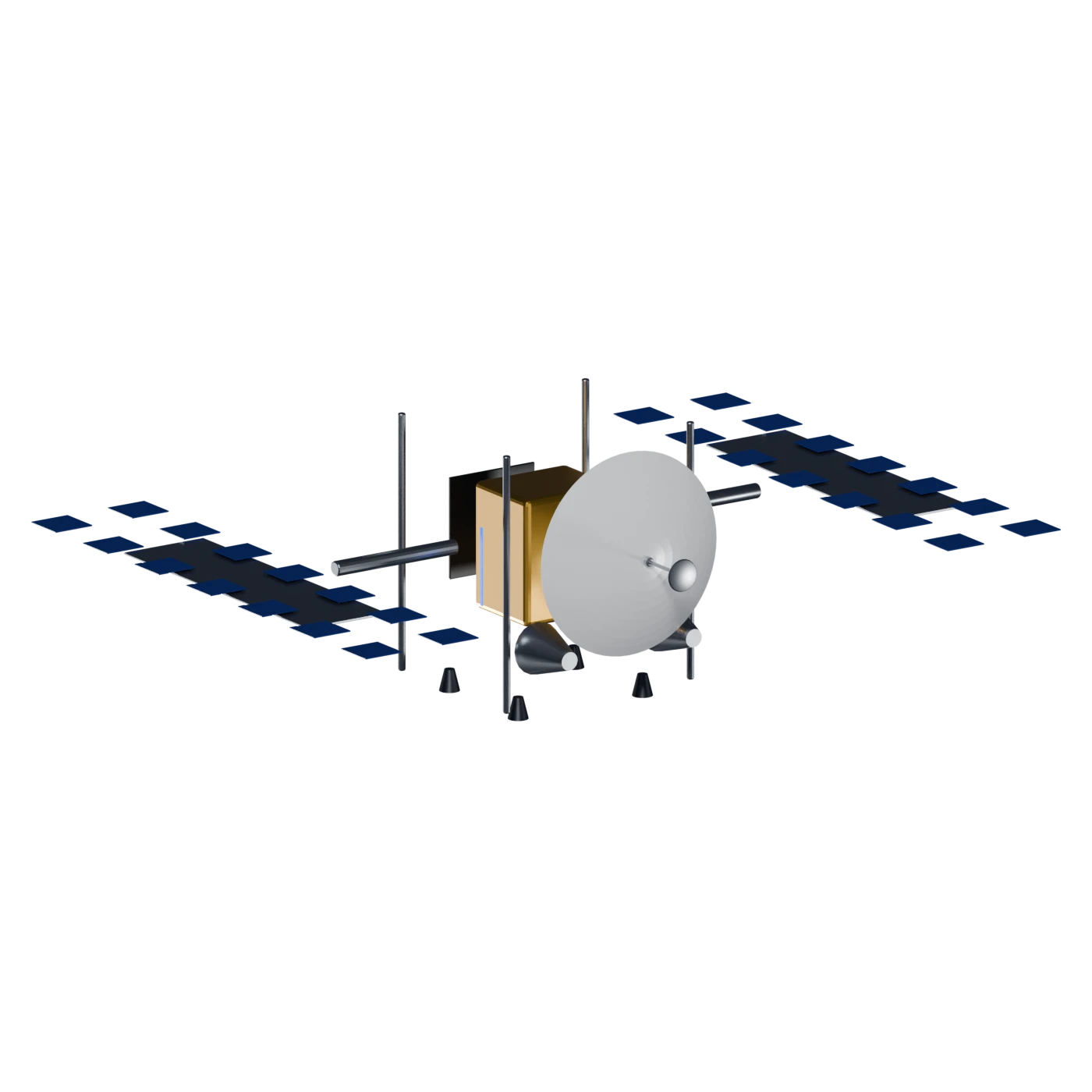
Communications satellite
Foil-wrapped bus, twin deployable arrays and a steerable main dish.
- A foil-wrapped box bus with two solar wings on a single rotation axis
- The steerable main dish points at Earth; two smaller horn feeds sit beside it
- A radiator on the anti-sun face and a station-keeping thruster cluster at the base
- Class
- Satellites
- Built scale
- 4.9 m across the solar wings
- Where the class lives
- Geostationary orbit, 35,786 km up
- Geometry
- 11,260 triangles, modelled as real parts
The class in service: hundreds of communications satellites hold geostationary slots — fleets from Intelsat, SES and Eutelsat among them, the largest spanning over 30 m across their wings. The model is the class, not any of them.
Lunar lander
Two stage crewed lander: gold blanket descent stage on four shock strut legs, pressure cabin and ladder above.
- Gold-blanket descent stage: four tanks in the quadrants, a throttleable engine under the centre
- Four splayed legs on telescoping shock struts, built as real struts, sleeves and ball joints
- The ascent-stage cabin above: canted approach windows, thruster quads, a docking tunnel on the roof
- The ladder down the forward leg is how a crew reaches the surface — and gets back off it
- Class
- Landers
- Built scale
- 9.6 m across the footpads
- Where the class lives
- The lunar surface
- Geometry
- 50,896 triangles, modelled as real parts
The class that has carried crew: Apollo's Lunar Module, six landings from 1969 to 1972. Its successors, SpaceX's Starship HLS and Blue Origin's Blue Moon MK2, are being built for NASA's Artemis programme. The model is the class, not any of them.
Surface rover
Six wheeled science rover on rocker bogie suspension: camera mast, stowed instrument arm and a radioisotope power unit.
- The rocker-bogie suspension is the signature: real bars on real pivots, not sticks — the linkage is what says rover
- A mast with a stereo camera head, and a robotic arm folded against the front bumper with an instrument turret at its wrist
- A radioisotope power unit with cooling fins on the tail, and a small steerable dish for the link home
- Class
- Rovers
- Built scale
- 3.3 m long, six wheels
- Where the class lives
- Planetary surfaces — Mars, today
- Geometry
- 39,488 triangles, modelled as real parts
Real rovers of the class: NASA's Curiosity and Perseverance, driving on Mars since 2012 and 2021 on exactly this suspension. The model is the class, not either of them.
Space telescope
Eighteen gold hexagons on an open backplane, a secondary on a tripod and a five-layer sunshield below.
- Eighteen gold-coated hexagonal mirror segments — segmentation is what lets a mirror wider than any fairing fold for launch
- A convex secondary held out on a tripod, five and a half metres from the primary
- The five-layer membrane sunshield keeps the optics cold enough to see infrared; the bus and solar array hang on the warm side
- Class
- Telescopes
- Built scale
- 12 m across the sunshield
- Where the class lives
- High orbits and Sun–Earth L2, 1.5 million km out
- Geometry
- 42,464 triangles, modelled as real parts
The class's famous members: Hubble, in orbit since 1990, and the James Webb Space Telescope at L2, whose segmented gold mirror this archetype echoes. The model is the class, not either of them.
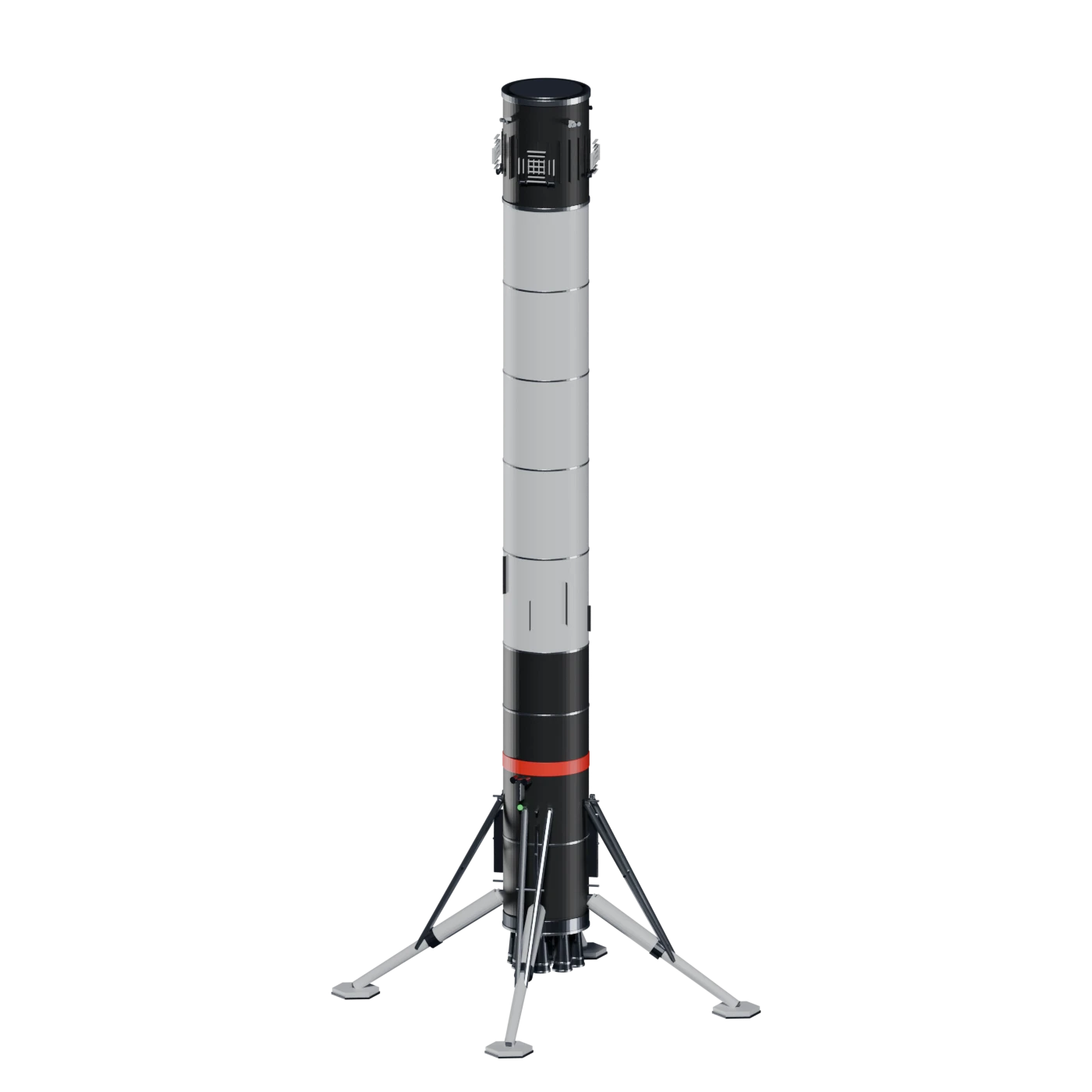
Reusable booster
First stage back from orbit: legs deployed, grid fins folded and the lower tank darkened by re entry.
- Four landing legs down and locked, built as real A-frames on pushrods
- Grid fins folded back against the interstage after steering the descent
- Nine engines up inside an open octaweb; the centre engine relights for the landing burn
- The lower third of the tank is darkened by the soot of re-entry
- Class
- Launch vehicles
- Built scale
- 41 m tall · 14 m across the deployed legs
- Where the class lives
- Pad to orbit and back — the only machine here that comes home
- Geometry
- 56,732 triangles, modelled as real parts
Flying today: SpaceX's Falcon 9 first stage proved the class, with single boosters past twenty flights, and Blue Origin's New Glenn landed its booster on its second flight in 2025. The model is the class, not either of them.
Illustration · class archetype · real geometry
The machinesThe classes of hardware the section covers
The machines
Signal from orbit
The developments beyond Earth, clearly explained.
Spaceflight, orbital infrastructure and the space economy in one briefing. Join the waitlist and be first in when it launches.

Transmission continues. About YFarmX Space →