YFarmX logoYFARMX SPACE
YFarmX Space · all sections

The hardware bay · Project file

Starlink Gen3.

On 6 July 2026 SpaceX asked the FCC for authority to fly 100,000 satellites, roughly nine times everything it has in orbit today, in shells so low they skim the atmosphere. On 18 September 2026 the Commission accepted the application for filing. The shells sit lower than anything SpaceX flies today, the spectrum runs to 275 GHz, and each satellite is built to last five years.

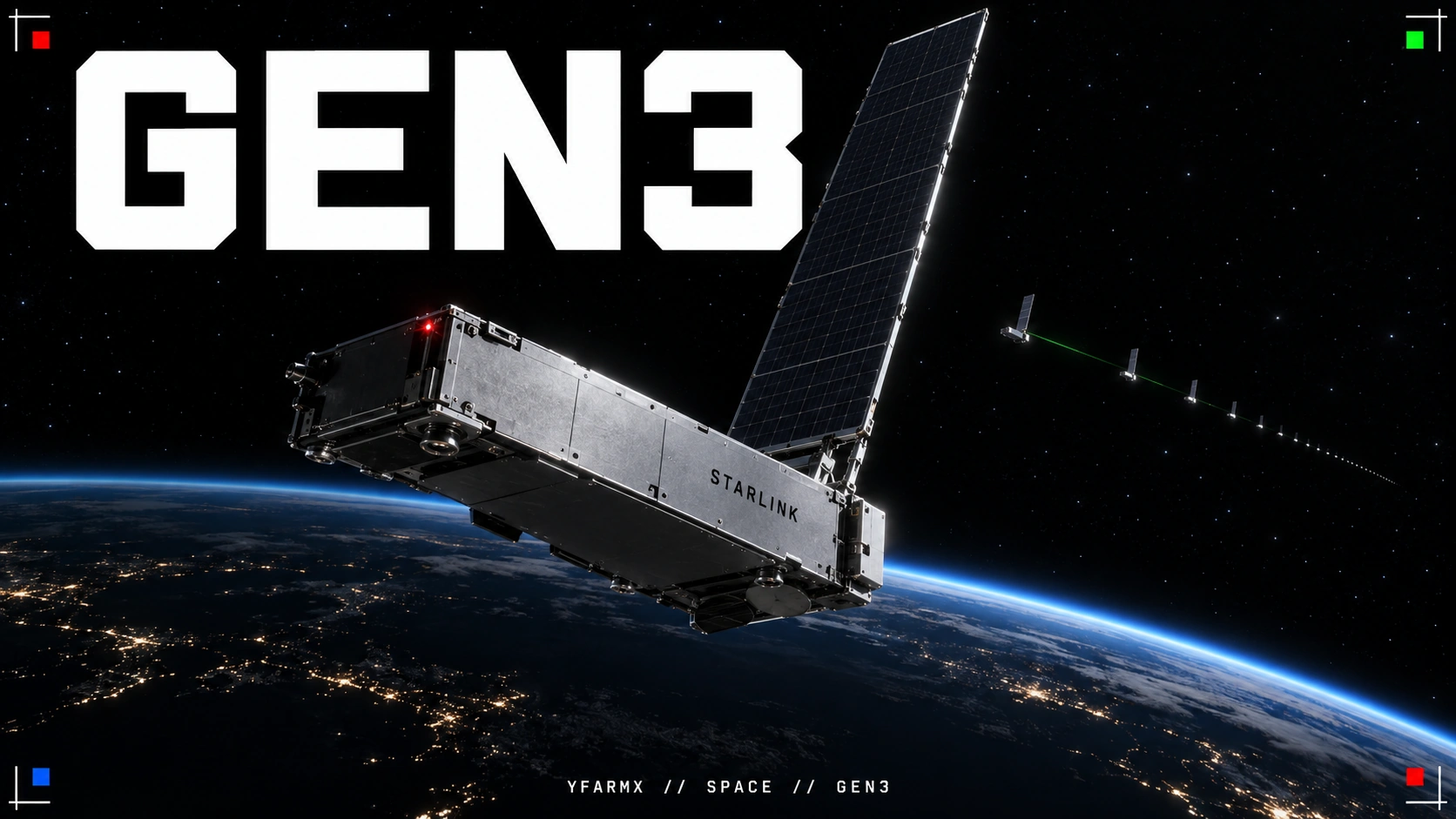
Concept artwork headlined GEN3: a flat-panel Starlink satellite with a single solar wing above Earth's night-side limb, a chain of identical satellites receding to bright points behind it
Concept artwork of the Gen3 constellation.
Satellites requested100,000
Filed6 Jul 2026
Accepted for filing18 Sept 2026
StatusPending review

The operating idea

SpaceX sells the bandwidth as AI infrastructure.

"SpaceX seeks authority to deploy Gen3: 100,000 satellites powering human connectivity and AI-fueled progress." The uplink-heavy design is built for machines: "AI requires massive uplink capacity to support high-definition spatial and auditory data necessary for real-time decision-making and industrial automation. Without it, the United States cannot compete in the AI revolution."

The waiver request puts it in one line: "The Gen3 system will provide the communications backbone of the AI age."
The orbits

Two thin bands, very low down.

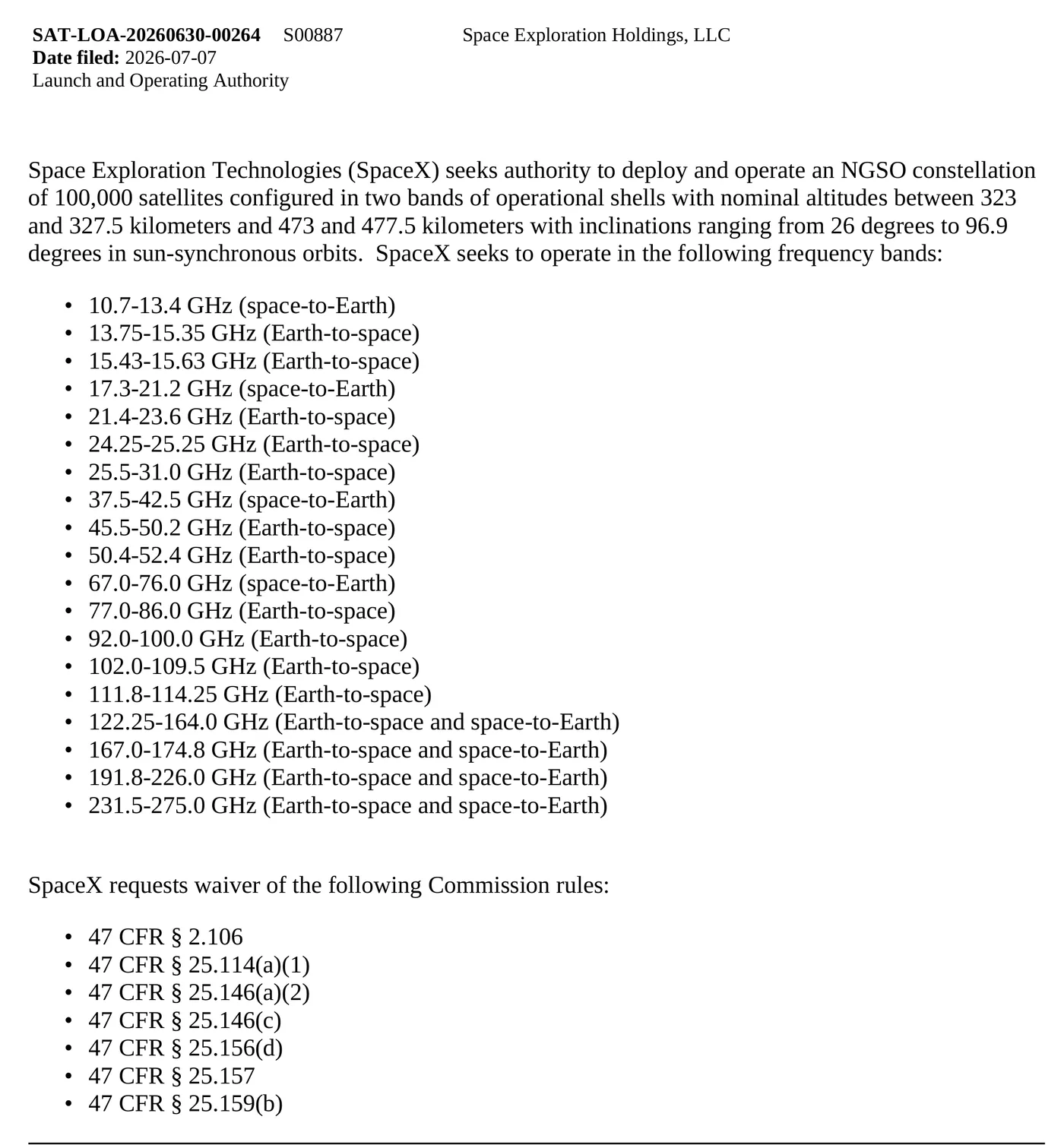
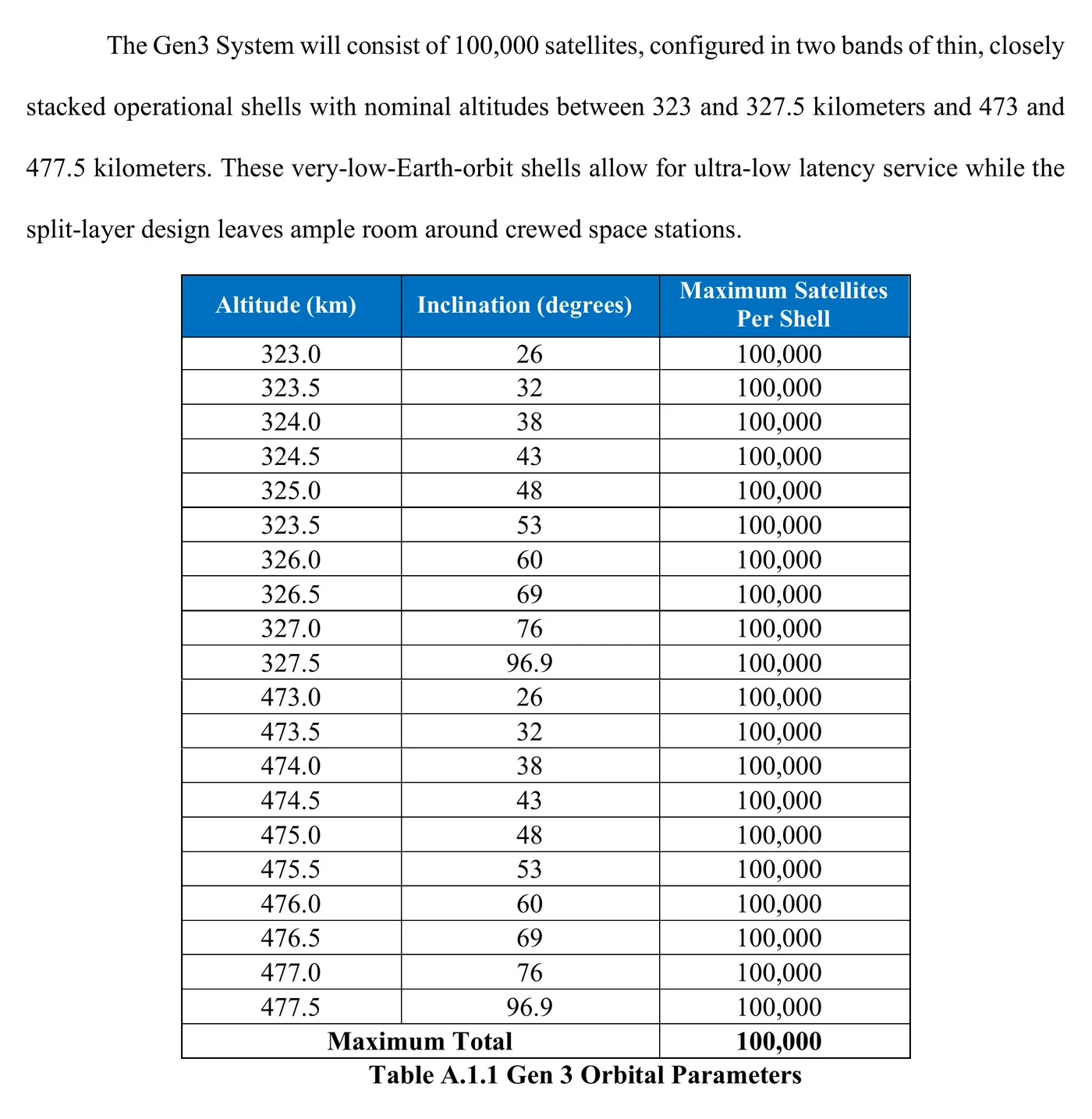
Gen3 is 100,000 satellites in two bands of thin, closely stacked shells, one band at 323 to 327.5 kilometres and one at 473 to 477.5 kilometres. Ten shells sit in each band, at inclinations from 26 degrees to a sun-synchronous 96.9, and the table caps every shell, and the whole system, at the same 100,000: the ask is flexibility to spread the fleet across the listed shells, under one hard total.

Altitude is the design's signature. Today's Starlink shells sit around 340 to 550 kilometres; Gen3's lower band flies beneath the International Space Station, where atmospheric drag deorbits a dead satellite in months rather than decades. The filing gives each spacecraft an operational lifetime of five years and argues the split-layer design "leaves ample room around crewed space stations". Low also means close, which is the latency argument: the narrative promises "extremely low-latency and multi-gigabit symmetrical throughput" for consumers, enterprises, governments and "billions of AI-powered devices".

Table A.1.1 from SpaceX's Gen3 technical attachment, listing the orbital shells: ten altitude and inclination pairs between 323 and 327.5 kilometres and ten more between 473 and 477.5 kilometres, with a maximum total of 100,000 satellites
Gen3 orbital parameters · SpaceX technical attachment, page 1 · FCC ICFS

The spectrum

Up to 275 GHz, into unused bands.

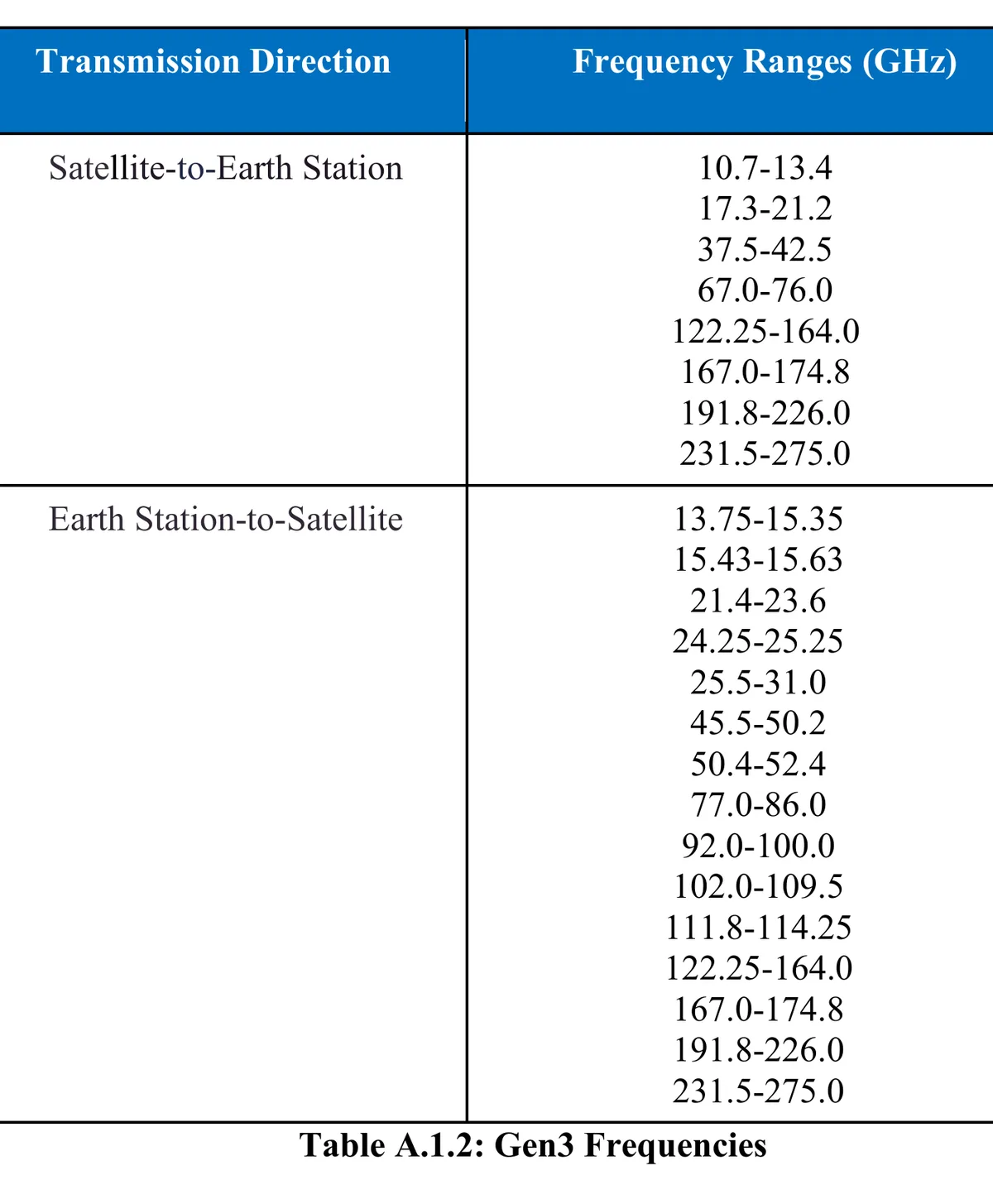
Gen2 runs on what the narrative calls the "workhorse Ku-, Ka-, V-, and E-band spectrum". Gen3 keeps all of it and reaches beyond: the filing says the system "will pioneer greenfield W- and D-band frequencies between 92 and 275 GHz", sub-terahertz territory no commercial constellation uses today. The frequency table runs from 10.7 GHz at the bottom of Ku-band to 275 GHz at the top, for both directions of the link.

The application asks for waivers of seven Commission rules, and SpaceX's August supplement argues the FCC's own Space Modernization order of July 2026 supports granting them. High frequencies buy enormous bandwidth and suffer badly in rain; flying very low is part of the answer, because a shorter, steeper path through the atmosphere loses less.

Table A.1.2 from SpaceX's Gen3 technical attachment listing the system's frequency ranges in both directions, from 10.7 gigahertz up to 275 gigahertz including the W-band and D-band ranges
Gen3 frequencies · SpaceX technical attachment, page 3 · FCC ICFS
Table A.2.2 from SpaceX's Gen3 technical attachment: coverage values for a 10 degree minimum elevation angle across the 473 to 477.5 kilometre shells, with maximum steering angles around 66.4 degrees and coverage radii around 1,500 kilometres
Coverage at a 10° minimum elevation angle · SpaceX technical attachment, page 4 · FCC ICFS

Reading the record

Where the 2,500 kg figure comes from.

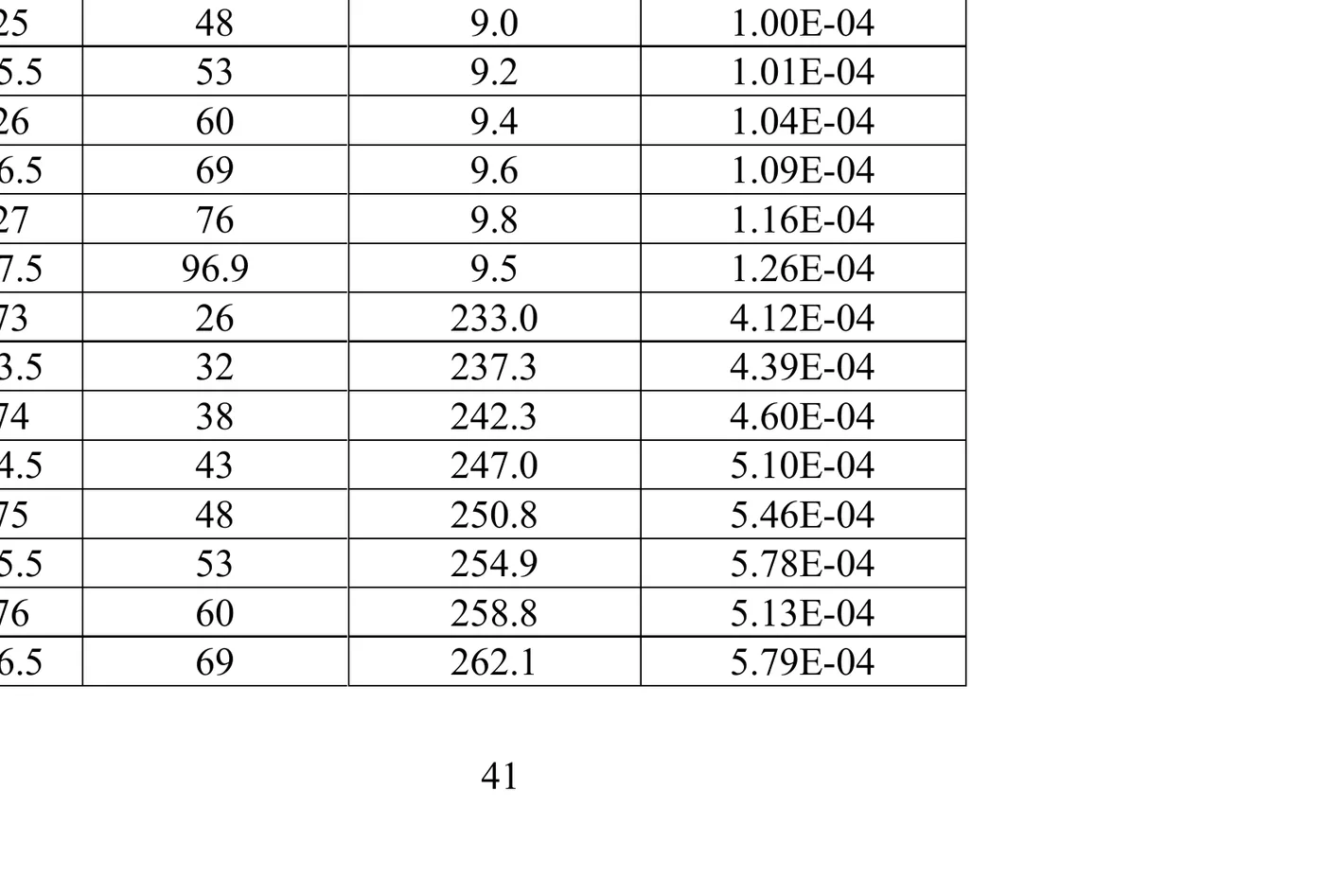
Coverage of the filing repeats a satellite mass of 2,000 to 2,500 kilograms, and it is worth knowing what those numbers are. They appear on pages 40 and 41 of the technical attachment as inputs to NASA's Debris Assessment Software: bounding cases, a 2,000 kg satellite of 300 square metres and a 2,500 kg satellite of 400 square metres, run to show the re-entry and collision numbers hold even for the heaviest plausible spacecraft. The filing declares them as modelling assumptions.

The four filed documents cover orbits, spectrum, power limits and debris behaviour.

Pages 40 and 41 of SpaceX's Gen3 technical attachment showing NASA Debris Assessment Software results for the bounding cases of a 2,000 kilogram satellite with 300 square metres of area and a 2,500 kilogram satellite with 400 square metres
Debris assessment bounding cases · SpaceX technical attachment, pages 40-41 · FCC ICFS

The proceeding

Accepted for filing on 18 September 2026.

The docket record, from the FCC's own filing system. Status as of 18 September 2026: pending review.

SpaceX files the Gen3 application

Space Exploration Holdings, LLC signs and files FCC Form 312 for launch and operating authority: 100,000 satellites under file number SAT-LOA-20260630-00264. The Commission's acceptance notice dates the filing 7 Jul 2026.

The first public comments arrive

A private individual files the docket’s first opposition, arguing the constellation should fly far higher, and follows it with a correction the next day. As of 18 September 2026 those two filings are the whole third-party record.

SpaceX leans on the new space licensing rules

A supplemental letter argues the Commission’s Space Modernization report and order of July 2026 supports granting the application’s waiver requests.

Latest

The FCC accepts the application for filing

Public notice SAT-02038 lists Gen3 as accepted for filing, which opens the formal window for petitions and oppositions under the Commission’s rules. The application’s status stands at pending review.

The FCC's public notice of 18 September 2026 listing the Gen3 application as accepted for filing, describing an NGSO constellation of 100,000 satellites in shells between 323 and 327.5 kilometres and 473 and 477.5 kilometres at inclinations from 26 to 96.9 degrees
Accepted for filing · FCC public notice SAT-02038, page 6, 18 Sept 2026

The opposition record is where this proceeding differs, so far, from the fights around it. As of 18 September 2026 the docket holds 2 third-party filings, both from one private individual; the organised objections from astronomy bodies and rival operators that mark SpaceX's separate orbital data centre application have a different file number and a different fight. Acceptance for filing starts the formal clock, and the petitions to deny, if they come, come next.

The constellation it grows from

Nine times today's fleet.

Scale is the whole story of this filing, and the current fleet is the yardstick. Figures stamped 18 September 2026.

Gen3 request100,000 satellites
Gen2 authorised15,000 · order of 9 Jan 2026
Active Starlinks in orbit11,114 · 17 Sept 2026
Gen3 shells323 to 327.5 km and 473 to 477.5 km
Stated lifetime5 years per satellite
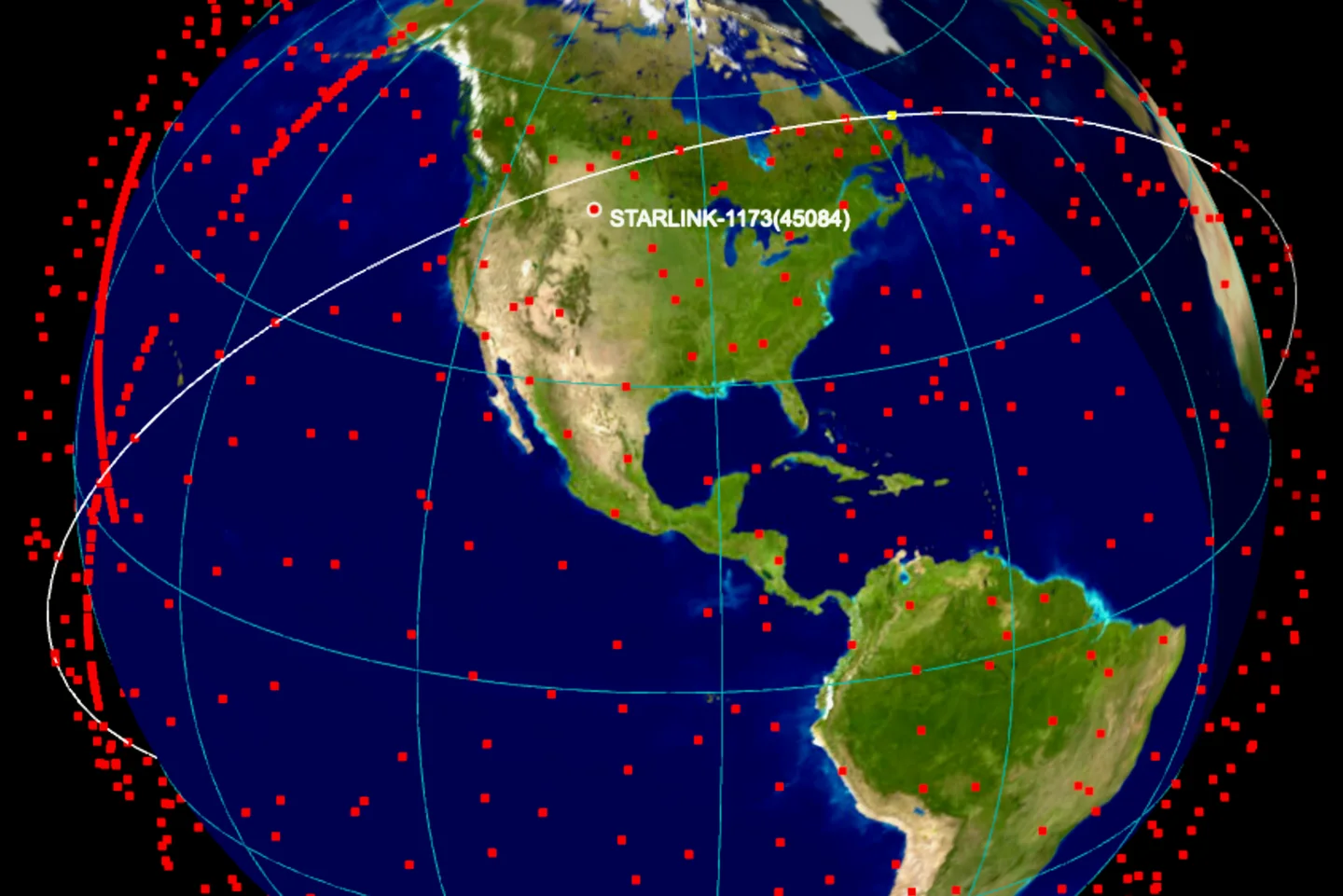
A satellite-tracking visualisation of the Starlink constellation, hundreds of satellites drawn as red points wrapped around the globe with one satellite's orbit traced as a white ring
The fleet Gen3 grows from, drawn from live tracking data. Visualisation: Steve Jurvetson · CC BY 2.0, Wikimedia Commons