
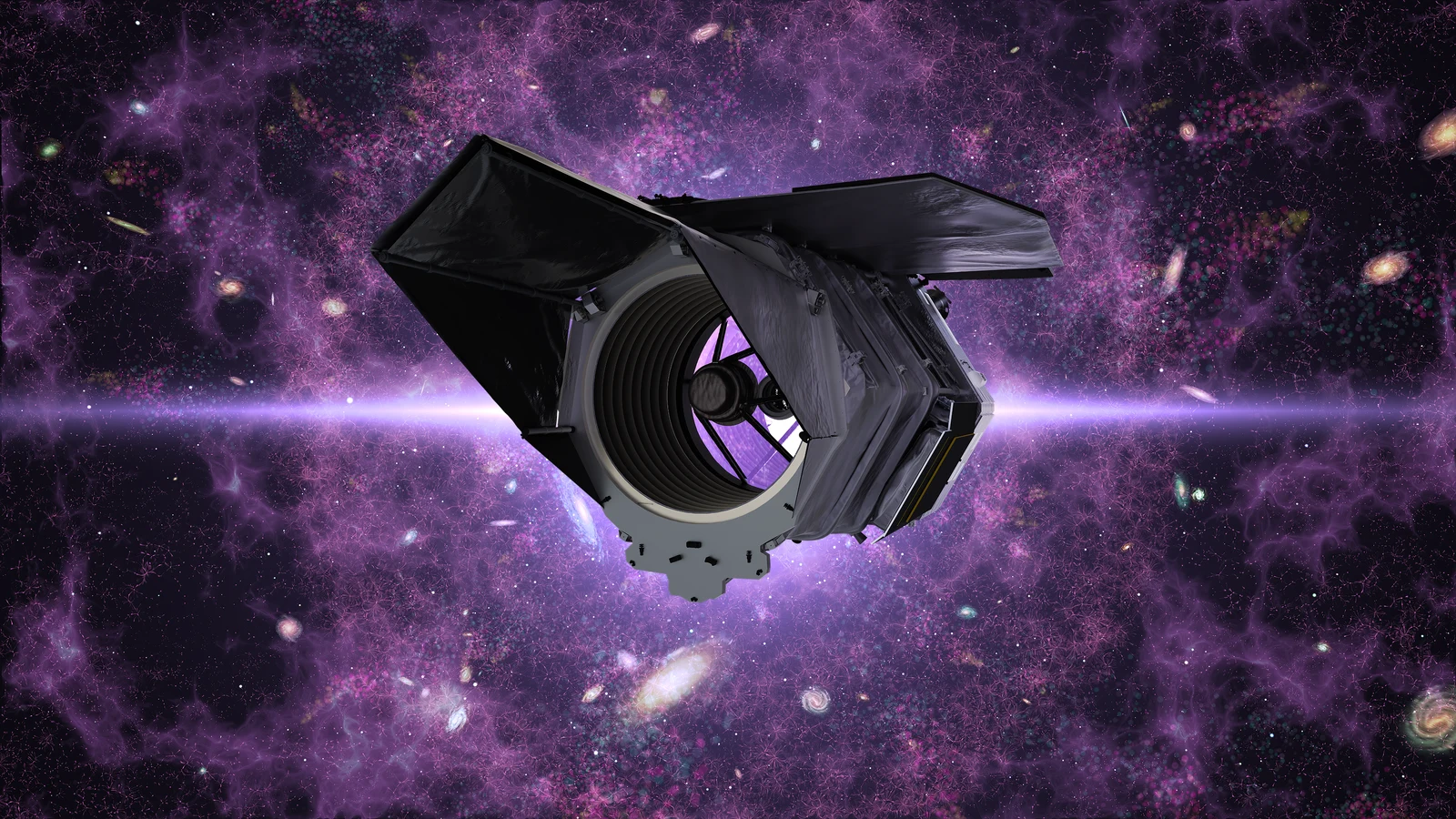
Nancy Grace Roman Space Telescope
NASA · Sun-Earth L2
Cruising towards L2 while NASA checks and calibrates the instruments.
At a glance
- Phase
- cruise
- Operator
- NASA
- Destination
- Sun-Earth L2
- Next milestone
- Continue camera and deformable-mirror calibration before the Coronagraph’s light-blocking demonstration; L2 arrival remains expected around early December
- Last verified
- 17 October 2026
Where it stands
NASA reported Wide Field Instrument checks and telescope focus work on 14 October. Measured optical error was 63 nm RMS against a 90 nm requirement; commissioning continues during the journey to L2. NASA announced on 15 October that Roman was named among TIME's Best Inventions of 2026.
The mission
NASA activated the Wide Field Instrument, the 300-megapixel primary camera, on 11 September 2026. On 30 September NASA reported that the fine-guidance tests showed the observatory holding steadier than 1/100,000 of a degree for half an hour at a time for Wide Field Instrument observations, and for eight hours at a time for the Coronagraph. NASA reported on 14 September that the first trajectory correction used about 18 kg of fuel against a 200 kg allocation, which with savings expected at the next correction and orbital insertion allows at least 22 years of potential science operations. On 25 September NASA reported that Roman's three ground stations, NASA's Near Space Network at White Sands, an ESA station near New Norcia in Western Australia and JAXA's Misasa station in Japan, received its test data between 7 and 17 September at up to 500 megabits per second. Roman is expected to downlink about 1.4 terabytes a day, the highest rate of any NASA astrophysics mission so far.
Related
Sources
- science.nasa.gov · https://science.nasa.gov/blogs/roman/2026/09/14/fuel-savings-double-potential-lifetime-for-nasas-roman-mission/
- science.nasa.gov · https://science.nasa.gov/blogs/roman/2026/09/15/nasa-activates-romans-primary-instrument-checks-out-coronagraph/
- science.nasa.gov · https://science.nasa.gov/blogs/roman/2026/09/25/nasas-roman-team-confirms-ground-stations-receiving-data/
- science.nasa.gov · https://science.nasa.gov/blogs/roman/2026/09/30/nasa-checks-roman-guidance-system-takes-first-coronagraph-observation/
- science.nasa.gov · https://science.nasa.gov/blogs/roman/2026/10/14/nasa-roman-team-checks-out-main-instrument-sharpens-telescopes-focus/
- science.nasa.gov · https://science.nasa.gov/blogs/honors/2026/10/15/time-best-inventions-of-2026/