Solana’s main network drops ‘beta’ and becomes Solana 1.0
The Solana Foundation renamed “mainnet beta” as “mainnet” on 16 November 2026 and gave the network a shared protocol version, Solana 1.0, separate from the Agave and Firedancer client release numbers.
Listen to this articleListen
The Solana Foundation has dropped the ‘beta’ label that Solana’s main network has carried since it launched in March 2020. In a post on Monday, it renamed “mainnet beta” as “mainnet” and gave the network a shared protocol version, Solana 1.0.
Nothing changes for people who hold SOL or use Solana apps. “For users, this is the same network, nothing changes,” the Foundation wrote. “Your SOL, accounts, assets, applications, and transaction history remain the same.” It coordinated the change with the teams behind Agave and Firedancer, the two independent pieces of validator software that run the network.
What does Solana 1.0 actually change?
Solana 1.0 gives the network’s rules their own version number, separate from the software that runs them. Agave, built by Anza, and Firedancer, built by Jump Crypto’s Firedancer team, have separate codebases, release schedules and version numbers. The Foundation says a shared protocol version “lets everyone refer to Solana’s evolution without using one client’s release number as shorthand for the entire network.”
The split shows up in the software itself. On Monday evening, the node behind Solana’s public endpoint still reported its software as version 4.4.0, a client release number, while the protocol that software implements is now called 1.0. Different client releases can support the same protocol version, so node operators check which releases match each rollout.
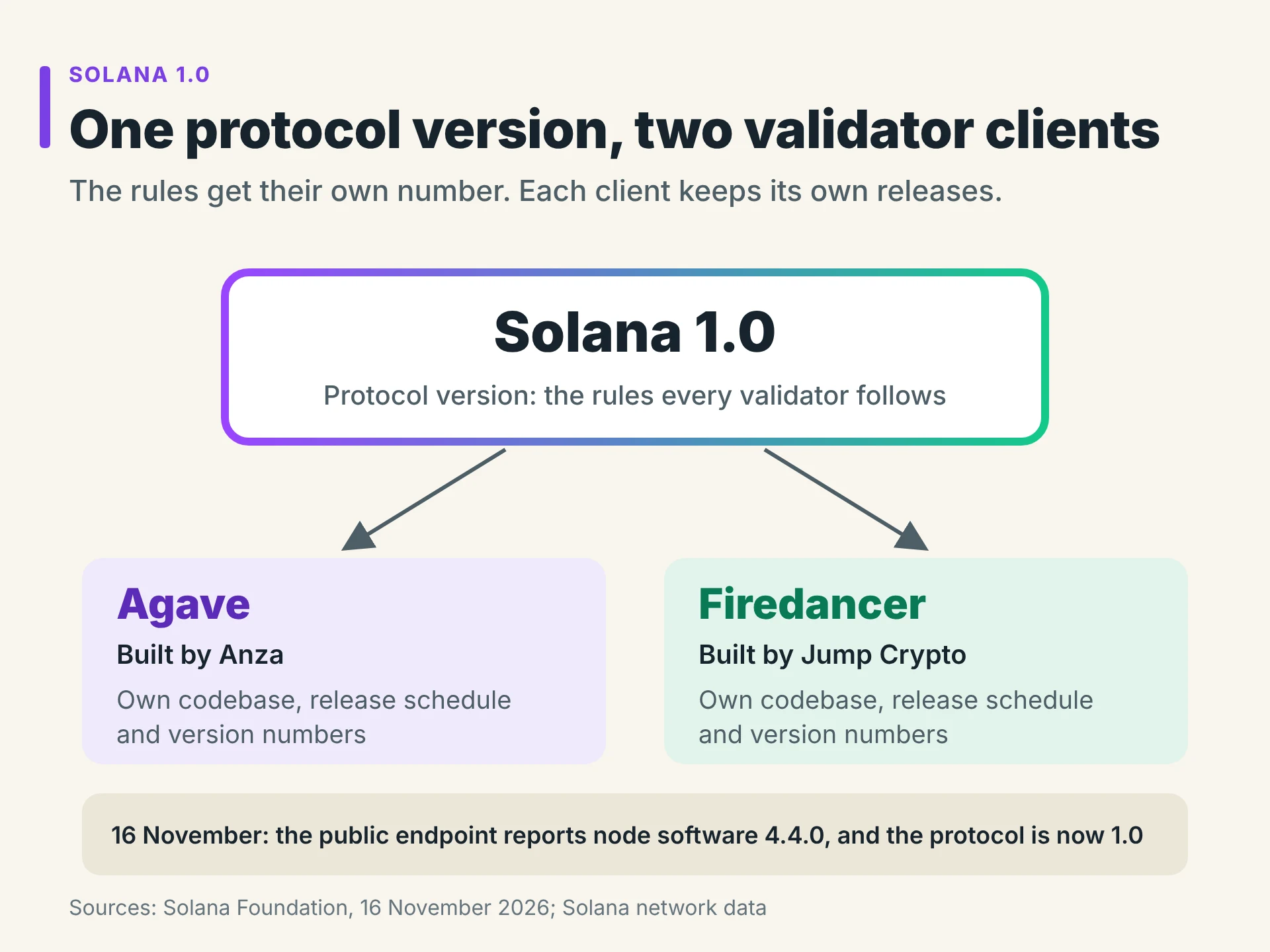
Software releases and network feature activations keep their own rollout requirements and timelines, the Foundation says. A protocol version is a reference point for those changes, and each feature still switches on in its own time.
Why drop the beta label now?
The Foundation points to two recent changes: much faster settlement, and a second independent validator client. Alpenglow, a new way for Solana’s validators to agree on blocks, went live on the main network in October. Anza, which built it, said it cut finality, the point at which a transaction is settled for good, from 12.8 seconds to 150 milliseconds. It had gone live on Solana’s developer network in September.
The second change is Firedancer, a validator client written independently of Agave. The Foundation says independent implementations “reduce reliance on a single codebase, limit the impact of bugs affecting one client, and strengthen network resilience.”

The label itself dates from launch. Solana’s mainnet beta went live in March 2020, and the Foundation now describes the network as “a live production network since genesis”, carried under a label that “never evolved to signal its production status.”
What do developers and operators need to do?
Users need do nothing, and developers and node operators follow each client’s release guidance as before. The Foundation asks application developers to review changes to the interfaces and software kits their apps use, which its weekly Solana Changelog tracks. Validator and RPC operators should check which client releases support each protocol rollout and follow the upgrade instructions in the Agave or Firedancer documentation.
Documentation and tooling teams are asked to “update network references as the new naming rolls out.” The rename has already reached the Foundation’s own developer documentation, which lists the main network’s public address without the word beta. Anza’s cluster page still gives the older address, and on Monday both addresses answered with the same software version.
| Before | Now | |
|---|---|---|
| Network name | mainnet beta | mainnet |
| Public RPC address | api.mainnet-beta.solana.com | api.mainnet.solana.com |
| Gossip entry point | entrypoint.mainnet-beta.solana.com:8001 | entrypoint.mainnet.solana.com:8001 |
| Listed by | Anza documentation | Solana Foundation documentation |
How big is the network that dropped the label?
Solana’s validators held about 429 million staked SOL on Monday evening, worth about $30.9 billion at Chainlink’s price. That total covers 662 validators voting normally and 37 marked as delinquent, meaning they had fallen behind. The current validators held 428,992,845 SOL; the delinquent accounts held the remaining 152,189 SOL. The figures below come from the network’s own data at a stated slot.
| Measure | Value | Reference point |
|---|---|---|
| Epoch | 1,088 | slot 470,294,616 |
| Validators voting / delinquent | 662 / 37 | slot 470,294,616 |
| Activated stake | 429,145,034 SOL | slot 470,294,616 |
| SOL price, Chainlink SOL/USD on Ethereum | $72.03 | round updated 22:07:47 UTC, 16 November 2026 |
| Value of the stake | about $30.9 billion | 429.1 million SOL at $72.03 |
| Alpenglow live on mainnet | 21 October 2026 | Anza and Solana announcements |
Upgrades now come with a protocol number
From here, Solana’s upgrades will be described against the protocol version as well as the client releases that deliver them. The Foundation’s Solana Upgrades page lists upcoming features, the compatible client releases and their activation status, so an operator can match a change to the software that switches it on. Explorers, websites and other services will move to the new name gradually, the Foundation says, and the network those names describe is the one that has been running since 2020.
Sources
- Solana Foundation: Solana 1.0, dropping -beta, and what comes next, 16 November 2026solana.com
- Anza on X: Alpenglow is live on mainnet-beta, 21 October 2026x.com
- Solana on X: Alpenglow is now live on Solana mainnet, 21 October 2026x.com
- Solana Foundation: May 2020 newsletter, on the March 2020 mainnet beta launchsolana.com
- Anza documentation: Solana clusters and public RPC endpointsdocs.anza.xyz
- Jump Crypto: Hardening Firedancerjumpcrypto.com
- Chainlink: SOL/USD price feed on Ethereumdata.chain.link