IBM targets 520 programmable qubits with new Nighthawk design
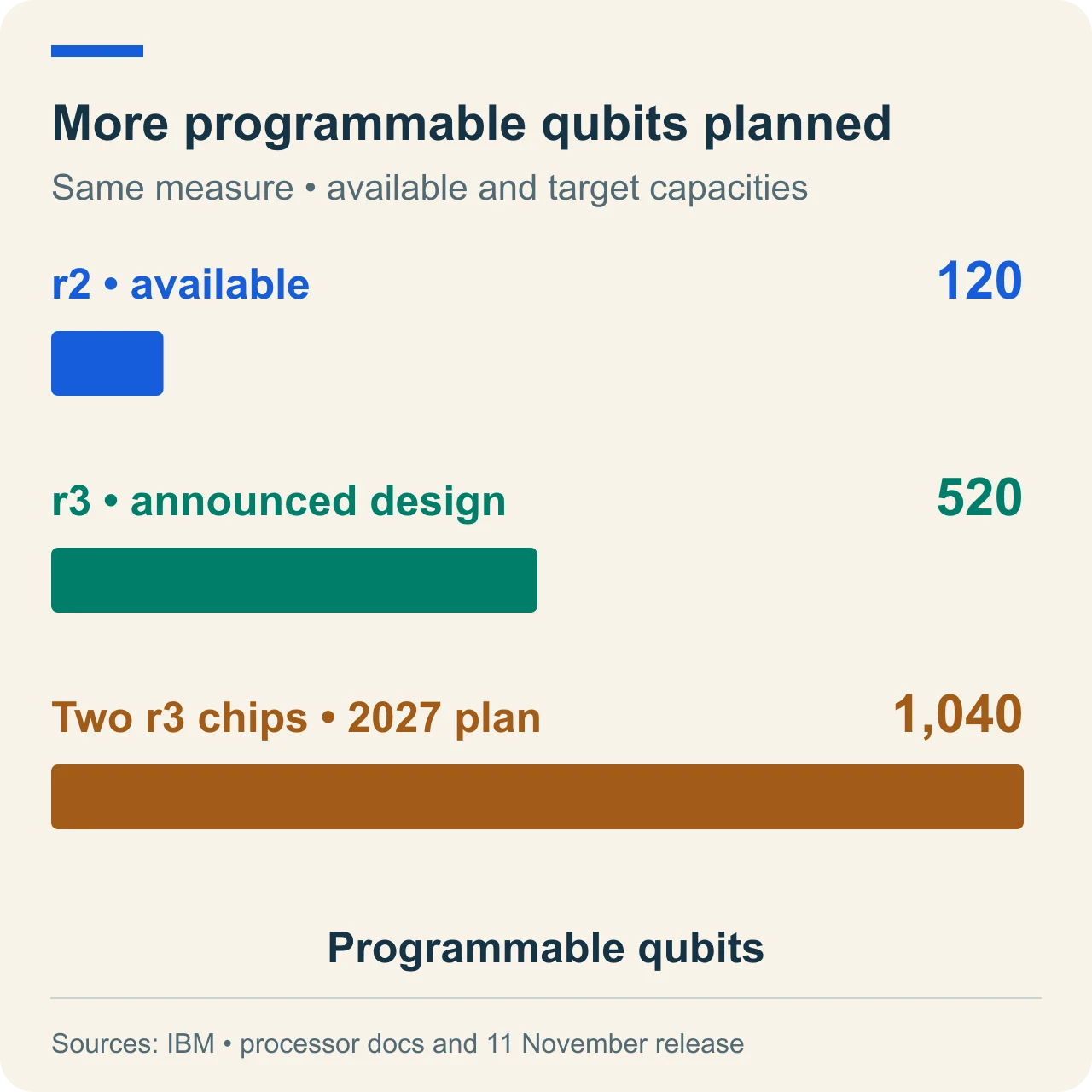
IBM announced Nighthawk r3 with targets of 520 programmable qubits and 10,000 operations, and plans a linked 1,040-qubit system in 2027.
Listen to this articleListen
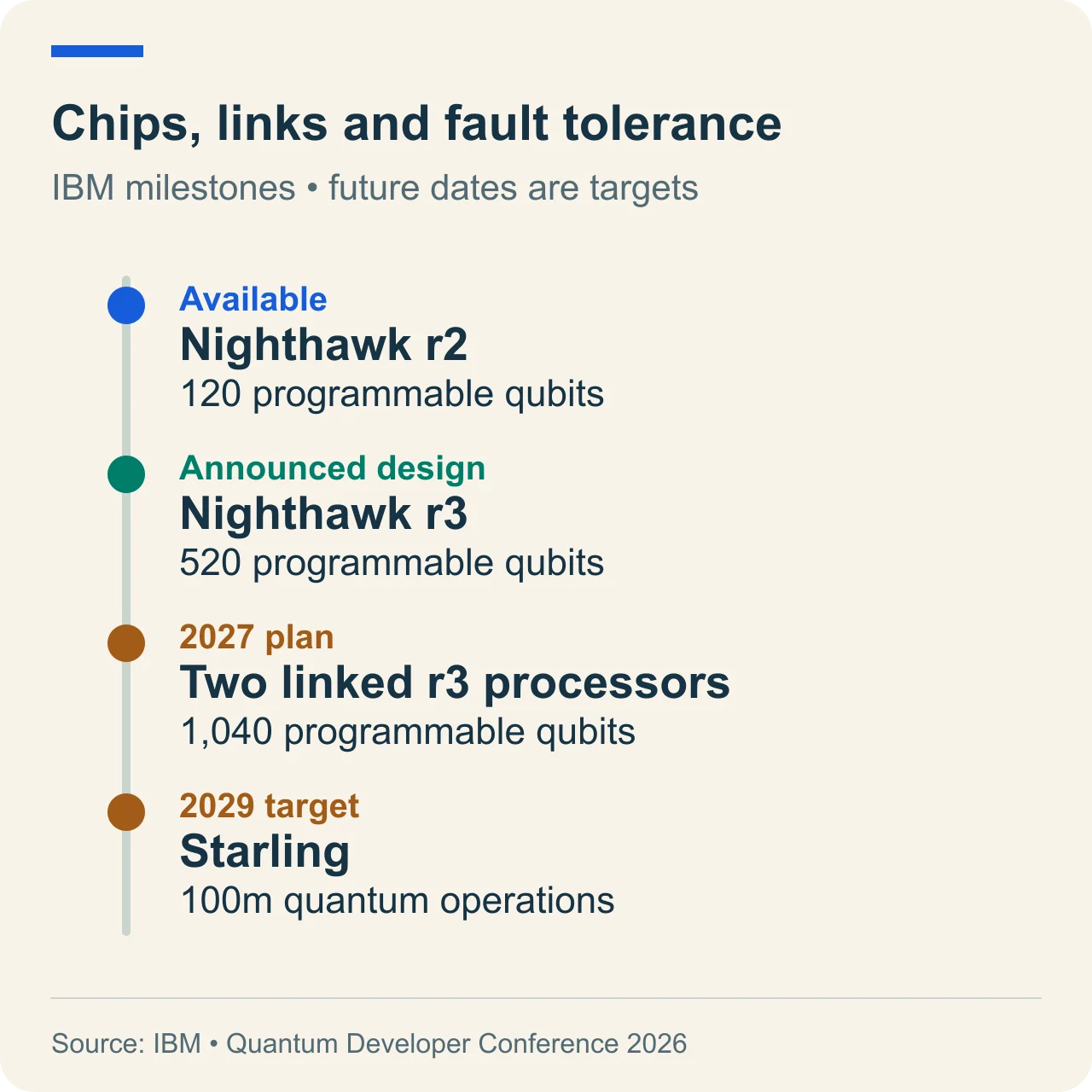
IBM has announced a Nighthawk r3 quantum processor designed for 520 programmable qubits and 10,000 quantum operations, with a plan to connect two processors into a 1,040-qubit system in 2027. The 11 November announcement extends the company’s superconducting hardware roadmap while its currently available Nighthawk r2 systems provide the performance results behind the new design.
The financial newswire Finwire also reports the 520-qubit design and planned 1,040-qubit system, attributing the targets to IBM’s announcement.
The proposal links two engineering challenges: executing larger calculations reliably and making separate cold processors work together. IBM’s Quantum Developer Conference update presents the work as part of a programme leading to its planned fault-tolerant Starling computer in 2029, alongside improvements to classical computing, control electronics and error correction.
The r3 design expands programmable capacity to 520 qubits
Nighthawk r3 is designed to execute 10,000 quantum operations across 520 programmable qubits, IBM says. The company reports 2,034 total physical qubits in the design and ten chip-to-chip links, called l-couplers, for connecting processors.
IBM’s processor documentation describes Nighthawk r2 as having 120 programmable qubits and 458 physical qubits. Both revisions use square-lattice connectivity, which determines the neighbouring qubits available for interactions during a calculation.
A physical processor count describes hardware resources. Protected logical qubits require an error-correcting code implemented across physical hardware, with repeated measurements and classical decisions. IBM’s announced programmable capacity and its longer-term fault-tolerant system roadmap therefore refer to different stages of the engineering work.
| Hardware or system | Status in IBM’s announcement | Programmable capacity |
|---|---|---|
| Nighthawk r2 | Available generation | 120 qubits |
| Nighthawk r3 | Announced design | 520 qubits |
| Two linked r3 processors | Planned for 2027 | 1,040 qubits |
Linking processors requires reliable transfers and shared refrigeration
IBM plans to use l-couplers to connect two r3 processors in 2027. Its published interconnect work describes experiments connecting Nighthawk processors through multiple links, an approach intended to extend computing capacity across chips.
In the new announcement, IBM reports a best quantum-state transfer fidelity of 99.3% in its r1 interconnect work and a target of 99.9%. Fidelity measures how well the transferred state matches the intended one. Repeated links in a larger computation require transfer errors to be controlled alongside errors in the processors themselves.
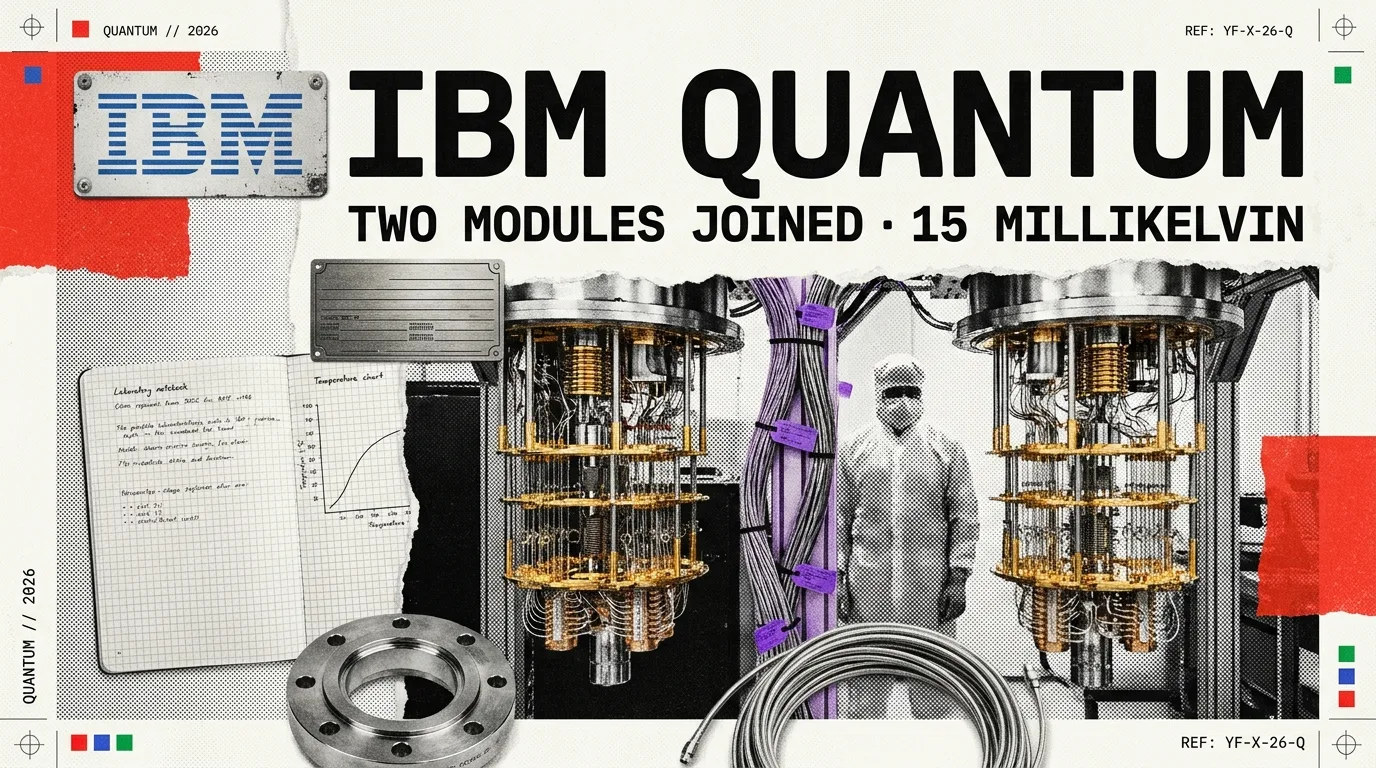
IBM also reports connecting two cryogenic modules into a single system, cooling below 15 millikelvin and reaching operating temperature in under five days. Keeping linked hardware sufficiently cold is a system-design requirement alongside the quantum operations performed on the chips.
The measured speed results belong to r2 workloads
IBM says clients and partners have run more than 34 billion circuits on Nighthawk r2, with some reporting speedups as high as 19 times relative to earlier IBM quantum processors. Those are workload and processor comparisons from the available generation supporting the next design.
The conference update describes high-speed reset, improved device tuning and larger circuits as part of r2’s progress. Reset prepares a qubit for its next use. Faster preparation and measurement can increase the rate at which a machine gathers the many samples needed for a useful result.
The benefit to an application also depends on the classical work around the quantum processor. IBM is integrating managed workflows, high-performance computing and quantum resources in its platform, so researchers can coordinate execution, error handling and analysis across them.
Starling turns the timescale into an engineering programme
IBM continues to target Starling for 2029, with a goal of 100 million quantum operations. Its conference account describes parallel development of quantum memory, interconnects, classical decoders, control chips and cryogenics to reach that stage.
The schedule puts the company’s intended transition to fault-tolerant computing within a few years. Delivering it means making the components work together at the error rates, speed and scale the complete system requires. The company’s published milestones give researchers and potential users specific results against which to judge that progress.
Nighthawk r3 is the next capacity step in that programme. The practical development is a combination of larger processors, more dependable links and a classical infrastructure that can keep pace with quantum execution.
Sources
- IBM: Nighthawk r3 announcement, 11 November 2026prnewswire.co.uk
- IBM: Quantum Developer Conference 2026 roadmap updateibm.com
- IBM: processor families and revisionsquantum.cloud.ibm.com
- IBM: connecting processors with l-couplersibm.com
- Finwire: Nighthawk r3 and the 2027 system targetplacera.se