IBM connected its first two cryogenic modules, the step that has to work before 2029
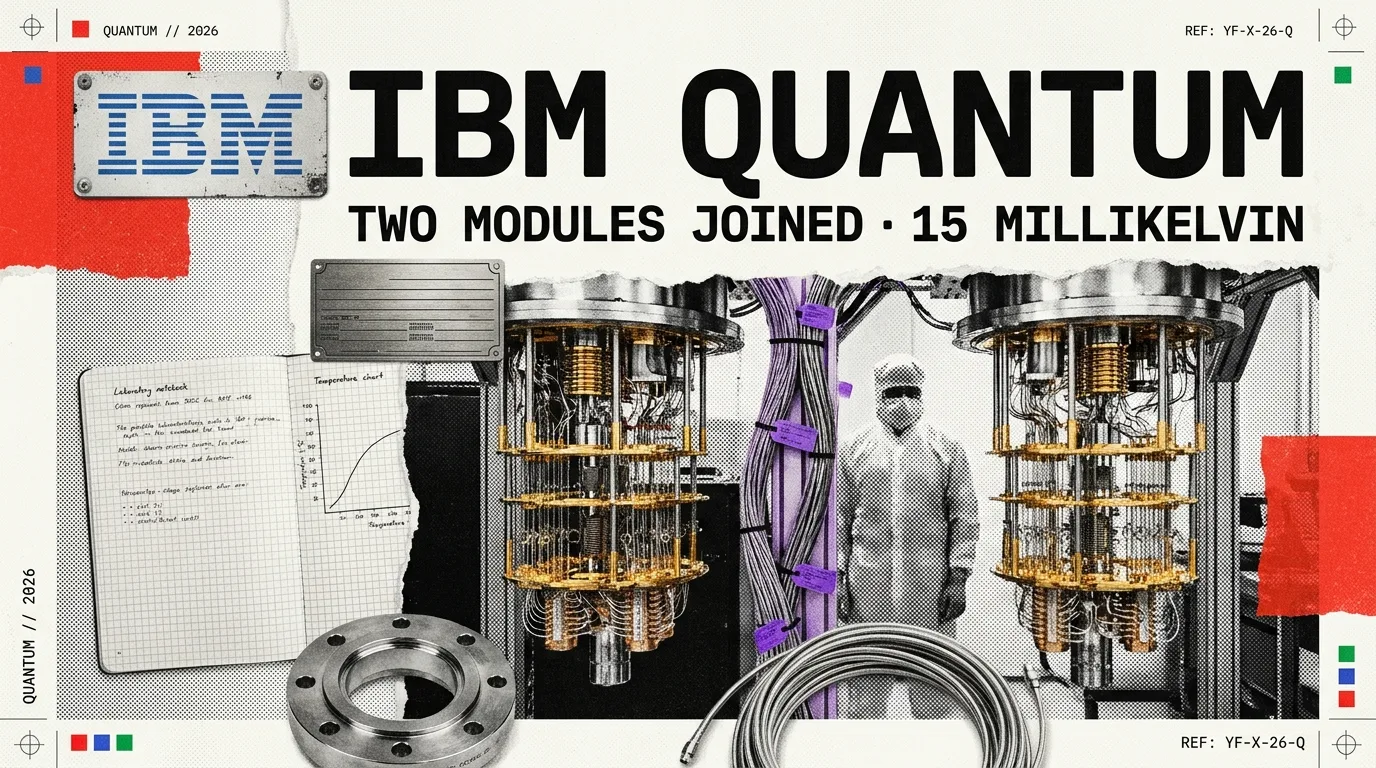
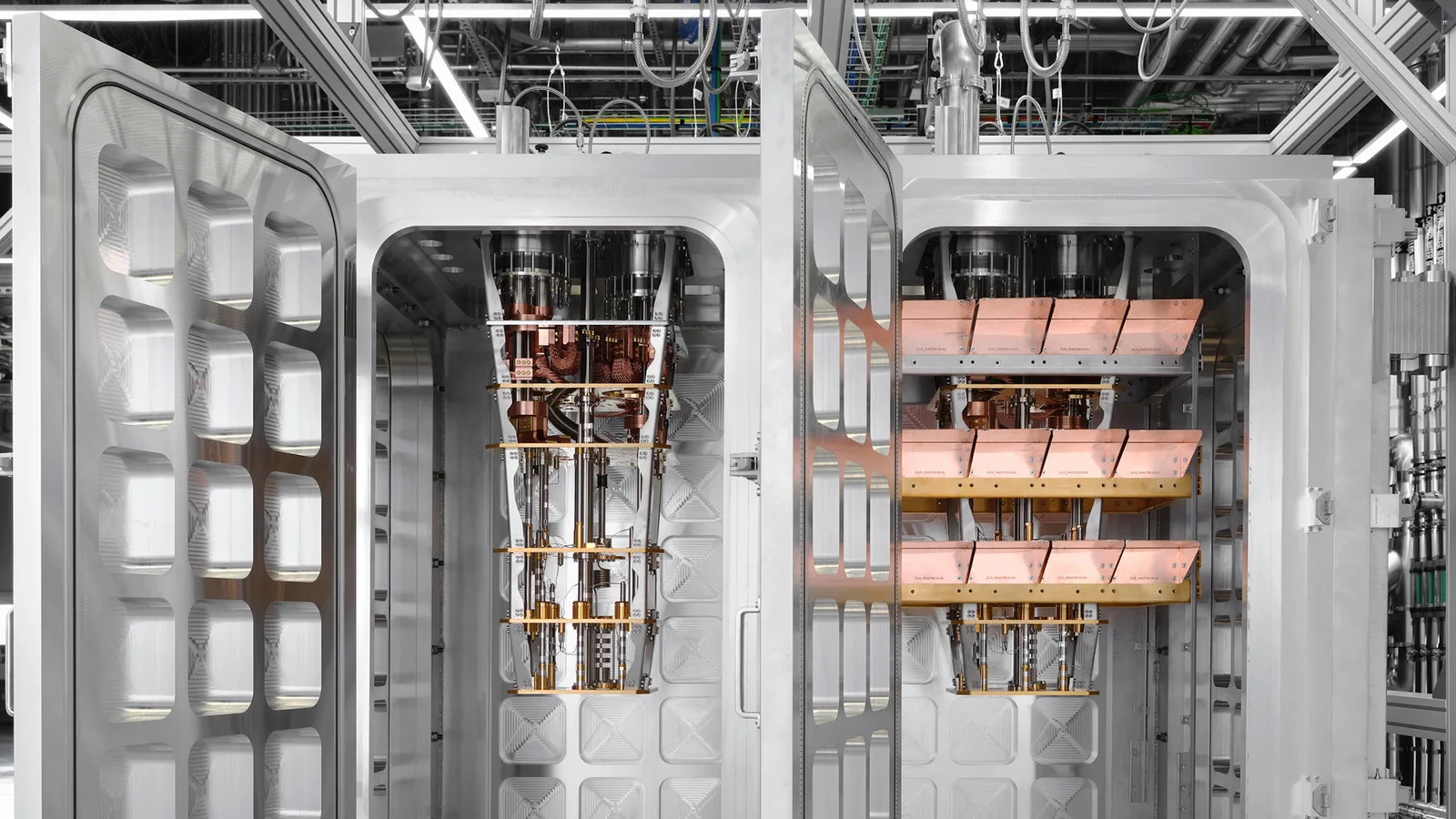
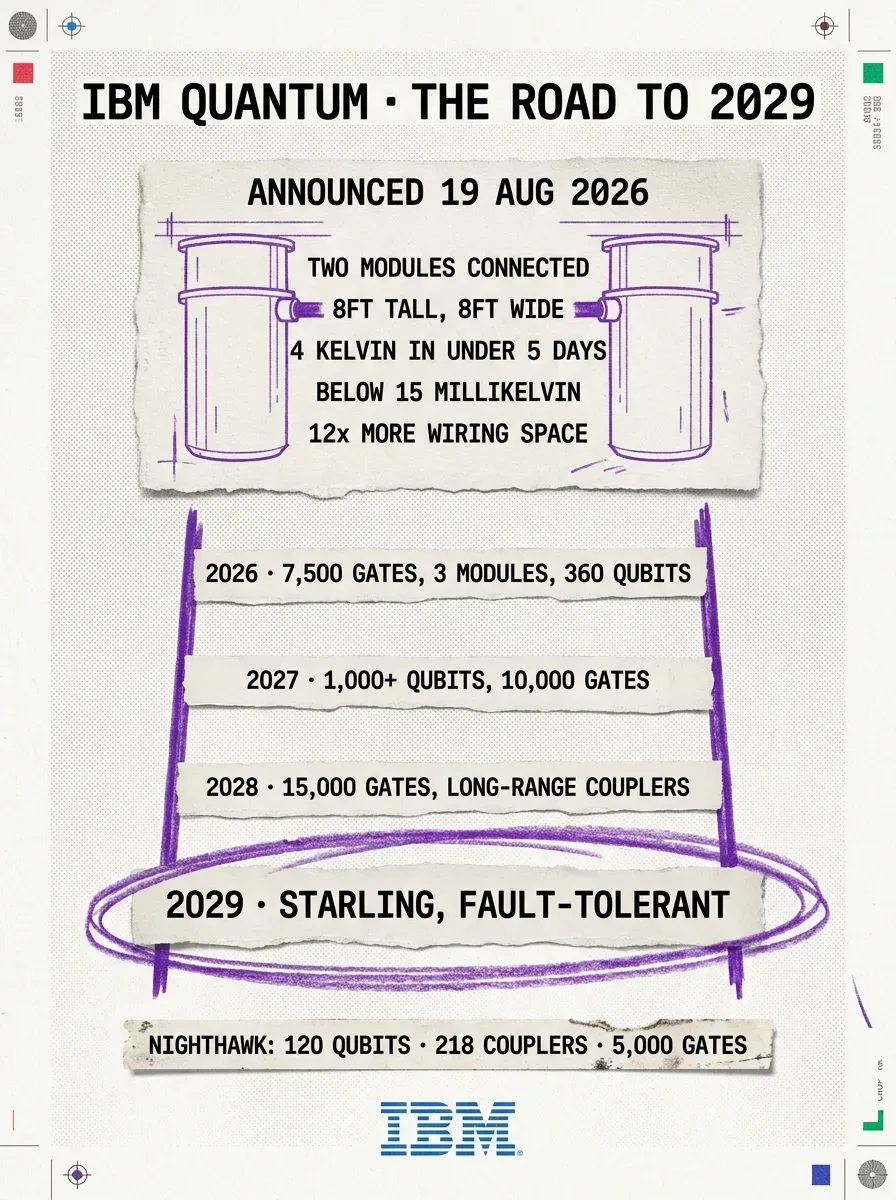
The two joined modules stand over eight feet tall, cool to 4 kelvin in under five days and settle below 15 millikelvin. Each carries twelve times the wiring space of IBM's existing quantum systems, which is the constraint that decides how many qubits fit in one machine.
Listen to this articleListen
IBM said on 19 August that it has connected and cooled two cryogenic modules into a single operating environment. That sentence does not sound like a milestone, and it is the one the rest of the company’s roadmap rests on.
The combined assembly stands over eight feet tall and eight feet wide. It reaches 4 kelvin in under five days and settles at a final temperature below 15 millikelvin, which IBM puts at more than 180 times colder than deep space. The two modules are joined by what IBM calls an L-coupler, the link that lets separate quantum chips share information and operate together.
The fridge is the bottleneck, not the chip
Superconducting qubits work at a few thousandths of a degree above absolute zero, inside a dilution refrigerator. Every qubit needs control and readout lines running from room-temperature electronics down through the cold stages to the chip. Those lines carry heat, and they take up space.
That is the real ceiling on a single machine. You can design a bigger processor; you cannot put it in a refrigerator that has no room for its wiring and no cooling headroom for the heat that wiring brings. IBM’s number for the new modules is the one to hold onto: each module’s vacuum enclosure offers twelve times more wiring space than its existing quantum systems.
The alternative to a bigger fridge is more fridges, working as one. That is what connecting two modules demonstrates, and it is why the announcement is about plumbing rather than qubits.
What goes inside, and when
IBM says it will install Nighthawk processors into the connected modules later this year for operational performance testing.
Nighthawk is the current generation: 120 programmable qubits on a square lattice, each linked to four nearest neighbours by 218 next-generation tunable couplers, over 20 per cent more couplers than the Heron chip before it. IBM’s claim for it is circuits of 30 per cent more complexity, supporting up to 5,000 two-qubit gates. Two Nighthawk devices are already running in IBM’s cloud fleet, ibm_miami in its US region since January and ibm_berlin in the EU region since April, with the first still classed as exploratory while it is tested and tuned.
The published roadmap then stacks them. IBM expects Nighthawk to run 7,500-gate circuits during 2026 using up to three 120-qubit modules, which is 360 qubits working together. In 2027 it intends to link multiple processors through L-couplers into a machine with at least 1,000 programmable qubits, and reach 10,000 two-qubit gates. The 2028 target is 15,000 gates across 1,000 or more connected qubits joined by long-range couplers.
The 2029 machine
All of it points at IBM Quantum Starling in 2029, which the company describes as the world’s first fault-tolerant quantum computer. Fault tolerance is the point at which errors are corrected faster than they accumulate, so a calculation can run as long as it needs to rather than as long as the hardware survives. Getting there needs far more physical qubits than logical ones, which needs far more wiring, which needs the modules IBM has just connected.
Jay Gambetta, director of IBM Research, framed 19 August as one of several: “Bringing fault-tolerant quantum computers to industries depends on several fundamental advances,” he said, calling the connection a leap forward.
IBM put money behind the schedule on 2 June, committing more than $10 billion to quantum computing over five years to fund the path from its current systems to Starling. Our reference page on IBM Quantum tracks the hardware line.
What has been shown, and what has not
Two modules were cooled and connected. No processor has yet run inside them; that testing is scheduled for later this year. No result has been produced on the combined system, and IBM has not claimed one.
The 2026 goal IBM has set itself is narrower than the headlines around quantum usually are: the first examples of quantum advantage from a quantum computer paired with classical high-performance computing. Whether the connected modules hold their temperature with 120 qubits of wiring and control hardware inside them is the question the next few months answer, and it is the one that decides whether 2027’s thousand-qubit target is a schedule or an ambition.
Sources
- IBM newsroom, 'IBM Connects Its First Modular Cryogenic Systems in Milestone Toward Fault-Tolerant Quantum Computing' (19 August 2026)newsroom.ibm.com
- IBM newsroom, 'IBM Delivers New Quantum Processors, Software, and Algorithm Breakthroughs on Path to Advantage and Fault Tolerance' (12 November 2025)newsroom.ibm.com
- IBM Technology Atlas, quantum roadmap for 2026ibm.com
- IBM Quantum, hardware and roadmapibm.com
- IBM Quantum Platform, latest updates (Nighthawk QPU availability)quantum.cloud.ibm.com
- IBM newsroom, 'IBM Commits More Than $10 Billion to Quantum Computing' (2 June 2026)newsroom.ibm.com