IBM has bought a second qubit technology and its published roadmap still does not mention it
IBM completed its purchase of HRL Laboratories on 26 August. The releases describe a whole second qubit modality. IBM's own quantum roadmap names spin qubits, silicon, HRL and Anderon zero times.
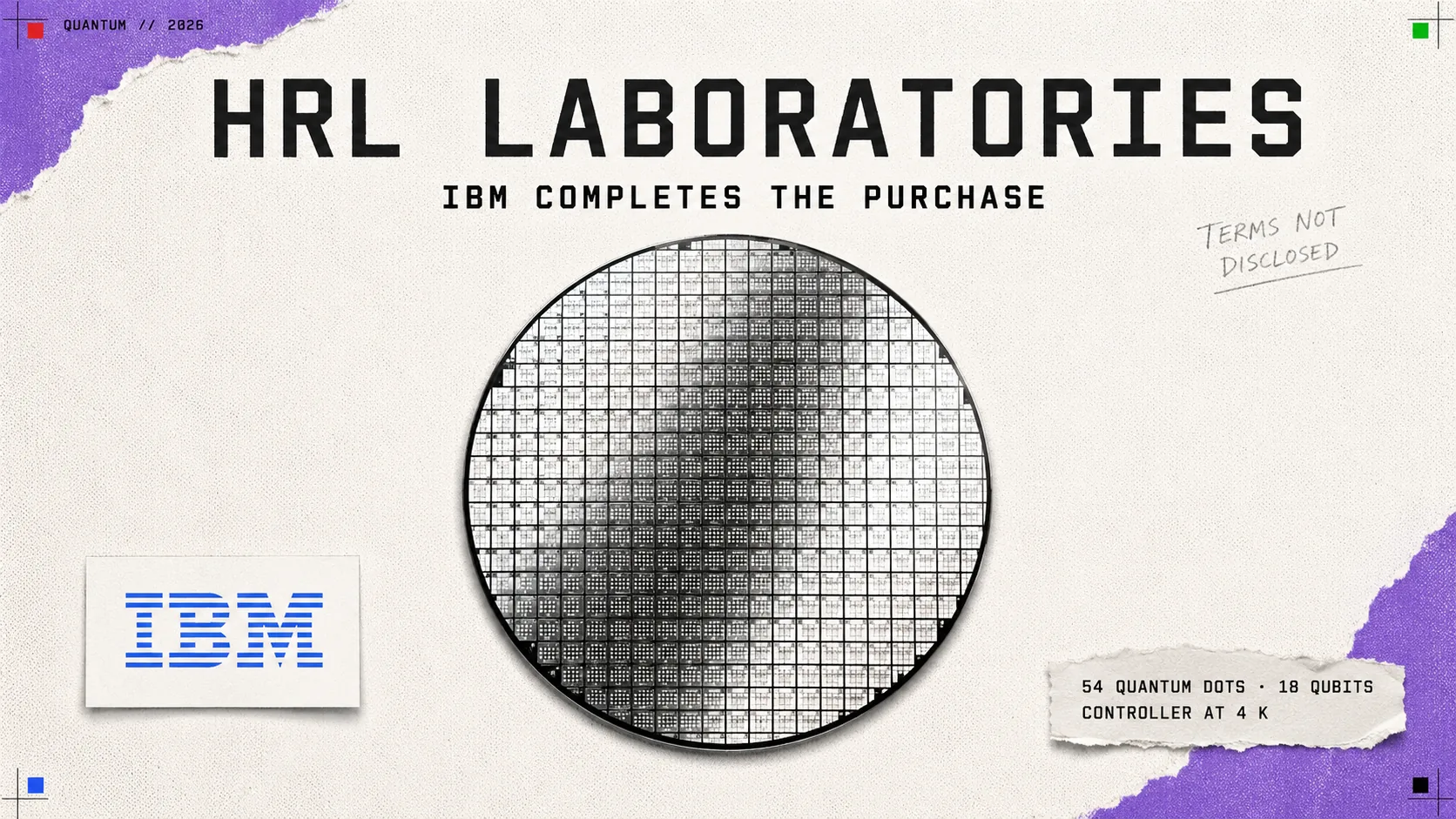
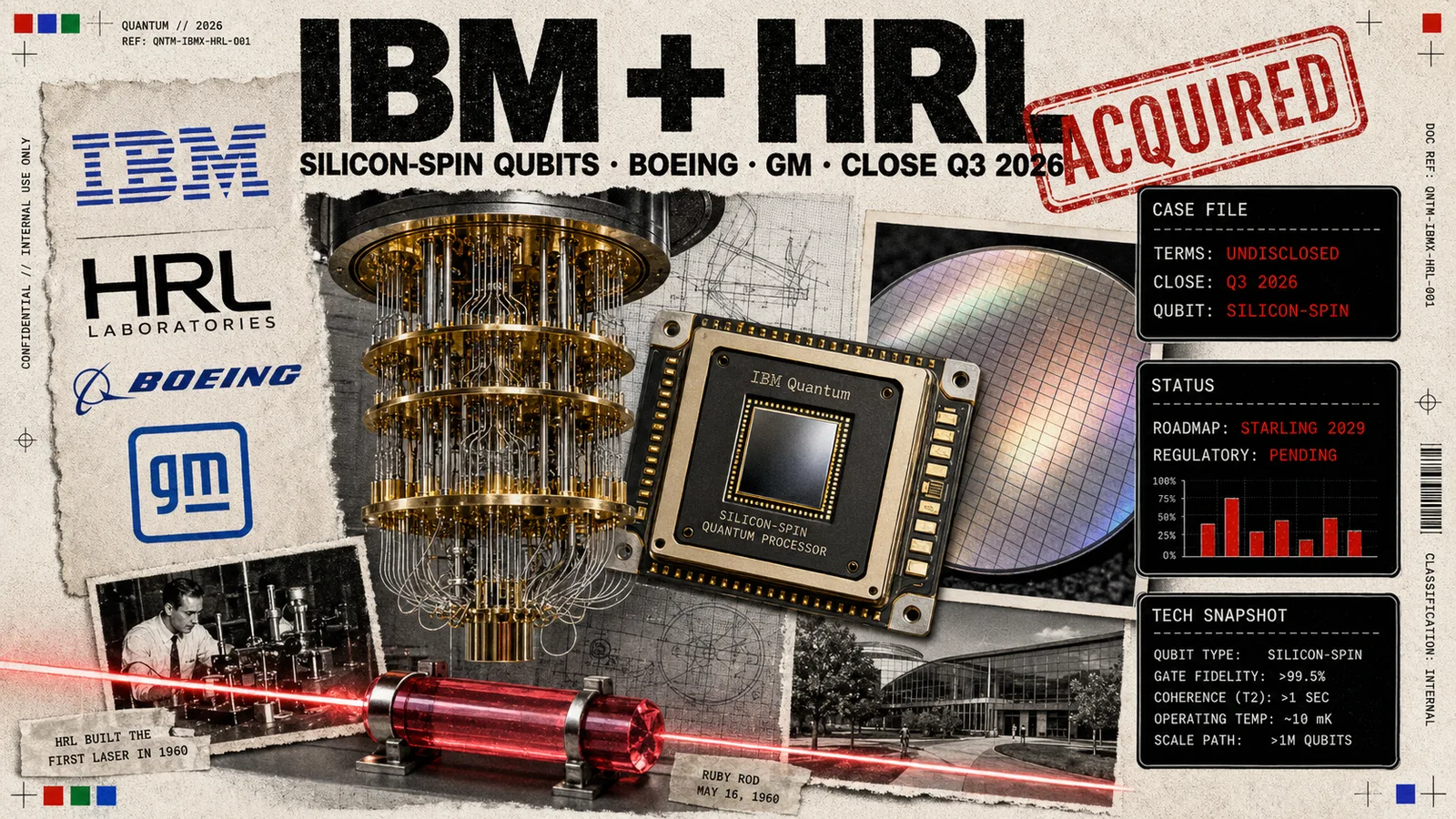
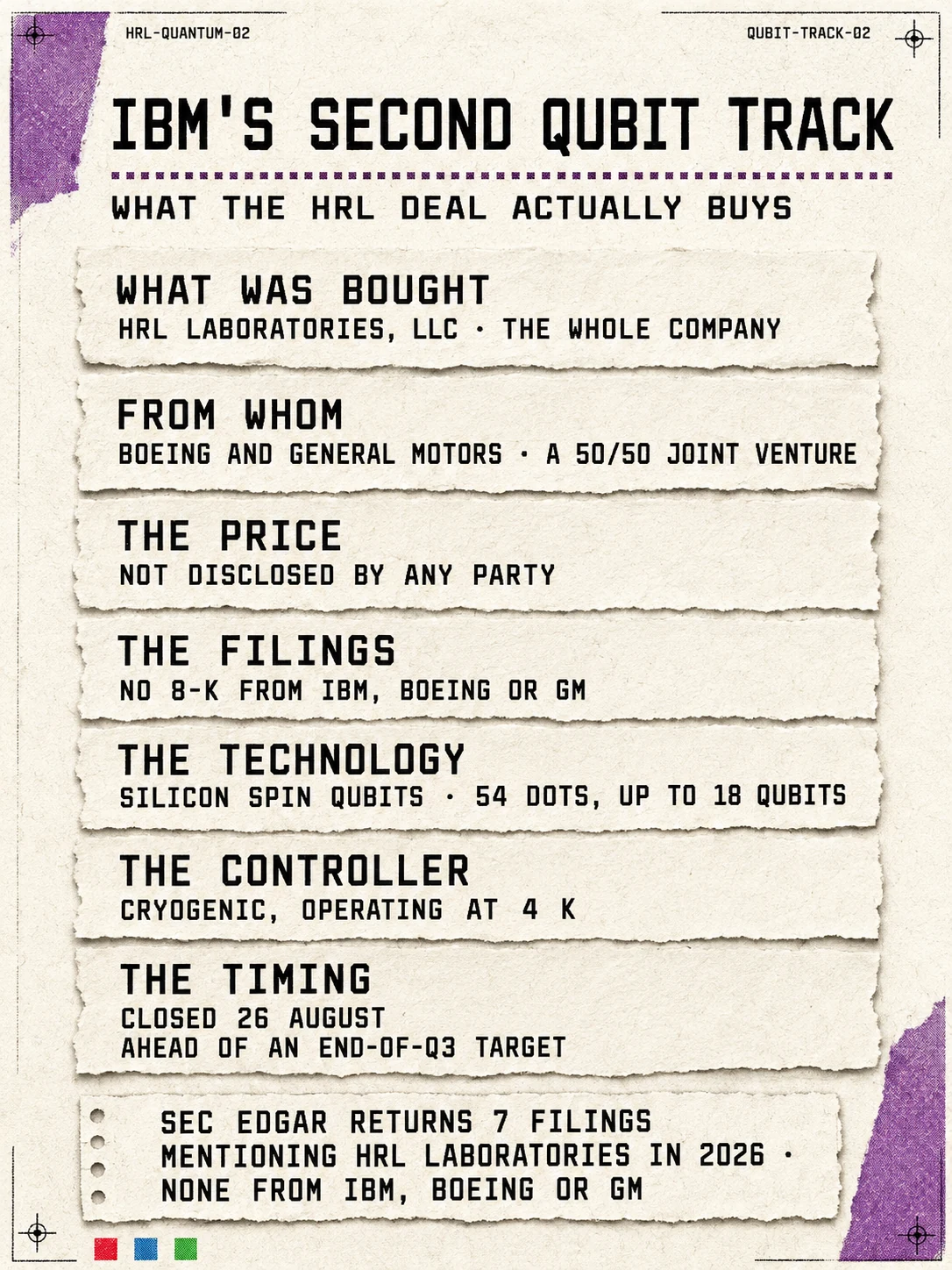
IBM announced on 26 August 2026 that it had completed its acquisition of HRL Laboratories, the Malibu research institution Boeing and General Motors have owned jointly since 2000. The release describes what IBM gains as expertise “in silicon-spin qubits”, which complements “IBM’s leadership in superconducting quantum computing”, plus quantum sensing, quantum materials, cryogenics, control electronics, packaging and interconnect.
Read as a strategy announcement, that is IBM adding a second way of making a qubit. Read against IBM’s own published roadmap, it has not happened yet.
The roadmap does not know
We read the roadmap this morning. Its own data stamps it last updated in March 2026, four months before the HRL agreement was even announced, so the silence is a page nobody has touched rather than a decision taken since. Its milestones are Nighthawk running 7,500 gates in 2026 across up to three 120-qubit modules, Kookaburra demonstrating a single module with a logical processing unit and a quantum memory, Nighthawk improving to 15,000 gates on up to 1,080 qubits by 2028, Starling arriving in 2029 as the first fault-tolerant machine at 200 qubits and 100 million gates, and Blue Jay at 2033 or later with 2,000 qubits and a billion gates.
Every one of those is superconducting. The words spin qubit, silicon, HRL and Anderon appear on the page no times at all.
That is not a criticism so much as a measurement of where the second track actually is. A modality that has been bought is not the same as a modality that has been scheduled, and IBM has published nothing that says when a spin qubit is supposed to do anything.
What IBM says the logic is
The company’s argument is about fabrication rather than hedging. Its July release put it as the two technologies sharing a foundation: superconducting and spin qubits both lean on state-of-the-art silicon fabrication, and that shared base is among the reasons IBM says both offer credible paths to scaling.
The completion release makes the manufacturing link explicit. HRL’s silicon expertise “creates opportunities for future collaboration with Anderon, IBM’s pure-play quantum wafer foundry”, the standalone company IBM announced in May 2026 with support from the US Department of Commerce.
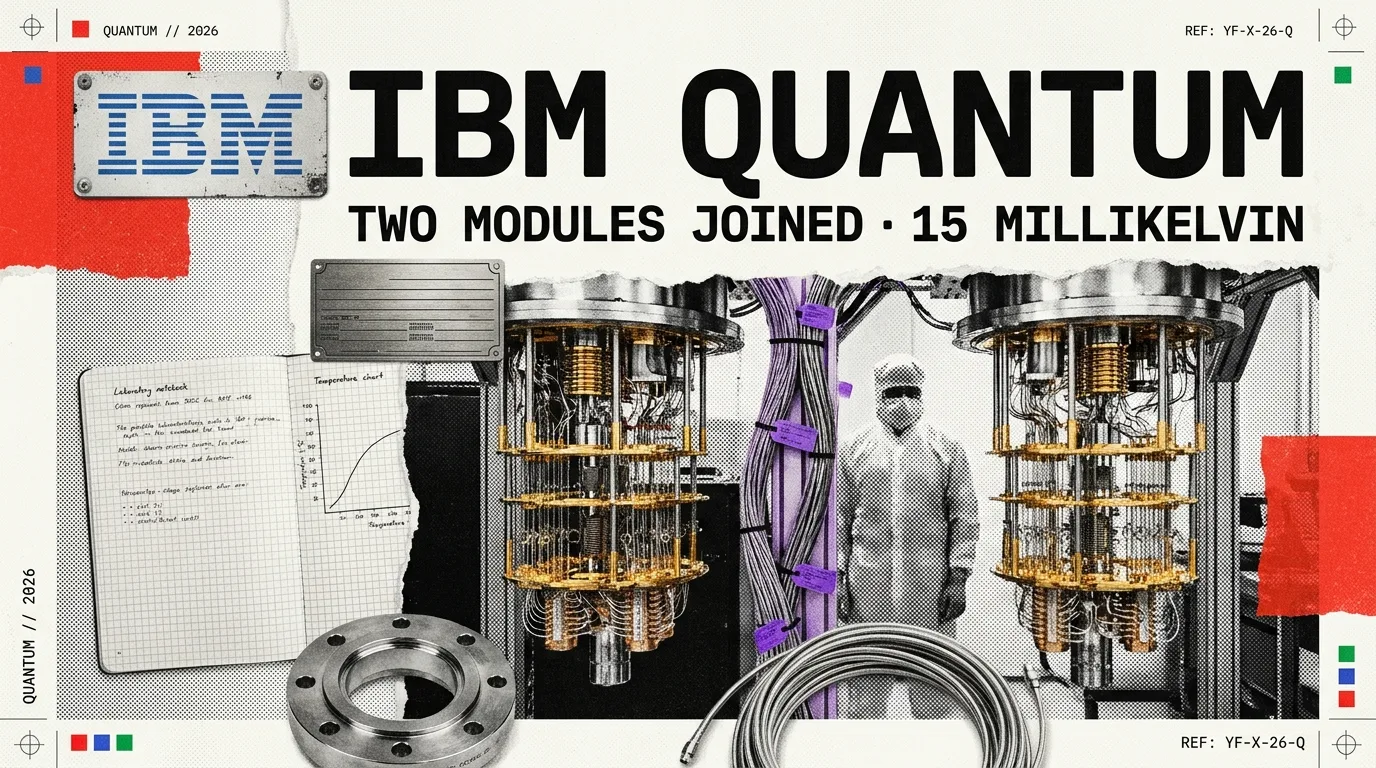
There is a thermal argument too, and IBM’s own Quantum blog states it flatly: spin qubits “can operate at 1K, versus superconducting qubit architectures which operate at .015K”. Two orders of magnitude of cooling is not a detail when your fridges are the size of a room. IBM’s own modular cryogenic milestone of 19 August described its first two operational modules as standing “more than 8 feet tall and 8 feet wide”.
The Nature result is about wiring, not qubits
HRL’s technical case landed four weeks before the deal closed, and it is not the result the framing implies.
The paper, published in Nature on 29 July 2026 under the byline “Members of the HRL Quantum Team and Collaborators”, is titled “A digitally controlled silicon quantum processing unit”. The chip is “a 3-rail array of 54 exchange-coupled quantum dots, configurable to host up to 18 exchange-only qubits”, made in a proprietary 200-mm wafer foundry process.
Eighteen qubits is not a record. What is new is where the control electronics live.
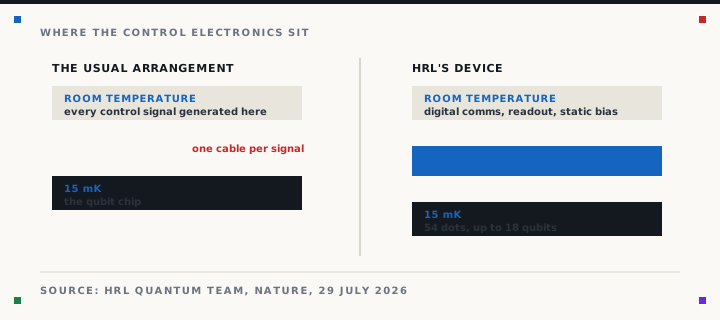
HRL used “a fully custom low-power CMOS chip operating at 4 K to generate all time-varying qubit control signals”, routed to the qubit chip through a high-density superconducting ribbon cable. What is left at room temperature is digital communication, readout and static biases. HRL says the distance-5 repetition code and distance-2 error-detecting code it ran are the first error correction executed entirely by a cryogenic controller, with no real-time involvement from electronics outside the fridge.
The qubit numbers are respectable rather than spectacular: the lowest reproducible CNOT error was 9 by 10 to the minus 4, and the paper claims an order-of-magnitude advance on the exchange-only state of the art.
Set that next to IBM’s own problem and the purchase reads differently. IBM’s completion release lists cryogenics, control electronics, packaging and interconnect among what it has bought, in that order, alongside the qubits. HRL has just published a cryogenic control result. The qubits may be the smaller half of what changed hands.
IBM cannot agree with itself on the chip
IBM’s Research blog describes HRL as having demonstrated a processing unit “comprising 56 quantum dots as 18 qubits”. The Nature paper says 54, and so does IBM’s own Quantum blog, in the same week.
Two dots is not a material error. It is not the only place IBM’s materials disagree either: the completion release puts Blue Jay in “the mid-2030s” where the roadmap says 2033 or later. A company publishing two figures for the same chip in the same week, about an asset it has just bought, is a small sign of how new the second track is inside IBM.
The deal closed without a price or a filing
IBM disclosed no price, in July or in August: “Financial terms of the transaction were not disclosed.”
Nor did it file. An EDGAR full-text search for “HRL Laboratories” across 2026 returns seven filings and none of them is from IBM, Boeing or General Motors, and IBM’s Q2 10-Q, filed on 23 July, the same day the agreement was announced, does not mention HRL.
For a company that booked its acquisition in a press release rather than a filing, that is a statement about size: not material enough to disclose.
The deal also closed early. The July release anticipated completion “by the end of the third quarter of 2026”, and it completed about five weeks later. Boeing’s own release announcing the same closing came a day before IBM’s, and describes HRL as “a 50/50 joint venture between Boeing and GM”. Both former owners say in a joint statement that they “will continue to partner with IBM and HRL on quantum applications and advanced technology development”, while focusing their own resources on their core businesses.
Four days after the close, HRL’s own About page still described the company as jointly owned by Boeing and GM.
Who IBM is now racing
The purchase puts IBM into a field that had been moving without it.
Diraq published a white paper the day after the close, on 27 August, targeting 150,000 physical qubits and up to 1,000 logical qubits by 2029, then more than 2 million physical and more than 10,000 logical by 2031, at a system cost it puts below $1 per qubit. The white paper itself puts Diraq’s single- and two-qubit gate fidelities at around 99.5 per cent. The stronger numbers in circulation are older and belong to imec: its release of 24 September 2025 reported fidelities above 99.9 per cent for state preparation and measurement on a 300mm industrial line, with one- and two-qubit gate fidelities systematically exceeding 99 per cent.
In Europe, Quobly raised a €115 million Series A on 3 June 2026 and says 2.4 million qubits have been fabricated at STMicroelectronics on 300mm wafers. In the UK, Quantum Motion’s silicon system is one of seven testbeds in the National Quantum Computing Centre’s £30 million programme with Innovate UK.
The absentee is the company that used to own this story. Intel released Tunnel Falls, a 12-qubit silicon chip, in June 2023 and published 99.9 per cent single-qubit gate fidelity across 300mm wafers in Nature in May 2024. Its newsroom has carried nothing on spin qubits since.
What IBM bought, then, is a team with a Trusted Foundry designation, 250,000 square feet of laboratory space, a 10,000-square-foot Class 10 clean room and more than 1,100 patents, in a field where the well-funded competitors are start-ups and the incumbent chipmaker has stepped back. The roadmap can catch up later.
Sources
- IBM completes acquisition of HRL Laboratories, 26 August 2026newsroom.ibm.com
- IBM to acquire HRL Laboratories, 23 July 2026newsroom.ibm.com
- Boeing and GM complete sale of HRL Laboratories to IBMboeing.mediaroom.com
- IBM Quantum Roadmap (IBM Technology Atlas)ibm.com
- A digitally controlled silicon quantum processing unit (Nature, 29 July 2026)nature.com
- HRL Laboratories and IBM (IBM Research blog)research.ibm.com
- What are spin qubits? (IBM Quantum blog)ibm.com
- HRL demonstrates a silicon quantum processor that runs itselfhrl.com
- HRL Laboratories company overviewhrl.com
- IBM connects its first modular cryogenic systems, 19 August 2026newsroom.ibm.com
- EDGAR full-text search for "HRL Laboratories" in 2026efts.sec.gov
- Diraq sets its roadmap for utility-scale quantum computingdiraq.com
- The Case for Silicon (Diraq white paper, PDF)diraq.com
- Quantum computing testbeds in the UK (NQCC)nqcc.ac.uk
- imec technology lights the path to utility scale for Diraq's quantum chips, 24 September 2025imec-int.com
- Quobly news, including the June 2026 Series Aquobly.io
- Intel releases Tunnel Falls, June 2023newsroom.intel.com
- Intel quantum research published in Nature, May 2024newsroom.intel.com