Five AI models mixed up 'even' and 'odd' in Swahili
YFarmX put eight hard puzzles to 30 AI models in 21 languages on 22 and 23 November 2026. Eleven models got every answer right, five misread two Swahili maths words, and a Sylheti answer cost 63% more than an English one.
Listen to this articleListen
Five AI models read the Swahili words for “even” and “odd” the wrong way round and failed a logic puzzle they solve in English. Writing the digits beside the two words lifted the models that had struggled from 20 right in 39 to 23 in 26. It was the clearest language failure YFarmX found when it put eight hard puzzles to 30 AI models in 21 languages on 22 and 23 November 2026.
The strongest models gave the same answers in every language. Most wrong answers were maths mistakes that the same models also make in English. The failures that belonged to a language came down to one word a model misread, one sentence it took a second way, or a slip made while writing the answer down. And every language other than English cost more to use.
Which AI models got every puzzle right in every language?
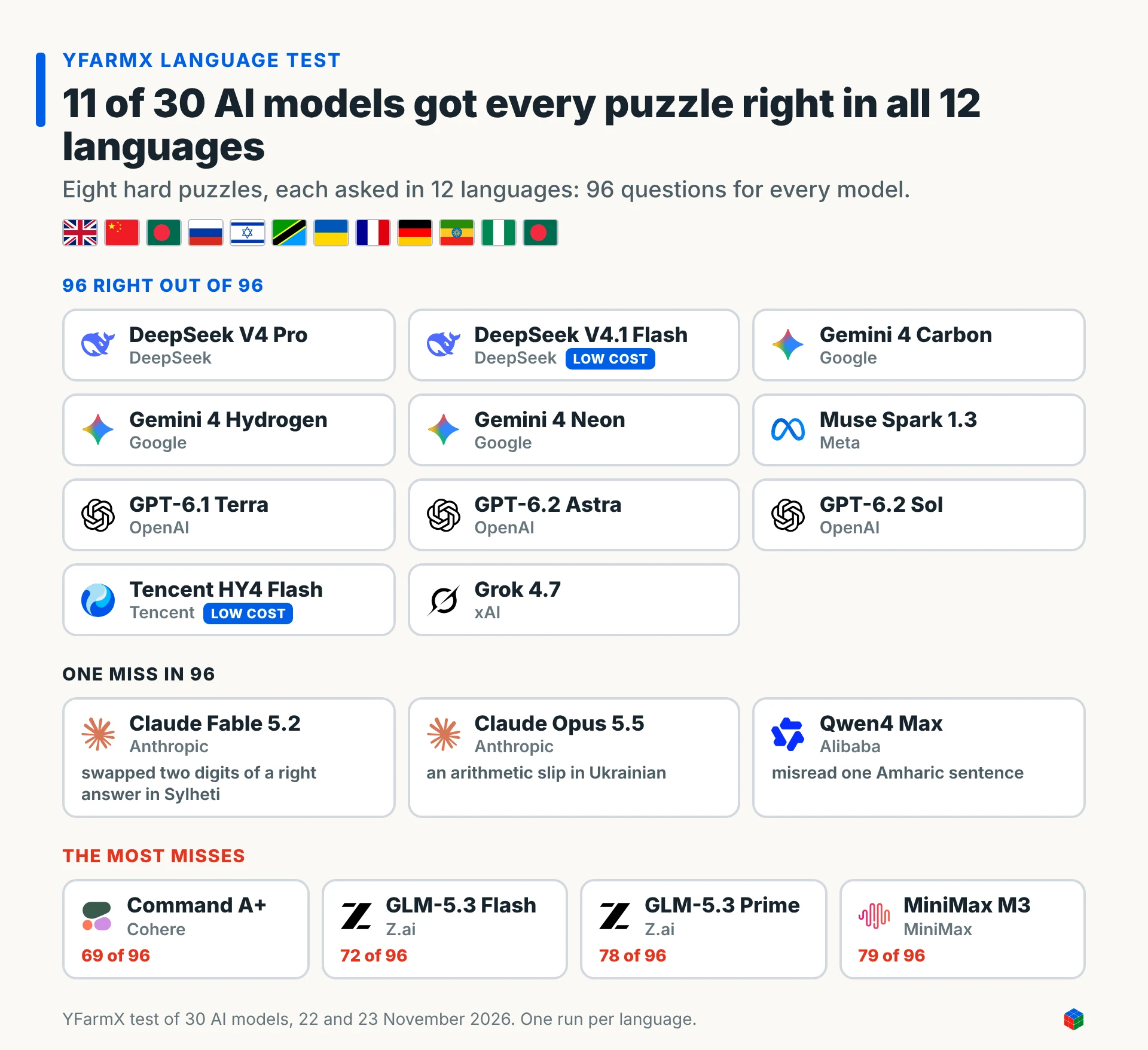
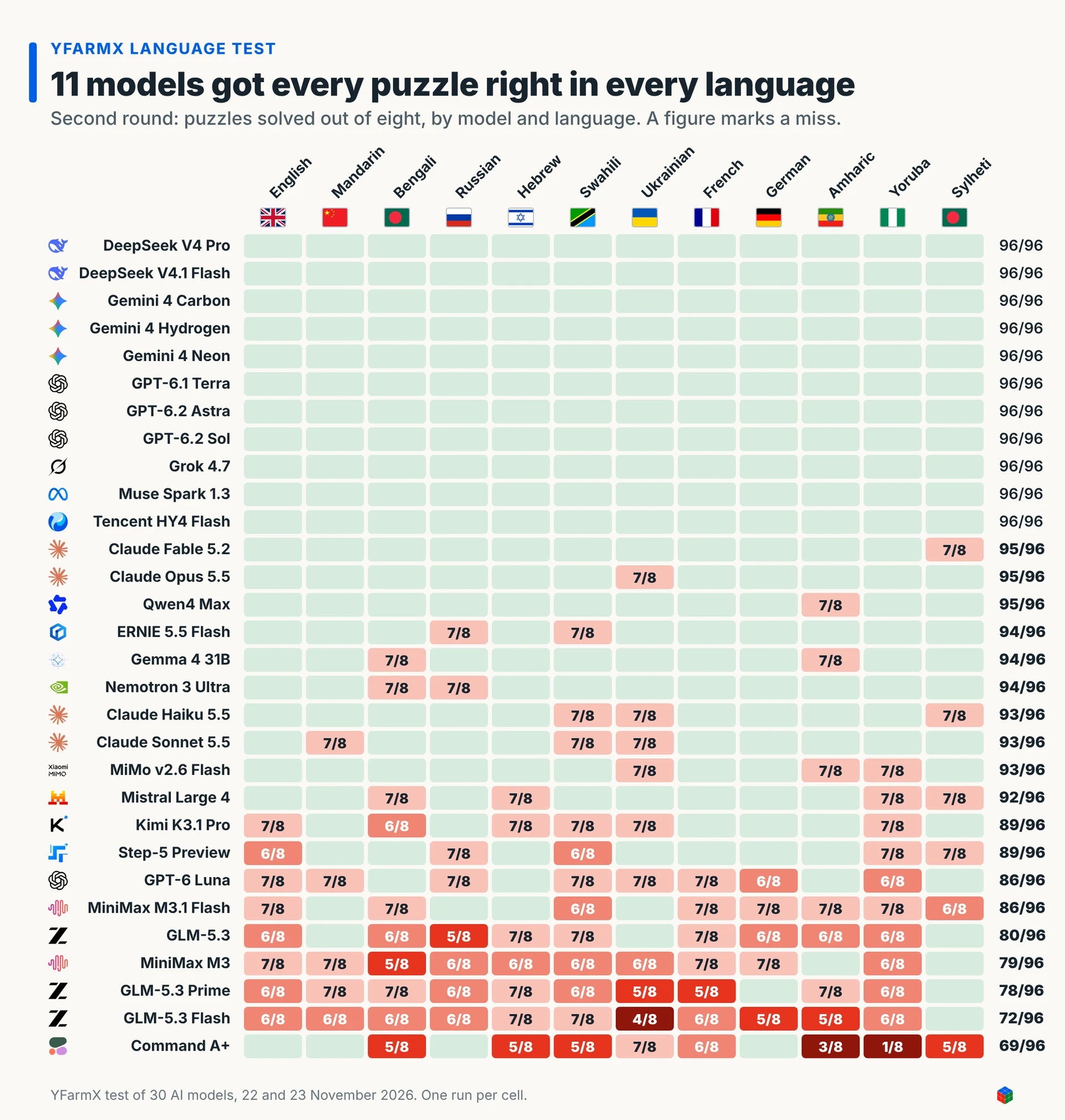
Eleven of the 30 models answered every question correctly in every language, across 60 answers in the first round and 96 in the second. They came from six companies, and two of them are among the cheapest models on sale.
| Company | Models with every answer right |
|---|---|
| OpenAI | GPT-6.2 Astra, GPT-6.2 Sol, GPT-6.1 Terra |
| Gemini 4 Carbon, Gemini 4 Neon, Gemini 4 Hydrogen | |
| DeepSeek | DeepSeek V4 Pro, DeepSeek V4.1 Flash |
| xAI | Grok 4.7 |
| Meta | Muse Spark 1.3 |
| Tencent | HY4 Flash |
Price was a poor guide. DeepSeek V4.1 Flash and Tencent HY4 Flash, both low-cost models, matched GPT-6.2 Astra and Gemini 4 Carbon answer for answer. HY4 Flash dropped one answer only in a repeat of the English run.
Three more models missed a single question out of 96 in the second round. Claude Fable 5.2 solved the race puzzle in Sylheti and wrote the last two digits of its answer in the wrong order. Claude Opus 5.5 made an arithmetic slip in Ukrainian, and Qwen4 Max misread one Amharic sentence.
Why did five models get the same Swahili puzzle wrong?
Five models read “shufwa”, the Swahili word for even, as odd, and “witiri”, the word for odd, as even. The puzzle gives eleven clues about eight runners, three of them about even and odd finishing places, and asks for the finishing order as one eight-digit number.
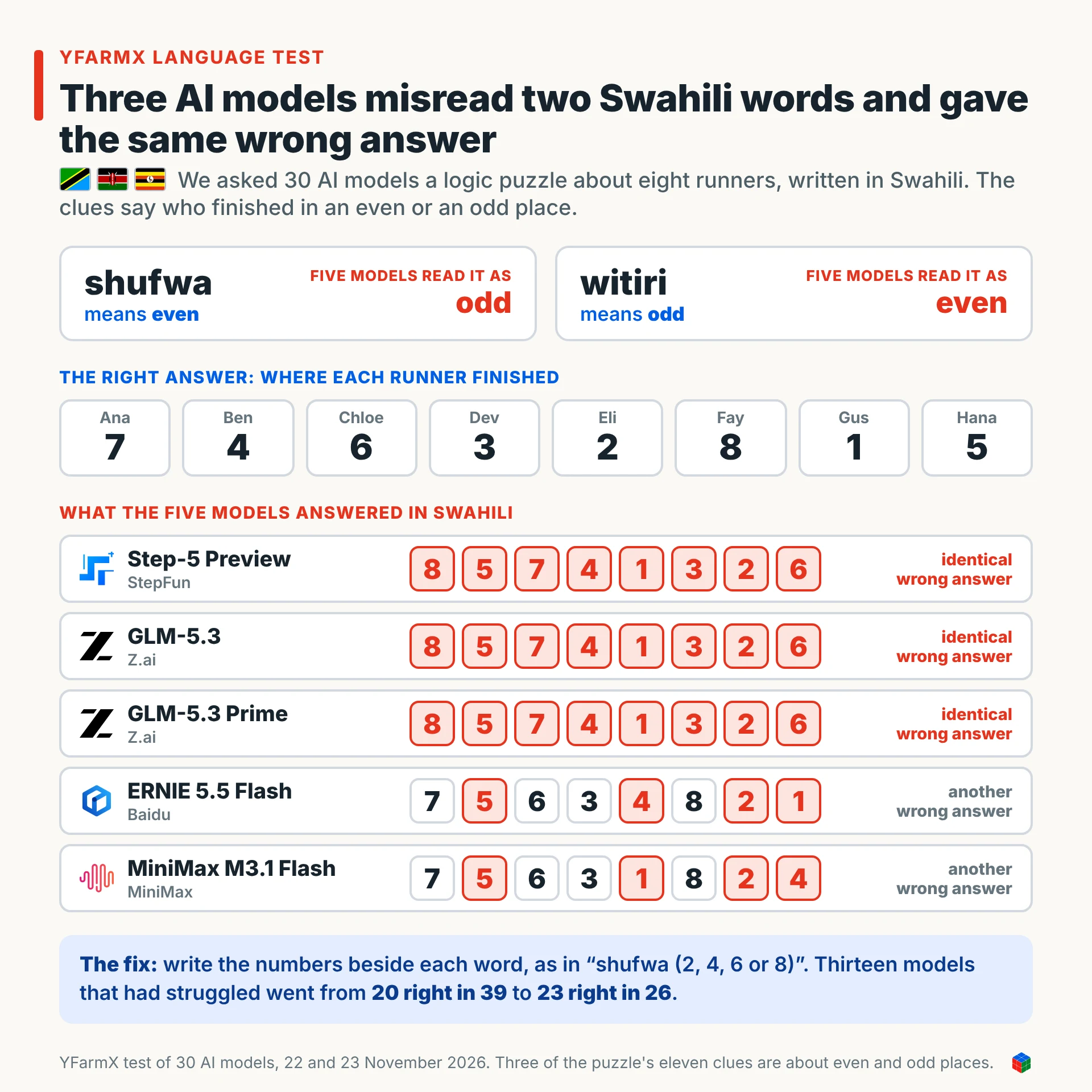
Step-5 Preview, GLM-5.3 and GLM-5.3 Prime all answered 85741326, which is a correct solution to the puzzle with even and odd swapped. ERNIE 5.5 Flash wrote that Ben finished in a “witiri” place and put him in third, fifth or seventh, where the question says “shufwa”. MiniMax M3.1 Flash swapped the words and then called “namba witiri” a likely translation error.
The Swahili wording passed two checks. A second model translating it back into English blind returned “even-numbered” and “odd-numbered”, and a second translation, made by a different model, chose the same two words. Ten models that had struggled with the Swahili race scored 5 right out of 10 on the second translation and 2 out of 10 on a rerun of the first.
To test the cause, 13 models that had struggled took the puzzle again with the digits written beside each word, as in “shufwa (2, 4, 6 or 8)”.
| Swahili race puzzle, 13 selected models | Correct |
|---|---|
| Original wording, three runs | 20 of 39 |
| Digits written beside the two words, two runs | 23 of 26 |
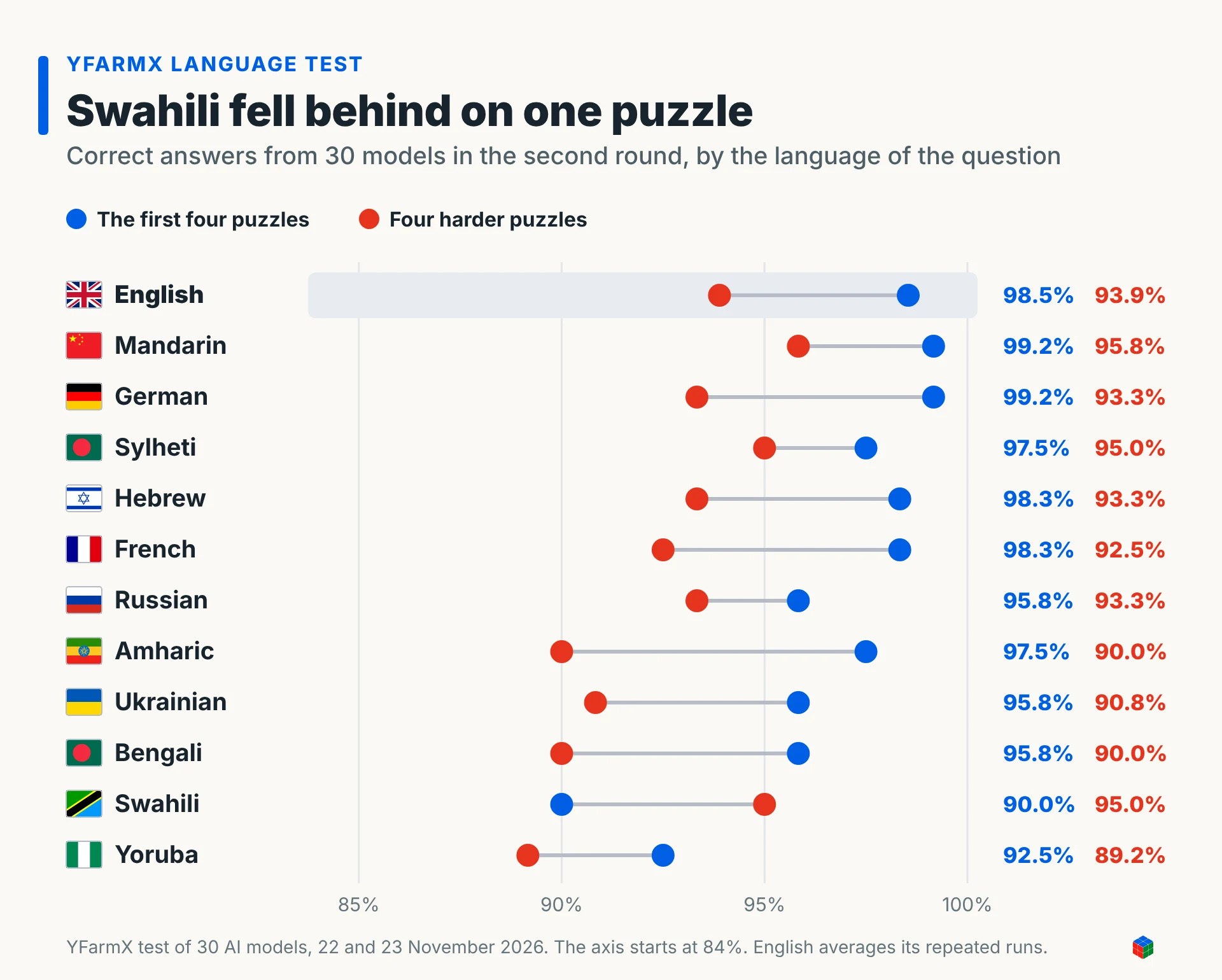
Those two words account for about half of the Swahili gap. Swahili scored 90% on the first four puzzles against 98.5% for English, and five of its 12 misses there are the flip. The race puzzle as a whole accounts for about 5.8 of the 8.5 points. On the four harder puzzles, which leave even and odd out, Swahili scored 95% against 94% for English.
Yoruba showed the same flip, less steadily. MiMo v2.6 Flash answered 85741326 in Yoruba, the number the three models gave in Swahili, and Kimi K3.1 Pro answered 85743126. MiniMax M3.1 Flash wrote in its Yoruba working that the two words “are reversed in Yoruba”, solved the puzzle without them and got it wrong.
| Yoruba race puzzle, four models that tripped on even and odd | Correct |
|---|---|
| Original wording, two reruns | 5 of 8 |
| Digits written beside the two words, two runs | 8 of 8 |
Kimi and MiMo solved the original Yoruba wording on both reruns, so in Yoruba the flip comes and goes.
What tripped Qwen4 Max in Amharic?
Qwen4 Max answered every question correctly in every language except one Amharic sentence, which it read as a different rule. A staircase puzzle bans two moves of three steps in a row. The Amharic reads “two consecutive moves whose size is 3”, and Qwen4 Max took the size to be the pair’s combined size.
Qwen4 Max wrote in its Amharic working that two consecutive moves must never add up to 3, so a 1 followed by a 2 cannot appear. GLM-5.3 read it the same way. Qwen4 Max then counted correctly under that rule and answered 1147, GLM-5.3 made a further error and answered 1099, and the answer is 27162.
| Amharic staircase puzzle | Correct |
|---|---|
| Qwen4 Max and GLM-5.3, original wording | 0 of 4 |
| Qwen4 Max and GLM-5.3, with “that is, a 3 followed by another 3” | 4 of 4 |
| Seven models, original wording | 6 of 14 |
| Seven models, with the clarification | 12 of 14 |
The original sentence passed the translation check, and a review by a native Amharic speaker comes next. The retest shows how sensitive the result is to wording: one added clause moved seven models from 6 right in 14 to 12.
Why do models solve a puzzle and then write the wrong number?
One wrong answer turned up 21 times, from models that had the right solution. In the race puzzle the correct number is 74632815: Ana seventh, Ben fourth, Chloe sixth, Dev third, Eli second, Fay eighth, Gus first and Hana fifth. Twenty-one answers in ten languages gave 74638215, the same order with Eli’s and Fay’s digits swapped.
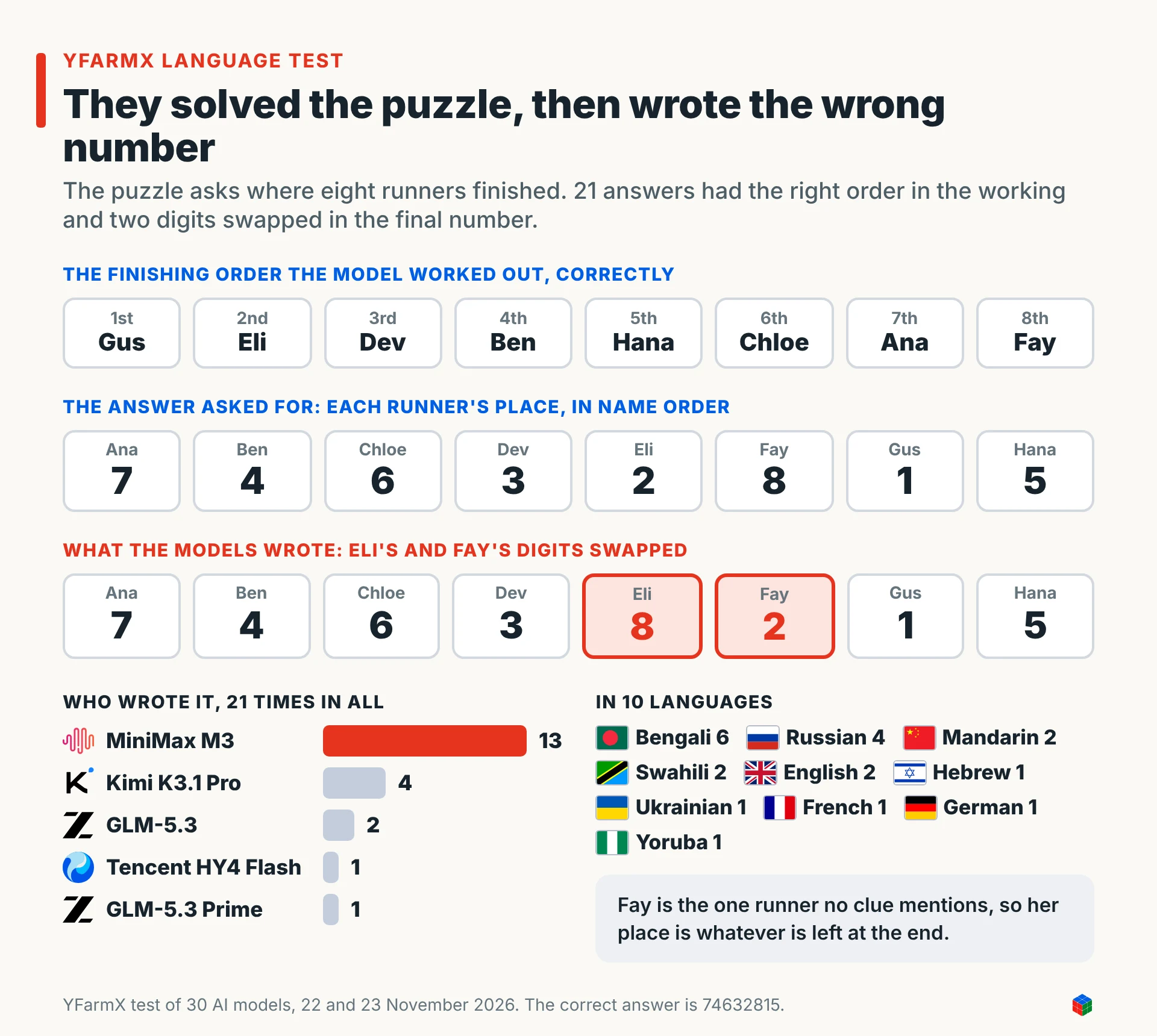
Fay is the one runner none of the clues mentions, so her place is whatever is left at the end. In each case the model’s own working listed all eight runners correctly, and the mistake appeared when it turned the list into one number.
MiniMax M3 produced 13 of the 21 swaps. Bengali had six of them in three runs and Russian four in three, against two in four runs of English. In the first round, right race answers written down wrong were two of Bengali’s five misses and four of Russian’s five.
| Race puzzle, 13 selected models | Before | After |
|---|---|---|
| Bengali, positions listed in English before the number | 32 of 39 | 24 of 26 |
| Bengali, runner names kept in Latin letters | 32 of 39 | 22 of 26 |
| Russian, runner names kept in Latin letters | 32 of 39 | 23 of 26 |
| Ukrainian, runner names kept in Latin letters | 35 of 39 | 24 of 26 |
Russian and Ukrainian change the ending of a name with its role in the sentence, so Ben appears as Бен, Бена and Беном. Keeping the names in Latin letters moved Russian from 82% to 88%, Ukrainian from 90% to 92% and Bengali from 82% to 85%, small moves on 13 selected models. Asking for the positions one by one before the final number lifted Bengali to 92%.
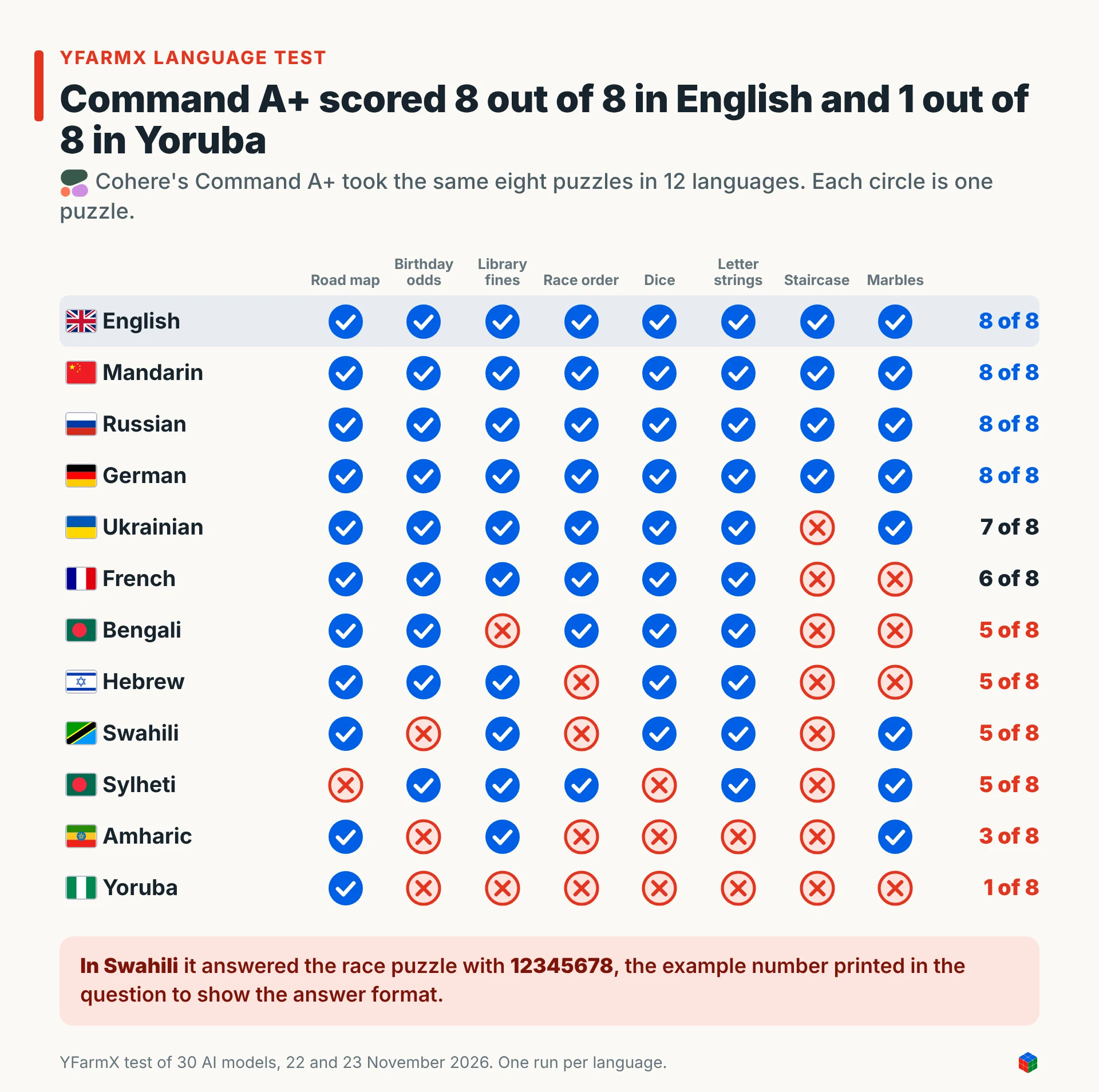
Cohere’s Command A+ had a habit of its own. It worked the race out correctly in Marathi, in Hebrew and in a Russian retest and wrote 76632815 each time, turning Ben’s 4 into a 6. In Swahili it answered 12345678, the number the question gives as an example of the answer format.
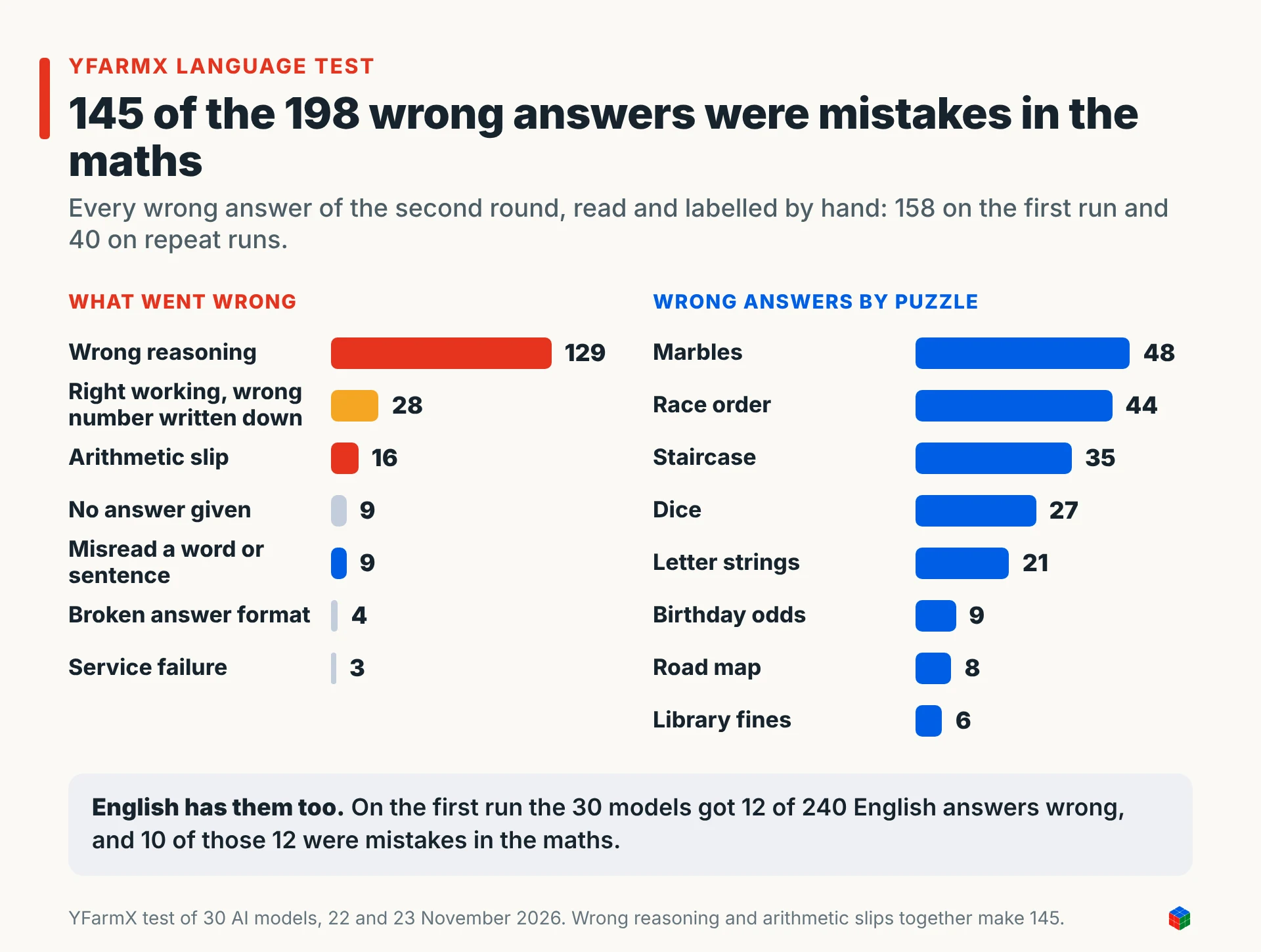
In the second round, 198 wrong answers were read and labelled by hand. Wrong reasoning accounts for 129, right working written down wrong for 28, arithmetic slips for 16, a missing answer for 9, a misread word or sentence for 9, a broken answer format for 4 and service failures for 3.
Which maths trap caught models in six languages?
Seven answers in six languages gave the identical wrong number, 2176567, on a dice puzzle. A die is rolled and the results added up until the total reaches at least 8, and the question asks for the chance the total lands on exactly 8.
The chance of landing exactly on a total follows a neat pattern for totals from 1 to 6: one sixth, then seven thirty-sixths, each one seven sixths of the last. The pattern holds up to a total of 6 and breaks at 7, because a die has six faces. Four answers carried it straight on through 7 and 8 and reached 2503159. Seven worked out the total of 7 correctly, applied the pattern once more for 8 and reached 2176567. The correct answer is 2129911.
The trap is in the maths, and it caught models in English, Russian, Hebrew, Ukrainian, French and German. Claude Sonnet 5.5 and Claude Haiku 5.5 fell into it only in Ukrainian and solved the dice puzzle in every other language.
Two more puzzles had a trap answer of their own. A marble puzzle drew the wrong answer 9697 21 times in nine languages, and a puzzle about strings of letters drew 47321 13 times in seven. Both appear in English as often as anywhere else.
Which model is strong in English and weak elsewhere?
Cohere’s Command A+ scored 8 out of 8 in English and fell further than any other model outside it. In its first run it solved 5 of 8 in Bengali, Hebrew, Swahili and Sylheti, 3 of 8 in Amharic and 1 of 8 in Yoruba.
| Command A+, three further runs of all eight puzzles | Correct |
|---|---|
| English | 24 of 24 |
| Hebrew | 23 of 24 |
| Bengali | 18 of 24 |
| Swahili | 13 of 24 |
Three more runs confirmed it for Bengali and Swahili. Command A+ stayed perfect in English, recovered in Hebrew, and solved three quarters of the puzzles in Bengali and just over half in Swahili.
The three GLM-5.3 models and MiniMax M3 scored low for a different reason. Each dropped answers in English too, 6 of 8 for all three GLM models and 7 of 8 for MiniMax M3, so their misses come from the reasoning and appear in almost every language.
GPT-6 Luna, OpenAI’s low-cost model, answered all 60 questions correctly in the first round and then dropped at least one answer in eight of the 12 second-round languages, English included.
Can AI models write Sylheti?
Just over half the replies to Sylheti questions came back in Sylheti: 136 of 240, with another 66 mixing Sylheti with a neighbouring language. Sylheti is the language of the Sylhet region in north-east Bangladesh, and the test asked all eight puzzles in it on 23 November 2026, written in Bengali script.
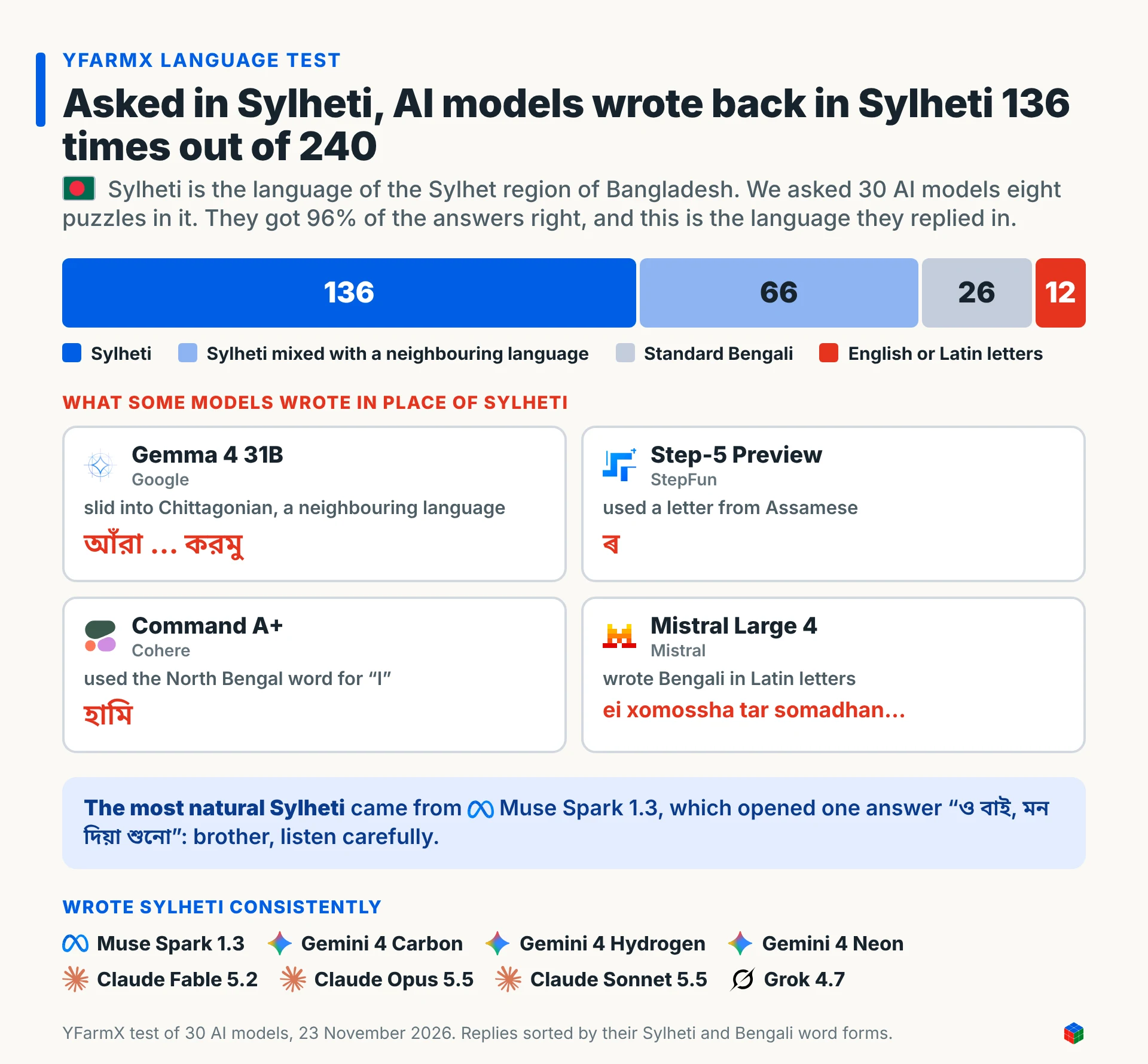
| Reply to a Sylheti question | Replies |
|---|---|
| Sylheti | 136 |
| Sylheti mixed with a neighbouring language | 66 |
| Standard Bengali | 26 |
| English, or Bengali in Latin letters | 12 |
The count sorts replies by the Sylheti and Bengali word forms in them. A hand read of 40 replies found about 25 in consistent Sylheti, and the rest blended in forms from nearby languages.
| Model | What it wrote in place of Sylheti |
|---|---|
| Gemma 4 31B | Chittagonian forms such as “আঁরা … করমু” |
| Step-5 Preview | The Assamese letter ৰ |
| Command A+ | “হামি”, the North Bengal word for “I” |
| Mistral Large 4 | Bengali typed in Latin letters |
Muse Spark 1.3 wrote the most natural Sylheti in the sample, opening one answer “ও বাই, মন দিয়া শুনো”, which is “brother, listen carefully”. The three Gemini 4 models, Claude Fable 5.2, Claude Opus 5.5, Claude Sonnet 5.5 and Grok 4.7 were the other consistent Sylheti writers.
The answers themselves held up. Sylheti scored 231 of 240, or 96%, a point above English in the same run, and all three GLM-5.3 models solved 8 of 8 in it.
Command A+ misread a Sylheti instruction. The instruction asked for “a whole number written with the digits 0 to 9”, and the model took that to mean a single digit. It worked out the correct distance, 35 km, and then answered 5.
How much more does an answer cost outside English?
A typical answer cost between 6% and 35% more in 14 other languages than in English, measured across the same 30 models and four puzzles on 22 November 2026. Bengali was the most expensive and German the cheapest of the fourteen.
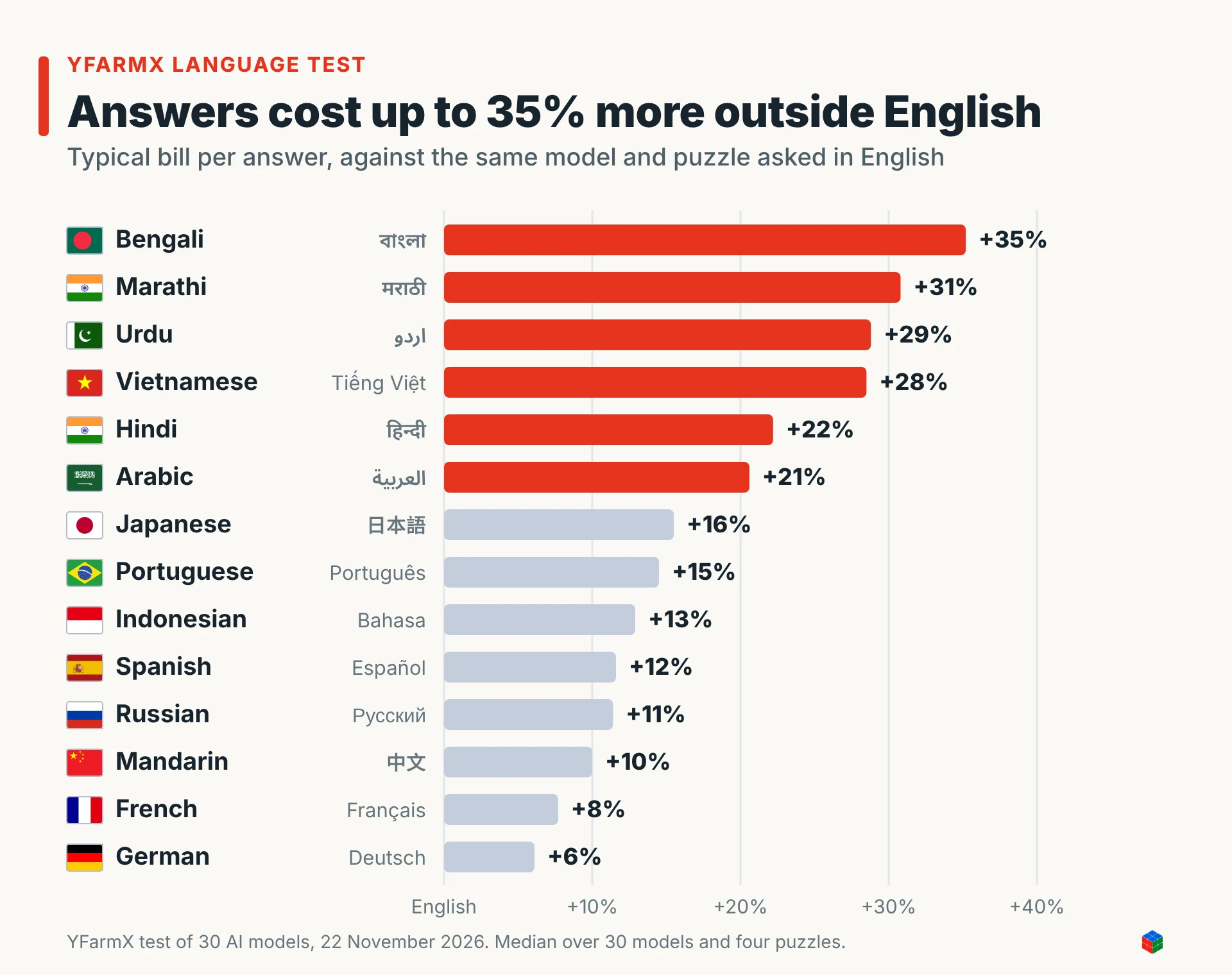
| Language | Question size | Answer length | Bill per answer |
|---|---|---|---|
| Bengali | +75% | +65% | +35% |
| Marathi | +93% | +51% | +31% |
| Urdu | +78% | +44% | +29% |
| Vietnamese | +32% | +52% | +28% |
| Hindi | +67% | +48% | +22% |
| Arabic | +33% | +42% | +21% |
| Japanese | +25% | +35% | +16% |
| Portuguese | +21% | +23% | +15% |
| Indonesian | +25% | +30% | +13% |
| Spanish | +13% | +20% | +12% |
| Russian | +22% | +30% | +11% |
| Mandarin | +1% | +22% | +10% |
| French | +20% | +17% | +8% |
| German | +20% | +20% | +6% |
Each figure compares a model with itself: the same puzzle, asked in English and in the other language, measured in tokens and in the provider’s bill. Each figure is the median of those comparisons.
In dollars, an answer averaged $0.012 in English across the 30 models, $0.014 in Bengali and Marathi and $0.015 in Japanese. An average leans on the most expensive models, so it orders the languages a little differently from the typical answer.
The second round measured eight puzzles in 11 languages against English on 22 and 23 November 2026, and Sylheti was the most expensive at 63% more.
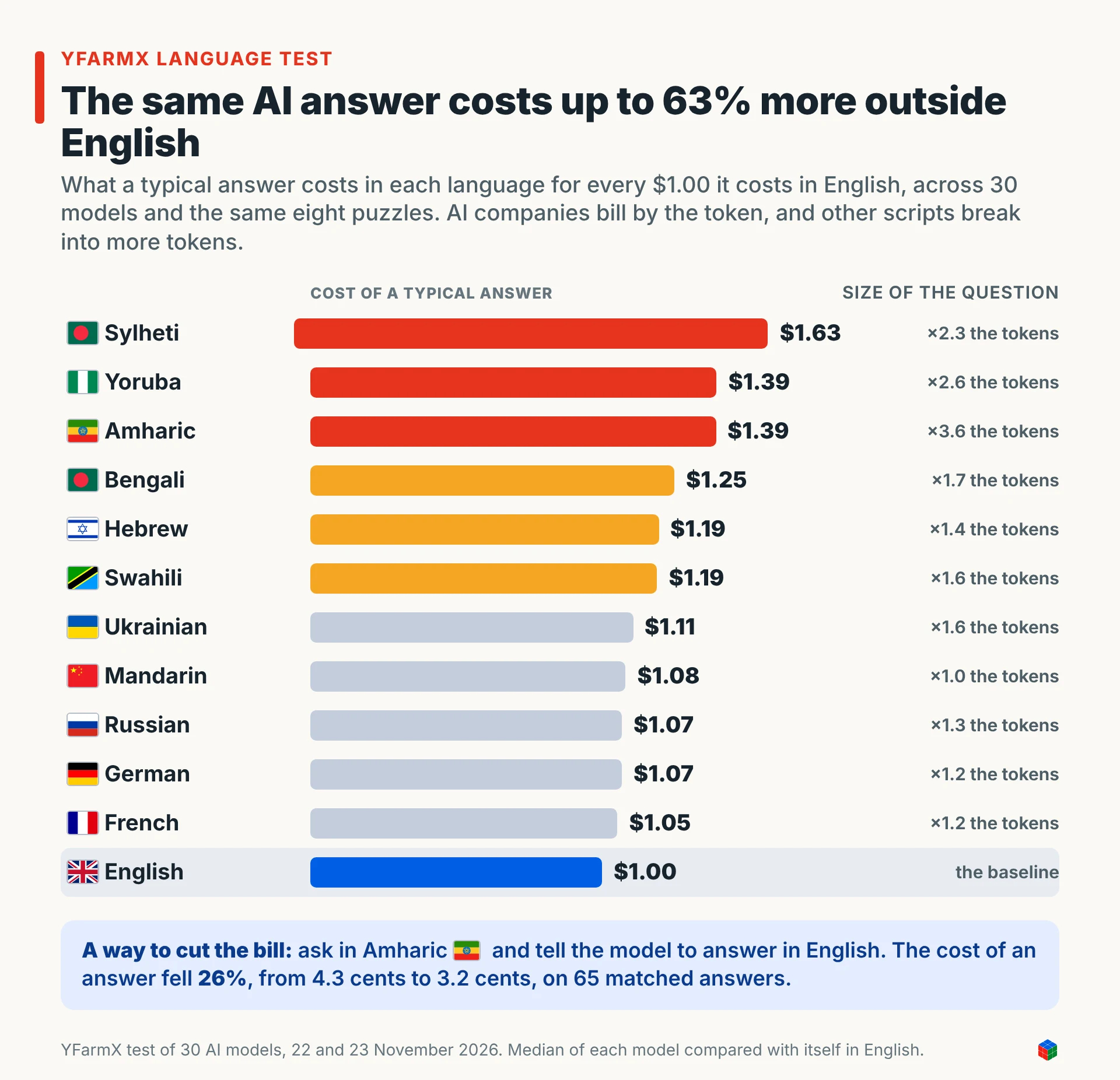
Bengali came out at 25% more across all eight puzzles, against 35% more on the first four.
Why does an Amharic question take 3.6 times the tokens?
AI companies bill by the token, a chunk of text that is often a whole word in English and a fragment of one in other scripts. An Amharic question took 3.6 times the tokens of the same question in English, the largest gap in the test. A Yoruba question took 2.6 times and a Sylheti one 2.3 times.
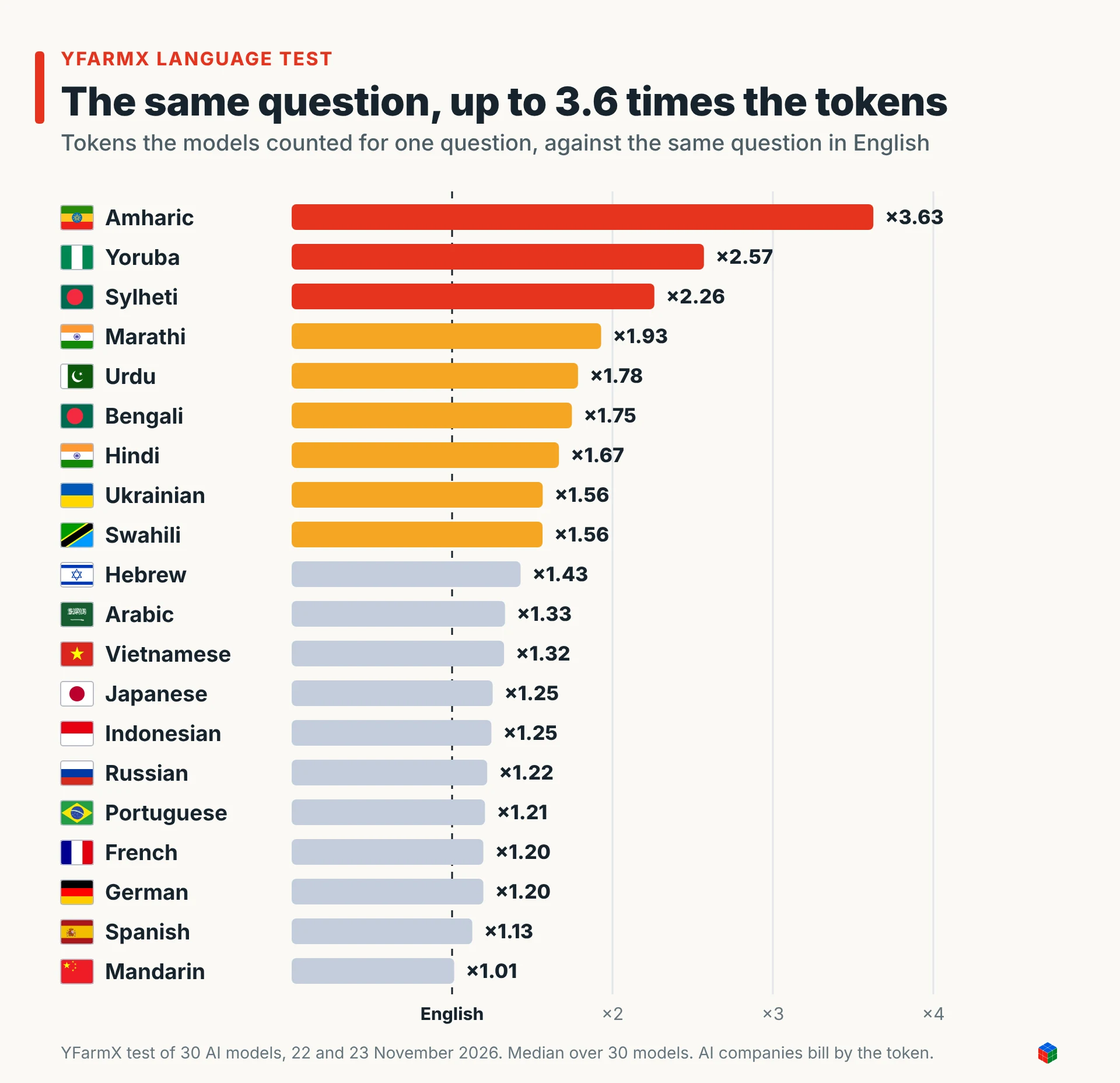
Mandarin sits at the other end, at 1% more than English, because one Chinese character carries a whole word.

The bill rises far less than the question does. The reasoning, the hidden working a model does before it answers, stayed within 5% below and 9% above its English length in every first-round language. So the Amharic bill came to 39% more than English, with a question more than three and a half times the size.
Sylheti is the exception. Models wrote 54% more reasoning for a Sylheti question than for the English one, and its bill rose 63%. Yoruba was next with 15% more reasoning, and every other second-round language stayed within 4% of English.
Does asking for the answer in English cut the bill?
Asking an Amharic question and requesting the answer in English cut the cost of a typical answer by 26%, from about $0.043 to $0.032, measured on 65 matched pairs of questions. Correct answers went from 60 to 58 of the 65. The question stayed in Amharic and only the reply changed language.
| Question language | Answer in the same language | Answer in English | Saving |
|---|---|---|---|
| Amharic | $0.0429 | $0.0319 | 26% |
| Bengali | $0.0376 | $0.0354 | 6% |
The saving tracks how many tokens a script needs. Amharic answers are the most expensive to write out, so moving the reply to English saves the most there. Bengali was measured on 68 pairs, with 64 right when the answer came in English and 60 when it came in Bengali.
What language do AI models do their working in?
Twenty-one of the 30 models returned their reasoning in English on at least 46 of the 56 questions they were asked in other languages in the first round. A question in Urdu or Japanese went in, English working came back, and the final answer arrived in Urdu or Japanese.
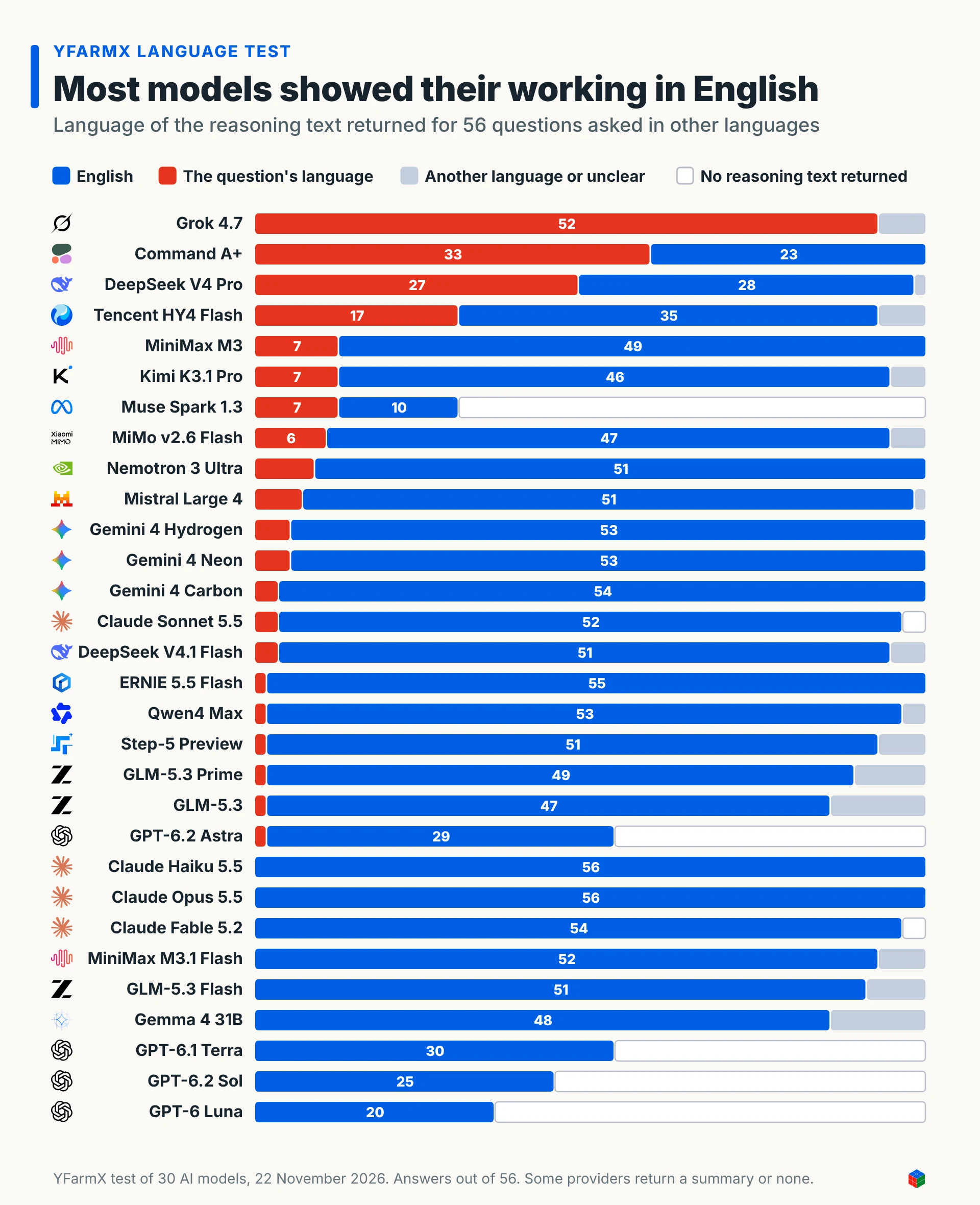
| Model | English | Question’s language |
|---|---|---|
| Claude Opus 5.5 | 56 of 56 | 0 |
| Gemini 4 Carbon | 54 | 2 |
| Qwen4 Max | 53 | 1 |
| Tencent HY4 Flash | 35 | 17 |
| DeepSeek V4 Pro | 28 | 27 |
| Command A+ | 23 | 33 |
| Grok 4.7 | 0 | 52 |
Grok 4.7 was the one model that worked in the language it was asked in, on 52 of 56 questions, and it never dropped an answer. In the second round it reasoned in the question’s language on all 88 questions asked outside English and answered every one correctly.
The text is what each provider chooses to return, and for some models it is a summary of the working. OpenAI’s four models returned reasoning text on 20 to 30 of these 56 questions, and Meta’s Muse Spark 1.3 on 17.
It lines up with what researchers see inside the models. Anthropic’s interpretability team reported on 27 March 2025 that Claude holds concepts in features shared across English, French and Chinese, with a shared concept “translated out into the language of the question”, in its paper Tracing the thoughts of a large language model. A 2024 study from EPFL, Do Llamas Work in English?, found that Meta’s Llama 2 models pass through a middle stage that sits closer to English than to the language of the question.
Which models answered in the wrong language?
Mistral Large 4 answered all four harder Amharic questions entirely in English, and got all four right. It did the same on three Bengali questions, and in the first round it replied in English or in mixed text on 6 of 56 questions asked in other languages.
GLM-5.3 Flash answered in the right language and then spilled its raw English working into the reply on 8 of 56 first-round questions. It did so again in the second round, where one spill in Sylheti contained a different number from its real answer.
Did any language get more wrong answers?
Swahili was the one language with a gap that held up in the statistics, 8.5 points behind English on the first four puzzles, and a single puzzle caused most of it. The result is exploratory, because it is the survivor of many comparisons.
In the first round all 15 languages scored between 115 and 120 out of 120, with Bengali and Russian lowest on 115.
The second round added four harder puzzles and six more languages. Across its 12 languages, first-run scores ran from 90.8% in Yoruba, 218 of 240, to 97.5% in Mandarin, 234 of 240, with English at 95.0%. Yoruba sat 6.0 points behind English on the first four puzzles, a gap that falls inside chance once the number of comparisons is counted.
How was the test run?
Thirty models answered eight puzzles on 22 and 23 November 2026, each at its high reasoning setting, with one fresh conversation per question. The models are the most used on OpenRouter’s public rankings for the week of 21 November, plus the current flagships of the large labs.
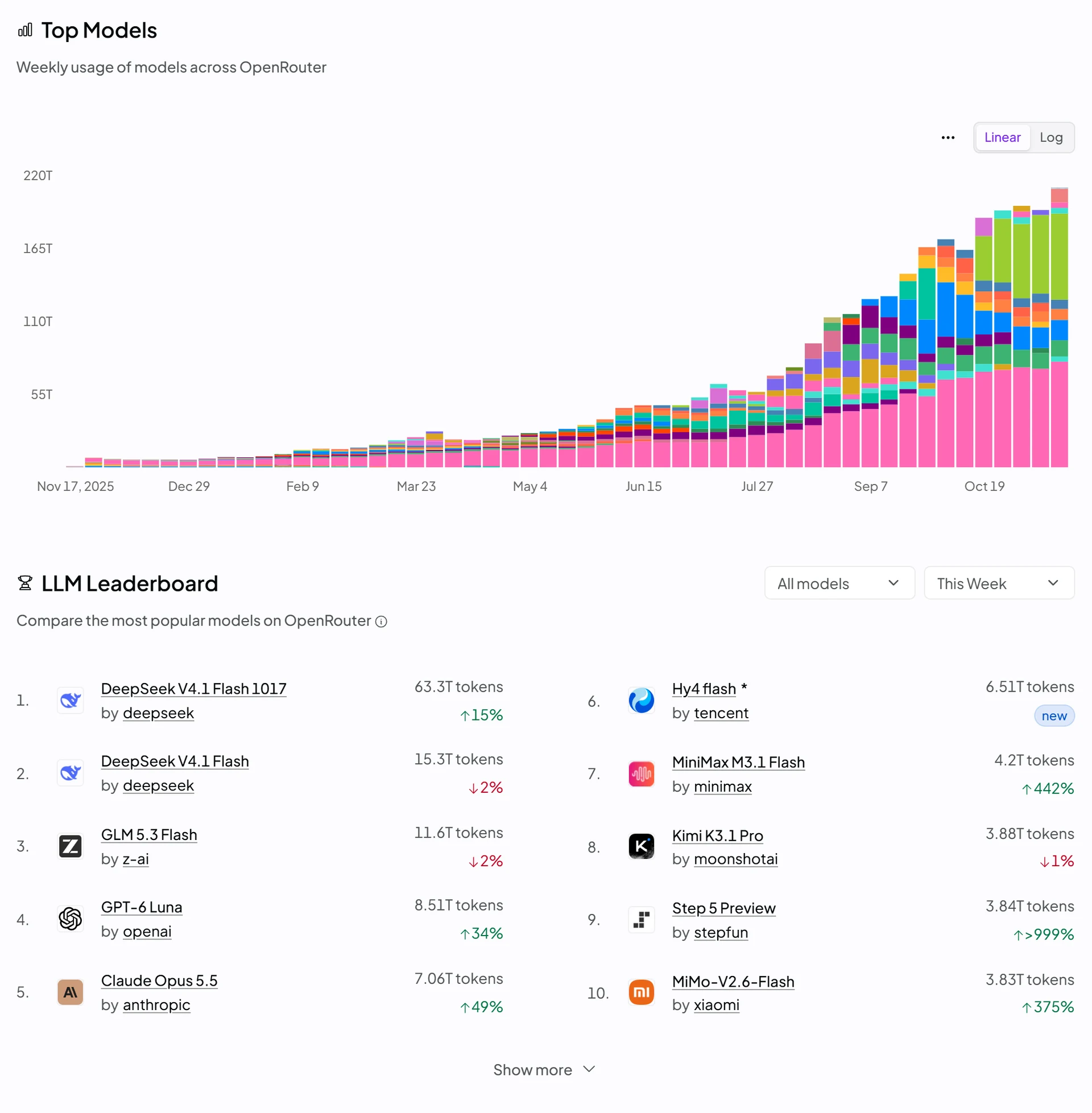
DeepSeek V4.1 Flash led that week with 63.3 trillion tokens, ahead of GLM 5.3 Flash on 11.6 trillion, GPT-6 Luna on 8.51 trillion and Claude Opus 5.5 on 7.06 trillion. The leaderboard lists DeepSeek V4.1 Flash twice, and the test covered all nine models on it.
| Puzzle | Answer |
|---|---|
| Shortest round trip on a map with one-way roads | 35 |
| Three children and a girl born on a Tuesday | 674 |
| Library fines counted over a calendar | 1015 |
| Eight runners and their finishing order | 74632815 |
| Dice rolled until the total reaches 8 | 2129911 |
| Twelve-letter strings with two banned pairs | 23427 |
| Ways up a 20-step staircase with two banned patterns | 27162 |
| First colour match on the fourth marble | 522 |
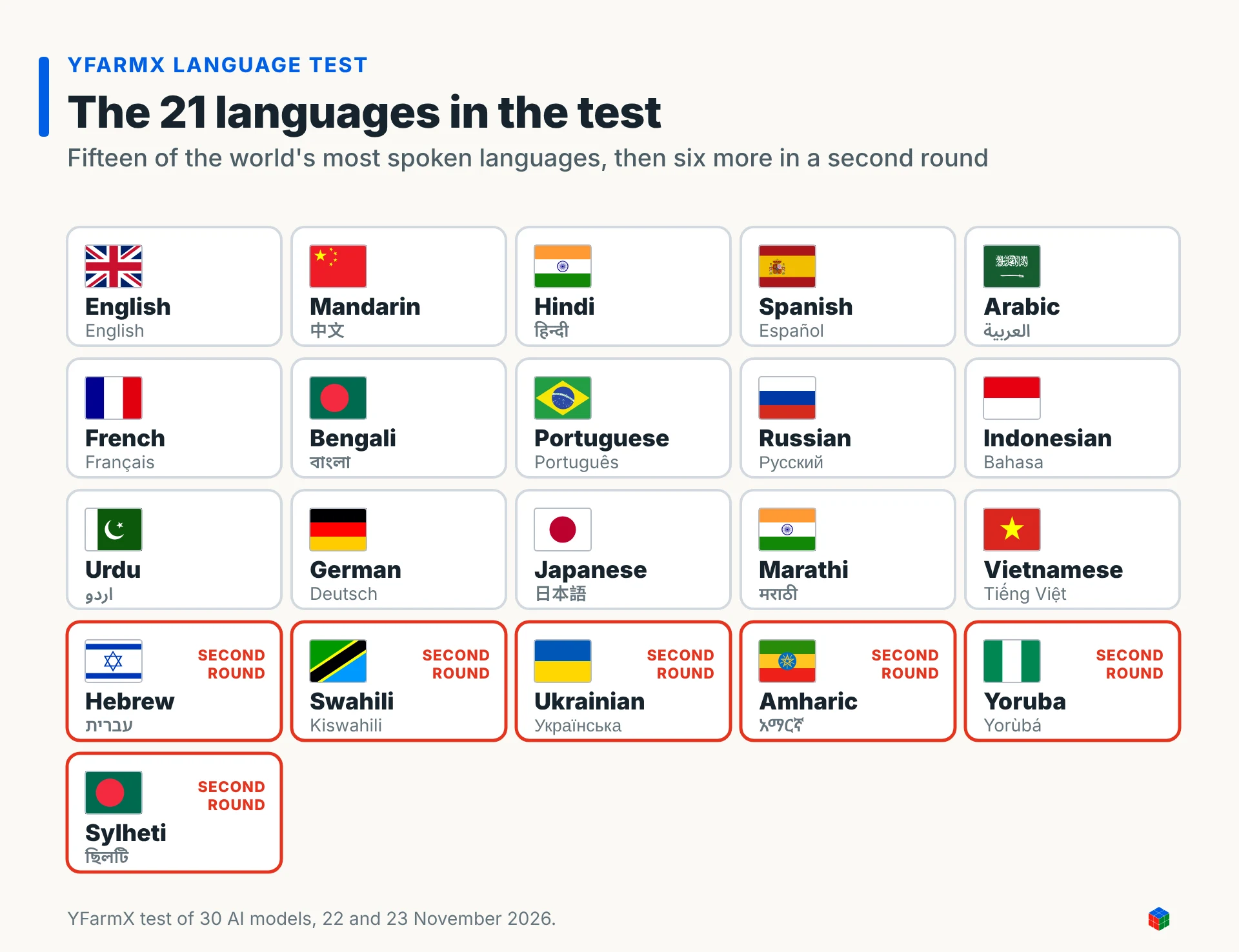
Each puzzle has one numerical answer, so grading is a comparison with a key. The first round used the first four puzzles in 15 languages, all among the most widely spoken in Ethnologue’s ranking. The second round used all eight in English, Mandarin, Bengali, Russian, Hebrew, Swahili, Ukrainian, French, German, Amharic, Yoruba and Sylheti.
The translations were made by machine, translated back into English blind by a second model and compared with the originals by a third. The next check is a review by native speakers, starting with Amharic and Sylheti.
Every wrong answer was read and labelled by hand, and the statistics of both rounds were audited independently.
The figures describe these eight puzzles on these two days, and most cells are a single run. The retests on Swahili, Amharic, Bengali and Russian used models chosen because they had struggled, so they show what fixed those models on those puzzles.
Sources
- OpenRouter: model rankings by weekly usageopenrouter.ai
- Ethnologue: the Ethnologue 200, the world's most spoken languagesethnologue.com
- Anthropic: Tracing the thoughts of a large language model, 27 March 2025anthropic.com
- Wendler, Veselovsky, Monea and West: Do Llamas Work in English? On the Latent Language of Multilingual Transformers, 2024arxiv.org
- Shi and others: Language Models are Multilingual Chain-of-Thought Reasoners, 2022arxiv.org