IBM quantum computers predicted where water sits in drug targets
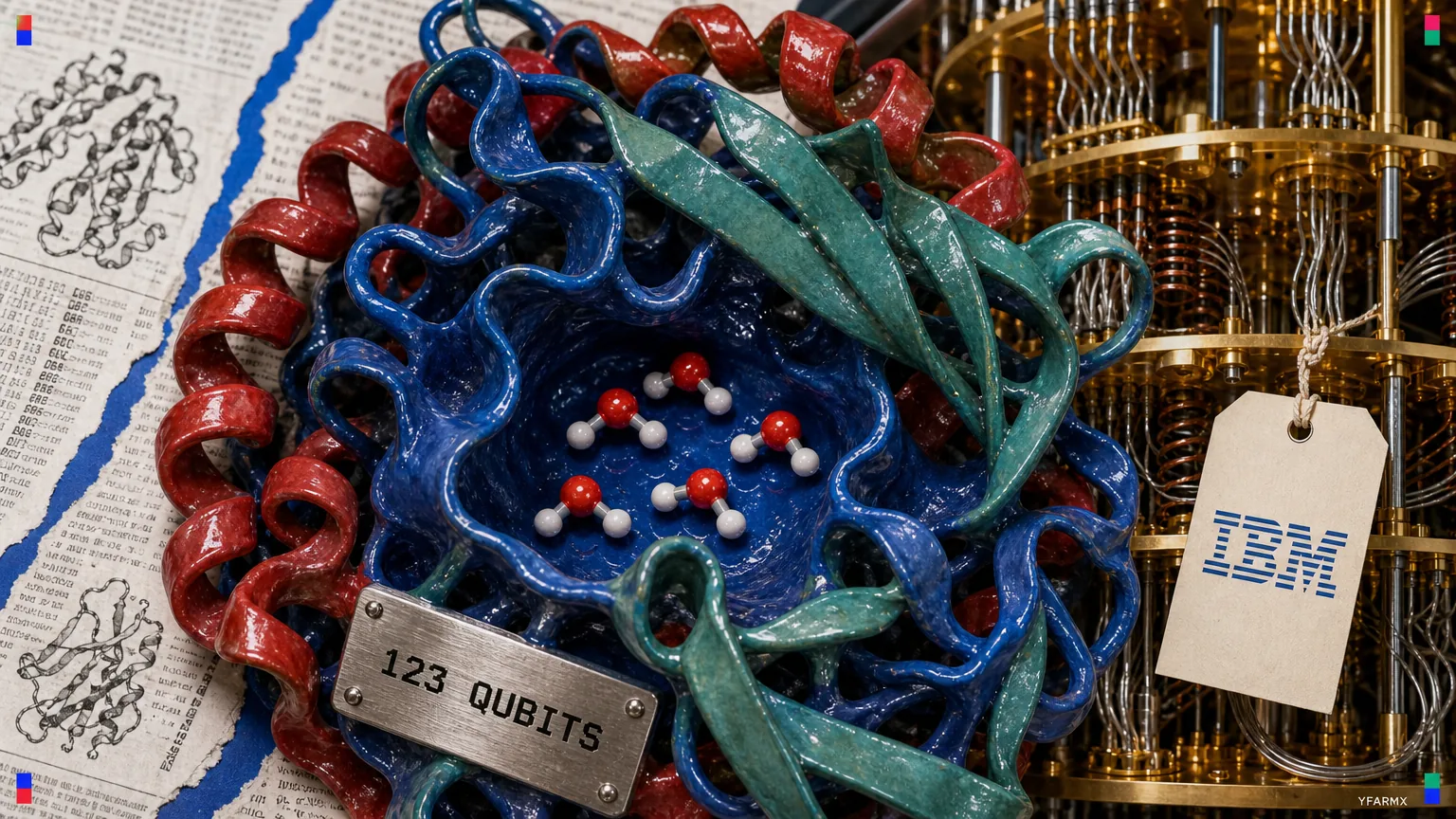
Researchers from Sorbonne Université, Qubit Pharmaceuticals and Q-CTRL used IBM Heron quantum processors to predict where water molecules sit in the pockets of proteins that drugs bind to, on problems of up to 123 qubits.
Listen to this articleListen
Researchers from Sorbonne Université, the Paris drug-discovery company Qubit Pharmaceuticals and the quantum software company Q-CTRL have used IBM quantum computers to predict where water molecules sit inside the pockets of proteins that drugs bind to. The team turned the problem into a set of yes-or-no questions, one for each spot where a water molecule could sit, and gave every question its own qubit: up to 123 of them on IBM’s Heron processors. The study, published in Physical Review Research on 21 September 2026, reports results “matching the precision of classical approaches”.
The water study’s senior author, Jean-Philip Piquemal, is also an author of two methods that shrink the quantum calculations chemists use to work out a molecule’s energy: one published in Communications Physics on 24 September 2026, and one, called VULCAN, first posted as a preprint on 29 October 2026.
Why do drug designers need to know where water sits?
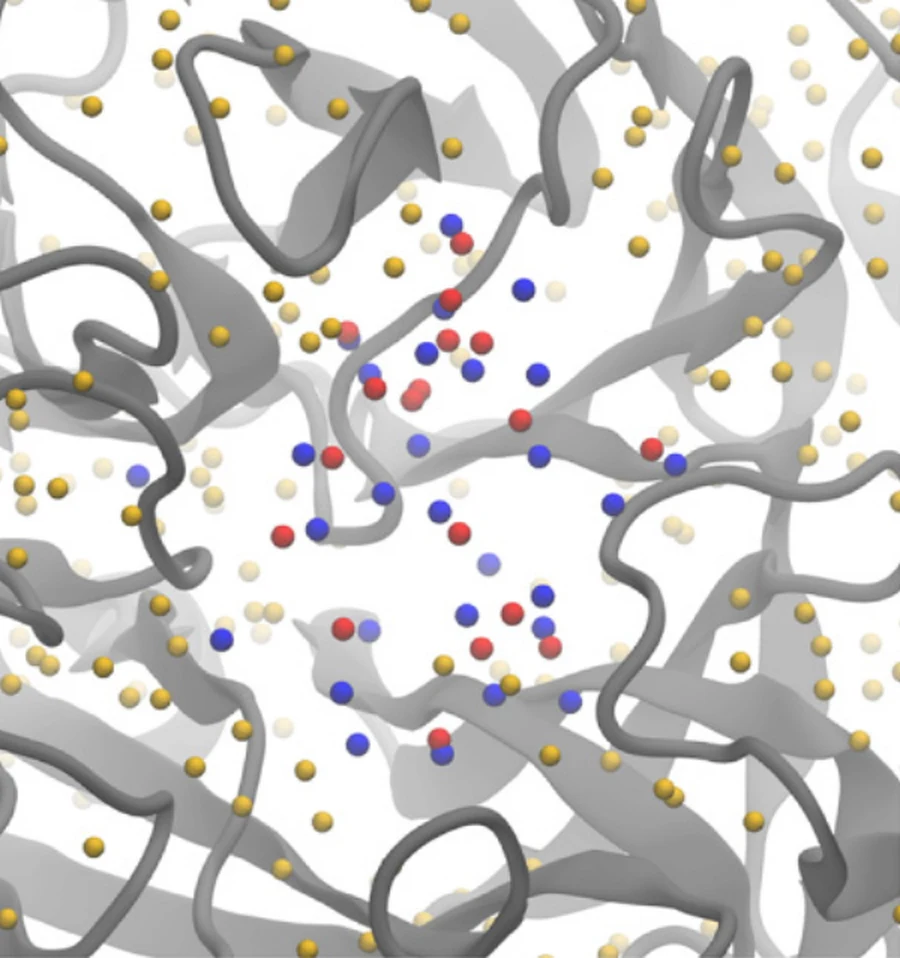
Water molecules trapped in a protein’s binding pocket can link a drug to the protein or stand in its way, so knowing where they sit helps chemists predict how tightly a drug will bind. The study describes how water molecules “can act as an intermediate between a protein and a ligand”, the ligand being the drug molecule. A water that bridges the two can be worth keeping in a design, while pushing a tightly held water out of the way to make room for part of a drug has an energy cost.
X-ray crystal structures, the usual 3D pictures of proteins, show where many of these waters sit, and the study used them as its answer key. The team tested the method on five proteins linked to human diseases, each with a drug approved by the US Food and Drug Administration bound inside, using structures from the Protein Data Bank.
How does a quantum computer place water molecules?
The team broke each pocket into candidate spots and asked one yes-or-no question about each: is there a water molecule here? Each answer is held by one qubit, a quantum bit that is read out as a 0 or a 1. A 1 places a water molecule at that spot, and a 0 leaves it empty.
The method runs in four steps:
- An ordinary computer works out a cloud showing how likely water is to be found at each point in the pocket, using an established method called 3D-RISM.
- The cloud is redrawn on a coarser grid, keeping only the points where water is likely. Each of those points is a candidate spot.
- Each candidate spot becomes a yes-or-no choice, held by one qubit.
- The quantum computer searches for the set of yeses whose waters together best match the cloud. Spots too close together carry a penalty, because two water molecules cannot sit almost on top of each other.
With 123 candidate spots there are 2 to the power of 123 possible sets of answers, a number 38 digits long, far too many to try one at a time. Mathematicians call this kind of search a quadratic unconstrained binary optimisation, or QUBO. Q-CTRL’s Fire Opal software ran it on the IBM processors: the quantum computer runs a circuit many times, each run returns one candidate set of answers, and an ordinary computer adjusts the circuit’s settings between rounds and keeps the best set found. Fire Opal also suppresses the errors the hardware makes, and a final classical step repairs answers with digits flipped by stray errors.

How well did IBM’s quantum computers do?
The quantum runs found the best possible arrangement of waters in all 11 test cases on IBM’s ibm_kingston processor, which ranged from 41 to 116 qubits. On the largest, at 116 qubits, the quantum search returned that best arrangement in about 9% of its attempts. Simulated annealing, a standard classical shortcut, found it in about 2%, and a simple step-by-step classical method missed it. These test problems were cut down to fit today’s hardware, and exact classical solvers handle them quickly: the runs show the whole method working on a real quantum computer.
The hardest test, at 123 qubits, ran on ibm_pittsburgh, a newer Heron processor that came online during the study. CPLEX, a widely used classical solver that hunts for the provably best answer, ran for three hours on a standard laptop and stopped at a score of −319.90, where lower is better. The quantum run reached −321.32 in a total run time of 25 minutes. Simulated annealing found the same best score as the quantum run, and found it more often.
| Test | IBM processor | Qubits | Result |
|---|---|---|---|
| 11 cases across five proteins | ibm_kingston (Heron r2) | 41 to 116 | Best arrangement found in all 11 |
| Hardest case | ibm_pittsburgh (Heron r3) | 123 | −321.32 in 25 minutes, against −319.90 for CPLEX after 3 hours |
How close did the predictions come to the real waters?
On the 123-qubit version of one test protein, the quantum run’s best answer put a predicted water within 3 ångströms, about the width of one water molecule, of roughly 60% of the 28 crystal waters in its pocket. The protein is the one filed in the Protein Data Bank as 3b7e, studied with its drug bound inside.
Finer grids find more. Solving bigger versions of the same pocket on an ordinary computer with simulated annealing, the method found about 90% of the crystal waters once the grid reached 1,450 candidate spots, far beyond the 156 qubits on a Heron processor. Using those larger classical runs, the team compared the method with four published tools on the same protein, and it and Hydraprot, a neural network built for this job, placed waters most precisely.
| Size of the problem | Solved on | Crystal waters found |
|---|---|---|
| 123 candidate spots | IBM quantum computer | About 60% |
| 1,450 candidate spots or more | Ordinary computer | About 90% |
When could quantum computers do this for real drug design?
The authors expect the method to become useful for drug design at around 900 to 1,000 candidate spots, and say the tests that could show a quantum computer doing better than classical methods may become possible by 2028. A 900-spot problem would need about 100,000 two-qubit operations, more than today’s processors can run reliably. Going by IBM’s published road map, the paper expects processors with around 1,000 qubits by 2027, and error-corrected machines able to run 100 million operations by 2029. If the operation count can be cut to 15,000, the authors write, the target could be reached as early as 2028 on IBM’s Nighthawk processors.
What is IBM Heron?
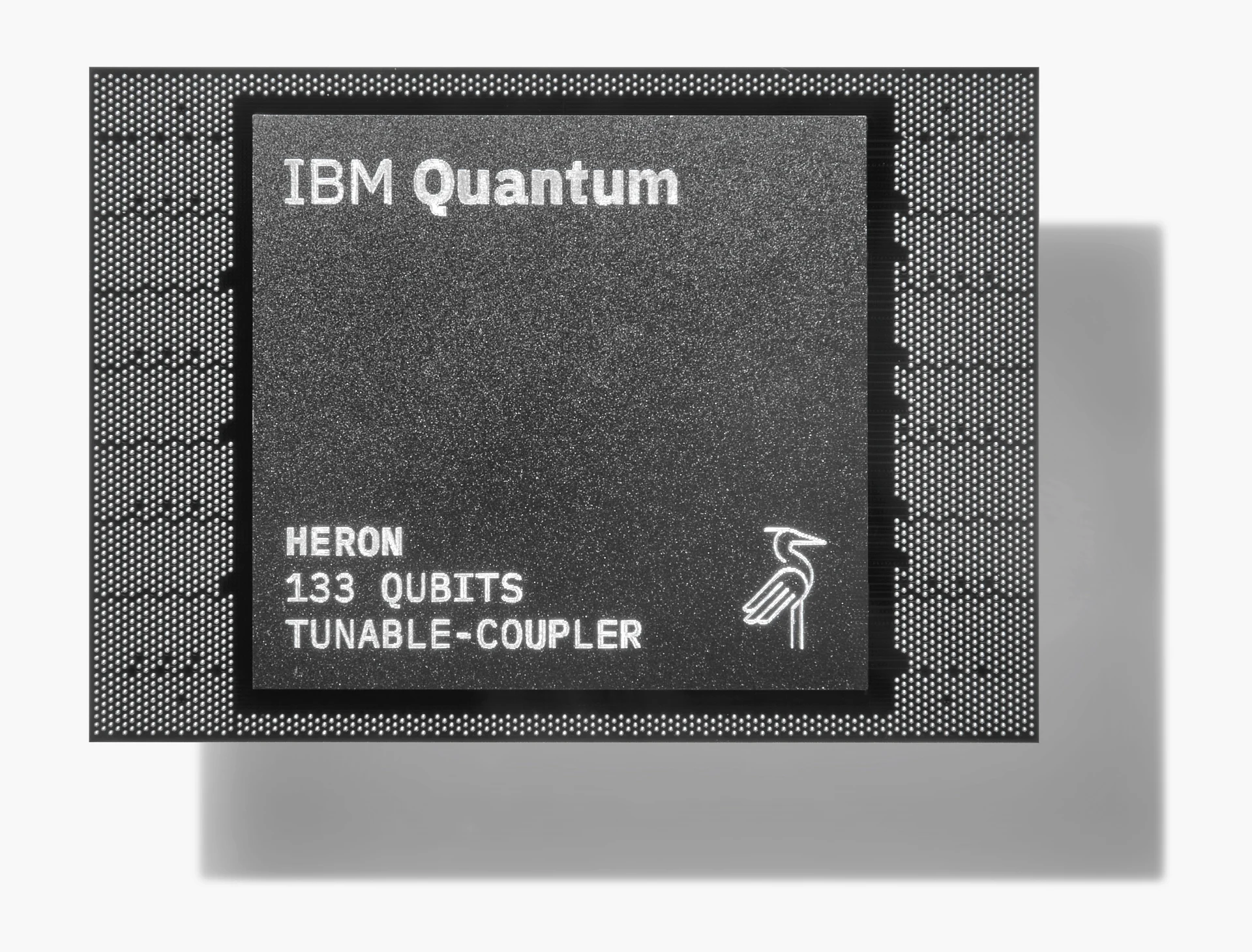
Heron is IBM’s family of quantum processors, the current versions with 156 qubits, which outside researchers use through IBM’s cloud. The study used two of them: ibm_kingston, a Heron r2, and ibm_pittsburgh, a Heron r3, the revision IBM introduced in July 2025 with better coherence, gate fidelity and readout. It used up to 123 of the 156 qubits at once, one for each candidate water spot. Researchers reach IBM’s quantum computers over the internet, and companies such as Q-CTRL run software on top of them to get more reliable results.
What do the two other papers add?
Two more papers with Piquemal among the authors make it cheaper for a quantum computer to work out a molecule’s energy, the number chemists use to predict how it behaves and how strongly it binds. Both improve the variational quantum eigensolver, or VQE, a method in which a quantum computer builds a circuit from a menu of standard operations, measures the energy it gives, and lets an ordinary computer adjust the settings until the energy is as low as it goes.
The first, in Communications Physics, is about choosing that menu. It gives a way to find the smallest set of building blocks that can still produce every operation the method needs, with a search whose cost grows polynomially with the size of the problem, where the usual search grows exponentially. The authors say this cuts the quantum resources needed, and lets a related family of methods, until now held to small molecules, take on much larger ones.
The second, VULCAN, grows the circuit a whole layer at a time, from operations worked out from the molecule’s own equations, which saves the costly measurements other methods use to pick one operation at a time. It draws on a menu 4 to 12 times smaller than a widely used alternative, trims the circuit as it goes, drops qubits the molecule does not need, and can finish with a correction calculated on a graphics chip. In simulations of small molecules including water, it reached chemical accuracy, the precision chemists need, at 5% to 20% of the measurement cost of a standard adaptive method, and with its graphics-chip correction it reached that precision on a 32-qubit molecule with three carbon atoms. The paper also reports a first test run on Quantinuum’s System Model H2, a trapped-ion quantum computer.
| Paper | What it improves | Headline result |
|---|---|---|
| Lie algebra generator pools, Communications Physics, 24 September 2026 | The menu of operations a VQE builds from | A search that grows polynomially, where the usual one grows exponentially |
| VULCAN, preprint, 29 October 2026 | How the circuit is grown and trimmed | Chemical accuracy at 5% to 20% of the usual measurement cost, in simulation |
Who is behind the work?
Qubit Pharmaceuticals is a Paris company, founded in 2021, that designs drug candidates using quantum physics and artificial intelligence, and Jean-Philip Piquemal of Sorbonne Université’s theoretical chemistry laboratory is one of its co-founders. Piquemal is an author of all three papers. Daniele Loco of Qubit Pharmaceuticals, and Kisa Barkemeyer and André Carvalho of Q-CTRL, a quantum software company with offices in Sydney and Berlin, wrote the water study with him.
Q-CTRL has published an example notebook that runs the water-placement search on IBM hardware through its Fire Opal software, as a tutorial anyone with access to the two platforms can follow.
Sources
- Loco, Barkemeyer, Carvalho and Piquemal: Practical protein-pocket hydration-site prediction for drug discovery on a quantum computer, Physical Review Research 8, 033344, 21 September 2026journals.aps.org
- Q-CTRL: predicting protein-pocket hydration sites using Fire Opaldocs.q-ctrl.com
- Viswanathan, Adjoua, Feniou and colleagues: An optimized construction of Lie algebra generator pools for variational quantum eigensolvers in chemistry, Communications Physics, 24 September 2026nature.com
- Nogueira, Badreddine, Adjoua, Traore, Michel and Piquemal: Grow, Compress, and Perturb, the VULCAN method, arXiv 2610.40561, first posted 29 October 2026arxiv.org
- IBM Quantum: processor typesquantum.cloud.ibm.com
- Qubit Pharmaceuticalsqubit-pharmaceuticals.com