QC Ware and IonQ report chemical accuracy on eight qubits, with no paper and no named benchmark
QC Ware said on 1 September 2026 that a hybrid workflow on IonQ's Forte computer got within 0.5 kcal/mol of classical benchmarks for an enzyme active site. The quantum part was eight qubits, and the benchmark it was measured against is not named.
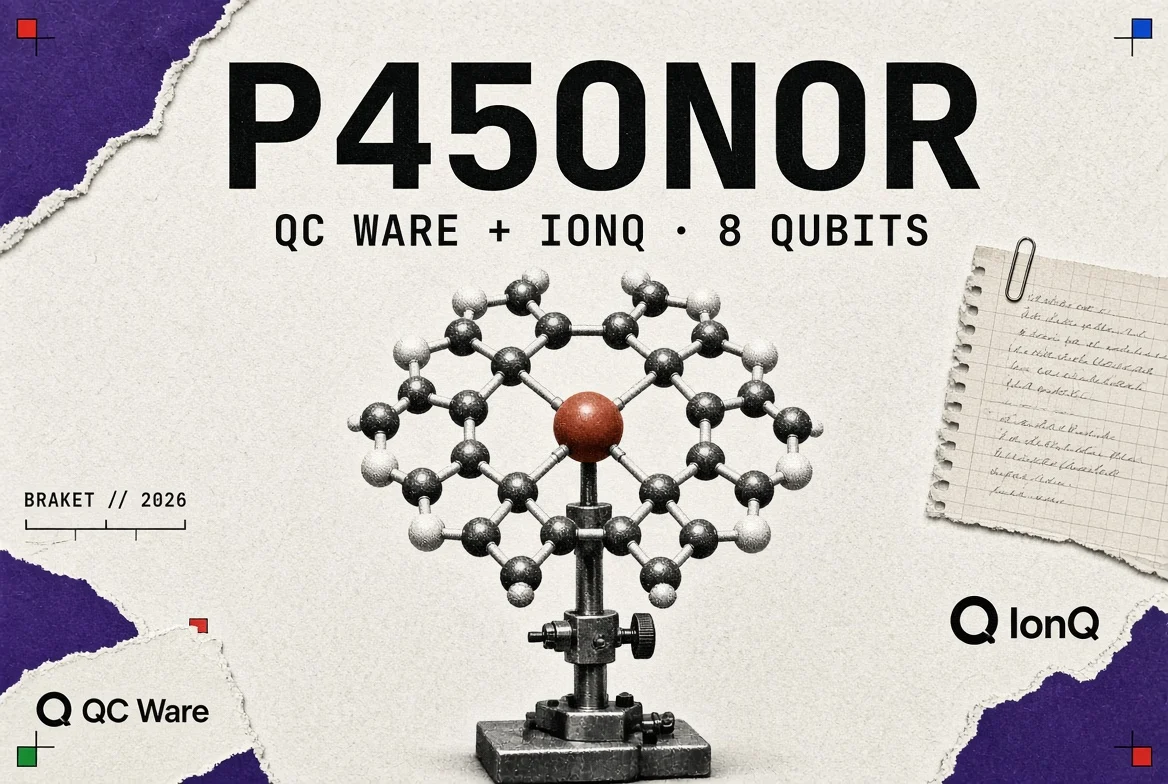
QC Ware put the announcement out at 08:00 New York time on Tuesday 1 September 2026, under a Palo Alto dateline and its own name. IonQ is quoted in it but is not a co-filer.
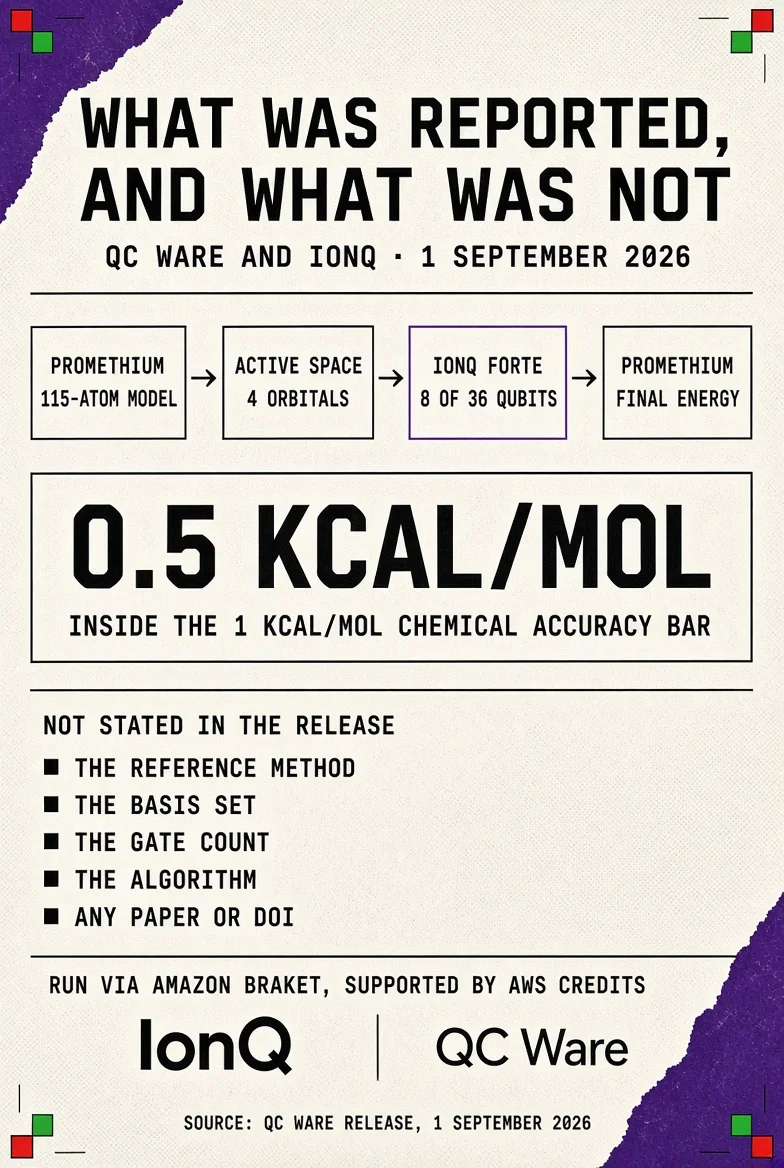
The claim, in the release’s own words: a hybrid workflow using QC Ware’s Promethium platform and IonQ’s Forte trapped-ion computer “calculated electrostatic interaction energy within 0.5 kcal/mol (~4%) of classical benchmarks. This falls well inside the 1 kcal/mol threshold for chemical accuracy and delivers more than double the accuracy of the standard classical mean-field method.”
Chemical accuracy is a real and useful bar. One kilocalorie per mole is roughly the error you can tolerate in a computed energy before the answer stops being able to tell you which of two molecules binds more tightly. Getting inside it on a metal centre is genuinely hard.
The question is what did the calculating.
What ran where
The release is unusually clear about the division of labour, and it is worth quoting in full:
Promethium built and preprocessed a complex 115-atom model of the P450nor active site containing over 1,000 molecular orbitals. It automatically isolated the strongly correlated region down to a 4-orbital active space mapped onto 8 qubits, which IonQ Forte measured in a single basis before returning results for Promethium to compute final interaction energies classically.
So: classical software built the model, classical software chose the four orbitals that needed quantum treatment, the quantum computer performed one measurement of those four orbitals, and classical software turned the result into an energy.
Eight qubits. IonQ’s own specification page says Forte has 36, and describes it as “IonQ’s largest single core quantum processor and our highest performing system to date”. The workflow used about a fifth of it, for one step.
The molecule, and why it was chosen
The system is the haem active site of cytochrome P450nor, which the release calls “a nitric oxide reductase in the cytochrome P450 superfamily”, and it notes that this is the same superfamily “whose monooxygenase members carry out most human drug metabolism.”
The relevance argument follows from that. Electrostatic interaction energy is, in the release’s framing, “a major factor in how tightly a drug candidate binds to its target”, and getting it right “at complex metal centers such as the iron site in P450nor, could improve candidate ranking and help identify metabolic risks earlier in the drug-discovery process.”
Note the mood of that sentence. Could improve. No drug, no target and no disease is named anywhere in the release, and no pharmaceutical company is credited with this work. The only drugmaker in the document is AstraZeneca, in IonQ’s standing corporate boilerplate about earlier systems.
What the number is measured against, which is the part that is missing
“Within 0.5 kcal/mol (~4%) of classical benchmarks” is a comparison, and a comparison needs a second term. The release never gives one.
It does not say whether the benchmark is coupled cluster with perturbative triples, a density matrix renormalisation group calculation, full configuration interaction, or an experimental value. Those choices are not interchangeable: agreeing to half a kilocalorie with a cheap reference and agreeing with an exact one are different achievements, and only the second would be interesting on a four-orbital active space that a laptop can diagonalise exactly.
The same omission runs through the technical detail. There is no electron count for the active space, no basis set, no two-qubit gate count, no circuit depth, no name for the algorithm, and no description of error mitigation or post-selection. The only hardware claim is architectural: “IonQ Forte’s all-to-all qubit connectivity enabled complex two-qubit entangling gates to execute as designed without the routing overhead or additional error typical of limited-connectivity architectures.”
And this particular result has no paper. Neither release contains the words arXiv, preprint, peer or DOI, and nothing on QC Ware’s publications page, which runs to 2 June 2026, covers the IonQ run, the 115-atom model or the 0.5 kcal/mol figure.
There is a direct precedent, and it is peer reviewed. In December 2023 three QC Ware researchers, Pauline Ollitrault, Matthias Loipersberger and Robert Parrish, published with Alpine Quantum Technologies and Boehringer Ingelheim colleagues what they called “the first hardware implementation of electrostatic interaction energies using a trapped-ion quantum computer”, on the same enzyme class: the reduction of nitric oxide catalysed by a nitric oxide reductase. It appeared in ACS Central Science in 2024 under DOI 10.1021/acscentsci.4c00058, and its result was electrostatic interaction energies “within chemical accuracy despite hardware noise”. That paper says what it measured against, on what hardware, with what circuits. This announcement, three years later and on a bigger model, does not.
The sentence that was there in August and is not there now
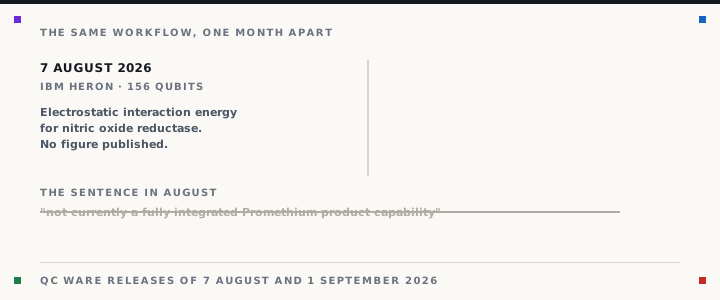
This is the second outing for the same workflow. On 7 August 2026 QC Ware announced the identical calculation, electrostatic interaction energy for nitric oxide reductase, run on IBM’s 156-qubit Heron superconducting processor rather than IonQ’s trapped ions. Kin-Joe Sham, QC Ware’s co-founder and chief operating officer, refers to it directly in the new release, calling the IonQ run “the same hybrid workflow” and saying it “shows that Promethium’s approach to combining classical and quantum computing is not tied to a single type of quantum hardware”.
The August release carried one sentence the September release does not:
This was a technology demonstration and is not currently a fully integrated Promethium product capability.
The September release still calls the work “a technology demonstration” in its opening line. It no longer says the capability is not in the product.
Nobody claims advantage, and nobody disclaims it
Neither release uses the word advantage. QC Ware and IonQ do not say the quantum computer did something a classical one could not, and they do not say it did something a classical one could. The phrase “classical computer” appears in neither document.
That silence is doing work. A four-orbital active space is small enough to solve exactly on a laptop, so the natural reading is that the hardware run reproduced a result already obtainable without it, on a system chosen to be chemically realistic rather than classically hard. Our explainer on quantum advantage sets out what would have to be shown for the stronger claim, and none of it is claimed here.
IonQ’s own commercial position is visible in the same release. The company’s boilerplate calls the IonQ Tempo its “newest generation” of systems, and this demonstration ran on Forte, the previous one. Our page on IonQ tracks the hardware line and what each machine can do.
Who paid for the cloud time
One line near the end names the third party: “Supported in part by Amazon Web Services (AWS) cloud compute credits, the demonstration highlights how QC Ware’s cloud-native Promethium® platform can potentially allow classical GPU clusters to seamlessly connect with cloud quantum computing resources on Amazon Braket.”
The IonQ machine was reached through Amazon Braket, which sells quantum computing time, and AWS part-funded the run with credits for its own service. That is a normal arrangement and it is disclosed, which is more than many such announcements manage.
What a reader should take from it
Two real things happened. A commercial chemistry platform ran the same hybrid pipeline on two entirely different quantum architectures a month apart, which is a portability result and a fair one to publicise. And a metalloenzyme active site, the kind of system quantum chemistry actually struggles with, was set up end to end in a workflow a pharmaceutical team could in principle run.
What has not happened is publication. The same group put its earlier trapped-ion result through a journal, with its methods attached; this one arrived as a press release with a number in it. Until the reference method is named, “chemical accuracy” here is a claim about agreement with an unnamed calculation, made by the parties who ran it.
Sources
- QC Ware and IonQ Demonstrate High-Precision Hybrid Quantum Workflow for Drug Discovery (QC Ware, 1 September 2026)prnewswire.com
- QC Ware Demonstration of Hybrid Quantum-Classical Workflow Using Promethium and IBM Quantum (QC Ware, 7 August 2026)prnewswire.com
- IonQ Forte system specificationsionq.com
- QC Ware research and publicationsqcware.com
- Estimation of Electrostatic Interaction Energies on a Trapped-Ion Quantum Computer (arXiv:2312.14739)arxiv.org
- Amazon Braket, IonQ hardware provider pageaws.amazon.com