IonQ's quantum link creates 1,000 entangled pairs per second
IonQ reported a 1.03 kHz entanglement rate between a trapped-ion qubit and a silicon-vacancy memory. The preprint reports 87.9% Bell-state fidelity for the heterogeneous link.
Listen to this articleListen
IonQ announced on 9 October 2026 that it had created more than 1,000 entangled pairs per second between a trapped-ion qubit and a quantum memory. The company’s announcement presents the photonic interconnect as a step towards distributed quantum computing.
The research preprint, submitted on 7 October, reports an average rate of 1.03 kHz and 87.9% Bell-state fidelity. Both figures describe the demonstrated link and are relevant when assessing its usefulness.
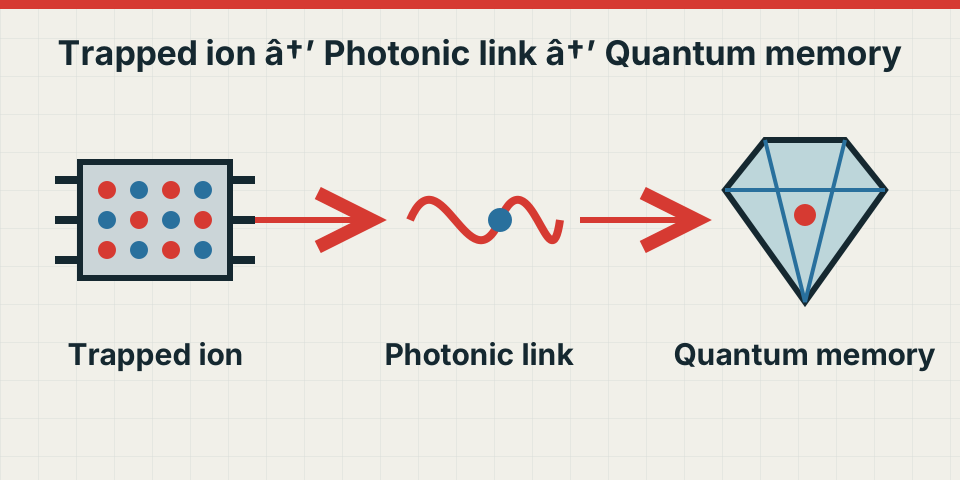
The link joins an ion to a memory in diamond
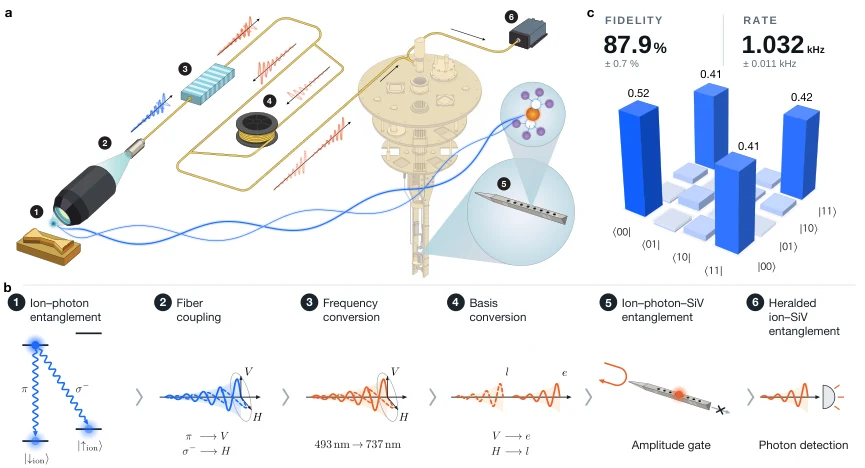
The experiment connects a trapped barium ion to a silicon-vacancy quantum memory in diamond. The two components use different physical systems to hold quantum information.
A photonic connection establishes entanglement between them. The memory provides a place to retain a quantum state while the network performs further operations, helping bridge the timing needs of separate devices.
Rate and fidelity describe different parts of the result
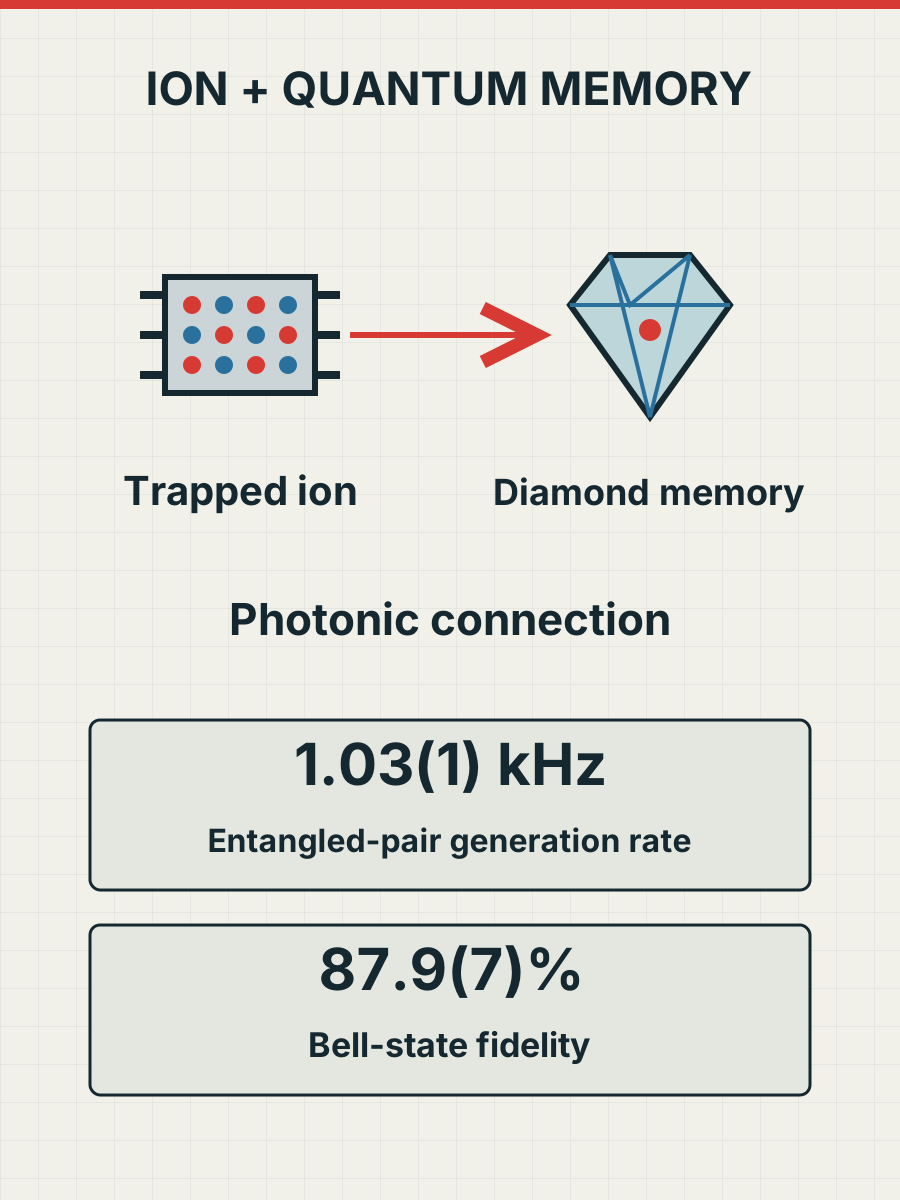
The 1.03 kHz rate covers initialisation through the start of readout; the fidelity describes the entangled pairs’ quality. The paper reports 612(4) Hz when final readout is included. The generation and fidelity figures are 1.03(1) kHz and 87.9(7)%, preserving the authors’ uncertainty notation.
| Reported measure | Result |
|---|---|
| Generation rate, through the start of readout | 1.03(1) kHz |
| Rate including final readout | 612(4) Hz |
| Bell-state fidelity | 87.9(7)% |
| Linked systems | Trapped barium ion and silicon-vacancy memory |
The authors include conversion losses in their rate. They compare it with the fastest reported ion-ion photonic link, describing roughly a fourfold increase.
Quantum memories can help processors work together
Distributed quantum computing needs quantum connections between separate processors, alongside the operations performed inside each machine. IonQ’s stated goal is to connect modules as a route to larger systems.
The memory-enhanced design brings computation and networking components into the same experiment. IonQ describes its work with heterogeneous quantum architectures as part of a broader effort supported by DARPA’s HARQ programme.
Networking must keep pace with processor cycles
The researchers connect their generation rate to the cycle time of planned trapped-ion processors. At around one generated Bell pair per millisecond, the link operates at a cadence relevant to coordinating separate modules.
IonQ describes the experiment as a world-first quantum memory-enhanced interconnect. Its measured connection combines a trapped-ion qubit, a photonic link and a solid-state memory in one heterogeneous system.