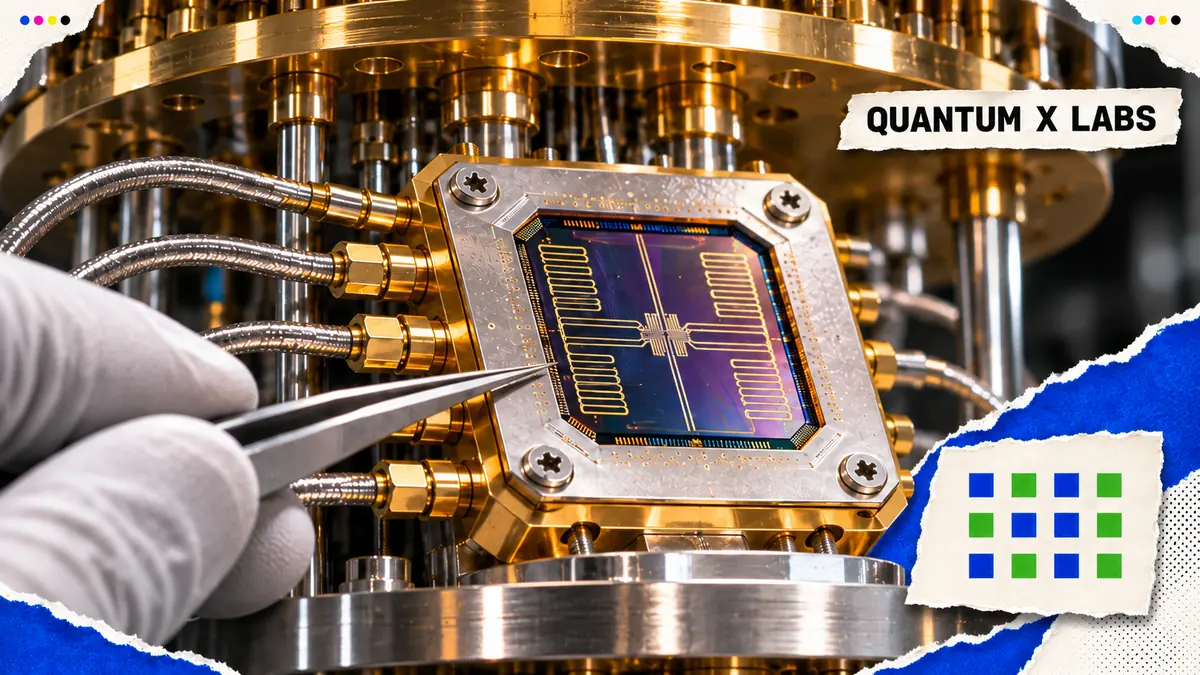
Quantum X Labs simulated radiation shielding on 16 IBM qubits
Quantum X Labs ran a 16-qubit algorithm on IBM's Fez processor that modelled 140 keV photons passing a tungsten collimator. After noise mitigation its results showed a root-mean-square deviation of about 0.03 to 0.04 from an exact classical simulation, the company said on 20 November 2026.
Listen to this articleListen
Quantum X Labs said on 20 November 2026 that a 16-qubit algorithm running on IBM’s Fez quantum processor had simulated how photons travel through a tungsten collimator, a form of radiation shielding, with results closely matching classical calculations. The Tel Aviv company’s Nuclear Simulation Team modelled 140 keV photons passing a two-dimensional collimator, a tungsten block with narrow channels that lets through only radiation travelling in line with them. After hardware-noise mitigation, the results showed root-mean-square deviations of about 0.03 to 0.04 from an exact classical simulation.
David Shnaiderov, the company’s Head of Nuclear Quantum, said the team had “demonstrated a coherent and efficient oracle that can serve as a foundation for quantum amplitude estimation”. Amplitude estimation is the method Quantum X Labs is building towards: a quantum way of estimating a probability that in theory needs far fewer samples than the random sampling behind Monte Carlo simulations.
What did the quantum computer simulate?
The 16-qubit circuit modelled photons at 140 keV, the same energy as the gamma rays from technetium-99m, the radioisotope most widely used in medicine, as they travel from a source through a tungsten collimator to a detector. Quantum X Labs says the model covers photon propagation, scattering, attenuation and detection, including the effects of channel geometry and the detector’s energy threshold, and the team varied the tungsten’s attenuation and the width of the channels. In a collimator, a photon either travels along a channel, is absorbed in the tungsten, or scatters and loses energy, and the threshold decides which arrivals the detector counts.

The circuit uses “quantum-state preparation and reversible quantum operations” to encode particle transport probabilities, Quantum X Labs says. Each measurement point was built from 4,096 shots, or repeated runs of the circuit.
How close were the results?
After mitigating hardware noise, Quantum X Labs reports root-mean-square deviations of about 0.03 to 0.04 between its IBM Fez results and an exact classical statevector simulation, with 4,096 shots for each measurement point. A root-mean-square deviation is the typical size of the gap between two sets of numbers. A statevector simulation computes a circuit’s output exactly on an ordinary computer, which is straightforward at 16 qubits, so it gives a true answer to compare against. The company says the results also closely aligned with analytical calculations.
| Detail | Figure |
|---|---|
| Algorithm size | 16 qubits |
| Processor | IBM Fez, a 156-qubit Heron r2 chip |
| Photon energy | 140 keV |
| Setup | Two-dimensional tungsten collimator |
| Shots per measurement point | 4,096 |
| Deviation from the exact simulation | About 0.03 to 0.04 (root mean square), after noise mitigation |
Why run radiation transport on a quantum computer?
Radiation transport is most often calculated by Monte Carlo simulation, which follows very large numbers of individual particles, and a quantum method called amplitude estimation could in theory reach the same accuracy from far fewer samples. “Conventional GPU-based methods can require large numbers of particle histories,” Shnaiderov said. Ashley Montanaro of the University of Bristol showed in 2015 that a quantum algorithm can estimate the average output of such a random process with “a near-quadratic speedup over the best possible classical algorithm”. In theory, an estimate that takes a million classical samples would take roughly a thousand calls to the quantum circuit, before the overheads of running deep circuits on today’s hardware.
This run measured accuracy: it built and tested the oracle, the part of the circuit that amplitude estimation calls on, at a size an ordinary computer can check exactly. Adding amplitude estimation, and comparing speed with GPU Monte Carlo, are the company’s next steps. “Our next objective is to integrate amplitude estimation and test whether it can deliver comparable accuracy” with “fewer sampling operations”, Shnaiderov said. “Demonstrating the underlying circuit on real quantum hardware is an important step toward that goal.”
What is IBM Fez?
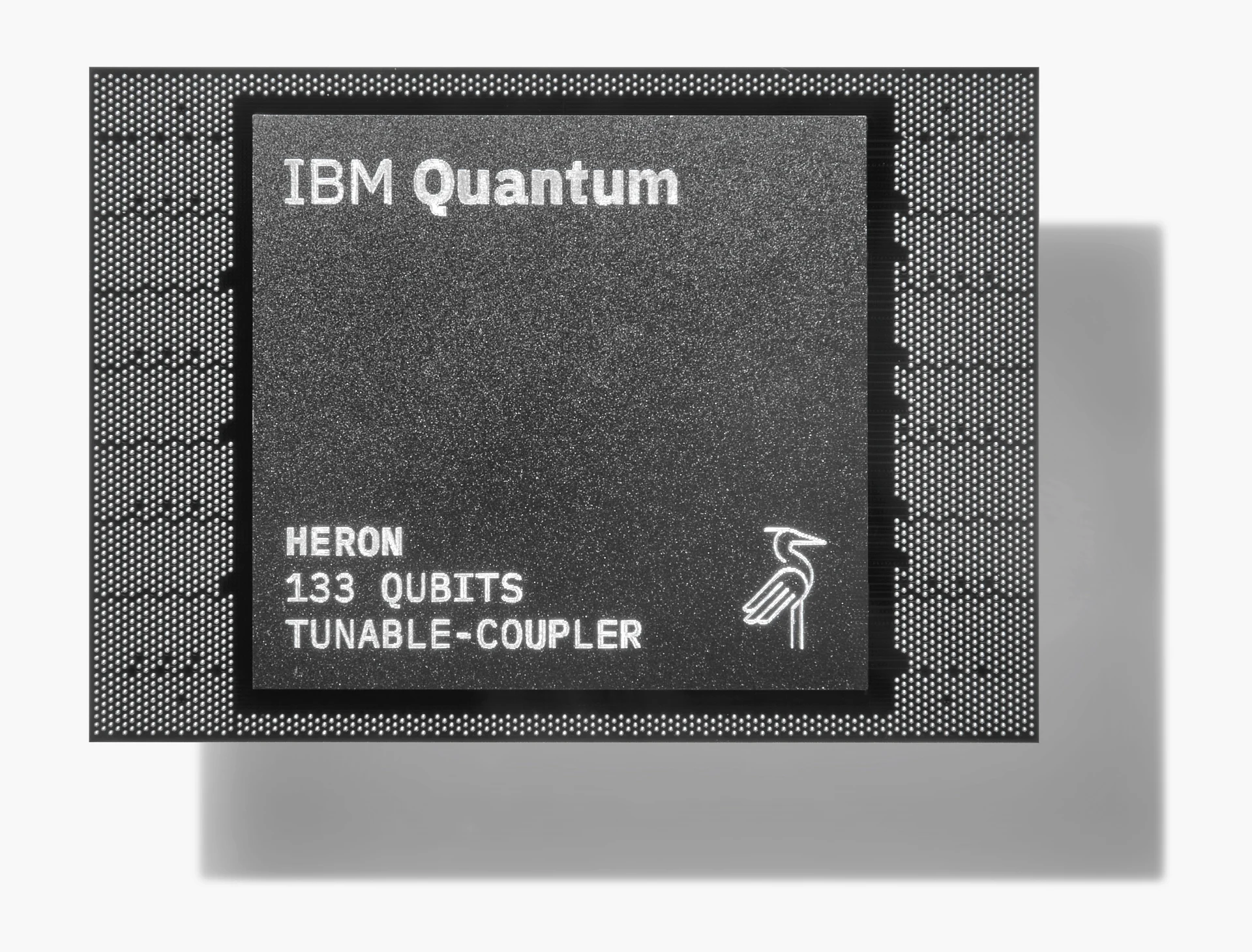
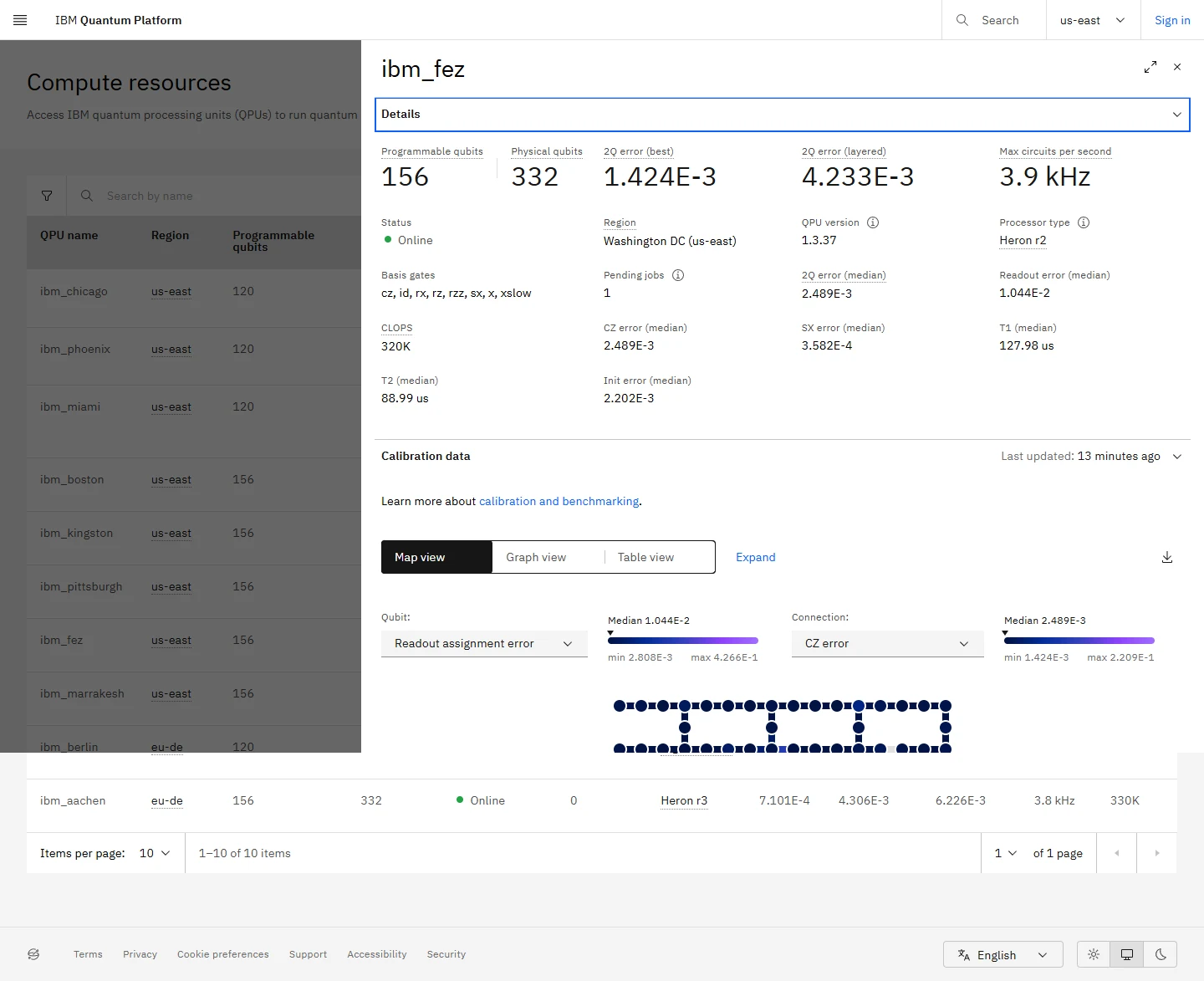
IBM Fez is a 156-qubit superconducting processor from IBM’s Heron r2 line, which IBM runs in its us-east region and lists on IBM Quantum Platform. IBM’s documentation says the Heron r2 chip, from July 2024, “has been redesigned to include 156 qubits in a heavy-hexagonal lattice”. Fez is one of several IBM quantum systems that outside companies can run circuits on through the cloud.
| IBM Fez on 20 November 2026 | Figure |
|---|---|
| Processor | Heron r2 |
| Qubits | 156 |
| Best two-qubit error | 0.14% (1.424 × 10⁻³) |
| Median two-qubit error | 0.25% |
| Median readout error | 1.04% |
| Speed | 320,000 circuit layer operations per second |
What comes next for Quantum X Labs?
Quantum X Labs plans to add amplitude estimation, make its nuclear simulation algorithms more complex and benchmark its sampling needs and computing performance against GPU-accelerated Monte Carlo methods. The company has worked with Fez data before: on 9 November it reported up to 20% fewer logical decoding failures in preliminary error-correction tests using data from Fez, Kingston and Pittsburgh.
Quantum X Labs Inc. describes itself and its subsidiaries as focused on quantum technology, digital advertising and computing, and enterprise artificial intelligence.
Sources
- Quantum X Labs: accurate quantum radiation simulation on IBM quantum computer, 20 November 2026globenewswire.com
- IBM Quantum: processor typesquantum.cloud.ibm.com
- IBM Quantum Platform: ibm_fezquantum.cloud.ibm.com
- IBM: next-generation quantum processor and IBM Quantum System Two, 4 December 2023newsroom.ibm.com
- Ashley Montanaro: Quantum speedup of Monte Carlo methods, 2015arxiv.org
- Quantum X Labs: error-correction programme expands to three IBM quantum processors, 9 November 2026globenewswire.com
- Washington State Department of Health: technetium-99m fact sheetdoh.wa.gov