
Quantum State of Play
State of Play
Quantum State of Play
The house verdict on where this frontier stands.
Time-sensitiveUpdated
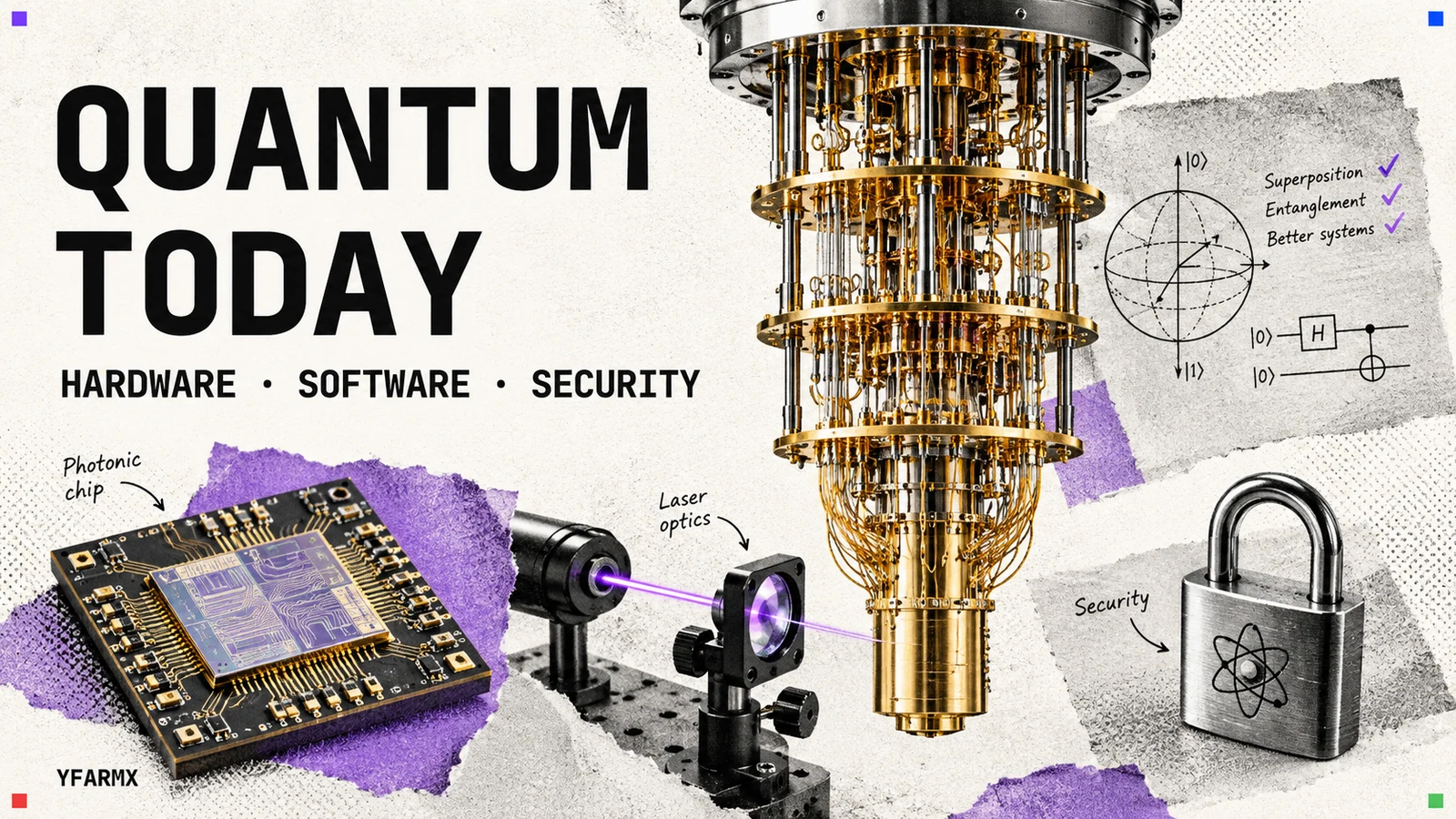
Qubits
QUBIT TECHNOLOGIES / HARDWARE APPROACHES
On 9 October, IonQ announced an experimental link between a trapped barium ion and a silicon-vacancy quantum memory. The paper reports entanglement generation at about 1,030 entangled pairs per second, with 87.9% fidelity, a measure of how closely the shared state matches the intended state. This processor-memory experiment is a step towards connecting separate quantum systems.
- 256
- Superion 256 planned physical qubits
- 2027
- Superion 256 planned delivery
- 9 OctOn 9 October, IonQ announced an experimental link between a trapped barium ion and a silicon-vacancy quantum memory. The paper reports entanglement generation at about 1,030 entangled pairs per second, with 87.9% fidelity, a measure of how closely the shared state matches the intended state. This processor-memory experiment is a step towards connecting separate quantum systems. Read more →
- 2 OctAlice & Bob and ENS de Lyon drive a new coupler with a DC bias of about one microvolt across a SQUID in place of the usual microwave pump, activating one-, two- and four-photon exchange between a memory resonator and a lossy buffer, with two-photon exchange at up to 18.5 MHz. Future cat qubits could be built around it (arXiv preprint). Read more →
- 8 SepSuperion 256 is an announced product with a working prototype milestone. IonQ dates customer deliveries to 2027. Read more →
- 26 AugIBM completes its acquisition of HRL Laboratories, the Boeing and GM venture behind silicon-spin qubits, agreed on 23 July: a second qubit technology now sits in-house beside the superconducting programme, with terms undisclosed and both former owners staying on as partners. Read more →
- 24 AugJapan's first full-stack neutral-atom quantum computer, Shunkai, is operational at the Institute for Molecular Science: roughly 50 qubits now and around 500 planned, built under the Moonshot programme with Infleqtion contributing to the quantum processing unit, and partially open to external users.
- 11 AugPasqal reports trapping four neutral atoms with light delivered from a photonic chip in place of the optical bench: a company claim, with no paper and no fidelity figures attached, against the 2,088-site array in its own 2024 paper. Read more →
- 5 AugD-Wave demonstrates a two-qubit entangling gate at roughly 99.9% fidelity in about 500 nanoseconds on dual-rail erasure qubits, published in Nature: its first serious gate-model hardware claim after two decades of annealing.
- JulyQuantinuum and academic partners demonstrate the first universal topological gate set from non-Abelian anyons on the H2 processor (Nature).
- StandingSeveral rival physical approaches remain in play, from superconducting circuits to laser-cooled atoms, and the pivot is towards those that natively support scaling and error correction.
Companies
MAJOR HARDWARE COMPANIES / FULL-STACK PLAYERS
IonQ priced a $2bn equity offering on 14 October. The announcement covers the proposed securities and pricing; it is separate from confirmation of closing or a reported cash balance.
- Stage C
- IonQ · independent assessment
- 19 Oct
- DOE application deadline
- 14 OctIonQ priced a $2bn equity offering on 14 October. The announcement covers the proposed securities and pricing; it is separate from confirmation of closing or a reported cash balance. Read more →
- 13 OctD-Wave and SkyWater extend their manufacturing collaboration in Minnesota for annealing and gate-model systems under a multiyear agreement. Read more →
- 7 OctDARPA’s 7 October roster lists Atom Computing, Diraq, IBM, IonQ, Microsoft and PsiQuantum in Stage C of its Quantum Benchmarking Initiative. Independent teams will assess whether each proposed system can be built and operated at a useful economic cost. Read more →
- 8 OctIonQ entered the final assessment stage of DARPA’s Quantum Benchmarking Initiative on 7 October. The programme will test successive Superion systems through 2029. Potential funding is up to $300m, with later amounts conditional on future appropriations and DARPA decisions. DOE competition applications close on 19 October. Read more →
- 28 SepPasqal leaves LSQUARE, the French defence quantum programme also known as PROQCIMA, after completing all the technical objectives of its first phase, to focus on commercial applications. France's SGPI and DGE have asked it to submit a research and development programme for fault-tolerant neutral-atom computing under civil public support (Pasqal's release). Read more →
- 25 SepGermany's Quantum Computing Competition moves six start-up-led consortia to its next phase: PlanQC and EQCITED on neutral atoms, QUDORA and neQxt on trapped ions, IQM Germany and Peak Quantum on superconducting circuits. Each must show at least 24 controllable qubits with two-qubit gate fidelity of at least 99.5% by 31 March 2027, on the way to at least two error-corrected machines in Germany by 2030, from a budget of about €640m ($729.8m). Read more →
- 24 SepPasqal reports its first results as a listed company: first-half revenue of €4.9m ($5.6m), up 14%, with QPU-related services up 34% to €3.9m ($4.4m); an operating loss of €59.2m ($67.3m), including €37.5m ($42.6m) of share-based payments and one-time charges; and €110.8m ($125.9m) of cash at 30 June, before its business combination closed on 27 August. Read more →
- 23 SepIonQ's Superion 256 will be the first quantum processor at Nvidia's Accelerated Quantum Research Center in Boston, linked to a GB200 NVL72 system through NVQLink with workloads run on CUDA-Q. Installation is scheduled for 2027, and the joint programme covers hybrid software and large-scale system prototyping. Read more →
- 22 SepMicrosoft opens a 15,000 sq ft quantum research centre in Maryland's Discovery District with the University of Maryland. DARPA gets on-site access to topological qubits built on the Majorana 2 chip for independent testing under its Underexplored Systems for Utility-Scale Quantum Computing programme, part of the Quantum Benchmarking Initiative. Read more →
- 22 SepGermany's research ministry sends QUDORA's NFQC-1k consortium to the full-application stage: a project of about €122m ($139.8m) over up to five years to build a trapped-ion computer of at least 1,000 physical and 50 logical qubits, plus a pilot line for its processor chips. Seven partners include PTB, NXP Semiconductors Germany and Forschungszentrum Jülich. Read more →
- 22 SepIonQ signs a contract to deliver a Superion 256, with 256 trapped-ion qubits, to Florida International University in Miami: its first Superion 256 sale in Florida and the state's first on-premises trapped-ion system, with installation expected in late 2027 once FIU's on-campus data centre is complete (IonQ's release). Read more →
- 17 SepThe DOE opens the Quantum Genesis Q Competition under RFA DE-FOA-0003657: up to $215m planned with $2.5m of FY2026 money appropriated, targeting a fault-tolerant machine of at least 100 logical qubits by 2028. Applications close 19 October, with initial selections expected no earlier than 13 November. Read more →
- 8 SepD-Wave’s agreement provides access to up to $100m for annealing and gate-model R&D. Disbursement remains subject to conditions, including milestones, and the government is to receive a minority, non-controlling stake. Read more →
- 8 SepRigetti’s $100m agreement targets readout electronics, cryogenic capacity and chip fabrication. The company explicitly states that a minority, non-controlling government stake is a condition of receiving funding. Read more →
- 8 SepQuantinuum finalised a $100m agreement for trapped-ion manufacturing R&D, following its May letter of intent. The company names GlobalFoundries and Monarch Quantum as domestic supply-chain partners. Read more →
- 8 SepPsiQuantum signs its own final CHIPS award of up to $100m the same day, funding electro-optic materials, single-photon detectors and packaging work at its Santa Clara facility, under the same minority, non-controlling equity condition. Four of the nine May letters of intent are now definitive agreements. Read more →
- 8 SepIonQ raises its full-year 2026 outlook at its investor day: combined revenue of $450m to $460m with SkyWater consolidated from the 31 July acquisition date, standalone guidance reaffirmed at $280m to $290m. Read more →
- 28 AugPasqal begins trading on Nasdaq as PSQL, a day after completing its business combination with Bleichroeder Acquisition Corp. II with roughly $360m of cash at closing; the shares end their first session at $19.11. On 24 August it also formed Pasqal Arabia with Eleven Ventures, a joint venture to deploy neutral-atom systems across Saudi Arabia and the wider region.
- 28 AugXanadu signs a definitive agreement with the Government of Canada for a CAD $195m investment through the Strategic Response Fund, the federal anchor of Project OPTIMISM: a CAD $893m plan for a 158,000 sq ft photonics research and manufacturing facility in Toronto, creating 275 high-skilled jobs.
- 26 AugIBM completes its acquisition of HRL Laboratories, agreed on 23 July: silicon-spin qubits and quantum sensing join the superconducting programme, terms undisclosed, and former owners Boeing and General Motors continue as partners on quantum applications. Read more →
- 25 AugIonQ researchers post a real-time decoder for a MegaQuOp trapped-ion machine on arXiv, benchmarked to 408 logical qubits on 12 cores of a single Apple M4 Max: the case, two weeks before the 8 September investor day, that its fault tolerance needs no FPGAs or ASICs.
- 25 AugIonQ appoints Dr Eric Ball and Timothy Baxter to its board; a day earlier its Skyloom optical communications terminals reached 84 on-orbit installations.
- 25 AugD-Wave's chief financial officer John Markovich announces his retirement, resigning with effect from 2 September; Greg Golkov, senior vice president of finance since May 2023, steps up as acting CFO. The company says the departure involves no disagreement over its business, accounting or reporting.
- 19 AugRigetti creates a dedicated systems delivery organisation to scale customer deployments, appointing David Rivas to the newly created chief operating officer role and Andrew Bestwick chief technology officer.
- 19 AugIBM connects and cools its first two modular cryogenic systems as a single environment: over eight feet tall, 4 kelvin in under five days, settling below 15 millikelvin. Nighthawk processors go inside later this year, on the roadmap that puts 1,000-plus linked qubits in 2027 and Starling in 2029. Read more →
- 18 AugIonQ signs a memorandum with Canada's CMC Microsystems to become a listed cloud provider on the FABrIC Quantum Computing Sandbox, funded by the Government of Canada's Strategic Response Fund, opening its trapped-ion systems to Canadian academics and small firms.
- 14 AugQuantinuum and Quanta Computer agree to develop the hardware infrastructure for its future systems together, aiming at machines that are modular and manufacturable at scale. Announced late on 13 August US time; no figures disclosed.
- 11 AugQuantinuum reports Q2: revenue up 279% to $8m, $2.1bn in cash, full-year guidance of $28-32m, and a claim of near five-nines logical fidelity on Helios. The same day, Oracle announces it will host Helios on-premises in an OCI AI data centre.
- StandingRoadmaps now carry dated fault-tolerance targets rather than ambitions: IBM's Starling is set for 2029, and the advantage era has opened ahead of the end-2026 target.
- 21 MayCommerce’s original letters of intent already included the equity condition for the selected companies, including Quantinuum. The September announcements move these three awards to definitive agreements. Read more →
Software
SOFTWARE / CLOUD / DEVELOPER PLATFORMS
IBM announced directed execution on 5 October, giving developers more control over how quantum jobs run. Its 6 October Qiskit guide also explains native Fortran, C++ and Julia access through the existing C interface. Quantinuum’s UWA agreement provides remote Helios access for research and training.
- 5 Oct
- IBM directed execution
- 98
- Helios physical qubits
- 8 OctIBM announced directed execution on 5 October, giving developers more control over how quantum jobs run. Its 6 October Qiskit guide also explains native Fortran, C++ and Julia access through the existing C interface. Quantinuum’s UWA agreement provides remote Helios access for research and training. Read more →
- 5 OctQuantinuum and the University of Western Australia announced an agreement on 5 October for remote access to Helios, research and training. Helios has 98 physical qubits. The agreement covers cloud access to the processor. Read more →
- 1 OctD-Wave opens a beta of its gate-model simulator, built around its dual-rail superconducting qubits, to select customers ahead of general availability: BBVA, FirstQFM, Florida Atlantic University and the Jülich Supercomputing Centre, through its Leap cloud service and Ocean SDK (D-Wave's release). Read more →
- 1 OctCloudflare Workers add ML-KEM-768 and ML-KEM-1024 key encapsulation and ML-DSA-44, ML-DSA-65 and ML-DSA-87 signatures to the Web Crypto API, as opt-in calls for developers (Cloudflare blog). Read more →
- 22 SepQuEra and HPE agree to integrate QuEra's neutral-atom machines with on-premises HPE Cray supercomputers, through integrated testbeds, hybrid algorithm co-design, software interoperability and system-level benchmarking, with plans for a potential gigaquop system. QuEra's first fault-tolerant machine, Libra, is an over-256-logical-qubit megaquop-class system targeted for cloud availability in 2028 (QuEra's release). Read more →
- 10 SepXanadu and AMD launch Backline, an open-source PennyLane extension linking CPUs, GPUs, FPGAs and SmartNICs to quantum hardware at sub-3-microsecond latency, aimed at real-time error correction and sensing (company release). Read more →
- 11 AugThe partners plan to put the 98-physical-qubit Helios system inside a US OCI AI data centre, integrating it with OCI compute, identity and governance. Oracle’s announcement gives a future preview window without a firm launch date. Read more →
- 25 JulQiskit's Functions catalogue adds Orbit, automating dynamical decoupling, hardware-aware transpilation and measurement error mitigation.
- StandingNVIDIA's CUDA-Q ships real-time error-correction tooling for its NVQLink interconnect.
- JuneHPE announces quantum-HPC integration with eight hardware companies.
- StandingAWS Braket and Azure Quantum remain the broadest cloud entry points.
Infrastructure
CONTROL / INFRASTRUCTURE / NETWORKING
IonQ agreed on 12 October to acquire Elisity, a network-security company, for up to $1.3bn in stock, including up to $150m tied to performance. Closing is expected in the fourth quarter of 2026, subject to approvals and other conditions.
- 300mm
- wafer manufacturing route
- 12 OctIonQ agreed on 12 October to acquire Elisity, a network-security company, for up to $1.3bn in stock, including up to $150m tied to performance. Closing is expected in the fourth quarter of 2026, subject to approvals and other conditions. Read more →
- 9 OctOn 9 October, IonQ announced an experimental link between a trapped barium ion and a silicon-vacancy quantum memory. The paper reports entanglement generation at about 1,030 entangled pairs per second, with 87.9% fidelity, a measure of how closely the shared state matches the intended state. This processor-memory experiment is a step towards connecting separate quantum systems. Read more →
- 29 SepCloudflare ships beta downgrade protection for IPsec in Cloudflare WAN and Magic Transit: an IKEv2 extension, developed with the IETF's IPSECME working group, that authenticates the full handshake transcript so an attacker cannot strip out the post-quantum key exchange. Cloudflare has brought its own full post-quantum deadline forward to 2029 (Cloudflare blog). Read more →
- 24 SepIndia's DRDO signs its first high-value deep tech agreement with a start-up under the Technology Development Fund: Zero mK India, of Alwar in Rajasthan, will develop a 20 millikelvin dilution refrigerator for quantum computing, the first high-value award from a Rs 500 crore ($52.1m) deep-tech corpus (Ministry of Defence release). Read more →
- 8 SepQuantinuum names 300mm wafer fabrication for future ion traps and control electronics, alongside scalable lasers and optical components. Read more →
- 25 AugIonQ researchers post a complete real-time decoding pipeline for a MegaQuOp trapped-ion machine on arXiv, benchmarked to 408 logical qubits and up to a million T gates on a single 2024 Apple M4 Max using 12 of its 16 cores: trapped ions' millisecond syndrome cycles, they argue, mean fault tolerance needs no FPGAs or ASICs.
- 19 AugIBM connects two cryogenic modules through its L-coupler and runs them as one environment, reaching 4 kelvin in under five days and settling below 15 millikelvin, with twelve times the wiring space of its current systems in each module's vacuum enclosure. Read more →
- 13 JulNVIDIA releases its open Ising decoder family, cutting colour-code logical error rates by 347.7 times. Read more →
- StandingNVQLink, adopted by 17 hardware builders and nine US national laboratories, couples QPUs to GPUs so correction happens live rather than afterwards.
- StandingRiverlane and Zurich Instruments continue building decode-and-control stacks for thousand-qubit machines.
Algorithms
ALGORITHMS / CORE METHODS
IonQ estimates that a future quantum computer with 19,397 physical qubits could attack the cryptography used by Bitcoin in 25.7 days. This is a calculation for a proposed fault-tolerant machine; today’s devices remain far smaller.
- 25.7 days
- estimated time per attempt
- 19,397
- physical qubits in design
- 1,457
- logical qubits
- 8 SepThe estimate maps Shor’s algorithm into error correction, routing and hardware resources. Its machine requirements are assumptions for a future system. Read more →
- StandingResearch has moved off the near-term heuristic methods that error-prone hardware defeats, standard VQE among them.
- StandingThe focus is now deep utility-scale algorithms such as phase estimation and advanced quantum simulation.
- StandingThese are written for hardware that corrects its own errors, which every roadmap now assumes arrives.
Engineering
ENGINEERING / BENCHMARKS / FAULT TOLERANCE
Google’s 8 October preprint studies virtual error cancellation using stored error-detection records and classical post-processing. Simulations of a surface-code error-correction scheme show more than three orders of magnitude suppression of logical errors in the tested setting. This is a numerical research result.
- 408
- logical qubits decoded · simulated
- 0.02%
- run-time stretch from decoding
- 2027
- Superion 256 delivery target
- 8 OctGoogle’s 8 October preprint studies virtual error cancellation using stored error-detection records and classical post-processing. Simulations of a surface-code error-correction scheme show more than three orders of magnitude suppression of logical errors in the tested setting. This is a numerical research result. Read more →
- 22 SepIonQ announces what it calls the industry's first end-to-end real-time error-correction decoder on a single off-the-shelf CPU. In benchmark circuits simulating 408 logical qubits across 88 memory blocks and magic factories, running more than 31.5 million operations, decoding stretched run time by as little as 0.02%. Read more →
- 8 SepIonQ is developing the larger Superion 10K platform alongside its 256-qubit product. Capacity and delivery targets remain company roadmap commitments. Read more →
- 2 SepQuantinuum researchers post experimental validation of the C4-Helix fault-tolerant architecture on Helios: a logical error rate of 4.6e-5 per logical qubit per correction cycle, logical Clifford error of 2.8e-4 per two-qubit gate, and a three-logical-qubit GHZ state at 99.925% fidelity or better (arXiv preprint). Read more →
- 25 AugIonQ publishes a real-time decoder for a MegaQuOp quantum computer on arXiv: benchmarked to 408 logical qubits and up to a million T gates on 12 cores of a single Apple M4 Max, keeping pace with syndrome-extraction cycles of 1 to 5 milliseconds.
- 5 AugD-Wave demonstrates a 99.9%-fidelity entangling gate in about 500 nanoseconds on dual-rail erasure qubits (Nature), with simulations showing logical error rates falling tenfold for each step up in code distance.
- 2026Quantinuum's 98-qubit Helios carries a Sandia-verified two-qubit infidelity of 7.9e-4 (Nature).
- StandingGoogle's Willow and USTC's Zuchongzhi 3.2 have both run surface codes below threshold.
- StandingAI-assisted decoders keep cutting logical error rates, so the yardstick is now logical quality held across deep circuits.
Applications
APPLICATIONS / SCIENCE / INDUSTRIAL USE CASES
Infleqtion announced £9m of Innovate UK funding on 13 October for phase two of QuDiFi with Leonardo. The project develops a deployable radio-frequency direction-finding system using Rydberg atoms.
- 5 Oct
- Arkansas supply-chain initiative
- A$3.6m
- Energy-forecasting trial funding
- 13 OctInfleqtion announced £9m of Innovate UK funding on 13 October for phase two of QuDiFi with Leonardo. The project develops a deployable radio-frequency direction-finding system using Rydberg atoms. Read more →
- 8 OctD-Wave and the University of Arkansas announced a supply-chain research and education initiative on 5 October. Separately, Silicon Quantum Computing and Schneider Electric’s expanded energy-forecasting trial has A$3.6m (US$2.5m) in funding and will cover hundreds of homes. Read more →
- 2 OctSilicon Quantum Computing and Schneider Electric move to Stage 2 of Australia's Critical Technologies Challenge Program with A$3.6m (US$2.5m). On the companies' own figures, SQC's Watermelon chip improved next-day grid-consumption forecasts by an average 20% against the classical benchmark over 12 months, with gains up to 41%; Stage 2 extends the modelling to hundreds of homes, with UNSW Sydney (SQC's release). Read more →
- 29 SepNATO publishes its Quantum Technology Roadmap: a pilot quantum-resilient link between NATO headquarters in Brussels and SHAPE in Mons by the fourth quarter of 2027, an industry study on readiness for quantum-resistant cryptography by the second quarter of 2027, and sea trials of quantum sensing for navigation without GNSS in 2026 and 2027 (NATO). Read more →
- 29 SepCloudflare announces it is becoming a public certificate authority, with its first production Merkle Tree Certificates due in the first quarter of 2027, aimed at Chrome's Quantum-resistant Root Store. Served to 50% of Chrome Beta 146 in a test, the certificates were 9% faster at the median than a classical certificate chain (Cloudflare blog). Read more →
- 23 SepStarkWare reports that a week-long optimisation challenge cut the GPU compute needed to build a quantum-safe Bitcoin transaction by 79%, from about $320 for the first mainnet transaction in August to an estimated $67 on the challenge's GPU benchmark. The leading entries came from developers working with AI models. Read more →
- 22 SepNIST's validation programme moves every remaining FIPS 140-2 certificate to Historical status on 22 September: new federal procurement should specify FIPS 140-3 modules, while existing systems may continue running the old ones (NIST's transition page). Read more →
- 17 SepIonQ and Synopsys embed a quantum-accelerated matrix-reordering algorithm in Ansys LS-DYNA, cutting total execution time by up to 14.6% on industrial models with meshes to 35 million data points; physical validation ran on IonQ's 36-qubit Forte. First Place Best Paper at IEEE Quantum Week 2026 (IonQ's own release). Read more →
- 8 SepThe paper’s 25.7-day estimate is per attempt, with a 40.7% proven lower bound on success under its assumptions. IonQ states that a machine capable of this computation has yet to be built. Read more →
- 8 SepUniversity of Science and Technology of China physicists describe a rubidium magnetometer with a 7 cubic centimetre probe drawing under 5 W, at 10 pT/√Hz sensitivity. In field tests it recorded a severe geomagnetic storm without a break, mapped metro trains from the street above a station and found a buried magnet by hand (Acta Physica Sinica). Read more →
- 26 AugThe first quantum-safe Bitcoin transaction is mined on mainnet, in block 964,199. StarkWare's Avihu Levy designed the hash-based Quantum-Safe Bitcoin scheme as an after-hours project, engineer Tomer Giladi finished the implementation, and MARA's Slipstream service mined the non-standard transaction: no soft fork, no private key, security resting on hash functions Shor's algorithm cannot break.
- 24 AugThe US Treasury launches its Quantum-Readiness Task Force, a public-private initiative with workstreams on sector alignment, vendor readiness and digital-asset risk; the same day the GSA describes its work under OMB memo M-26-15, with a 17-agency identity-management working group already meeting.
- 18 AugNTT DOCOMO puts a second D-Wave application into production, optimising network signalling: daily-peak location-registration signals cut 65.3% and paging signals 7.0%, with a representative 333-base-station problem solved in about five minutes.
- 13 AugXanadu partners with the University of Alberta's chemistry department to design photosensitizers for photodynamic cancer therapy with quantum algorithms.
- JuneExecutive Order 14412 sets US federal deadlines of 2030 for encryption and 2031 for authentication.
- Jan 2027The NSA's CNSA 2.0 procurement gate opens.
- StandingClassic McEliece became the first post-quantum algorithm to gain an ISO standard, and exact molecular simulation remains the long-term prize. Read more →