India funds a quantum computer fridge colder than outer space
India's Defence Research and Development Organisation has signed a Technology Development Fund agreement with Zero mK India, a start-up in Alwar, Rajasthan, to develop a 20 millikelvin dilution refrigerator in India. The Ministry of Defence announced it on 24 September 2026.
Listen to this articleListen
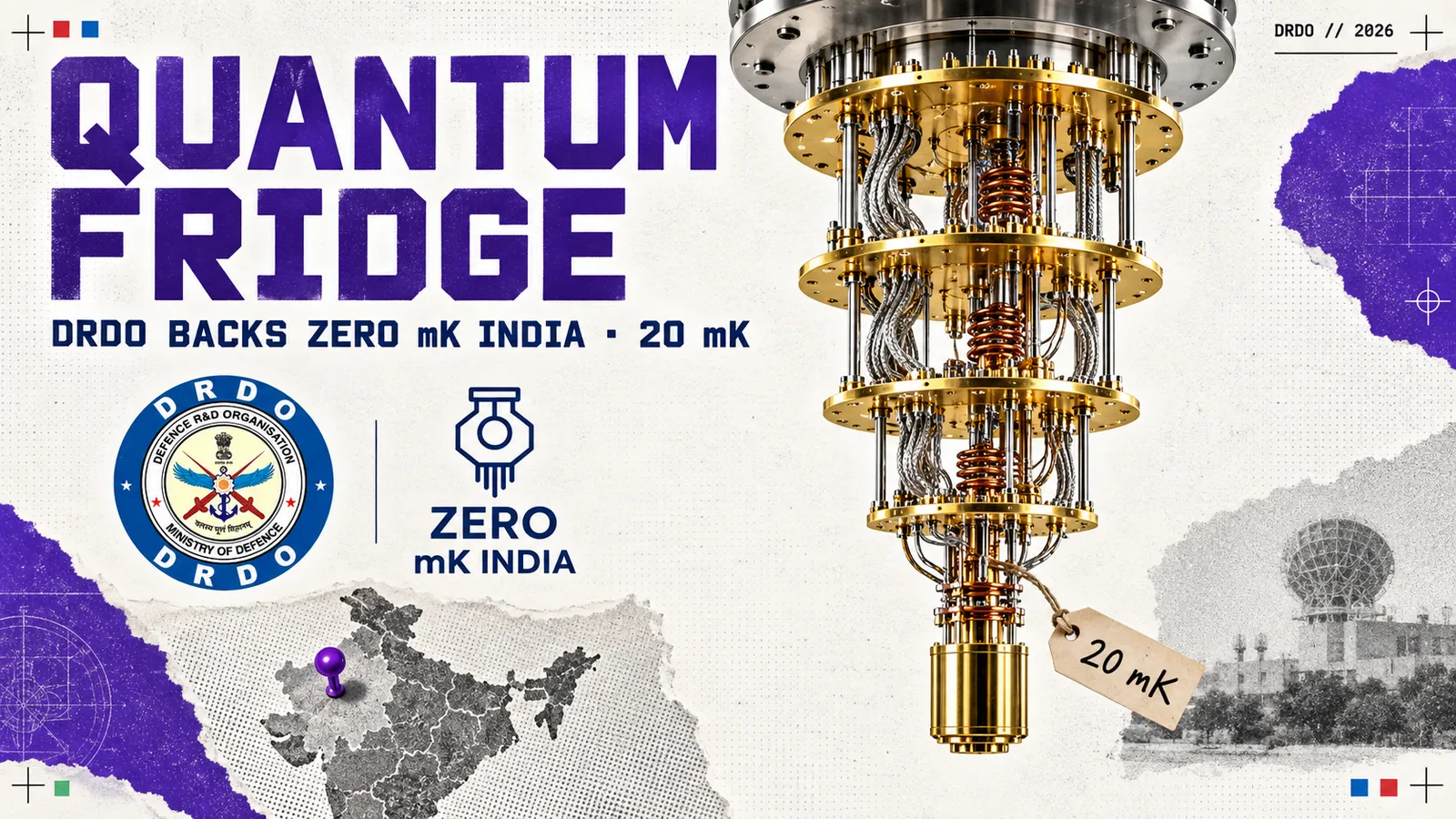
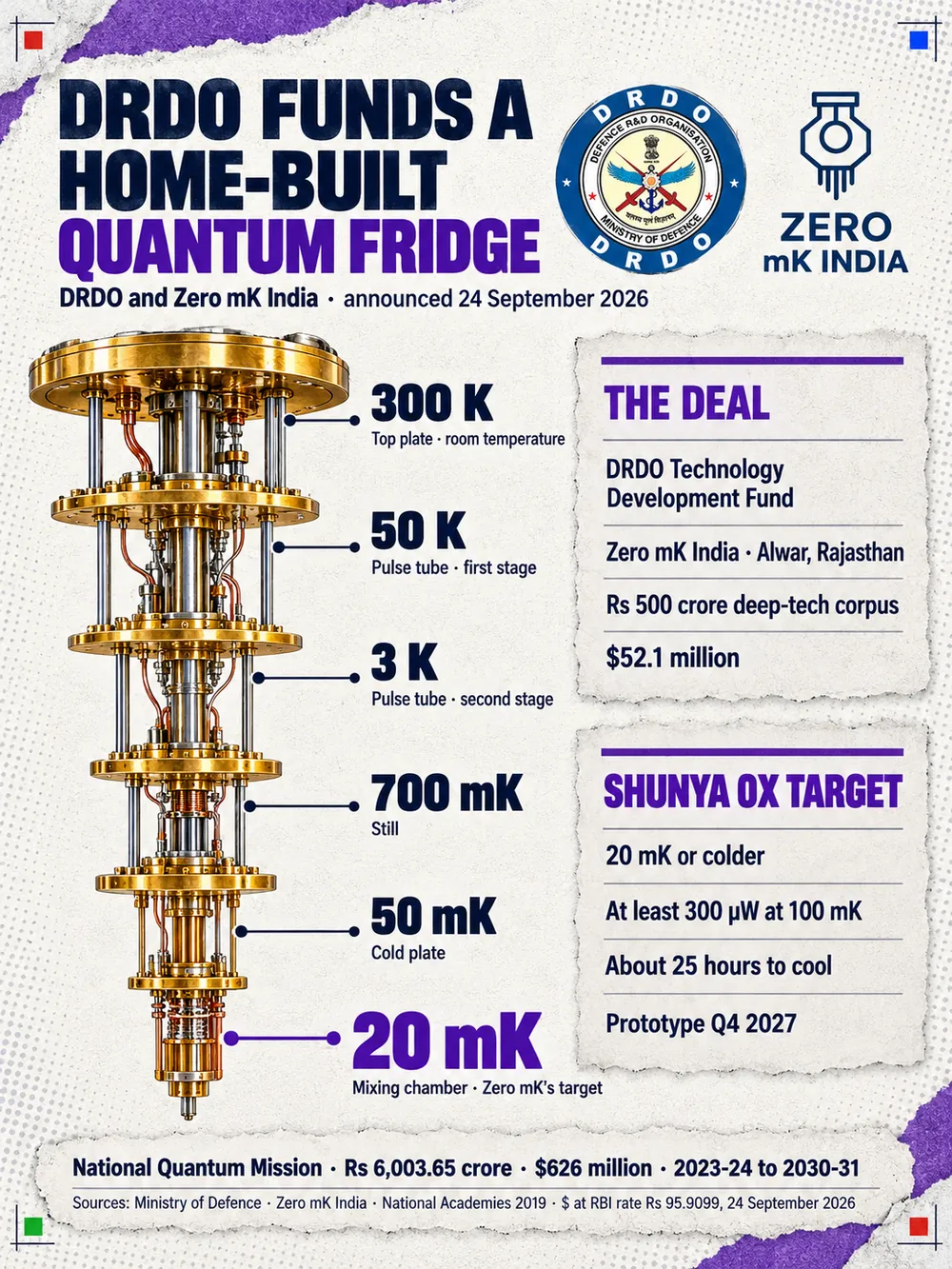
India’s Defence Research and Development Organisation (DRDO) has signed an agreement with Zero mK India Private Limited, a start-up based in Alwar, Rajasthan, to develop a 20 millikelvin dilution refrigerator in India. The Ministry of Defence announced the deal on 24 September 2026 as DRDO’s first high-value deep tech project agreement with a start-up under its Technology Development Fund (TDF), and the first high-value agreement under a Rs 500 crore ($52.1 million) corpus set aside for deep-tech projects.
A dilution refrigerator is the machine that holds superconducting qubits and many quantum sensors at millikelvin temperatures, colder than outer space. The ministry says building one at home will contribute “towards reducing dependence on imported cryogenic infrastructure and strengthening the domestic quantum technology ecosystem”.
What did DRDO and Zero mK India agree?
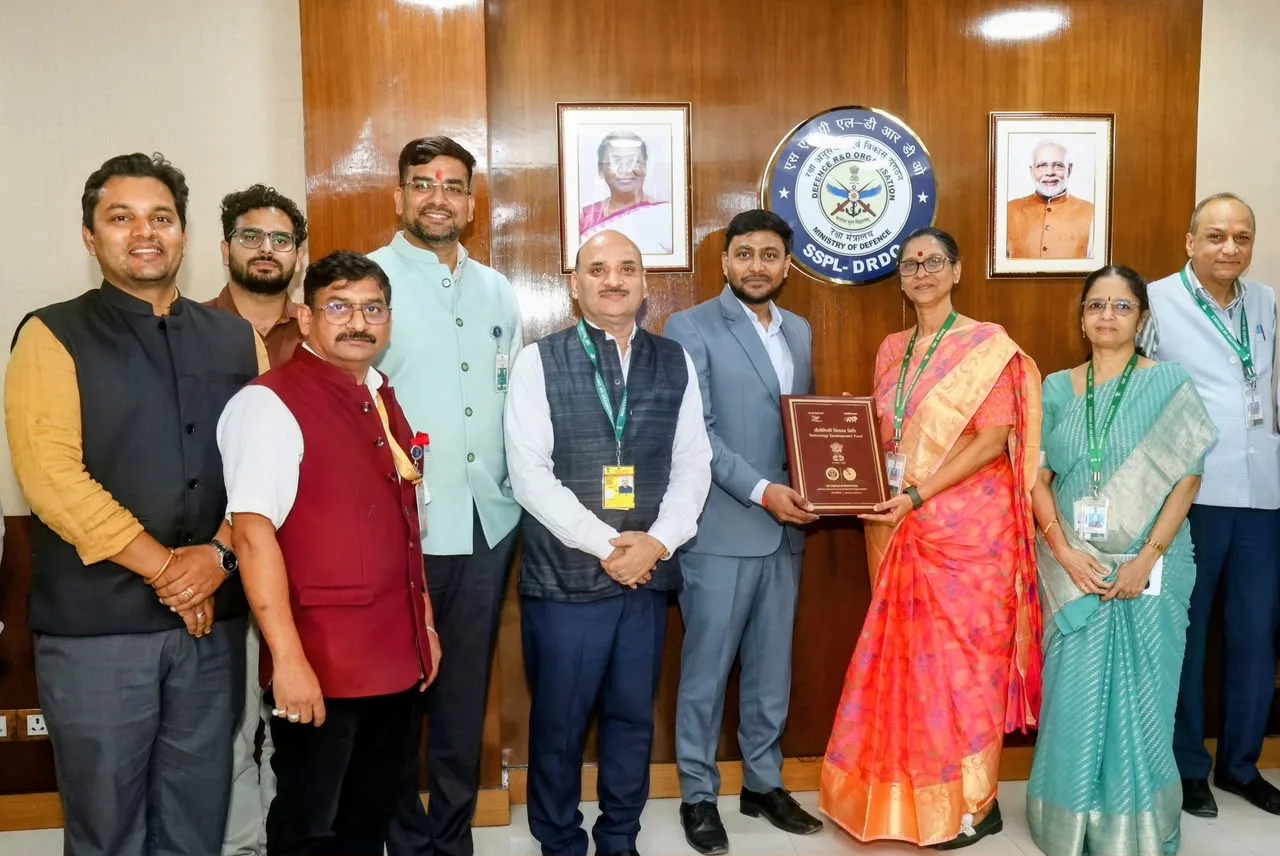
DRDO agreed to back Zero mK India’s development of a 20 mK-class dilution refrigerator for quantum applications, under the Technology Development Fund. The TDF is a Ministry of Defence scheme, run by DRDO, that supports “indigenous development of components, products, systems and technologies by MSMEs and start-ups”, in the words of a June 2022 ministry release. The Director of TDF and Zero mK India signed the agreement in New Delhi. DRDO’s Director General for microelectronic devices, computational systems and cyber security, its Director General for technology management and the Director of its Solid State Physics Laboratory (SSPL) attended.
The money comes from a separate pot. Defence Minister Rajnath Singh approved “an additional grant or Corpus of Rs 500 crore” for deep-tech and cutting-edge projects, run as separate verticals within the TDF, Minister of State for Defence Sanjay Seth told the Lok Sabha in a written reply on 25 July 2025. Under the scheme’s standard terms a project can receive up to 90 per cent of its cost, and the ceiling per project rose from Rs 10 crore ($1.0 million) to Rs 50 crore ($5.2 million) in June 2022.
| The deal | Detail |
|---|---|
| Funder | DRDO, Technology Development Fund |
| Company | Zero mK India Private Limited, Alwar, Rajasthan |
| Target | 20 mK-class dilution refrigerator |
| Funding pot | Rs 500 crore ($52.1 million) deep-tech corpus |
| Mentor | Director of SSPL and his team, Delhi |
| Announced | 24 September 2026 |
Dollar figures use the Reserve Bank of India’s reference rate for 24 September 2026, Rs 95.9099 to the US dollar.
What does a dilution refrigerator do?

A dilution refrigerator cools a chip to within a hundredth or two of a degree of absolute zero, using a mixture of two helium isotopes. The machine is a stack of metal plates, each colder than the one above. An electromechanical pulse-tube cooler takes the upper plates to about 50 K and then 3 K, according to the National Academies of Sciences, Engineering, and Medicine. At 3 K a mixture of helium-3 and helium-4 condenses and circulates down through stages at about 700 mK and 50 mK, to a base near 10 mK in commercial machines.
The deepest cold comes from the mixing. Below 0.87 K the mixture separates into a layer rich in helium-3 and a layer poor in it, Bluefors, a maker of dilution refrigerators, explains. Pumping helium-3 across the boundary between the two, inside the mixing chamber, draws heat from the surroundings, and the experiment hangs just below. The National Academies put a full cool-down from room temperature at about 36 to 48 hours.
Why does a qubit need 20 mK?
A superconducting qubit works at microwave frequencies around 5 GHz, and heat at about 250 mK carries the same energy, so the chip has to sit far colder than that to hold its state. The National Academies say the qubit “must thus be operated at much lower temperatures in order to avoid unwanted thermal excitation of the excited state”. At 20 mK, the heat energy is less than a tenth of the qubit’s.
That is why superconducting processors, the qubit approach behind the machines of IBM and Google, sit at the bottom of a dilution refrigerator. Zero mK India pitches its system at superconducting qubit research, quantum sensing and materials science at millikelvin temperatures. The ministry calls the ultra-low temperature “essential for the operation and testing of several quantum computing platforms and associated quantum technologies”.
Zero mK plans its first prototype for late 2027
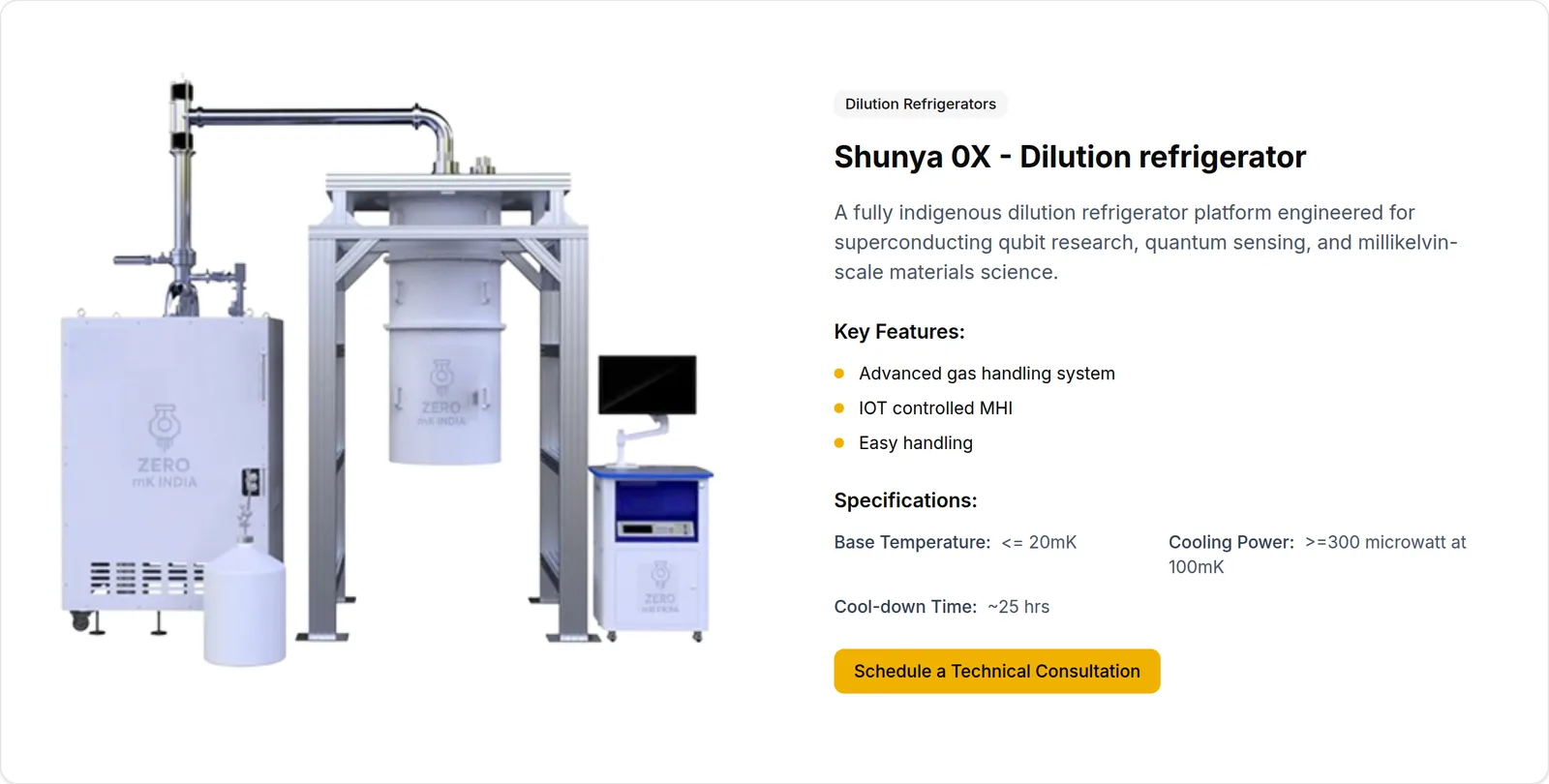
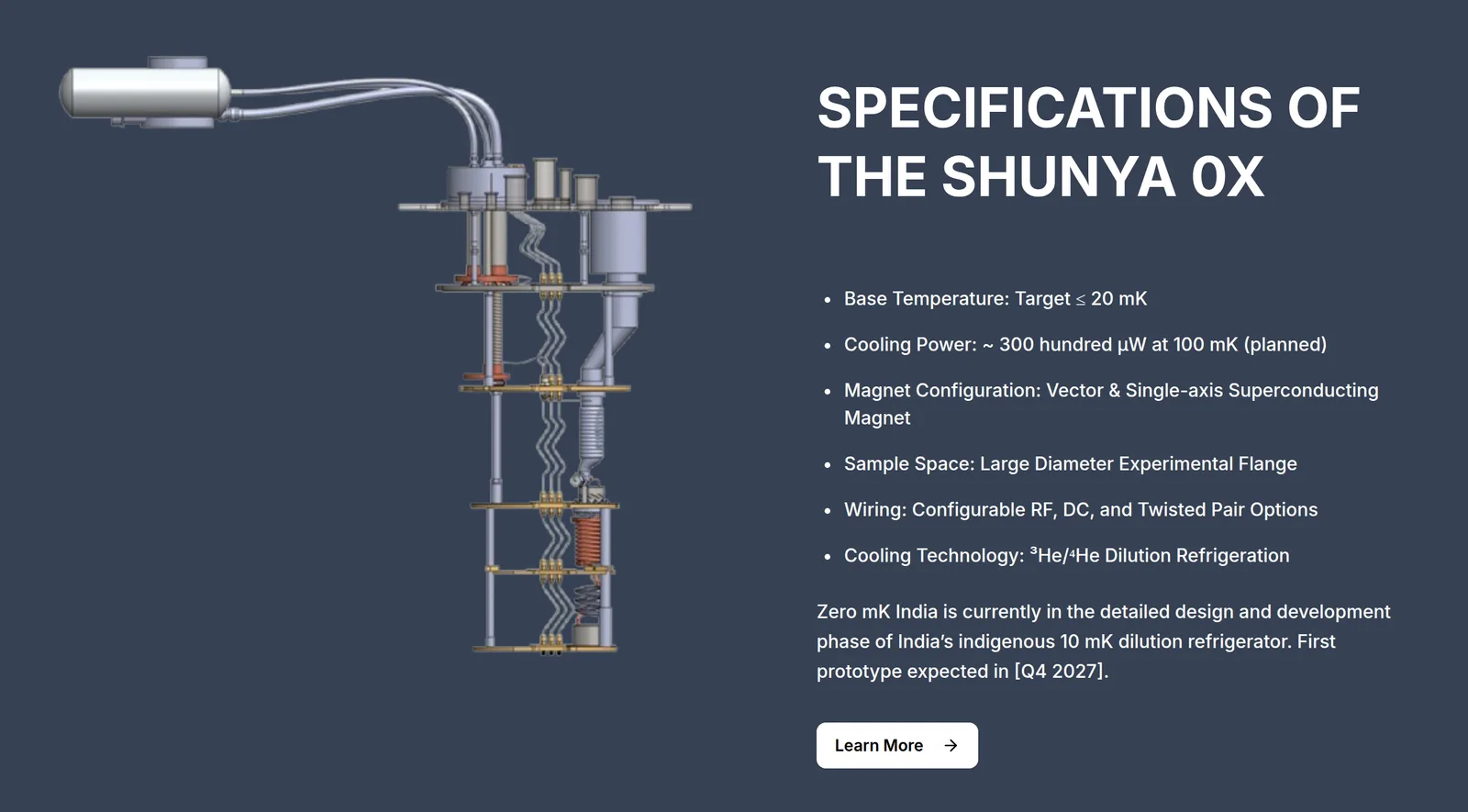
Zero mK India’s fridge is the Shunya 0X, which targets 20 mK or colder, and the company expects a first prototype in the fourth quarter of 2027. Its home page says the project is in the detailed design and development phase. The product page lists a cooling power of at least 300 microwatts at 100 mK and a cool-down of about 25 hours.
| Figure | Shunya 0X, Zero mK’s target | Commercial fridges, National Academies (2019) |
|---|---|---|
| Base temperature | 20 mK or colder | about 10 mK |
| Cooling power at 100 mK | 300 microwatts or more | about 1,000 microwatts |
| Cool-down time | about 25 hours | 36 to 48 hours |
The company, a start-up recognised by India’s Department for Promotion of Industry and Internal Trade (DPIIT), is led by founder and chief executive Kapil Bansal, a mechanical engineer from NIT Jaipur with more than a decade in CNG and hydrogen technology. Its group company, Sar Indus Kikai, made a gas purity tester for the infrared seeker cooling of the Spyder missile system, based on a Joule-Thomson cryogenic micro-cooler. IIT Kharagpur advises on the refrigerator’s design and validation, and IIT (ISM) Dhanbad on cryogenic materials and vacuum engineering.
Zero mK India also lists Anant, a two-stage pulse-tube cryocooler rated at about 0.8 to 1.5 watts at 4 K and meant for pre-cooling a dilution refrigerator. The company’s stated mission is dilution refrigerators that reach about 10 mK, and its home page describes the machine in development as a 10 mK refrigerator.
India wants these fridges built at home
India’s quantum programme needs dilution refrigerators, and the United States controls exports of the largest ones. The National Quantum Mission, approved by the Union Cabinet on 19 April 2023, has a budget of Rs 6,003.65 crore ($626 million) for 2023-24 to 2030-31. It targets intermediate-scale quantum computers of 50 to 1,000 physical qubits within eight years, on platforms including superconducting and photonic technology. The ministry says the refrigerator project “aligns with the National Quantum Mission”.
The United States has required an export licence since 6 September 2024 for cooling systems rated at 600 microwatts or more at 0.1 K for longer than 48 hours, the class that covers large dilution refrigerators, with an exception for countries that apply matching controls. The entry, 3A904, sits among the US quantum export controls and also covers specified two-stage pulse-tube cryocoolers. The Bureau of Industry and Security gave its reason: “development of larger quantum computers is typically done using systems with the highest cooling power”.
DRDO has been building its own quantum base in parallel. It opened a Quantum Technology Research Centre at Metcalfe House, Delhi, on 27 May 2025, where SSPL leads work on a miniature atomic clock, an atomic magnetometer and solid-state quantum devices and materials.
A Delhi defence lab will mentor the build
The Director of SSPL and his team are monitoring, mentoring and supporting the Zero mK project, the ministry says. TDF projects run against milestones under a Project Monitoring and Mentoring Group. A Technical Committee chaired by DRDO’s Director General (Technology Management) meets every month, and an Empowered Committee chaired by the DRDO chairman every four months.
Defence Secretary Rajesh Kumar Singh, who is also Secretary of Defence R&D and chairman of DRDO, congratulated the teams. Rajnath Singh expressed confidence, in the ministry’s words, that the partnership “will set an important precedent for future DRDO-Industry collaborations in emerging technology domains”. Zero mK India’s own date for the first Shunya 0X prototype is the fourth quarter of 2027.
Questions people ask
- What did DRDO sign with Zero mK India?
- India's Defence Research and Development Organisation signed a Technology Development Fund agreement with Zero mK India Private Limited, a start-up in Alwar, Rajasthan, to develop a 20 mK-class dilution refrigerator for quantum applications. The Ministry of Defence announced it on 24 September 2026 as the first high-value agreement under a Rs 500 crore ($52.1 million) corpus for deep-tech projects.
- What is a dilution refrigerator used for?
- A dilution refrigerator cools a chip to within a hundredth or two of a degree of absolute zero, using a mixture of helium-3 and helium-4. Superconducting qubits need it because they work at microwave frequencies around 5 GHz, which the National Academies of Sciences, Engineering, and Medicine equate to heat at about 250 mK, so the chip must sit far colder.
- When will Zero mK India's dilution refrigerator be ready?
- Zero mK India says its dilution refrigerator is in detailed design and development, with a first prototype expected in the fourth quarter of 2027. The listed target for its Shunya 0X is a base temperature of 20 mK or colder and at least 300 microwatts of cooling at 100 mK.
Sources
- Ministry of Defence via PIB: DRDO inks first high-value deep tech project agreement with a start-up under TDF scheme, 24 September 2026pib.gov.in
- PTI via ETV Bharat: DRDO signs MoU with start-up for development of dilution refrigerator for quantum applications, 25 September 2026etvbharat.com
- ANI: DRDO inks first high-value deep tech project agreement with a start-up under TDF scheme, 24 September 2026aninews.in
- Zero mK India: Shunya 0X dilution refrigerator and Anant pulse tube cryocooler, product pagezeromkindia.com
- Zero mK India: company home page, Shunya 0X specifications and prototype timingzeromkindia.com
- Zero mK India: leadership teamzeromkindia.com
- Zero mK India: partnerships, IIT Kharagpur and IIT (ISM) Dhanbad roleszeromkindia.com
- Ministry of Defence via PIB: Technology Development Fund scheme, Lok Sabha written reply, 25 July 2025pib.gov.in
- Ministry of Defence via PIB: TDF funding enhanced to Rs 50 crore per project, 8 June 2022pib.gov.in
- Cabinet via PIB: Cabinet approves National Quantum Mission, 19 April 2023pib.gov.in
- Department of Science and Technology: National Quantum Missiondst.gov.in
- Ministry of Defence via PIB: DRDO inaugurates Quantum Technology Research Centre, 27 May 2025pib.gov.in
- National Academies of Sciences, Engineering, and Medicine: Quantum Computing, Progress and Prospects, Appendix C, Superconducting Quantum Computers, 2019nationalacademies.org
- Bluefors: How does a dilution refrigerator work?bluefors.com
- Bureau of Industry and Security: Commerce Control List additions and revisions, 89 FR 72926, 6 September 2024govinfo.gov
- Reserve Bank of India: reference rate archive, US dollar, 24 September 2026rbi.org.in