
Google Quantum AI
Willow and verifiable advantage
Key facts
- 105Willow
- Qubits
- 99.97%single-qubit
- Gate fidelity
- 13,000xvs classical
- Speed-up
- 100microseconds, T1
- Coherence
- 2 of 6roadmap
- Milestone
- Oct 2025Nature
- Paper
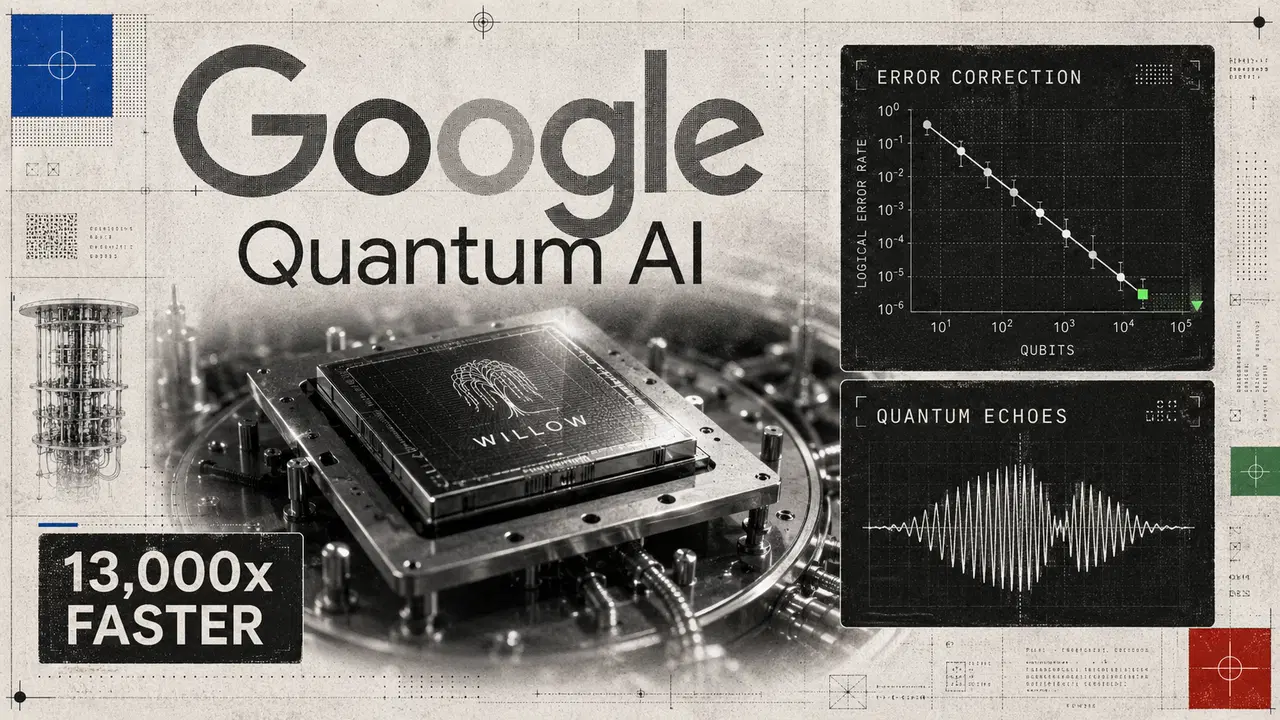
Google built the first chip that gets better as it gets bigger, the below-threshold moment the whole field had chased for thirty years. Its Willow processor is the proof; the roadmap now runs from party trick to useful machine.
What Willow is
Google’s quantum programme includes superconducting processors and a neutral-atom research effort announced in March 2026. Its best-known processor is Willow, a 105-qubit superconducting processor; Google’s peer-reviewed result describes the first verifiable quantum advantage. Taken together they explain why the google willow chip has become the benchmark by which the company’s progress, and much of the field’s, is now judged.
The numbers behind the chip
The numbers behind the chip are the reason it draws attention. The google willow chip recorded 99.97% single-qubit gate fidelity, 99.88% entangling gate fidelity and 99.5% readout fidelity. Fidelity here simply means the fraction of operations that go as intended: a single-qubit gate rotates one qubit, an entangling gate links two so their states become correlated, and readout is the act of measuring the answer at the end. Each is quoted as a percentage because each introduces a little error, and those errors compound across a circuit. The chip also holds a T1 coherence time of around 100 microseconds, T1 being the interval over which a qubit keeps its state before decaying to noise. A hundred microseconds sounds brief, but against gate times measured in tens of nanoseconds it leaves room for a great many operations.
The genuinely significant figure is a threshold rather than any single fidelity. Willow was the first processor to operate below threshold for error correction, meaning that adding more physical qubits to a protected logical qubit made the logical error rate fall rather than rise. Below that crossover, error correction finally helps instead of hurting, which is the precondition for building a machine that can run indefinitely. It is the result the whole superconducting approach had been chasing.
The advantage claim
On top of the hardware sits the advantage claim. In an October 2025 Nature paper, the team reported the first verifiable quantum advantage using an algorithm it calls Quantum Echoes, an out-of-time-order correlator. Such a routine measures how a small disturbance spreads and then reverses through a quantum system, a quantity that is hard for classical machines to track. The result was reported at 13,000 times faster than the best classical algorithm running on the fastest available supercomputer. Verifiable is the operative word: the point of the exercise is that the outcome can be checked, not merely asserted, and the work was led by Hartmut Neven and Erik Lucero. As with any advantage claim, the honest position is to report the number and note that classical methods sometimes catch up; our quantum explainers set out why these contests are rarely settled at once.
For all that, Google places itself only at Milestone 2 of its own six-milestone roadmap, still working toward a long-lived logical qubit that survives far longer than the physical parts it is made from. The company’s public position is that a genuinely useful, error-corrected machine remains several defined steps away, and it is candid about the distance.
The strategy off the chip
Google also announced its own neutral-atom hardware programme on 24 March 2026, led by Adam Kaufman in Boulder. It runs alongside the superconducting programme. In a neutral-atom machine, lasers hold and control individual atoms as qubits. Google’s investment in QuEra gives it another connection to that approach, while its acquisition of Atlantic Quantum supports modular superconducting hardware.
What to watch
What to watch next is whether the below-threshold result scales: whether the fidelities that made the google willow chip notable hold up as qubit counts rise, and whether the Quantum Echoes advantage withstands classical counterattack. If both survive contact, Google’s six-milestone schedule gains credibility. If either slips, the roadmap lengthens, and the field’s most-discussed chip becomes a marker of how hard the next milestone really is.
More Quantum
All Quantum →
Google Opens the Door to Willow: Early Access Invites Researchers onto Its Quantum Processor
Google Quantum AI is inviting outsiders onto its most advanced quantum chip.

Quantum Computers Could Crack Encryption Before 2030, Studies Warn
Two new preprint studies from Google Quantum AI and Cornell University suggest quantum computers capable of breaking today’s encryption may arrive far sooner than expected, potentially before the end of this decade.