
Quantum advantage
what counts as beating a classical computer
Key facts
- Any taskeven a useless one
- Supremacy
- Defined taskcompare the best classical method
- Advantage
- 2019Google, Sycamore
- First claim
- Often notclassical methods catch up
- Claims survive?
- 30 July 2026task-specific benchmarks
- IBM claims
A quantum computer can outperform a classical method at a benchmark or at a useful task. The task, classical comparison and cost determine what an advantage claim establishes.
Few phrases in technology are as abused as quantum supremacy. It has a precise technical meaning, a far looser popular one, and a track record of claims that did not survive contact with better classical algorithms. Understanding the distinction is the single most useful defence against overstated quantum headlines.
The two terms
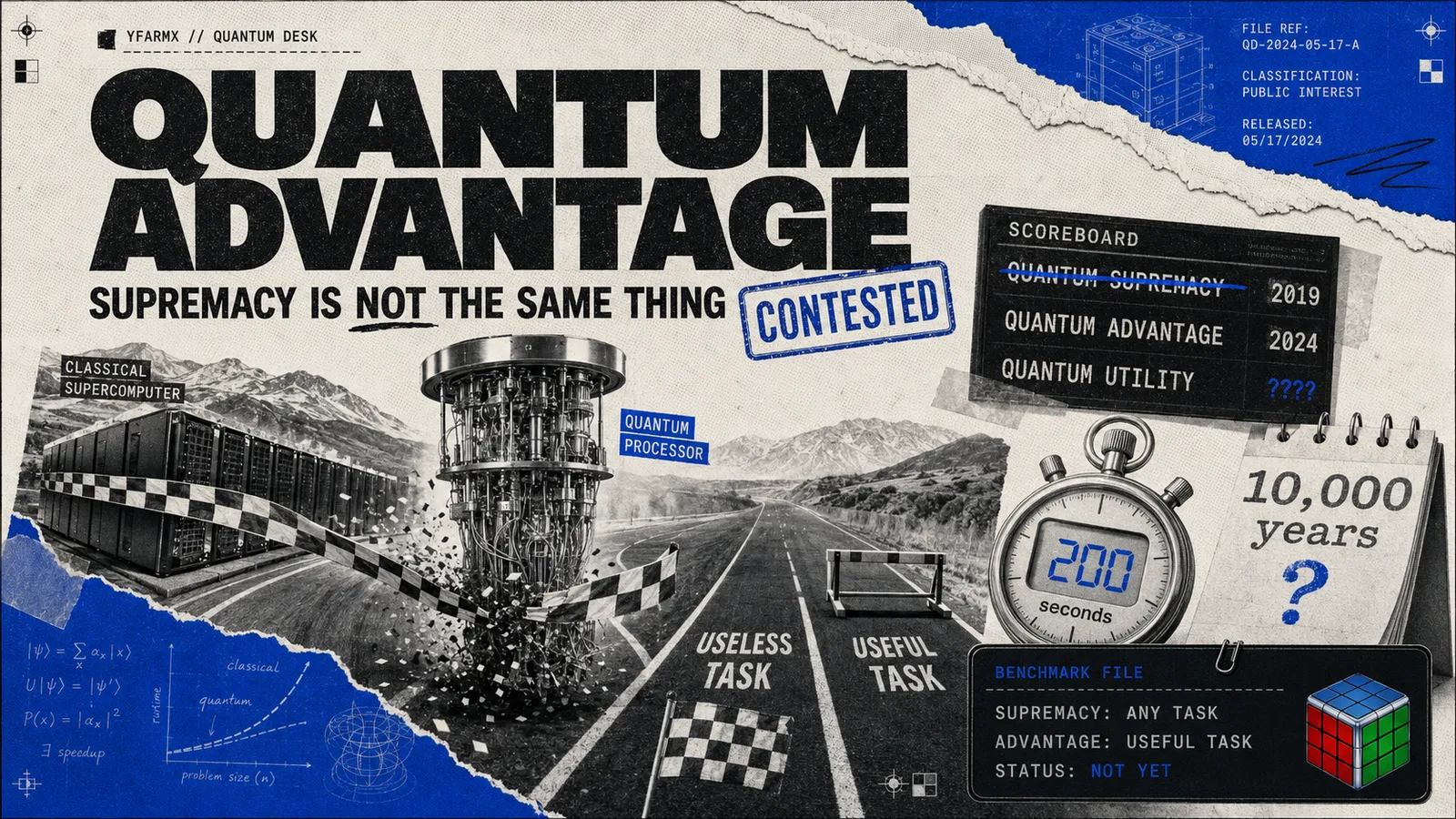
Quantum supremacy means a quantum computer performing some task faster than any classical computer could, where the task does not have to be useful. It is a physics demonstration: proof that the machine is doing something a conventional computer genuinely cannot follow.
Quantum advantage means outperforming the best available classical method on a defined task. Useful or commercial advantage adds a further requirement: doing something people want done with a practical benefit. Simulating a molecule for drug discovery, optimising a logistics network, pricing a portfolio. This is the commercial milestone, and it is the one that has not convincingly arrived.
The distinction is not pedantry. It is the difference between a laboratory result and a product.
Why the claims keep collapsing
Google announced supremacy in 2019 with its Sycamore processor, reporting that a sampling task taking its machine about 200 seconds would take the best supercomputer around 10,000 years. Within weeks IBM argued the classical estimate was wrong, and over the following years improved classical simulation methods narrowed the gap dramatically on that class of problem.
This has become the pattern. A quantum result is announced, classical algorithm researchers study the specific task, and a cleverer conventional method closes much of the distance. The lesson is not that the quantum results are fraudulent; it is that “no classical computer can do this” is a claim about every possible classical algorithm, including ones nobody has invented yet, and such claims are extraordinarily hard to make stick.
What a credible claim looks like
Three questions cut through most announcements. First, is the task useful, or was it chosen because quantum hardware happens to be good at it? Sampling from random circuits is the classic example of the latter. Second, what is the honest classical baseline, run by people motivated to beat it rather than by the same team? Third, does the advantage grow with problem size, or does it vanish as soon as the problem is scaled to a realistic case?
Where it stands
On 30 July 2026, IBM and its partners announced three quantum-advantage claims, covering quantum dynamics, heterogeneous quantum-system simulation and structured circuit sampling. These are the company’s claims, offered for classical challenge. The IBM and University of Chicago paper studies hard circuit sampling with a fidelity certificate. Each result should be judged on its task and classical baseline; the announcement alone establishes no general commercial advantage.
More Quantum
All Quantum →
US Reclassifies 18 Technologies Including Quantum Computing as Critical for National Advantage
The United States has reclassified 18 advanced technologies including quantum computing as critical to national security, granting the Commerce Department new authority to control exports.