
Superposition & entanglement
the two effects doing the actual work
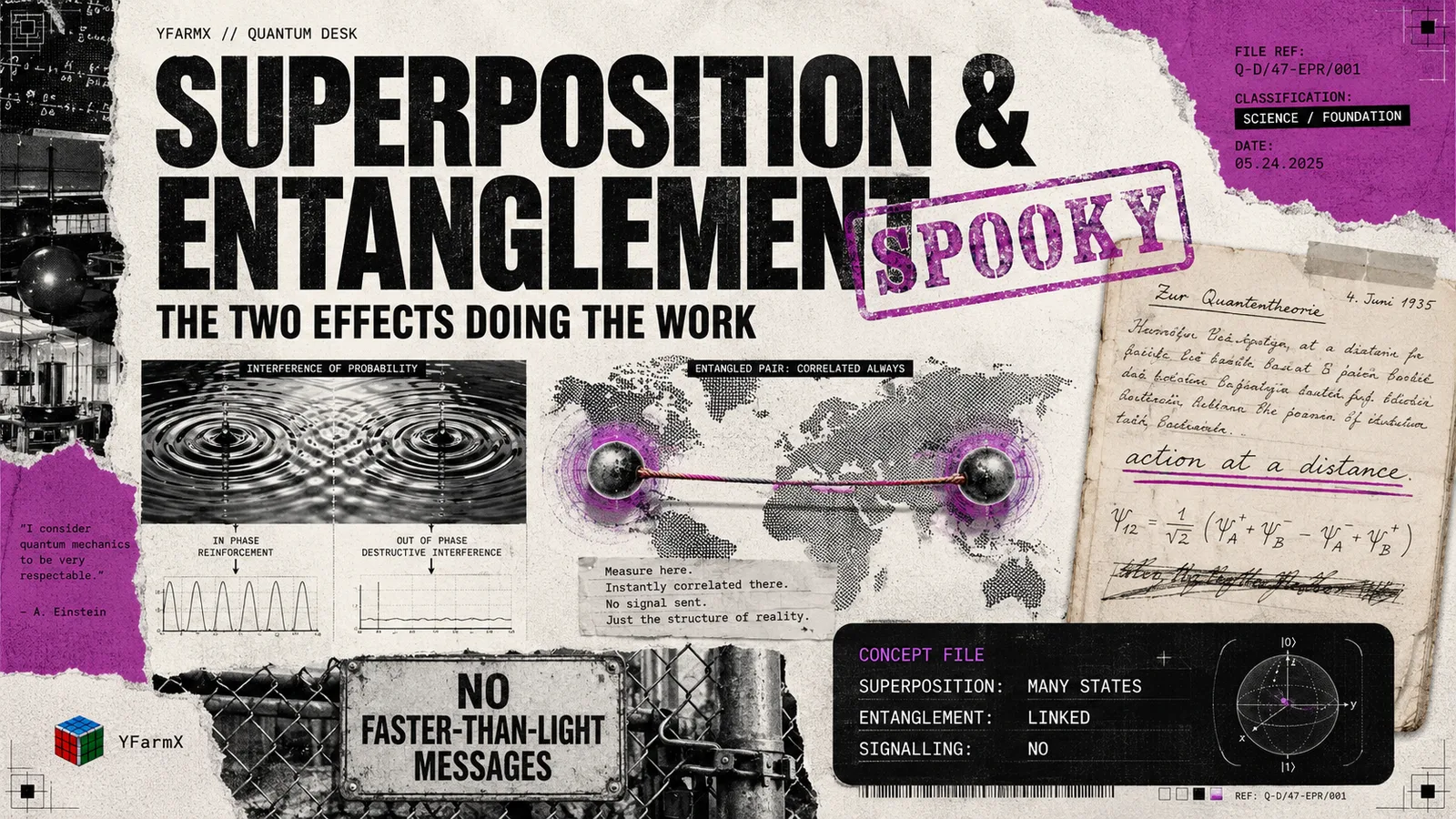
Key facts
- Many statesin one qubit
- Superposition
- Linked fatesacross qubits
- Entanglement
- Spookyaction at a distance
- Einstein called it
- Nono faster-than-light signalling
- Sends messages?
Two ideas do nearly all the work in quantum computing, and both sound like conjuring tricks. One lets a qubit be several things at once. The other ties qubits together so tightly that measuring one tells you about the other, instantly, at any distance.
Two effects separate a quantum computer from every machine that came before it. Superposition is what lets a single qubit carry more than one possibility. Entanglement is what lets qubits act as a single system rather than a row of independent switches. Neither has an everyday equivalent, which is why both attract bad analogies.
Superposition
A qubit in superposition holds a combination of 0 and 1, weighted by two numbers called amplitudes. The common description, that the qubit is “in both states at once”, is close enough to be useful and loose enough to mislead. A better way to hold it: the qubit has no definite value yet, and what exists instead is a set of weights that determine what you will see when you look.
Those weights can be negative, or complex, which is the property that makes quantum computing more than probability. Two paths through a calculation can cancel each other out, exactly as two water waves meeting crest-to-trough leave flat water. Quantum algorithms are built out of that cancellation: the machine is steered so the paths leading to wrong answers destroy each other and the path to the right answer survives.
Entanglement
Entanglement is what happens when qubits stop having individual descriptions. Two entangled qubits are described by one shared state, and measuring one immediately fixes what the other will show, whether they sit side by side or on opposite sides of the planet. Einstein disliked this intensely and called it spooky action at a distance; experiments have since confirmed it repeatedly, and the 2022 Nobel Prize in Physics went to work that closed the remaining loopholes.
The correlation cannot be used to send a message. The result you get at your end looks random until you compare notes with the other party over an ordinary channel, so nothing travels faster than light. What entanglement does provide is a way to spread information across many qubits at once, which is why an entangled register can represent relationships no collection of separate bits can.
Why both are needed
Superposition alone gets you very little; a computer that explores many possibilities but cannot make them interact is just a slow random number generator. Entanglement is what makes the qubits into a single computational object, so an operation on one can affect the whole register. Algorithms such as Shor’s factoring method depend on both working together, and on the fragile relationship between the qubits, the phase, surviving long enough to finish the job.
That fragility is the practical problem. Entanglement is easy to create and very hard to keep, which is what quantum error correction exists to solve.