Quantinuum reports five logical-memory errors per million rounds
Quantinuum reports a logical-memory error rate of about five in a million correction rounds on Helios, corresponding to 99.9995% fidelity per round. Its distance-7 colour-code result and error-suppression measurements support the company's fault-tolerance research programme.
Listen to this articleListen
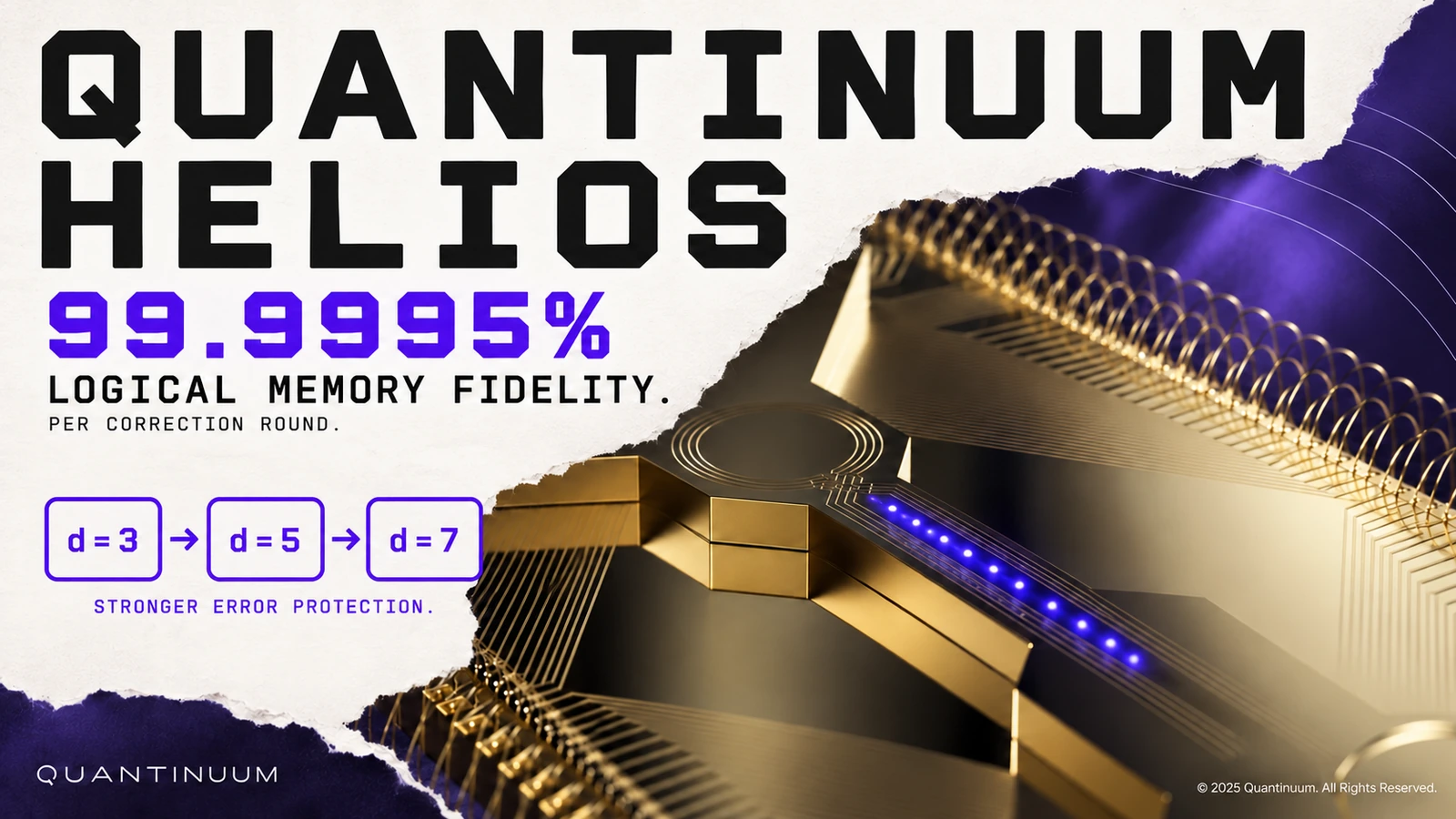
Quantinuum has reported a logical-memory error rate of roughly five per million error-correction rounds on its Helios trapped-ion processor. The result corresponds to 99.9995% logical-memory fidelity per round, according to the company’s 19 October account.
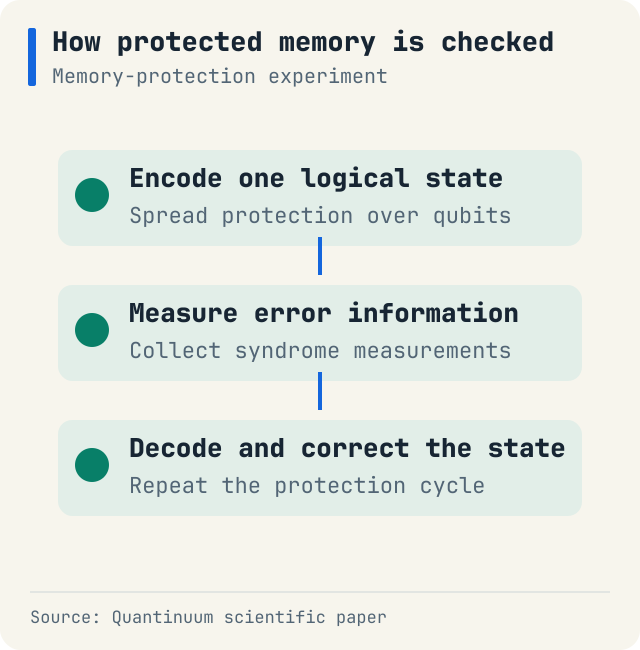
The experiment measures how reliably protected quantum information survives repeated checks for errors. Its unit is a syndrome-extraction cycle: one round of collecting the information needed to identify errors in the protected state.
Stronger protection reduced memory errors
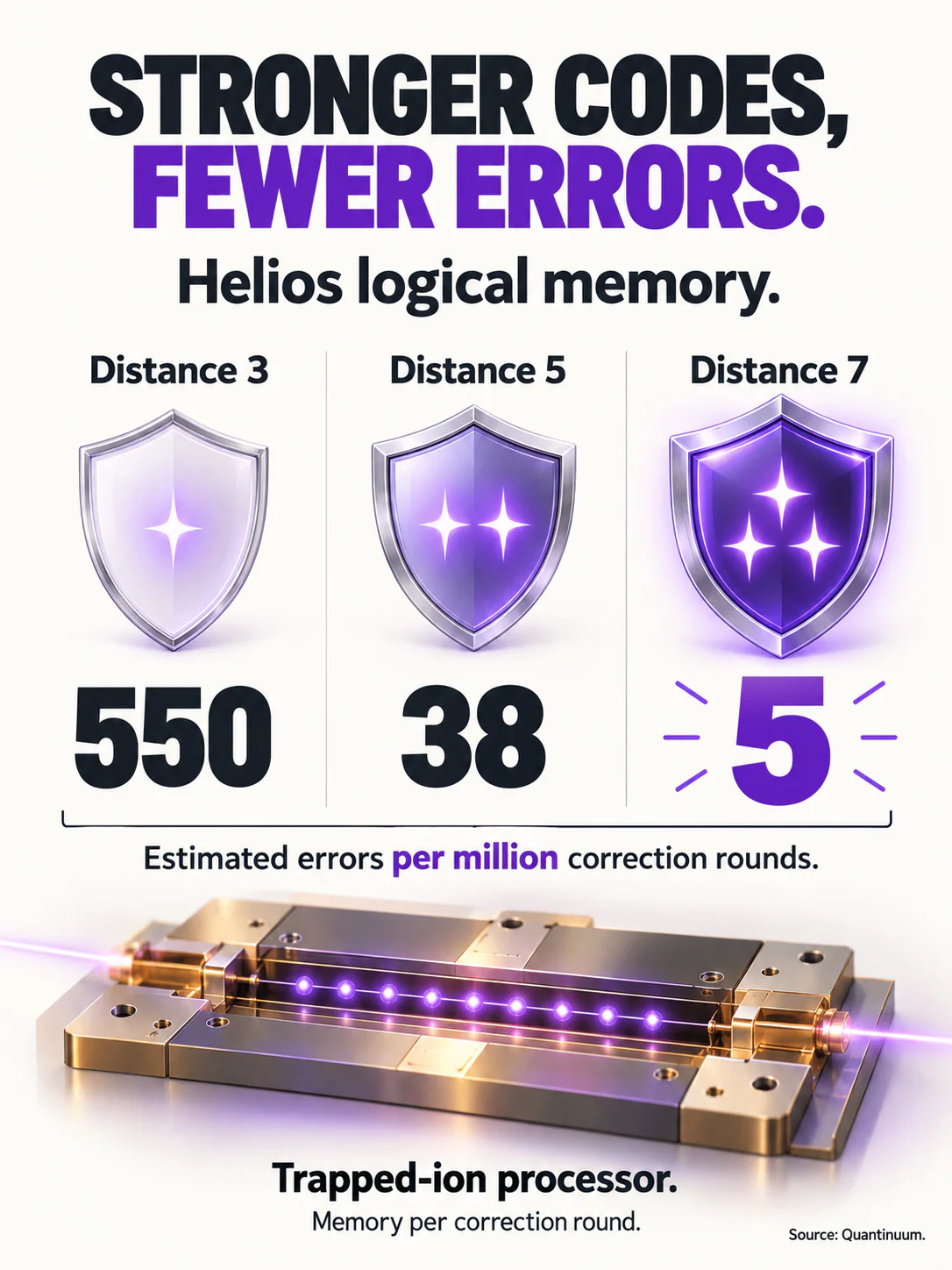
The scientific paper tests triangular colour codes with distances of three, five and seven. Code distance describes the strength of the protection, with larger codes using more physical qubits to protect the logical state.
The reported memory-error estimates are 5.5 × 10⁻⁴ at distance three, 3.8 × 10⁻⁵ at distance five and 5 × 10⁻⁶ at distance seven. The last estimate has a reported range of +4/−2 × 10⁻⁶. Quantinuum’s paper describes the uncertainties as one-standard-deviation Wilson intervals unless specified otherwise.
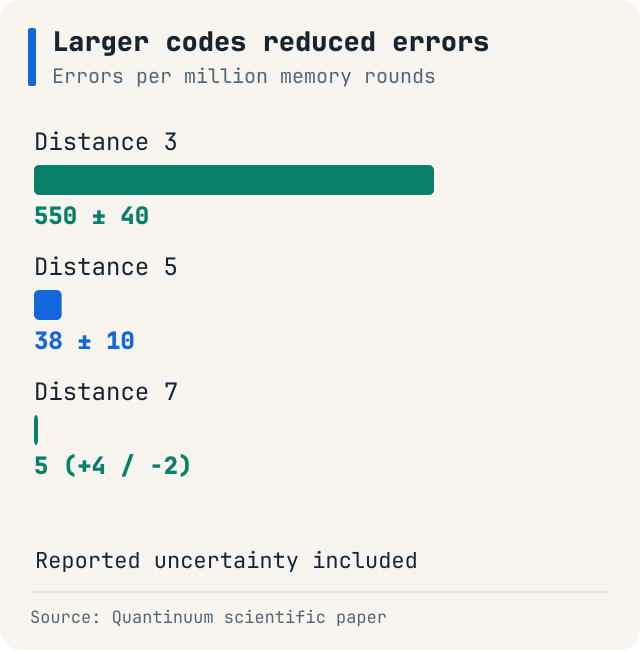
The fitted memory-error suppression factor is approximately 12 as the tested code distance increases. This scaling result is significant because error correction becomes useful when added protection reduces the remaining logical failures despite requiring additional hardware operations.
Independent surface-code experiments by Google researchers have also demonstrated error suppression as code distance increases. Those results use a different processor and code; the shared engineering goal is to make a larger encoded memory more reliable.
Memory and gate experiments have their own results
The team separately tested logical two-qubit Clifford operations at distances three and five. The paper reports below-threshold scaling for those experiments too, with a suppression factor of roughly nine.
The 99.9995% headline describes logical memory per correction round. The logical-gate experiments provide their own error rates and scaling evidence.
Helios informs the Apollo programme
Quantinuum says the memory result reduces errors tenfold compared with its September record. The two demonstrations used different error-correcting codes on the same Helios hardware, allowing the researchers to investigate different balances of protection and qubit use.
The company connects that work with Apollo, its planned universal fault-tolerant system for 2029. That remains a development target. Extending reliable memory and logical operations into larger computations is the programme those measurements are intended to support.