
Quantinuum
highest fidelities, newly public
Key facts
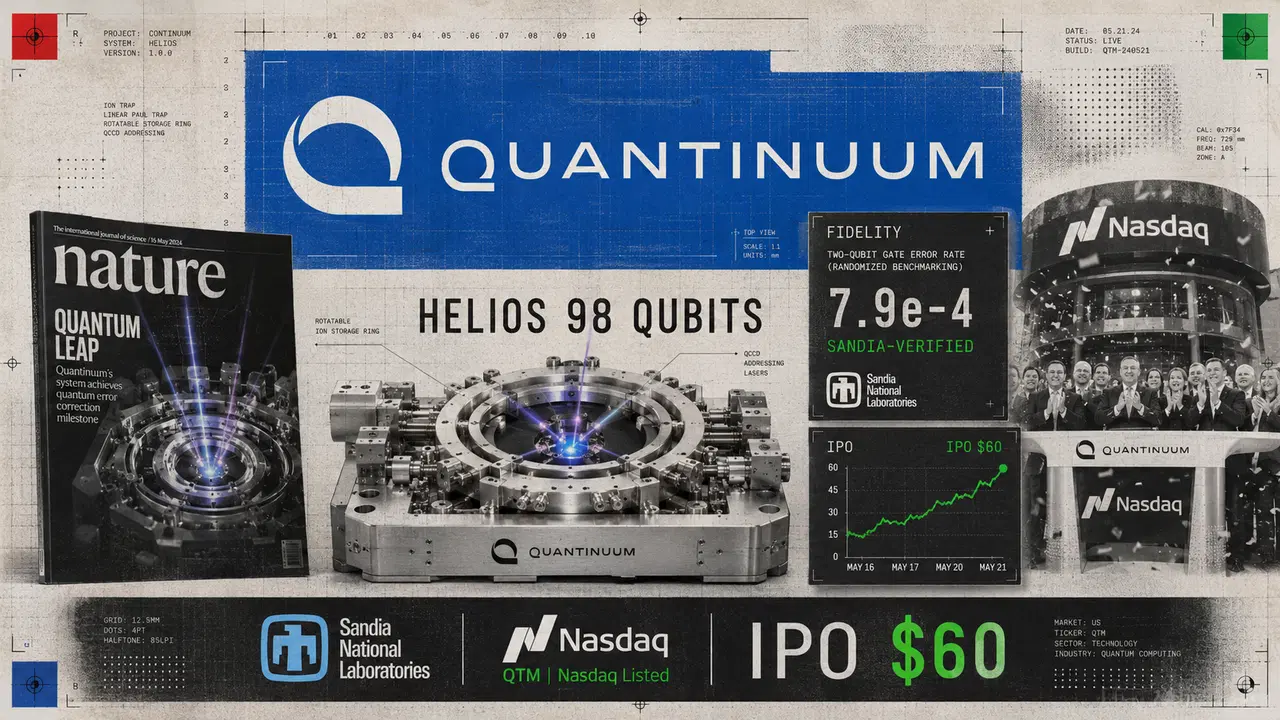
- 98Helios, trapped-ion
- Qubits
- 7.9e-4Sandia-verified
- 2Q infidelity
- $60per share
- IPO price
- $1.68bnJune 2026
- Raised
- $43.00close, 10 Nov 2026
- Share price
- 100 logicalSol target, H2 2027
- Next gen
The cleanest qubits in the business, independently checked. Quantinuum's trapped-ion machines hold the accuracy records, and its June 2026 listing made it the most valuable pure quantum company on any exchange.
The hardware claim
Quantinuum arrives in public markets with the strongest hardware numbers in the sector and a set of accounts that need careful reading. The company’s flagship processor, Quantinuum Helios, operates 98 trapped-ion qubits, and its published error rates are, on the figures released, the lowest anyone has independently verified. Understanding why quantinuum helios draws such attention means separating the physics from the finances, because the two tell rather different stories.
The error rates
Trapped-ion machines hold their qubits as individual charged atoms suspended in electromagnetic fields, addressed with lasers. The approach tends to produce very clean operations, and the processor pushes that advantage far. It reports an average single-qubit gate infidelity of 2.5e-5 and a two-qubit gate infidelity of 7.9e-4, infidelity being simply the error rate, the fraction of operations that go wrong, so smaller is better. It also reports a state-preparation-and-measurement figure of 3.3e-4, covering the errors made when a qubit is initialised and when it is finally read out. What lends these numbers weight is that they were independently evaluated by Sandia National Laboratories and published in Nature in June 2026, rather than self-reported. A further structural advantage is all-to-all connectivity: through a rotatable ion storage ring, any qubit can be made to interact directly with any other, sparing the machine the costly shuffling that fixed-neighbour designs require.
Third-quarter revenue was $9.1m
Quantinuum’s 5 November results report $9.1m of third-quarter revenue, up 233% from a year earlier. Full-year revenue guidance increased to $31m–$34m. The company reported a $118m GAAP net loss, an $80m adjusted EBITDA loss and $1.94bn of cash and equivalents at 30 September.
Quantinuum listed on Nasdaq in June 2026 at $60 per share. QNT closed at $43.00 on 10 November, according to Nasdaq. The dated market quote and quarterly operating figures measure different things.
The roadmap and partnerships
Quantinuum’s 5 November outlook targets Sol for the second half of 2027, aiming at 100 logical qubits and a logical error rate of 10⁻⁵. Apollo remains targeted for 2029. These are roadmap goals; the current Helios memory experiments have their own measured conditions and results.
The commercial strategy leans on partnerships with established engineering and computing names. In July 2026 the company announced work with Rolls-Royce, Riverlane and EPCC on computational fluid dynamics, the simulation of how air and fluids flow, which is one of the more plausible near-term uses for quantum hardware. In June 2026 it announced a collaboration with HPE on quantum-HPC integration, the plumbing that lets a quantum processor sit alongside a conventional supercomputer and share the workload. The second-quarter results announcement of 11 August 2026 added a partnership with Oracle to deploy Helios as a service on Oracle Cloud Infrastructure. An earlier $600m raise at a $10bn valuation, backed by NVIDIA, had already signalled that the largest computing firms were taking the trapped-ion approach seriously. On 8 September 2026 Quantinuum finalised a $100m CHIPS R&D award from the Department of Commerce, following its May letter of intent, to build US manufacturing for large fault-tolerant trapped-ion machines: GlobalFoundries is to fabricate ion traps and control electronics on 300mm wafers, and Monarch Quantum to make scalable lasers and optical components. Readers wanting the wider context can start with our quantum hub.
On 5 October 2026, Quantinuum and the University of Western Australia announced a memorandum of understanding covering cloud access to Helios, research applications and training. The agreement gives the university a route to use the processor remotely.
Follow the hardware and customer milestones
Track the measured performance of each processor, progress against the Sol and Apollo schedules, and revenue from customer deployments. A laboratory memory experiment, a complete error-corrected program and a commercial service require different evidence.
Helios tests a lower logical-memory error rate
Quantinuum’s 19 October paper reports a logical-memory error rate of about five errors per million correction cycles at code distance seven. Increasing the code distance from three to five to seven reduced memory errors by a fitted factor of about twelve at each step. The experiment decoded its results offline; streaming decoder processing was benchmarked separately. Memory cycles, logical gates and a complete computer are different measurements. The original paper gives uncertainties of +4/−2 errors per million cycles for the best memory result. Its separate distance-five two-qubit Clifford result is about seven errors per 100,000 logical two-qubit Clifford operations.
The company announcement presents the result as progress towards Apollo in 2029. The experiment and proposed future machine keep their separate scopes.
Nexus has further software changes planned for December
The 5 November Nexus roadmap describes automatic error-correction encoding for supported programs on Helios. Quantinuum’s third-quarter results report 215 organisations using Nexus. More error-correcting codes, execution analytics and responsive hybrid workflows are planned for December.
GE Vernova joins a superconductivity research programme
Quantinuum and GE Vernova announced research on high-temperature superconductivity on 27 October. They plan to study the Fermi-Hubbard model using Helios and the Nexus platform. This is a research programme whose results will need to establish any benefit for materials or energy applications. The partners’ announcement describes the scientific work and access arrangements.
RIKEN’s Reimei upgrade is complete
Quantinuum confirmed on 10 November that Reimei at RIKEN had been upgraded to System Model H2, with 56 fully connected qubits. Two research projects combine it with ROQUO and Fugaku for materials and biomolecular chemistry. The technical account places regular Test User Program operations after those projects conclude.
More Quantum
All Quantum →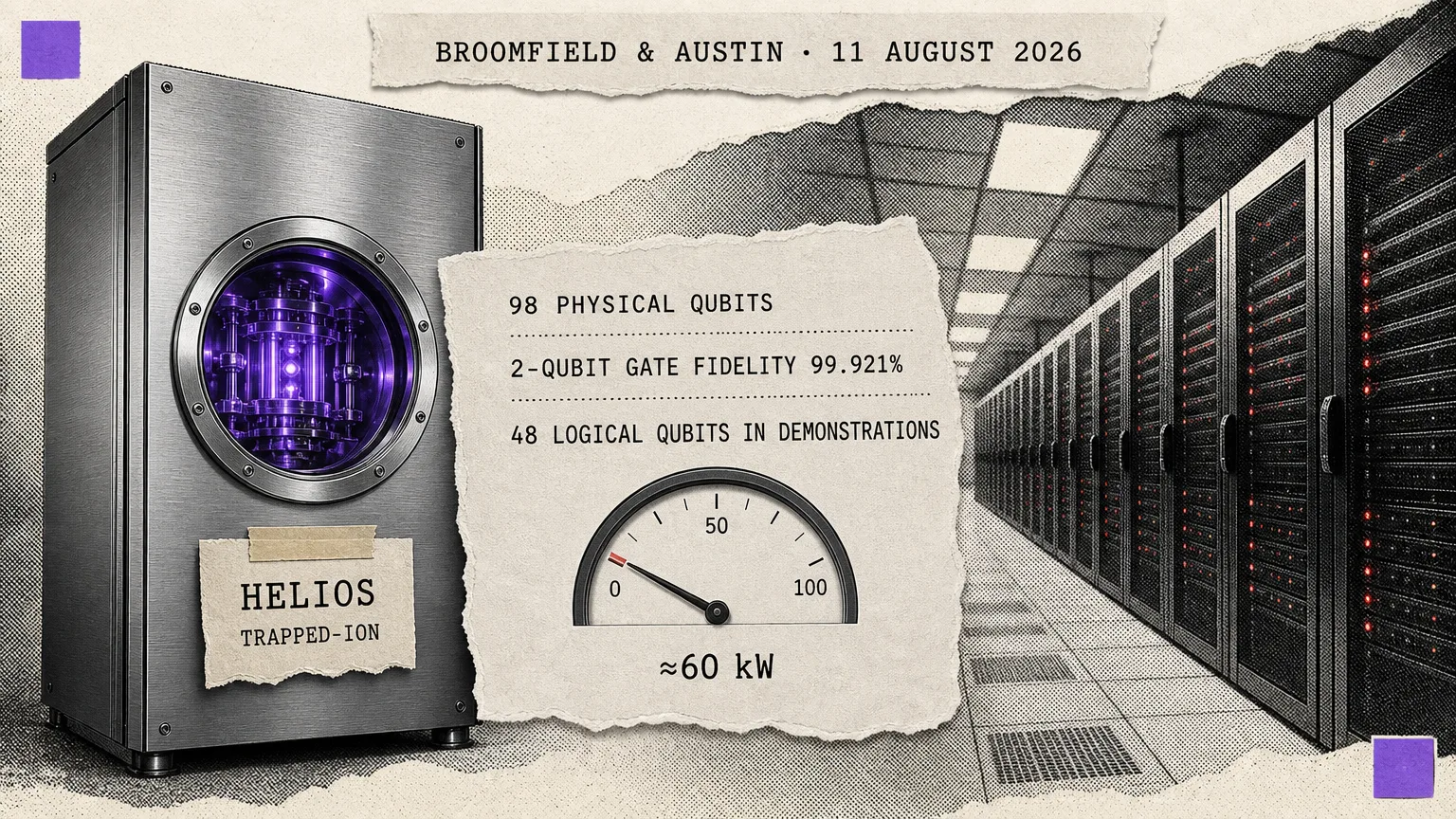
Oracle is installing Quantinuum's Helios quantum computer inside its AI cloud
Oracle and Quantinuum announced a multi-year partnership on 11 August to deploy Helios, the 98-qubit trapped-ion system, inside a US Oracle Cloud AI data centre, with an OCI quantum service to preview in the coming months.
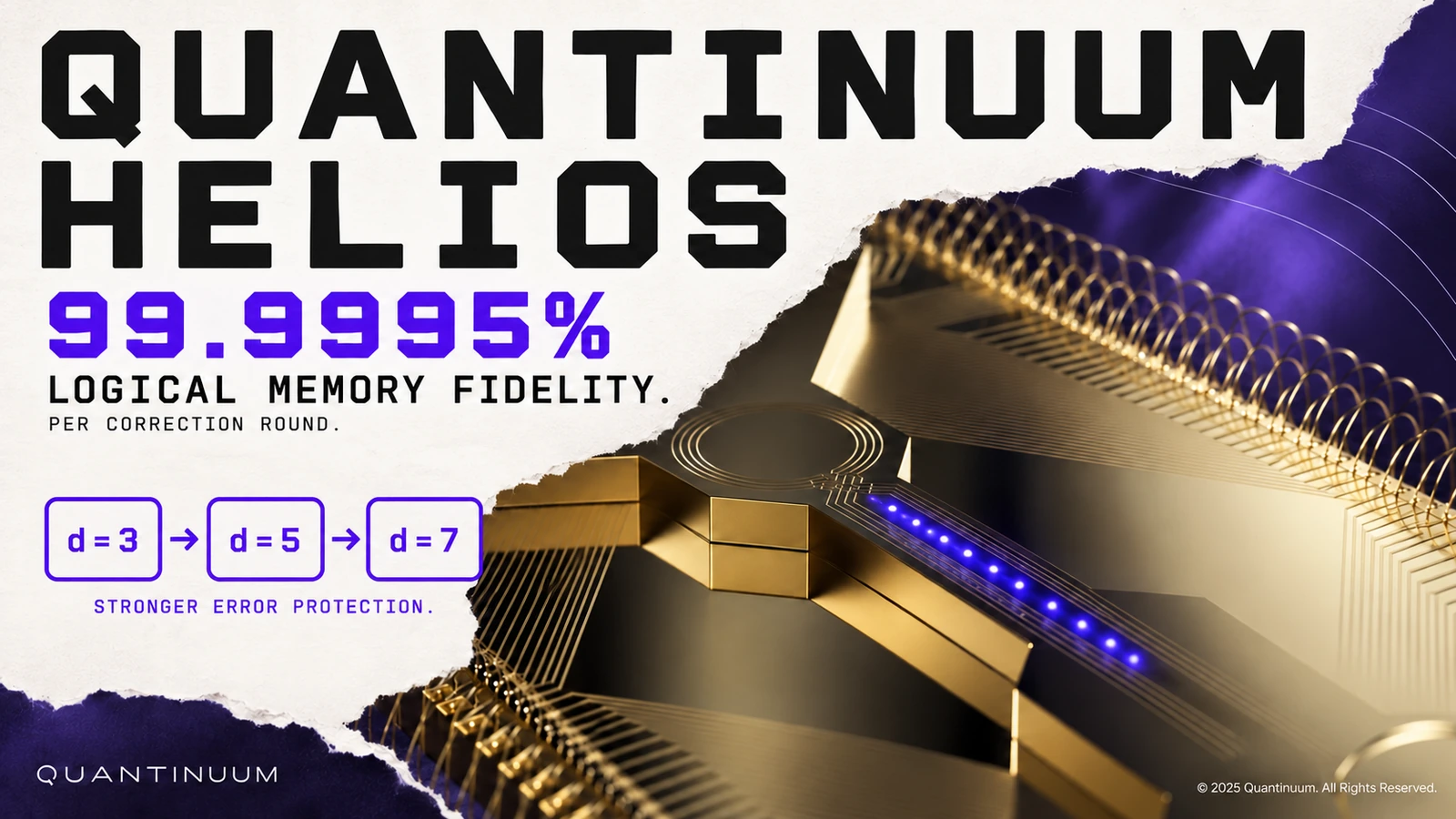
Quantinuum reports five logical-memory errors per million rounds
Quantinuum reports a logical-memory error rate of about five in a million correction rounds on Helios, corresponding to 99.9995% fidelity per round. Its distance-7 colour-code result and error-suppression measurements support the company's fault-tolerance research programme.
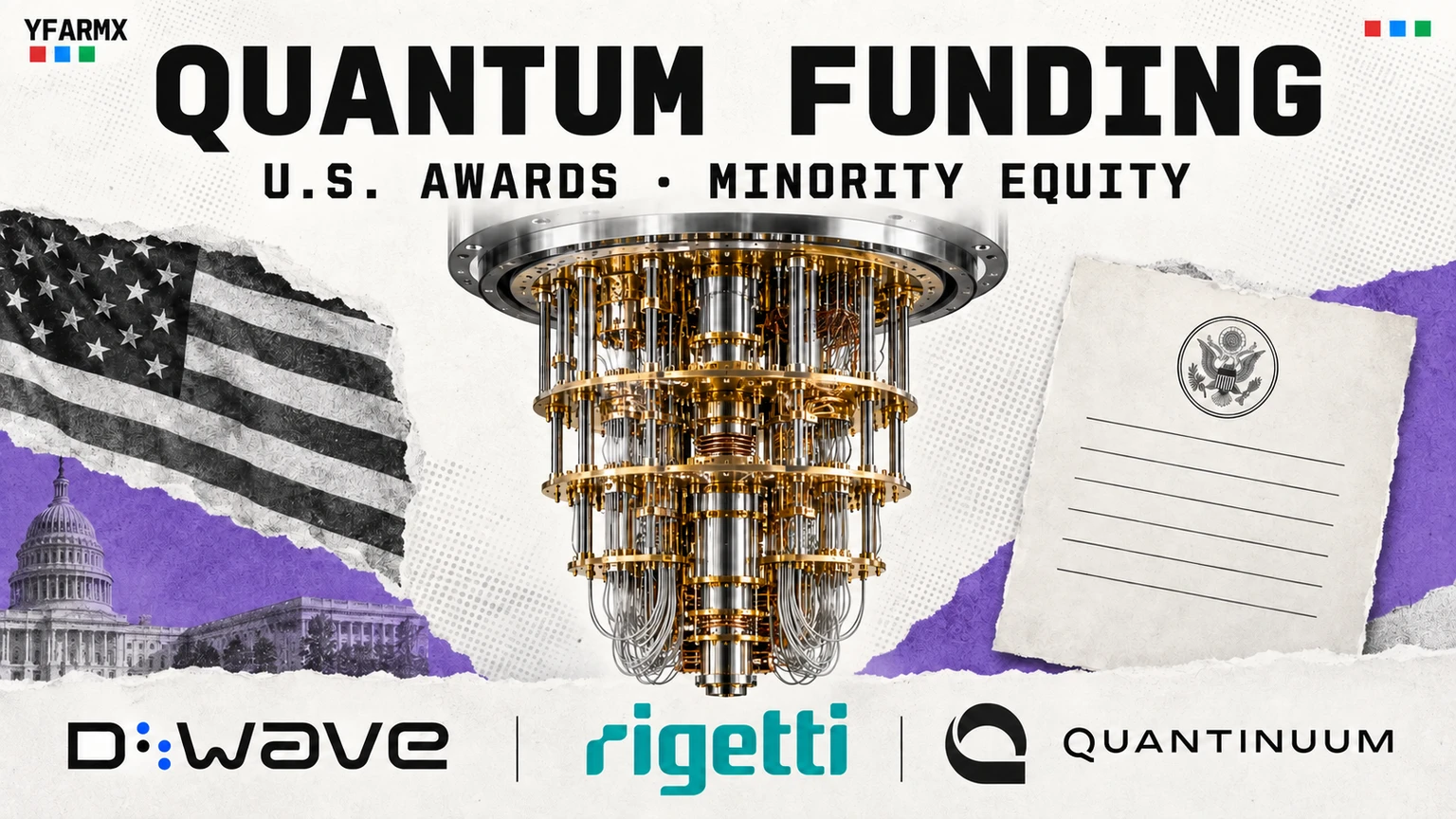
U.S. quantum awards pair funding for D-Wave, Rigetti and Quantinuum with equity stakes
D-Wave, Rigetti and Quantinuum have finalised CHIPS awards totalling up to $300 million under a programme requiring minority government equity stakes.