
Trapped ions
the most accurate qubits anyone has built
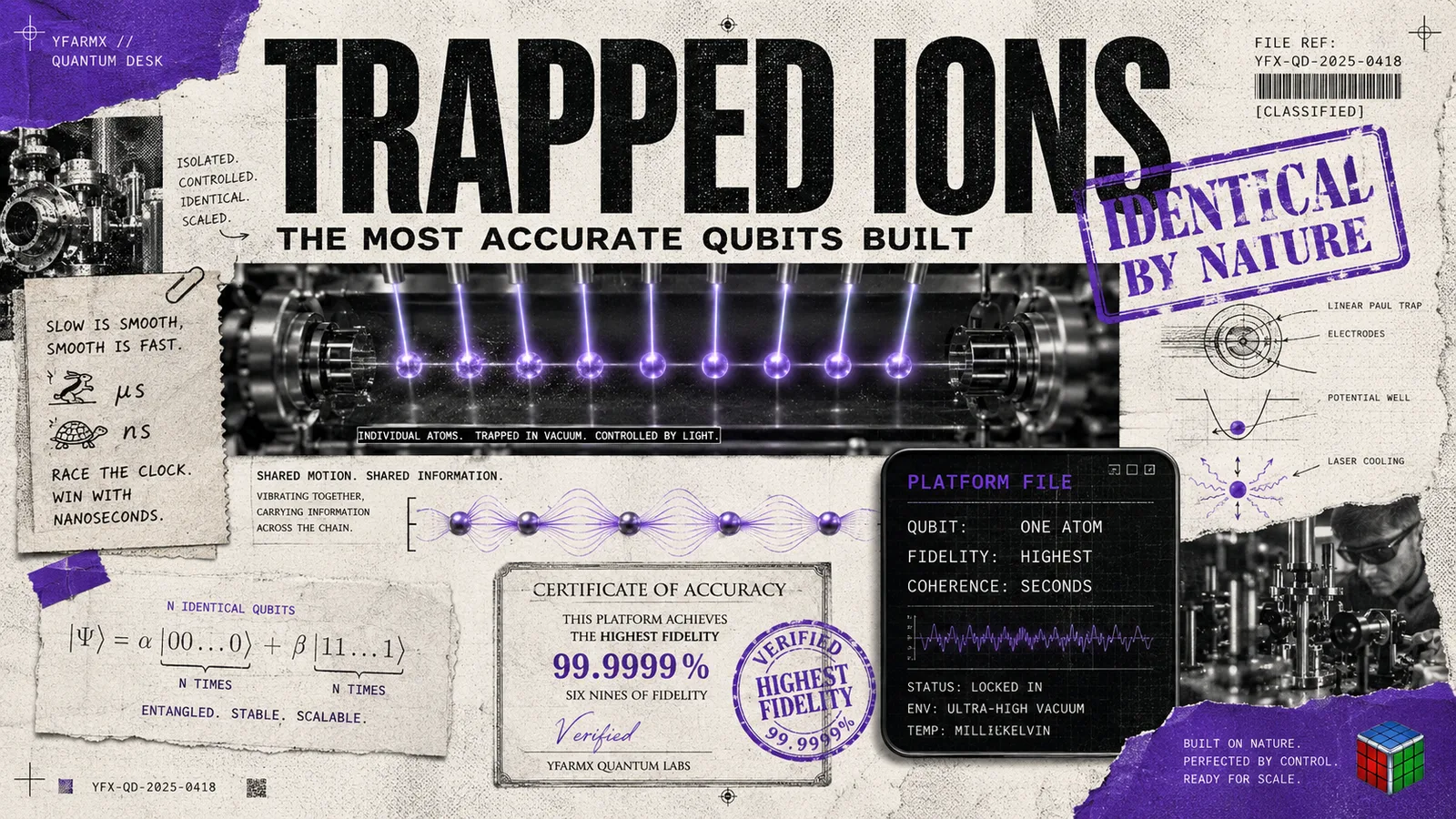
Key facts
- One atomidentical every time
- The qubit
- Highestbest two-qubit gates
- Fidelity
- Secondsvs microseconds
- Coherence
- Microsecondsslower than superconducting
- Gate speed
Individual atoms, plucked from nature, held motionless in an electric field and poked with lasers. Every atom is identical to every other, which is why these are the most accurate qubits anyone has made.
Trapped ions take the opposite approach to superconducting circuits. Rather than manufacturing a qubit, they use one nature already made: a single charged atom, suspended in empty space by electromagnetic fields and manipulated with lasers. It is the slowest way to compute and the most accurate, and Quantinuum and IonQ have built the leading machines on it.
How it works
Atoms of an element such as ytterbium or barium are stripped of an electron, which gives them a charge so electric fields can hold them. Held in an ultra-high vacuum, a row of these ions floats in a line, spaced apart by their mutual repulsion. Two internal energy states of each atom serve as 0 and 1, and finely tuned laser pulses move the atom between them.
Two-qubit operations exploit a neat trick: because the ions repel each other, they vibrate as a connected chain, and that shared motion can carry information from one ion to another. Any ion in the chain can be entangled with any other, not just its neighbours, which is a real advantage over chip-based designs where connections are fixed by the wiring.
Why the accuracy
Every ytterbium ion in the universe is exactly identical. There is no manufacturing variation to calibrate around, no fabrication defect, no drift between one qubit and the next. That single fact is why trapped ions consistently hold the records for gate fidelity, the measure of how often an operation does what it should. Coherence times run to seconds, against microseconds for superconducting circuits, so the quantum state survives orders of magnitude longer.
They also run warm, in the sense that they need vacuum rather than a dilution refrigerator, which removes one large engineering burden.
The trade-off
Speed is the price. Laser-driven operations take microseconds where superconducting gates take nanoseconds, so a trapped-ion machine performs perhaps a thousand times fewer operations per second. Long coherence partly compensates, but on raw throughput they lose.
Scaling is the harder question. A single chain of ions cannot grow indefinitely: add too many and the shared vibrations become impossible to control cleanly. The answer being pursued is to break the problem up, shuttling ions between zones on a chip, or linking separate traps with photons. Both work in the laboratory; neither has yet produced a machine with the qubit counts superconducting rivals report.
Where it stands
Trapped ions dominate the quality benchmarks and lag on quantity. Because error correction turns quality into fewer physical qubits per logical qubit, that is a stronger position than raw counts suggest, and the platform remains a serious contender for the first genuinely useful fault-tolerant machine.
Linking a processor to quantum memory
On 9 October, IonQ announced an experimental link between a trapped barium ion and a silicon-vacancy quantum memory. The paper reports entanglement generation at about 1,030 entangled pairs per second, with 87.9% fidelity, a measure of how closely the shared state matches the intended state. This processor-memory experiment is a step towards connecting separate quantum systems. IonQ’s announcement and the research preprint describe the apparatus and measurements. The result concerns this laboratory link; a larger distributed computer also needs reliable operations across the connected systems.
More Quantum
All Quantum →
IonQ's quantum link creates 1,000 entangled pairs per second
IonQ reported a 1.03 kHz entanglement rate between a trapped-ion qubit and a silicon-vacancy memory. The preprint reports 87.9% Bell-state fidelity for the heterogeneous link.
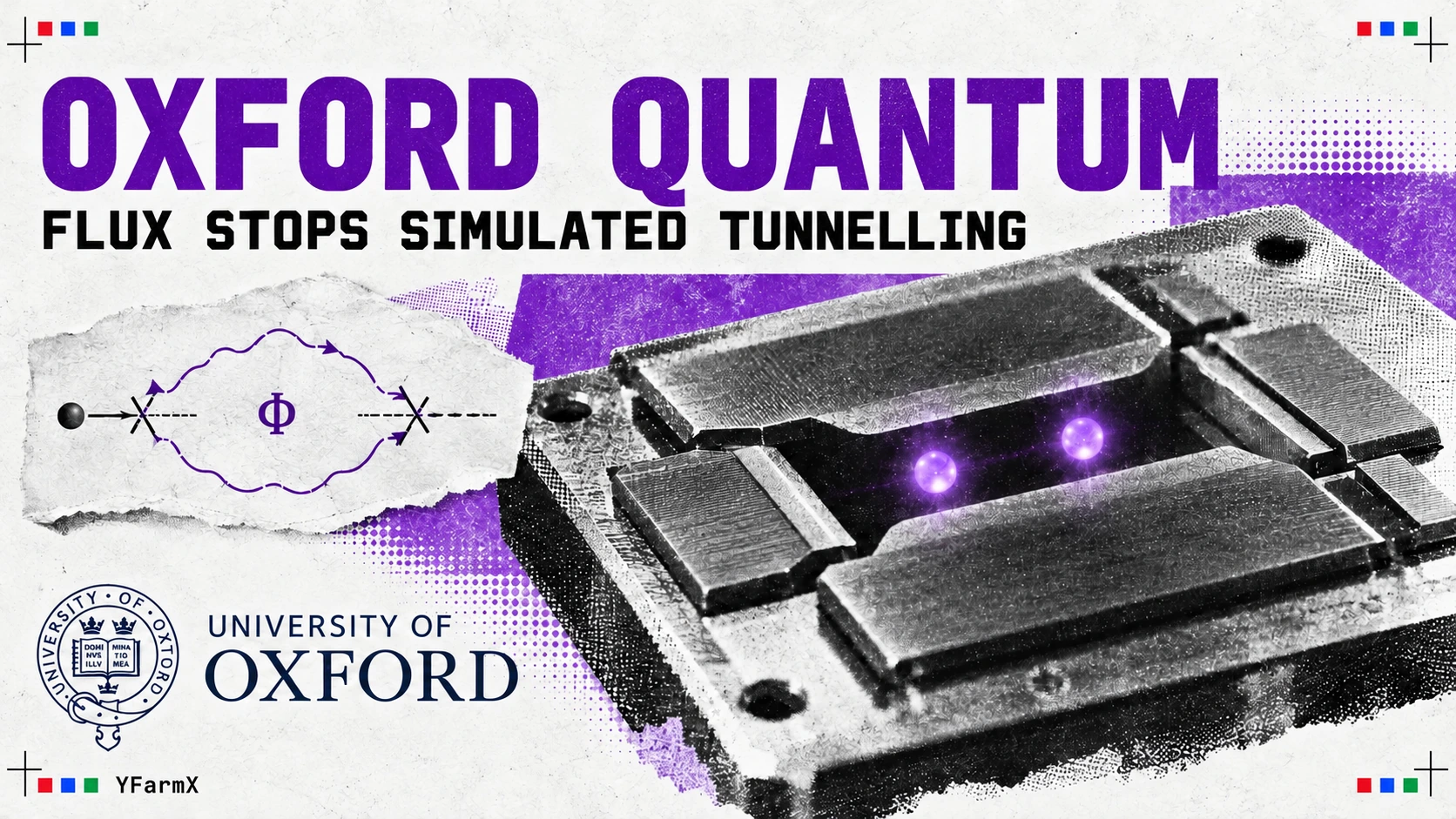
Oxford's hybrid quantum computer simulates magnetic flux stopping tunnelling
Oxford physicists used qubits and vibrating trapped ions to observe magnetic-flux interference in a simulated particle system. The study appeared in Nature Physics on 25 September.