Oxford's hybrid quantum computer simulates magnetic flux stopping tunnelling
Oxford physicists used qubits and vibrating trapped ions to observe magnetic-flux interference in a simulated particle system. The study appeared in Nature Physics on 25 September.
Listen to this articleListen
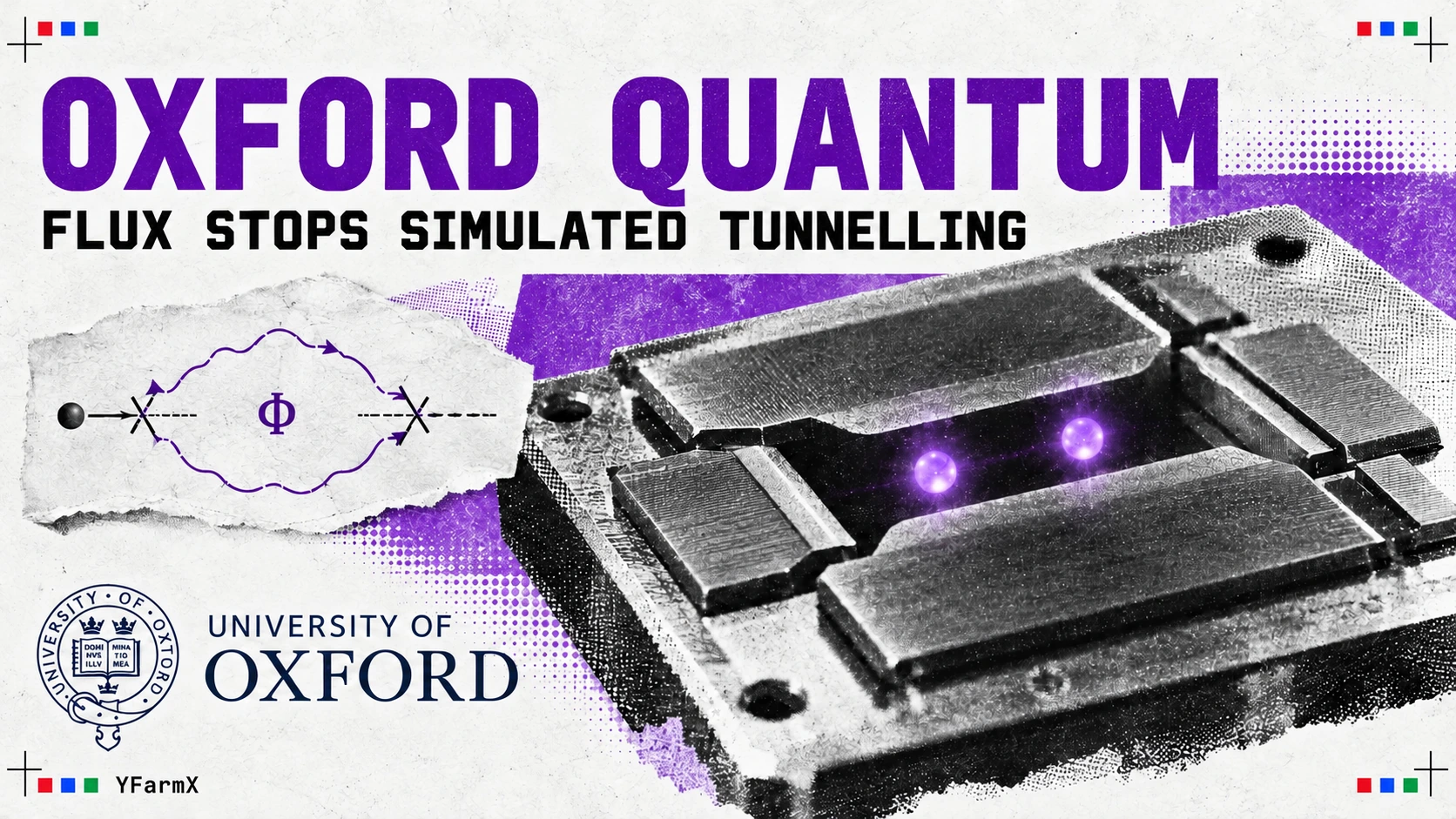
Oxford physicists have used a hybrid quantum computer to observe magnetic flux stopping a simulated particle from tunnelling. The experiment, published in Nature Physics on 25 September 2026, combined qubits with quantum oscillators: the controlled vibrations of trapped ions.
The team reproduced the Aharonov-Bohm effect, a quantum phenomenon in which a particle travelling around magnetic flux acquires a phase that changes how its possible paths interfere. Oxford’s account describes a particle responding to a magnetic field enclosed by its route while travelling through a field-free region.
Two qubits and two oscillators formed the loop
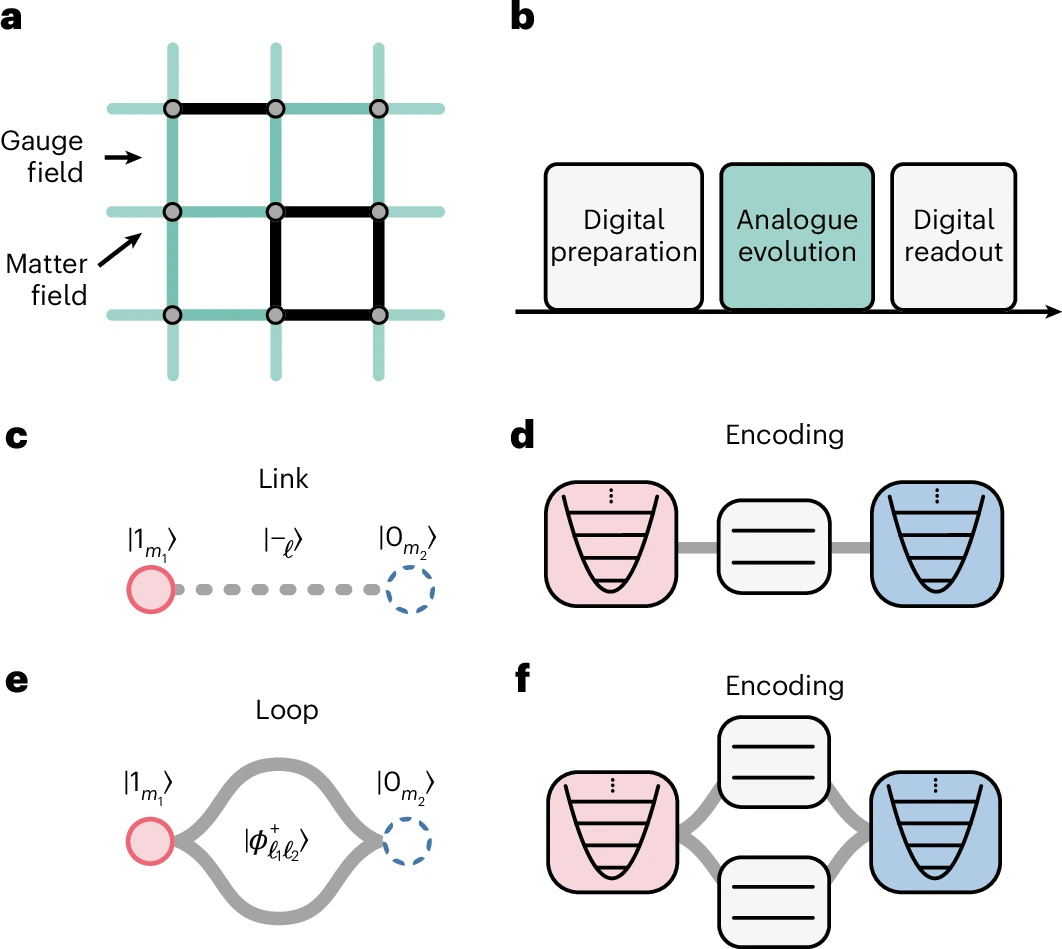
The Oxford experiment represented a small lattice gauge theory using two qubits and two oscillators. A lattice gauge theory places particles at the points of a grid and fields on the links connecting them. It provides a way to study how particles and force-carrying fields evolve together.
In the experimental paper, the internal electronic states of trapped strontium ions encoded the qubits. Those qubits represented the gauge fields. Two vibrational modes represented the particle sites.
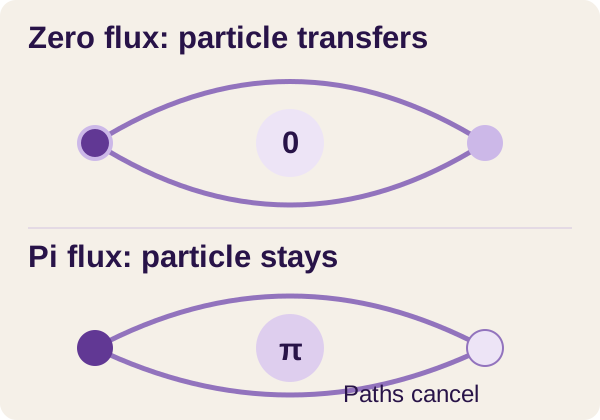
The researchers first tested a single link and then added a second ion to build a loop. Two connections between the same particle sites gave the simulated particle two tunnelling paths.
The two paths cancelled when the flux changed
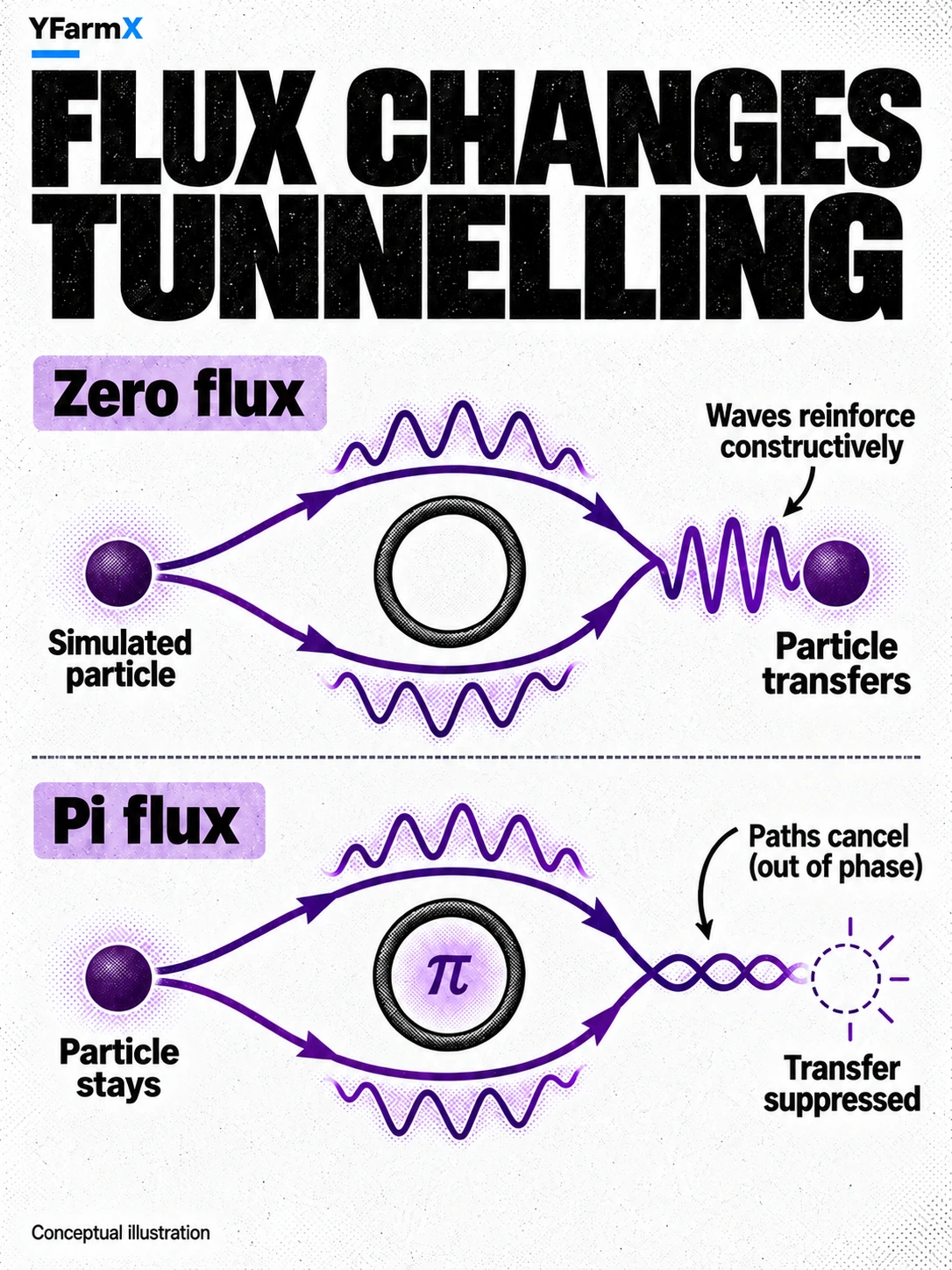
Preparing the qubits in different entangled states switched the loop between zero flux and pi flux. With zero flux, the particle moved between the two sites. With pi flux, destructive interference suppressed that movement, leaving the particle in its starting configuration.
The magnetic flux was encoded in the quantum state of the simulated gauge fields. The experiment therefore followed the particle and the fields as parts of the same evolving quantum system. The researchers tracked site populations and field correlations to measure the result.
Hybrid hardware gives each part of the simulation its own role
The qubit-oscillator architecture lets discrete quantum states and vibrational motion represent different parts of the same theory. The team combined digital operations for state preparation and measurement with analogue evolution under an engineered interaction.
This small experiment establishes a building block for larger simulations. The paper proposes extending the geometry through additional qubit-oscillator connections, creating synthetic spatial dimensions within the trapped-ion device.
Larger interacting particle-and-field systems become increasingly demanding for classical computers. Oxford’s result gives researchers an experimentally demonstrated route towards studying those dynamics with hybrid quantum hardware.