Germany's race for a 1,000-qubit quantum computer: QUDORA's team advances
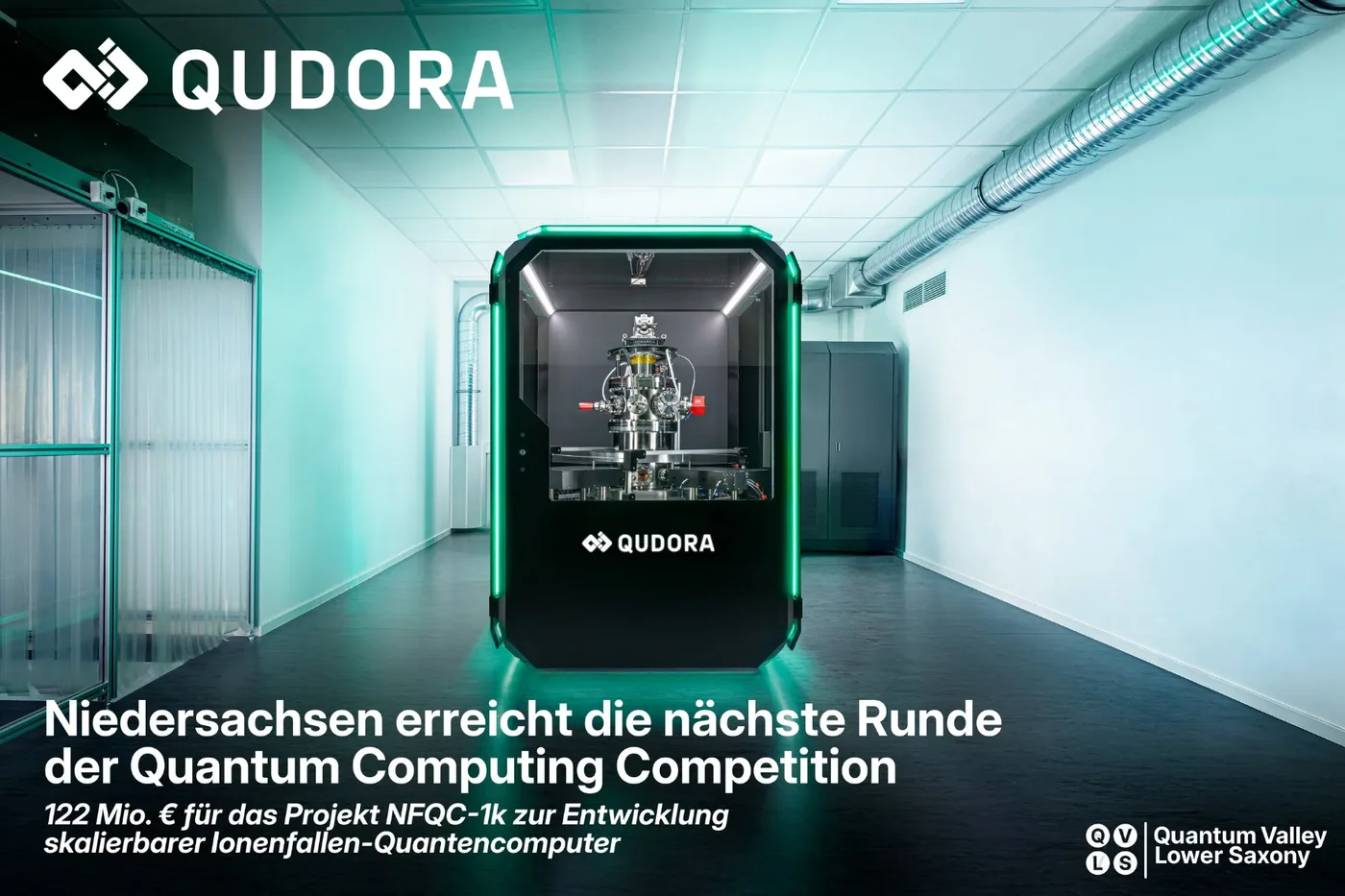
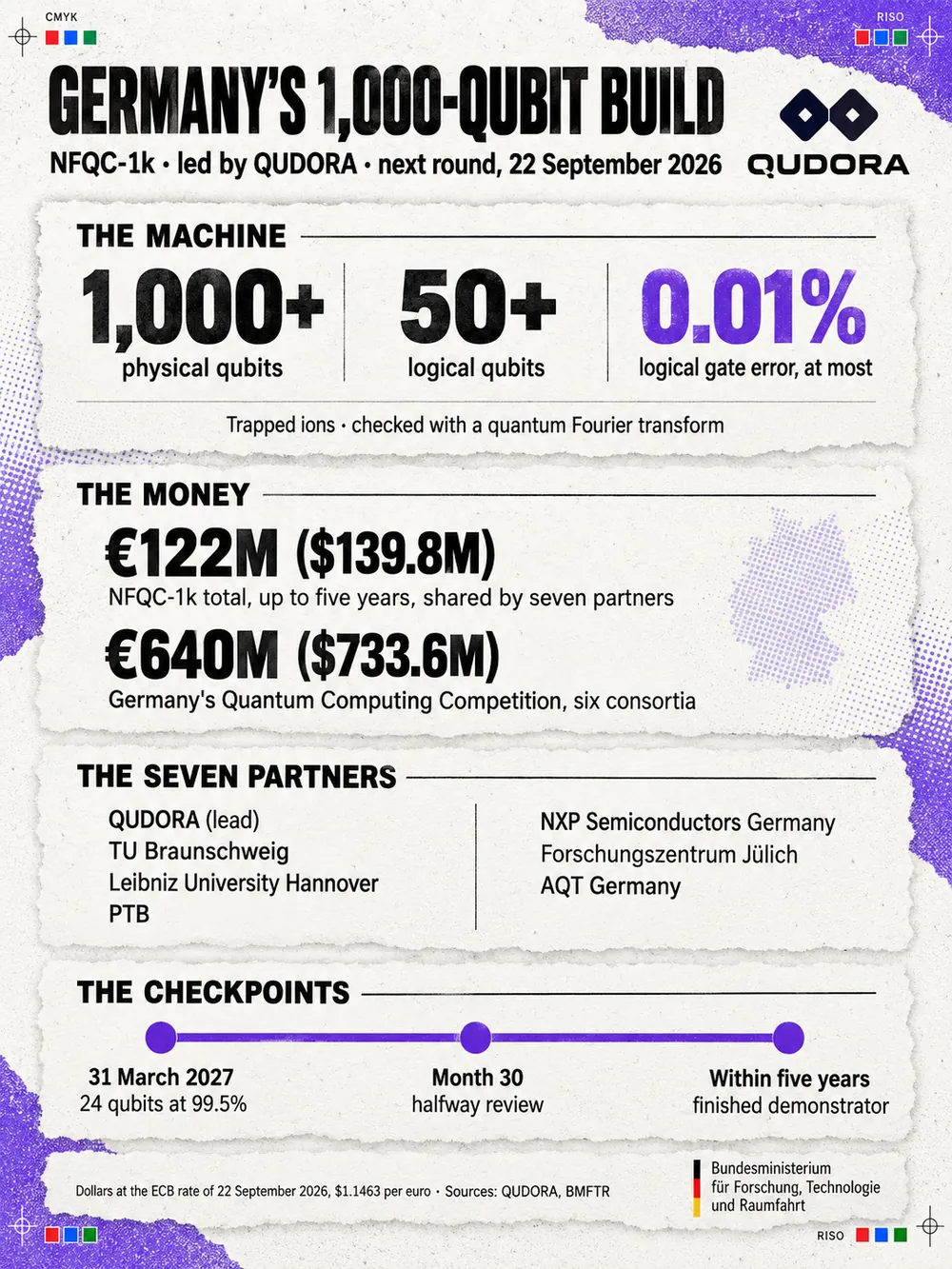
Germany's research ministry has put a seven-member consortium led by the start-up QUDORA through to the next round of its contest to build a trapped-ion quantum computer with at least 1,000 physical and 50 logical qubits. The NFQC-1k project totals about €122m ($139.8m) over up to five years.
Listen to this articleListen
Germany’s research ministry has put a seven-member team led by QUDORA, a start-up in Braunschweig, through to the next round of its contest to build a trapped-ion quantum computer with at least 1,000 physical qubits and 50 logical qubits. QUDORA announced it on 22 September 2026. The project, NFQC-1k, has a total volume of about €122 million ($139.8 million) over up to five years, and it also builds a pilot line for the machine’s processor chips.
NFQC-1k is one of six consortia that the Federal Ministry of Research, Technology and Space (BMFTR) has sent through to the next round of its Quantum Computing Competition, according to the ministry’s quantum systems programme office. The ministry has about €640 million ($733.6 million) for the competition, which serves the federal goal of at least two error-corrected quantum computers in Germany by 2030. With its outline approved, the consortium now files its full application. Dollar figures use the European Central Bank’s reference rate for 22 September 2026, $1.1463 to the euro.
Who is in the QUDORA consortium?
QUDORA Technologies leads NFQC-1k as system integrator, with six partners from research and industry. QUDORA was founded in 2021 and builds full-stack trapped-ion quantum computers. The €122 million is the total for the whole consortium, shared across all seven members, according to QUDORA.
| Partner | Who they are |
|---|---|
| QUDORA Technologies (lead) | Braunschweig start-up founded in 2021; develops and integrates the whole system |
| TU Braunschweig | Technical university in Braunschweig |
| Leibniz University Hannover | University in Hannover |
| Physikalisch-Technische Bundesanstalt (PTB) | Germany’s national metrology institute |
| NXP Semiconductors Germany | German arm of the chipmaker NXP |
| Forschungszentrum Jülich | Research centre active in quantum computing |
| AQT Germany | German unit of Alpine Quantum Technologies, a University of Innsbruck spin-off that builds trapped-ion computers |
Three partners, Leibniz University Hannover, TU Braunschweig and PTB, laid the scientific foundations for NFQC-1k, according to Quantum Valley Lower Saxony (QVLS), the regional quantum cluster that brought their work together. The cluster’s QVLS-Q1 project set out in 2021 to build a 50-qubit trapped-ion computer, with about €25 million ($28.7 million) from Lower Saxony’s science ministry and the Volkswagen Foundation. QUDORA grew out of that ecosystem.
“That our project has been selected shows the confidence of German government in our technology as well as the expertise of our partners and the Quantum Valley Lower Saxony,” said Henning Hahn, QUDORA’s chief operating officer.
What does the finished machine have to do?
The NFQC-1k demonstrator must control at least 1,000 individually addressable physical qubits and run at least 50 logical qubits, with logical gate errors of 0.01 per cent or less. The BMFTR’s funding guideline of 7 April 2026 sets the same minimums for every trapped-ion entry.
| Trapped-ion target | Requirement |
|---|---|
| Individually addressable physical qubits | 1,000 or more |
| Logical qubits | 50 or more |
| Error rate of logical two-qubit gates | 0.01% at most |
| One error-correction cycle across the full register | 20 milliseconds at most |
| Benchmark | Quantum Fourier transform, on logical qubits at the end |
| Funding period | Up to five years |

The guideline also asks each project to demonstrate a universal set of logical gates and to build exactly one demonstrator. A quantum Fourier transform, a core building block of quantum algorithms, runs on the hardware at the halfway point and again on logical qubits at the end. An interim evaluation after month 30 uses the milestones as the criterion for stopping a project.
A logical qubit is built from many physical ones
In NFQC-1k a physical qubit is a single trapped ion, and a logical qubit is one unit of error-corrected information spread across a group of them. Physical qubits make mistakes. Quantum error correction encodes each logical qubit redundantly across several physical qubits and checks the group over and over, finding and fixing errors without reading out the data itself. Done well, the logical qubit fails far less often than any ion inside it.
The NFQC-1k ceiling of 0.01 per cent means at most one failed logical two-qubit gate in every 10,000. At the minimums, 1,000 physical qubits for 50 logical ones is 20 physical qubits for each logical qubit.
For scale, Quantinuum’s Helios, a trapped-ion computer launched on 5 November 2025 and now going into Oracle’s cloud, has 98 physical qubits at 99.921 per cent two-qubit gate fidelity, and Quantinuum lists 48 error-corrected logical qubits on it. NFQC-1k asks for about ten times the physical qubits and a similar count of logical ones.
Why build it from trapped ions?
A trapped ion is a single charged atom held in place by electric fields inside a vacuum chamber, and every ion of an element is identical to the next, which is why ions have produced some of the most accurate qubits built. The BMFTR funds three platforms because its guideline treats the winner for 2030 as open, and it sets each platform targets that reflect its physics. Two consortia went through for each platform: trapped ions, neutral atoms and superconducting circuits, where one team is led by the German arm of IQM.
| Platform | Minimum qubits, physical and logical | Longest correction cycle | Consortia in the next round (lead) |
|---|---|---|---|
| Trapped ions | 1,000 physical, 50 logical | 20 ms | NFQC-1k (QUDORA), Nexus (neQxt) |
| Neutral atoms | 4,000 physical, 50 logical | 10 ms | LOGIQC (planqc), SPARQC (EQCITED) |
| Superconducting circuits | 300 physical, 2 logical | 0.1 ms | SuperPilot (IQM Germany), ATHENA-X (Peak Quantum) |
All three share the same logical error ceiling of 0.01 per cent. Ions are asked for 50 logical qubits from a quarter of the physical qubits set for neutral atoms. They also get 200 times longer per correction cycle than superconducting chips, since ion gates run slower.
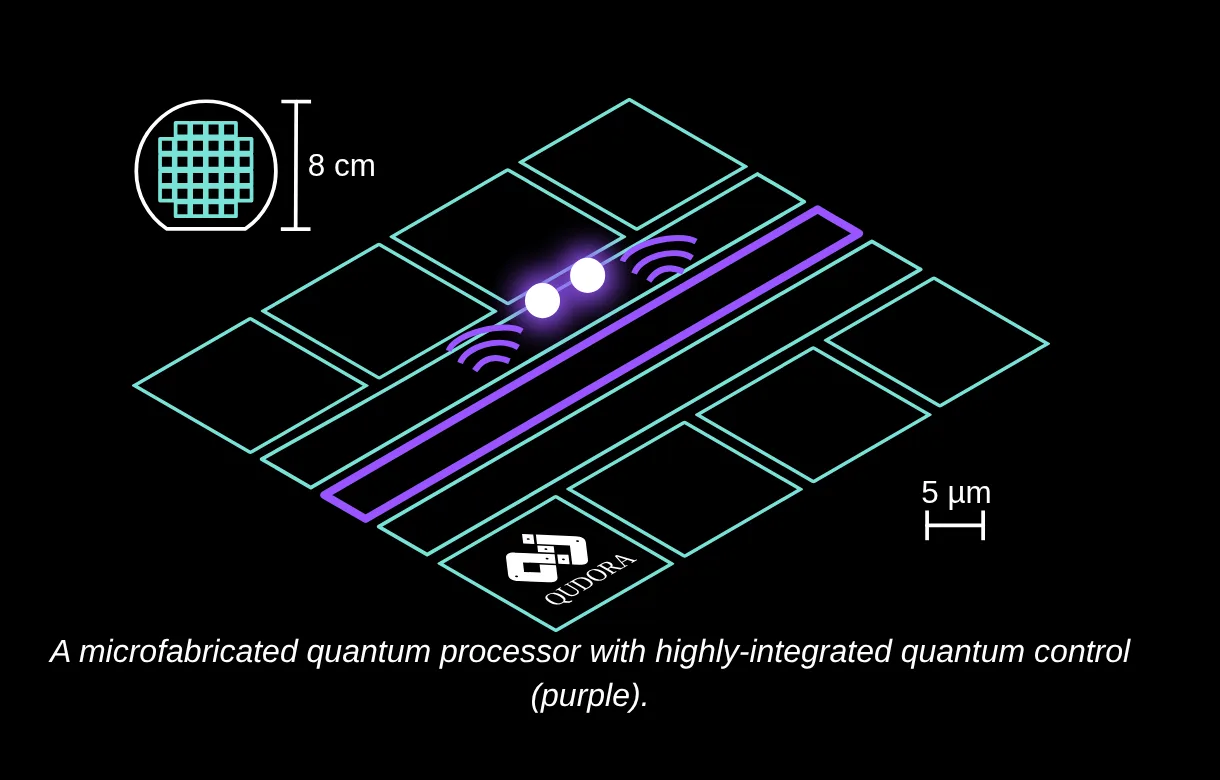
QUDORA steers its ions with microwaves. Its Near Field Quantum Control technology, NFQC, replaces the bulky laser systems of conventional trapped-ion machines with microwave electronics on the chip, made with standard semiconductor processes, according to QUDORA. Chief executive Amado Bautista-Salvador described the job as “building an architecture in which thousands of resilient qubits can be controlled, and operated reliably, without the system falling apart as it scales”.
The money also pays for a chip pilot line
Alongside the demonstrator, NFQC-1k builds a pilot line for high-performance trapped-ion quantum processors, the chips at the centre of the machine. The BMFTR runs the competition in two modules. Module A funds research and development, capped at €20 million ($22.9 million) of federal money per consortium. Module B funds research and pilot manufacturing facilities where a project’s targets require them, which for ion traps includes equipment for microfabricating traps, radio-frequency electronics, and optical and vacuum systems.
The grants are non-repayable. Companies carry an appropriate share of their own costs, while universities and research institutes can be funded at up to 100 per cent of eligible costs. Results may be used only in Germany, the European Economic Area and Switzerland. The competition sits inside a larger budget: the BMFTR plans to invest about €2.2 billion ($2.52 billion) in quantum systems up to and including 2029.
Research minister Dorothee Bär opened the competition in April with a promise of clear, measurable success criteria and quantum computers “Made in Germany”.
The first test is due by 31 March 2027
At least one partner in every consortium in the Quantum Computing Competition must show, by 31 March 2027, a working system with at least 24 addressable qubits and two-qubit gate fidelity of at least 99.5 per cent. That entry check, set by the BMFTR’s programme office on 25 September 2026, comes first. The month-30 review follows, and a consortium that misses its milestones there can lose its funding.
The United States is running a race of its own: the Department of Energy opened its Quantum Genesis Q Competition on 17 September 2026, with up to $215 million for machines of at least 100 logical qubits. Germany’s version backs six teams to get two machines. For NFQC-1k, the headline number is 1,000 qubits. The first number the team has to hit is 24.
Questions people ask
- What is NFQC-1k?
- NFQC-1k is a German project to build a trapped-ion quantum computer with at least 1,000 individually addressable physical qubits and at least 50 logical qubits, with logical two-qubit gate errors of 0.01 per cent or less, plus a pilot line for trapped-ion quantum processor chips. QUDORA Technologies leads the seven-member consortium. QUDORA announced on 22 September 2026 that Germany's Federal Ministry of Research, Technology and Space had approved the project's outline and invited its full application. The project totals about €122 million ($139.8 million at the ECB rate of 22 September 2026) over up to five years.
- Who is in the NFQC-1k consortium?
- Seven members: QUDORA Technologies as lead and system integrator, TU Braunschweig, Leibniz University Hannover, the Physikalisch-Technische Bundesanstalt (PTB), NXP Semiconductors Germany, Forschungszentrum Jülich and AQT Germany, the German unit of Alpine Quantum Technologies. QUDORA says the €122 million total is shared across all seven.
- Which consortia went through to the next round of Germany's Quantum Computing Competition?
- Six, two per hardware platform, according to the BMFTR's quantum programme office on 25 September 2026. Neutral atoms: LOGIQC (planqc) and SPARQC (EQCITED). Trapped ions: NFQC-1k (QUDORA Technologies) and Nexus (neQxt). Superconducting circuits: SuperPilot (IQM Germany) and ATHENA-X (Peak Quantum). The ministry is providing about €640 million ($733.6 million) for the competition.
Sources
- QUDORA: German government selects QUDORA-led consortium for €122 million project NFQC-1k, 22 September 2026qudora.com
- Quantum Valley Lower Saxony: Lower Saxony reaches next round of the Quantum Computing Competition, 23 September 2026qvls.de
- BMFTR Quantum Systems programme (VDI Technologiezentrum): six start-up-led consortia reach the next funding phase, 25 September 2026quantensysteme.info
- BMFTR: funding guideline for the Quantum Computing Competition, Bundesanzeiger, 7 April 2026bmftr.bund.de
- BMFTR press release 18/2026: Dorothee Bär on the Quantum Computing Competition, 8 April 2026bmftr.bund.de
- QUDORA: EU backs QUDORA in Quantum Grand Challenge, with a description of NFQC technology, 8 September 2026qudora.com
- Quantinuum: commercial launch of the Helios quantum computer, 5 November 2025quantinuum.com
- US Department of Energy: DOE launches the Quantum Genesis Q Competition, 17 September 2026energy.gov
- European Central Bank: euro reference exchange rate, US dollar (1.1463 on 22 September 2026)ecb.europa.eu