DOE advisers chart path to error-corrected quantum computer by 2028
Advisers to the US Department of Energy set out a three-phase quantum roadmap whose first phase aims at DOE's goal of an error-corrected quantum computer by 2028. Under Secretary Darío Gil announced it on 17 September 2026. Their illustrative 2028 range is about 50 to 100+ logical qubits.
Listen to this articleListen
Darío Gil, the US Department of Energy’s Under Secretary for Science, announced a roadmap from his department’s scientific advisers on 17 September 2026 that starts with DOE’s goal of an error-corrected quantum computer by 2028 and runs into the 2030s. The report, titled “A Pathway to an Integrated Quantum Future” on its cover and dated September 2026, comes from the quantum subcommittee of the Office of Science Advisory Committee (SCAC).
It lays out three phases: competitions called Quantum Grand Challenges until 2028, a national Quantum Computing User Facility from 2028 if the results justify one, and quantum machines built into DOE’s supercomputing and AI work from 2030. Its illustrative range for 2028 is about 50 to 100+ logical qubits, the error-protected units a fault-tolerant machine computes with, each one spread across many physical qubits. Our explainer on quantum error correction covers how that works.
What did DOE ask its advisers for?
Gil asked the committee on 1 April 2026 for a roadmap “to identify the near-term steps to a concrete 2028 goal of an error-corrected quantum computer with sufficient scale to enable revolutionary scientific advances”, due by July 2026. The 2028 date is DOE’s own, written into his charge letter to SCAC chair Persis Drell. The committee’s task was the route, and the SCAC charter describes its duties as “solely advisory in nature”.
Anna Grassellino of Fermilab chaired the subcommittee, with Supratik Guha of Argonne National Laboratory and the University of Chicago as vice-chair. The other members were Eric Isaacs of the Research Corporation for Science Advancement, Lara Jehi of Cleveland Clinic, Mark Papermaster of AMD and Martin Schmidt of Rensselaer Polytechnic Institute. Gil thanked Grassellino, Guha and “the hundreds of stakeholders from industry, academia, and federal agencies who contributed to this report”.
| How the committee gathered input, April to July 2026 | Count |
|---|---|
| One-hour interviews, including IBM, Google, Quantinuum, IonQ, Rigetti, QuEra, D-Wave, Infleqtion and PsiQuantum | More than 30 |
| Written responses to a public call for input | About 50 |
| Registrations for the virtual town hall on 12 June 2026 | About 490 |
| Talks at the town hall, picked from more than 100 abstracts | 42 |
The subcommittee presented its final report to the full SCAC in July 2026.
The plan runs in three phases
The roadmap runs from Quantum Grand Challenges in 2026 to 2028, to a DOE Quantum Computing User Facility from 2028 “if warranted”, to quantum computing built into DOE’s wider science from 2030. The committee designed the first phase to meet “the Committee’s charged objective of demonstrating a scientifically relevant, error-corrected quantum computing capability by 2028”.
Phase 1 is a run of milestone-driven competitions for teams from national laboratories, universities and industry, judged on science and hardware together. Its science milestones for 2028 include accurate electronic structure for catalytically important molecules, models of strongly correlated materials, validated simulations of fusion-relevant materials and plasmas, realistic neutrino and nuclear interactions, and key effects in the quantum field theories of particle physics.
Phase 2 turns on a decision. The committee asks DOE to plan the facility alongside the challenges, so that once the milestones are met, “possibly in 2028”, it can decide the facility’s scale. The test is whether the machines “collectively enable scientifically compelling user programs, reliable operation, and a sustainable path for future growth”. Gil wrote that the facility “will be an open, collaborative scientific instrument where researchers can co-develop hardware architectures, control systems, and software stacks alongside technology providers.”
Phase 3, from 2030, spreads quantum processors, simulators and sensors across DOE’s science “wherever they provide the greatest scientific value”.

How many logical qubits by 2028?
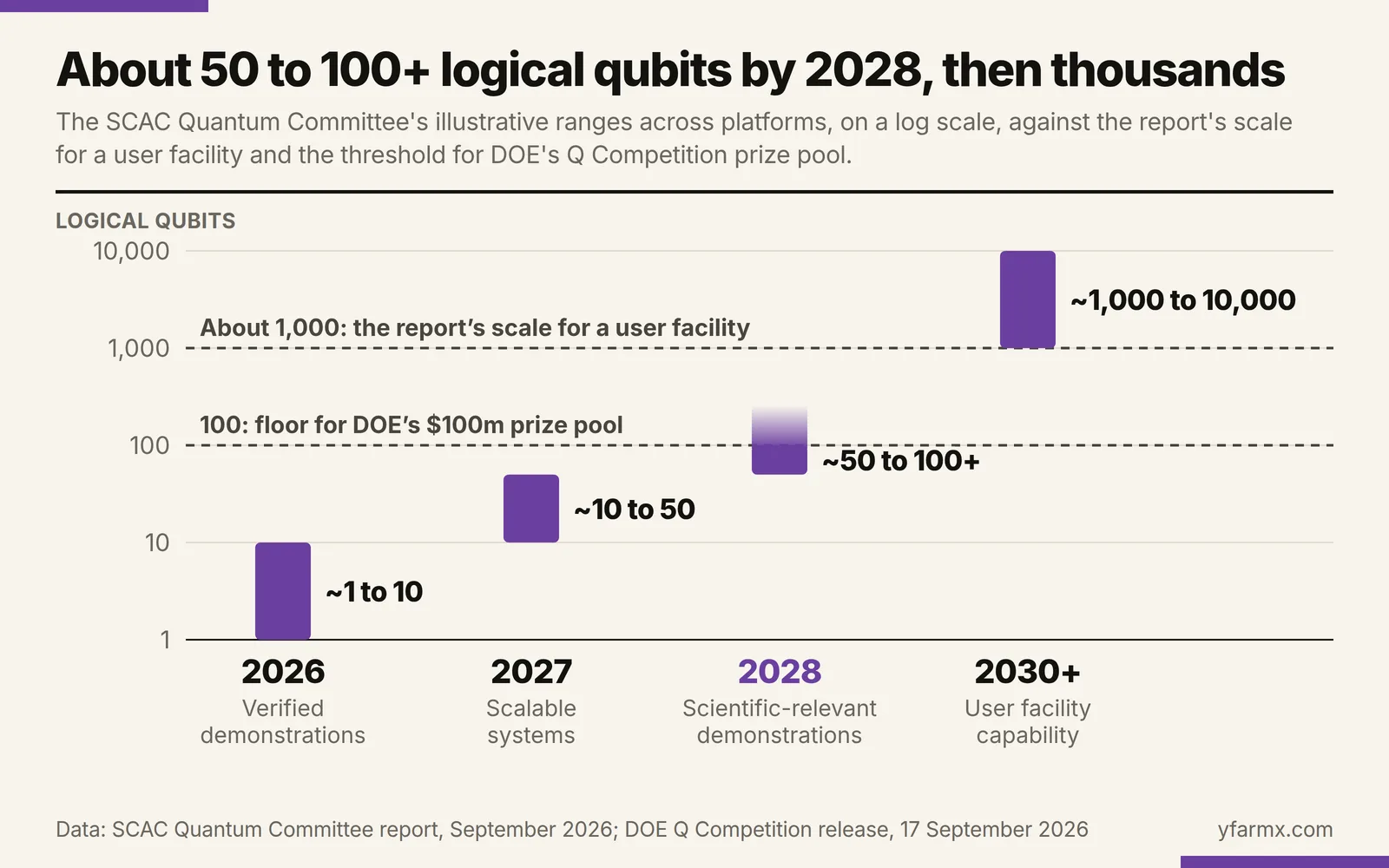
The committee’s hardware table puts 2028 at about 50 to 100+ logical qubits performing about 10,000 to 100,000 hard logical operations, rising to about 1,000 to 10,000 logical qubits from 2030. The committee calls them “illustrative performance ranges” across platforms and keeps its milestones technology-neutral. Hard logical operations are the steps an error-correcting code finds most costly and a full calculation still needs, the same measure DOE’s Q Competition request for applications benchmarks alongside its qubit count.
| Year | Stage, in the report’s words | Logical qubits | Hard logical operations |
|---|---|---|---|
| 2026 | Verified demonstrations | About 1 to 10 | Up to about 10,000 quantum operations, in tightly controlled demonstrations |
| 2027 | Scalable systems | About 10 to 50 | About 1,000 to 10,000 |
| 2028 | Scientific-relevant demonstrations | About 50 to 100+ | About 10,000 to 100,000 |
| 2030+ | User facility capability | About 1,000 to 10,000 | About 1 billion to 10 billion |
The 2028 column also asks for a full scientific calculation returned within 24 hours, and an end-to-end workflow across quantum, HPC and AI with scientific validation. The committee’s technology roadmap sets its 2028 goal as “an integrated, reliable, and scalable technology stack on a credible path to a ≥1,000-logical-qubit user facility”.
DOE’s $100 million pool opens at 100 logical qubits
DOE opened its Quantum Genesis Q Competition on 17 September 2026, the day Gil announced the report, and its $100 million general prize pool goes to companies that demonstrate at least 100 logical qubits. DOE’s release says the competition “builds on the recommendations made in the Blueprint for DOE Quantum Supercomputing and today’s Office of Science Advisory Committee report”, and the report maps its first phase onto the competition.
DOE and the groups advising it put different numbers on 2028:
| Document | Published | Whose number | Logical qubits in 2028 |
|---|---|---|---|
| Blueprint for DOE Quantum Supercomputing | 30 April 2026 | National laboratory team’s goal for DOE | At least 100 |
| Blueprint for DOE Quantum Supercomputing | 30 April 2026 | National laboratory team’s projection for at least one platform | 25 to 100 |
| Quantum Genesis announcement | 23 June 2026 | DOE’s aim | The low hundreds |
| SCAC Quantum Committee report | September 2026 | The advisers’ illustrative range | About 50 to 100+ |
| Q Competition announcement | 17 September 2026 | DOE’s prize threshold | At least 100, with bonus pools at 150 and 200 |
A machine with 60 logical qubits in 2028 would sit inside the advisers’ range and below the line that opens DOE’s prize pool. The Blueprint, written by a team from DOE’s national laboratories, carries both kinds of number: a goal of at least 100 logical qubits by 2028, and a judgement that at least one platform could plausibly build a machine of 25 to 100 logical qubits that year. Infleqtion, which announced on 24 September 2026 that it had entangled 30 logical qubits in experiments completed in August, says it is aiming for 100 in 2028.
DOE’s release sets out the money: Phase I fixed awards worth up to $1.5 million per awardee, the $100 million general pool, and two $50 million bonus pools for 150 and 200 logical qubits. Total planned funding is up to $215 million, “with $2.5 million in Fiscal Year 2026 dollars and outyear funding contingent on congressional appropriations”. The same release opens a $45 million call for DOE’s national laboratories to build the tools that will test and validate the machines, with $14 million in Fiscal Year 2026 dollars. Applications to the competition close on 19 October 2026.
Quantum machines would work alongside the labs’ supercomputers
The advisers want quantum computers working with DOE’s supercomputers and AI from the start: Phase 1 includes coupling to classical high-performance computing (HPC) and AI, and the 2028 hardware milestones include an end-to-end quantum, HPC and AI workflow. Their fourth recommendation extends that to “leadership-class HPC, artificial intelligence, scientific user facilities, advanced technology facilities, experimental platforms, quantum sensing, networking, and data infrastructure”.
The committee “anticipates a hybrid model in which cloud and on-premises resources complement one another”. Cloud access brings breadth and commercial hardware; machines installed at the laboratories bring “close interaction between hardware developers and scientific users” and “integration with leadership-class HPC systems and AI infrastructure and expertise”. It pictures a portfolio of instruments, possibly at different laboratories, spanning superconducting circuits, neutral atoms, trapped ions, photonics and spin qubits. Gil’s line on hardware: “Crucially, we must maintain a technology-neutral stance.”
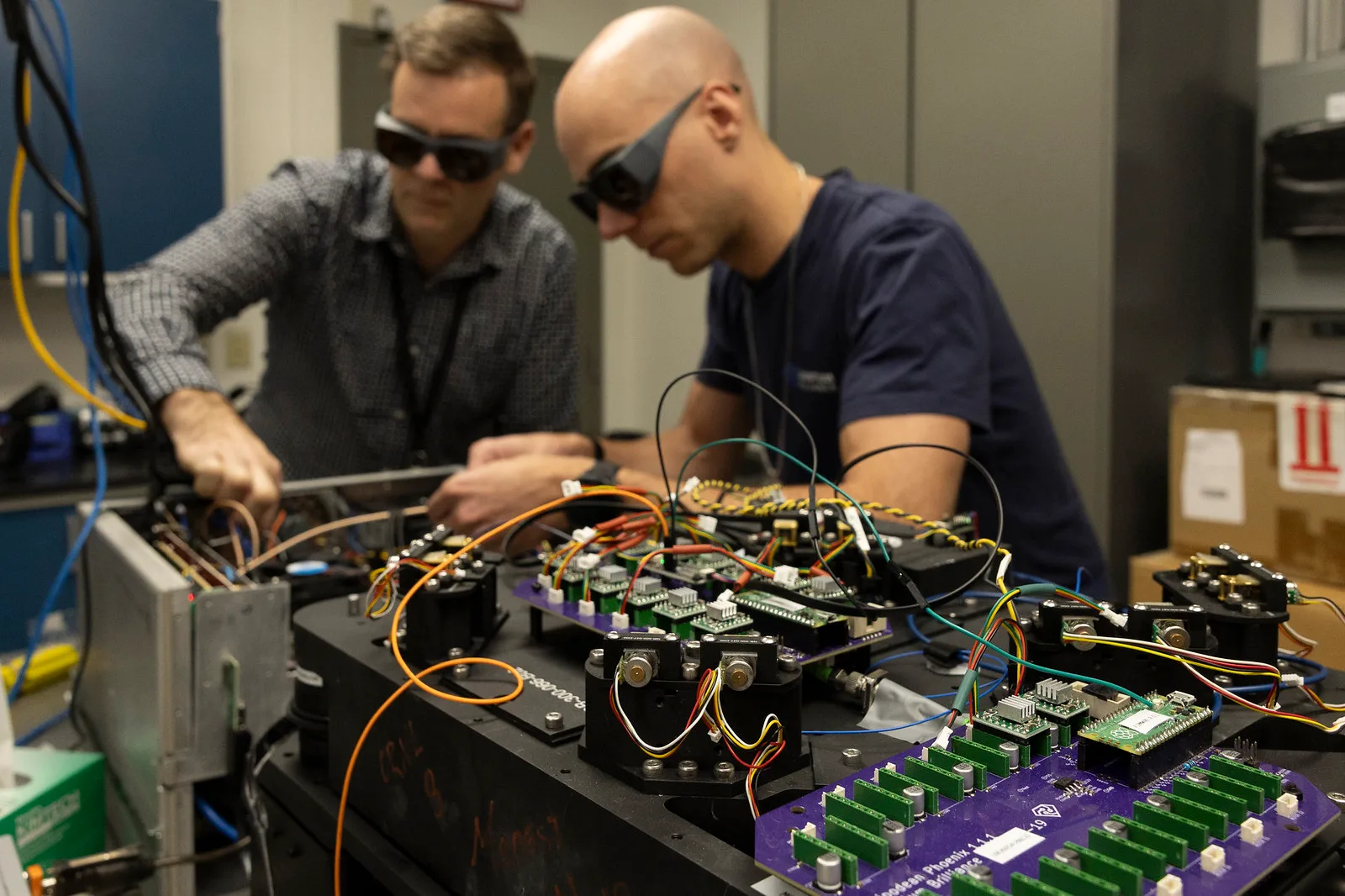
To put company engineers and laboratory scientists side by side, the committee proposes embedded co-design fellowships of 6 to 18 months, joint appointments, shared technical staff and hardware placed at DOE laboratories. The wider federal programme, from the CHIPS awards to DARPA’s benchmarking work, is on our US quantum policy page.
Reaching 2028 needs more money, the advisers say
The committee concludes that DOE’s 2028 goal “will require acceleration beyond current investment and development trajectories” and a coordinated effort across the whole of government. Its sixth recommendation asks DOE and Congress for “broadened investments, commensurate with the scale and strategic importance of the emerging opportunities”, and says the vision “will require resources beyond those currently available”. Cost estimates are left to a later “rigorous, community-informed process” involving the laboratories, academia and industry.
The people the committee consulted split on timing. Most interviewees saw 2028 as “an appropriate target for demonstrating scientific utility, provided coordinated investments continue across hardware, algorithms, software, and systems engineering”. Some expected scientifically useful fault-tolerant systems by 2028, while others saw large-scale fault tolerance “as requiring a substantially longer timeframe”. The committee chose to leave those debates open, and it builds an annual review into the roadmap.
Gil put the weight on the next three years: “The choices and investments we make over the next three years will shape global scientific leadership for decades to come.”
Questions people ask
- What is the SCAC Quantum Committee report?
- It is a report by the quantum subcommittee of the Office of Science Advisory Committee, which advises the US Department of Energy's Office of Science. Its cover title is A Pathway to an Integrated Quantum Future, and it answers Under Secretary for Science Darío Gil's charge of 1 April 2026 to map the near-term steps to an error-corrected quantum computer by 2028. Gil announced it on 17 September 2026, and the copy DOE hosts is dated September 2026.
- How many logical qubits does DOE expect by 2028?
- DOE and the groups advising it give different answers. The advisers' report gives an illustrative range of about 50 to 100+ logical qubits for 2028, running about 10,000 to 100,000 hard logical operations. The Blueprint for DOE Quantum Supercomputing, published by national laboratory researchers on 30 April 2026, targets at least 100 and projects 25 to 100 as plausible. DOE's Q Competition of 17 September 2026 sets at least 100, and its Quantum Genesis announcement of 23 June 2026 spoke of the low hundreds.
- How much money is behind DOE's quantum roadmap?
- The advisers' report asks DOE and Congress for broader investment and says its vision needs resources beyond those available today, with cost estimates to follow from a community-informed process. DOE's dollar figures so far are in its Q Competition release of 17 September 2026: up to $215 million planned, of which $2.5 million is Fiscal Year 2026 money and the rest depends on Congress, plus a $45 million laboratory call with $14 million in Fiscal Year 2026 money.
Sources
- DOE Office of Science: The Quantum Inflection Point, Charting a Science-First Roadmap for the Nation, by Darío Gil, 17 September 2026energy.gov
- SCAC Quantum Committee Report: A Pathway to an Integrated Quantum Future, September 2026 (PDF)science.osti.gov
- Darío Gil: charge to the Office of Science Advisory Committee on quantum computing, 1 April 2026 (PDF)science.osti.gov
- Office of Science Advisory Committee charter (PDF)science.osti.gov
- DOE Office of Science: DOE Launches Competition to Accelerate Development of World's First Fault-Tolerant Quantum Computer, 17 September 2026energy.gov
- DOE Office of Science: Request for Applications DE-FOA-0003657, The DOE Quantum Genesis Q Competition, version 1.0 (PDF)files.simpler.grants.gov
- DOE Office of Science: Energy Department Announces Initiative to Create and Deploy the World's First Scientifically Relevant, Fault-Tolerant Quantum Computers, 23 June 2026energy.gov
- OSTI: Blueprint for DOE Quantum Supercomputing, Ensuring U.S. Leadership in the Quantum Decade, 30 April 2026osti.gov
- Blueprint for DOE Quantum Supercomputing, full text (PDF)osti.gov
- Infleqtion: Infleqtion achieves 30 entangled logical qubits on its Sqale quantum computer, 24 September 2026infleqtion.com
- Infleqtion: Demonstration of 30 logical qubits on Sqale, Pranav Gokhale, 24 September 2026infleqtion.com
- U.S. Department of Energy on Flickr: the Quantum Brilliance Quoll system at Oak Ridge National Laboratoryflickr.com