Infleqtion entangles 30 logical qubits made from just 80 atoms
Infleqtion said on 24 September 2026 that it entangled 30 logical qubits, encoded in 80 atoms, on its commercial Sqale quantum computer, helped by an entangling gate found with an AI model. It targets 100 logical qubits in 2028.
Listen to this articleListen
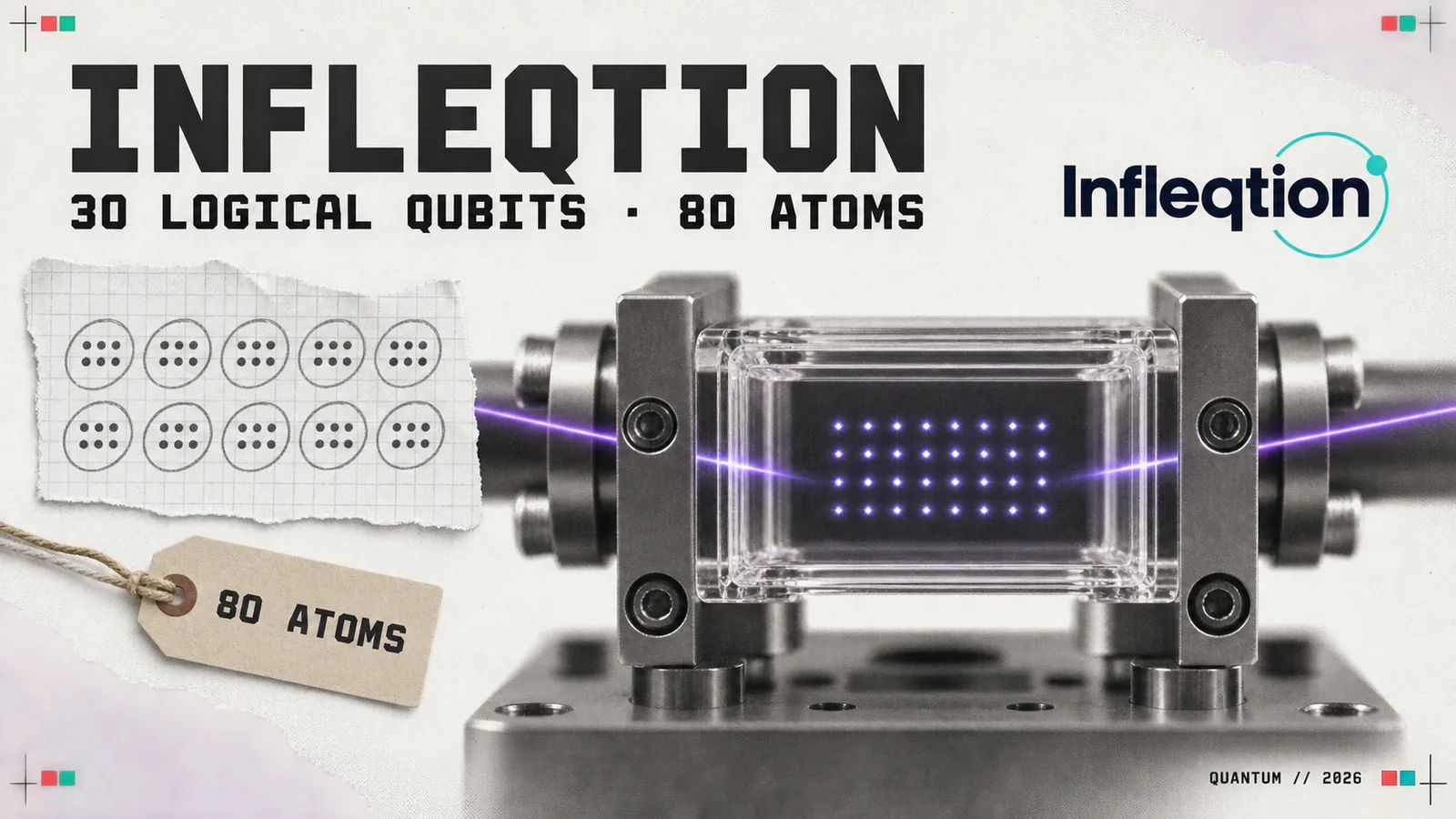
Infleqtion says it has made 30 logical qubits work together on its commercial Sqale quantum computer, using just 80 atoms. The company announced the result on 24 September 2026 and presented it at Quantum World Congress 2026, calling itself “the first neutral-atom quantum computing company to reach 30 logical qubits on a commercial system”.
“Getting 30 logical qubits to work together is hard, and our team has done it,” said Matt Kinsella, Infleqtion’s chief executive, adding that the company is “moving quickly toward our target of 100 logical qubits in 2028”.
What is a logical qubit?
A logical qubit is one unit of quantum information spread across several physical qubits, so the machine can catch the errors that single atoms make. Physical qubits are fragile: an atom can be knocked out of its state or lost from its trap altogether. Spreading the information across a group, under a set of rules called an error-correcting code, lets the machine check the group for faults. Our explainer on quantum error correction covers the idea in more depth.
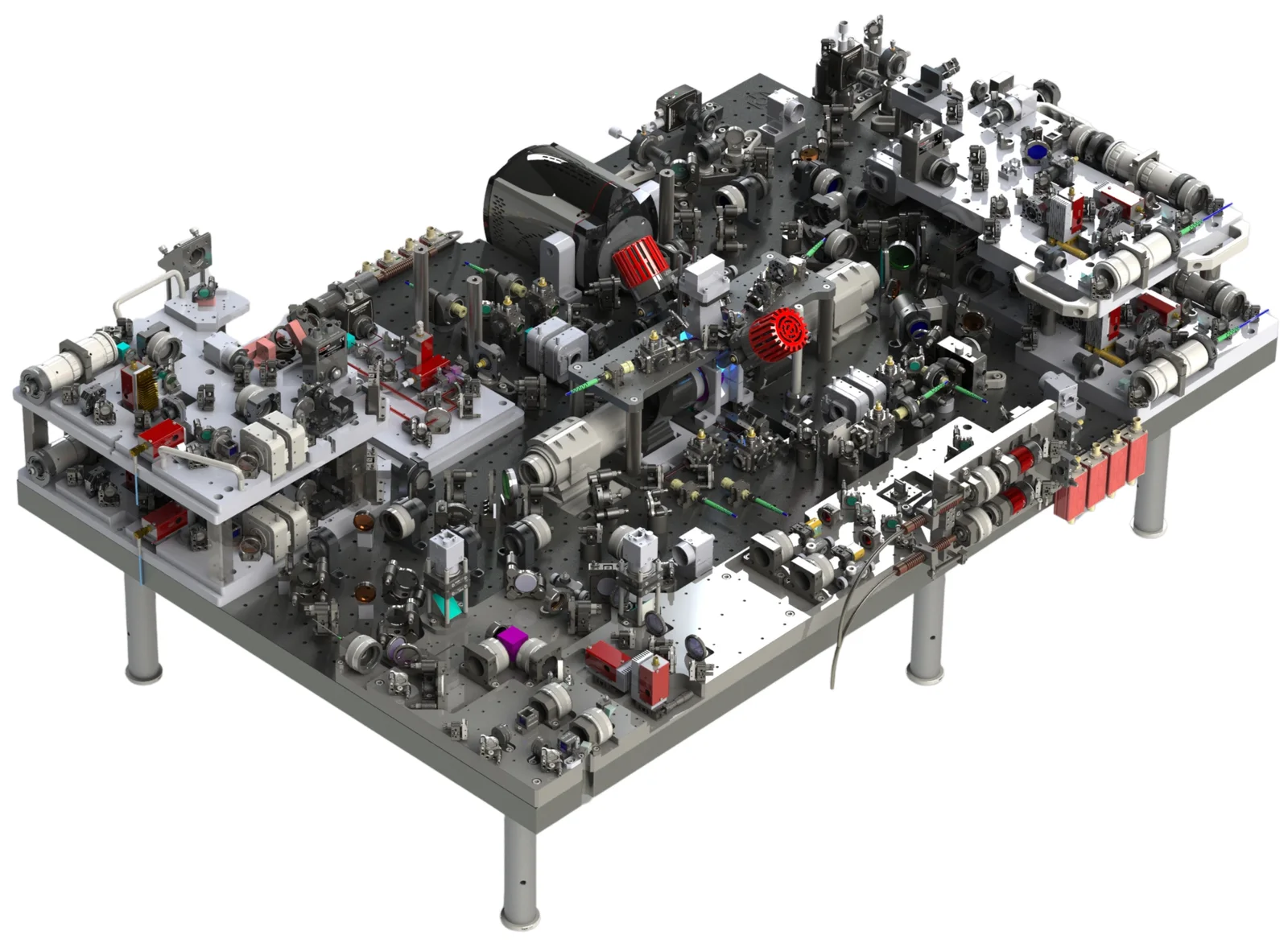
Infleqtion builds its qubits from single atoms held in beams of laser light, the neutral-atom approach. The atoms can be moved around the array mid-calculation, which lets any qubit interact with any other.
Infleqtion packed three logical qubits into every eight atoms
Infleqtion grouped its 80 atoms into ten blocks of eight and encoded three logical qubits in each block, a ratio of eight atoms to three logical qubits, according to the company’s technical post. Each block was prepared in the distance-3 [[8,3,3]] code. For the experiments that followed, the qubits ran in the distance-2 [[8,3,2]] encoding, “which can detect any error or correct for a lost atom”. Infleqtion completed the experiments in August.

| Measure | Figure |
|---|---|
| Physical qubits (atoms) | 80 |
| Logical qubits | 30, in ten blocks of three |
| Physical two-qubit gates in the entangling circuit | 136 |
| Physical operations in all | about 1,000 |
| Share of runs landing on a right answer | about 25% |
| Share a random guess would land on | about 0.024%, one in 4,096 |
The test was finding a needle among a billion answers
Infleqtion ran a circuit that entangles all 30 logical qubits, and the machine’s answers landed in the small set of right outcomes about 25 per cent of the time, roughly 1,000 times the rate of random guessing. The circuit, a type called IQP, has more than a billion possible 30-bit outcomes, of which only 262,144 are correct. A random output would hit one of them about once in every 4,096 tries. The circuit included four CCZ gates, a type of three-qubit gate a quantum computer needs for work beyond what classical machines can simulate.
Two steps happen in software after the run. When an atom is lost, the machine knows which one, and “parity constraints let us reconstruct a missing X-basis measurement outcome in a block with one lost atom”, Infleqtion wrote. That loss correction quadrupled the number of good results, at the cost of a higher error rate. Runs with detected errors are discarded, a method called post-selection, and the company lists “real-time control and mid-circuit measurement to go beyond post-selection” among its next priorities. It plans a full paper “in the coming weeks”.
An AI model found a cheaper way to entangle logical qubits
Infleqtion says OpenAI’s GPT-5.6 Sol model helped it discover a new gate, which it calls a double-CZ, that entangles two groups of logical qubits with four physical two-qubit gates instead of eight. Until then, Infleqtion wrote, the only known method for this step was the transversal CX, at eight physical gates per logical entanglement. Halving that is what brought the whole circuit down to 136 two-qubit gates.
“Every gate can introduce an error,” said Pranav Gokhale, Infleqtion’s chief technology officer, so a circuit with fewer gates leaves less room for mistakes as computations grow longer. The week before, Infleqtion had reported an error-correcting code built with Nvidia’s CUDA-Q Logical that uses about six physical data qubits per logical qubit, about five times fewer than the surface code it compared against.
How 30 compares with other logical-qubit results
Infleqtion says 30 makes it the first neutral-atom company to reach that many logical qubits on a commercial system; Microsoft and Atom Computing entangled 24 on theirs in November 2024. Bigger counts have come from a university-led team on neutral atoms and from Quantinuum’s trapped-ion hardware, using different codes and tests, so the figures below are each group’s own and not a like-for-like ranking.
| Result | Who | Hardware | Announced |
|---|---|---|---|
| 48 logical qubits from 280 physical | Harvard, QuEra, MIT, NIST and University of Maryland | Neutral atoms, research machine | 6 December 2023 |
| 24 entangled logical qubits | Microsoft and Atom Computing | Neutral atoms, commercial machine | 19 November 2024 |
| 94 error-detected logical qubits in one entangled state, from 98 physical | Quantinuum | Trapped ions, Helios | 4 March 2026 |
| 30 entangled logical qubits from 80 physical | Infleqtion | Neutral atoms, Sqale | 24 September 2026 |
Microsoft and Atom Computing also ran computations on 28 logical qubits made from 112 physical qubits. Quantinuum reported a fidelity of 94.9 per cent for its best 94-qubit state.
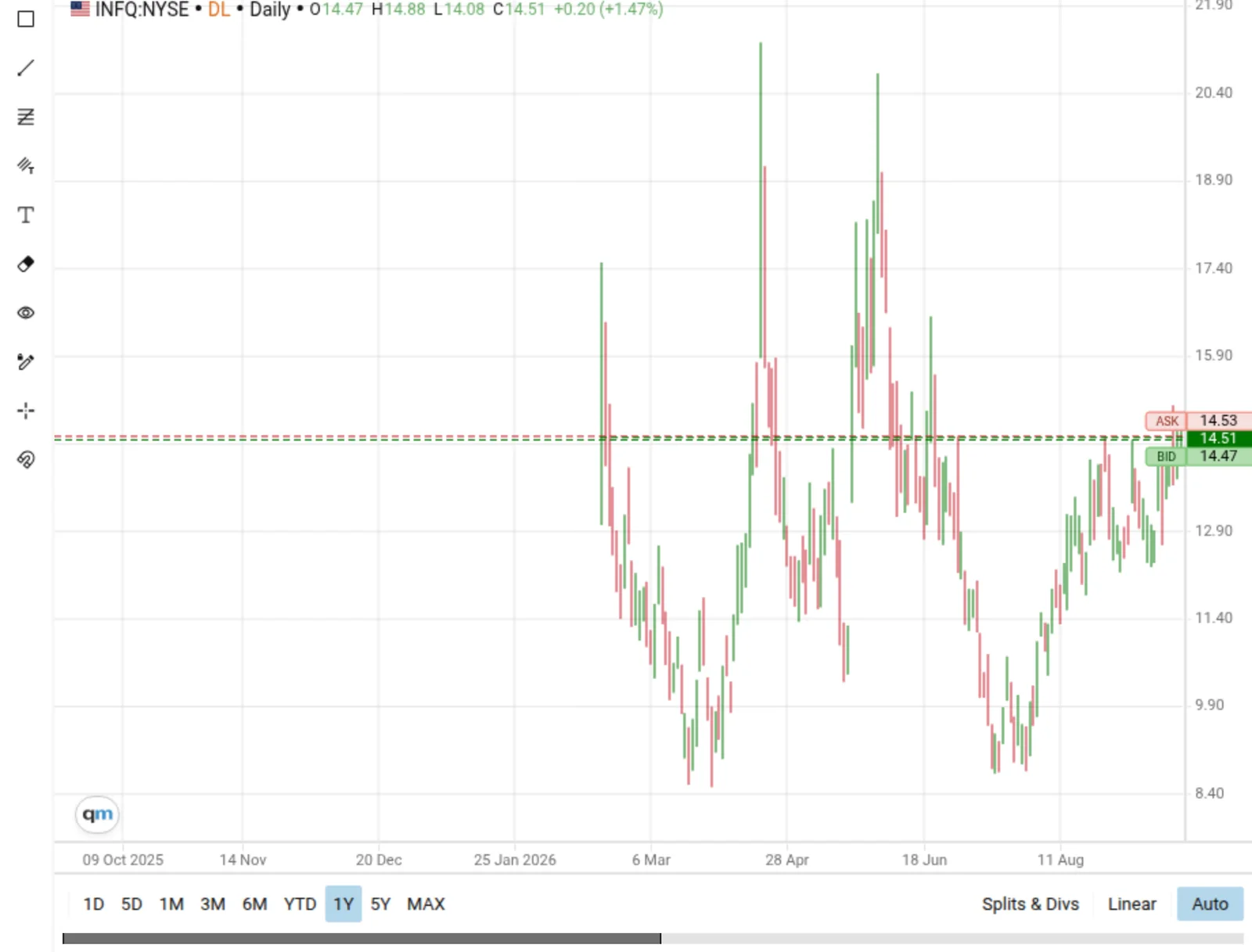
Infleqtion’s shares rose 3.4% on the day
Infleqtion’s shares closed at $14.30 on 24 September 2026, up 3.4 per cent from $13.83 the day before, and at $14.51 on 25 September, according to Nasdaq’s record. The company has traded on the New York Stock Exchange as INFQ since 17 February 2026, after a merger with the listed shell company Churchill Capital Corp X that it said would deliver more than $550 million of gross proceeds.
Infleqtion’s next target is 100 logical qubits in 2028
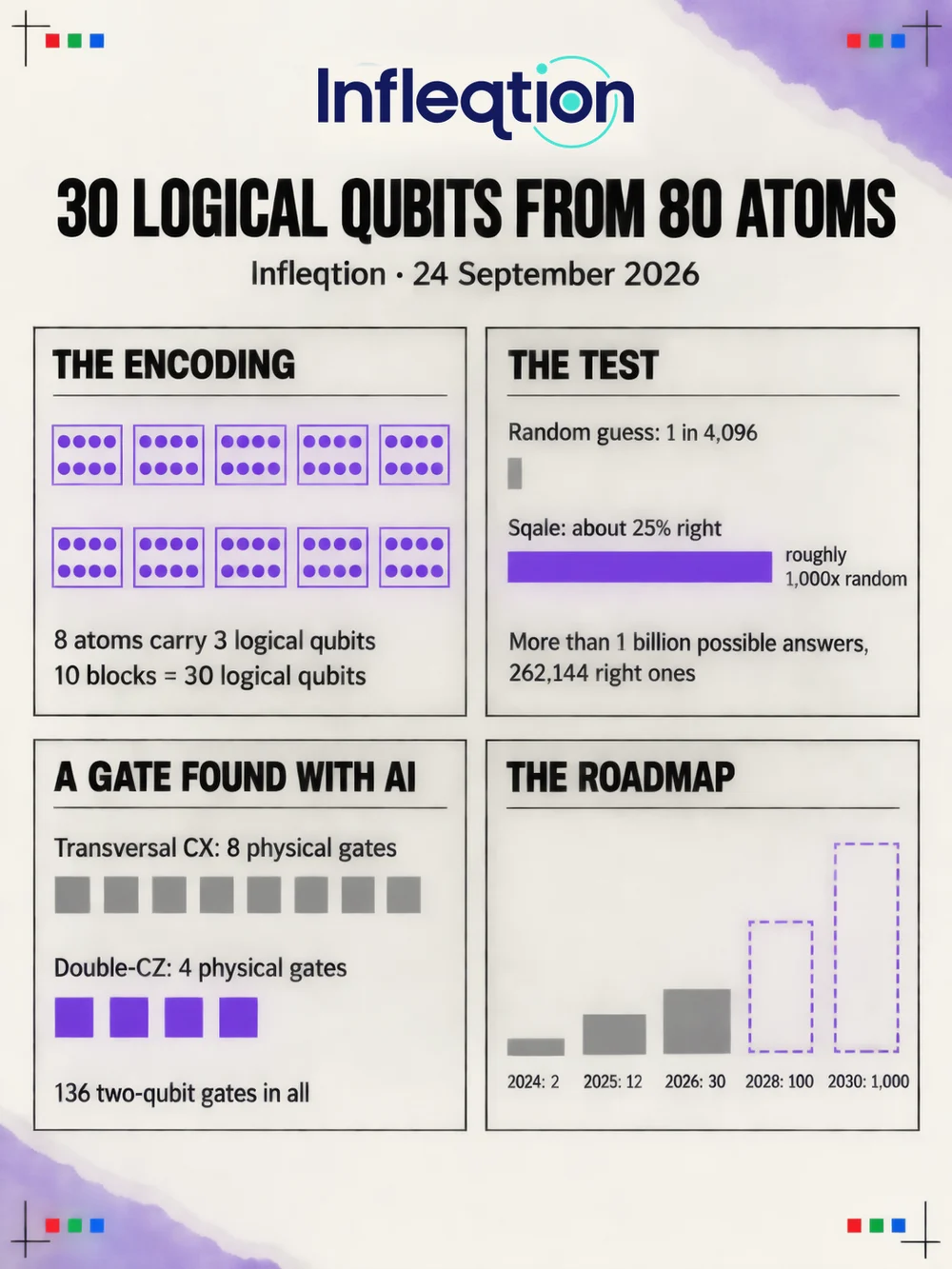
Infleqtion says it is on track to deliver 100 logical qubits in 2028 and 1,000 by 2030, after two on Sqale in 2024, twelve in 2025 and thirty now. It has three customers running logical-qubit circuits on Sqale, one of them the Wellcome Leap Quantum for Bio programme, where its work on biomarker discovery was first demonstrated at 12 logical qubits.
The 30-qubit circuit ran about 1,000 physical operations, which Infleqtion calls a KiloQuOp. The step it is aiming for next is the MegaQuOp, about a million.
Questions people ask
- What did Infleqtion announce?
- Infleqtion said on 24 September 2026 that it had entangled 30 logical qubits on its Sqale neutral-atom quantum computer, using 80 physical qubits. It called itself the first neutral-atom quantum computing company to reach 30 logical qubits on a commercial system, and said the result was confirmed by a signal about 1,000 times stronger than the underlying noise.
- How did Infleqtion fit 30 logical qubits into 80 atoms?
- It grouped 80 atoms into ten blocks of eight and encoded three logical qubits in each block, an 8:3 ratio, using the distance-3 [[8,3,3]] code. For the experiments it ran the qubits in the distance-2 [[8,3,2]] encoding, which can detect any error or correct for a lost atom.
- What is Infleqtion's roadmap?
- Infleqtion says it is on track to deliver 100 logical qubits in 2028 and 1,000 by 2030. It demonstrated two logical qubits on Sqale in 2024, twelve in 2025 and thirty in 2026.
Sources
- Infleqtion: Infleqtion achieves 30 entangled logical qubits on its Sqale quantum computer, 24 September 2026infleqtion.com
- Infleqtion: Demonstration of 30 logical qubits on Sqale, Pranav Gokhale, 24 September 2026infleqtion.com
- Infleqtion: Sqale quantum computinginfleqtion.com
- Infleqtion: Advances fault-tolerant quantum computing software with NVIDIA CUDA-Q Logical, 14 September 2026infleqtion.com
- Infleqtion and Churchill Capital Corp X complete business combination, Exhibit 99.1 (SEC EDGAR)sec.gov
- Nasdaq: Infleqtion (INFQ) historical quotesnasdaq.com
- QuEra: Harvard, QuEra, MIT and NIST/UMD perform error-corrected quantum algorithms on 48 logical qubits, 6 December 2023quera.com
- Microsoft Azure Quantum blog: Microsoft and Atom Computing offer a commercial quantum machine with the largest number of entangled logical qubits on record, 19 November 2024azure.microsoft.com
- Quantinuum: Skinny logic, quantum codes go on a diet, 4 March 2026quantinuum.com
- OpenAI: GPT-5.6 Sol model pagedevelopers.openai.com
- arXiv 2509.13247: Demonstration of a logical architecture uniting motion and in-place entanglement, September 2025arxiv.org