Infleqtion wins £9 million for quantum radio direction-finding
Innovate UK awarded Infleqtion £9 million to develop deployable Rydberg-atom radio direction-finding equipment with Leonardo, building on the QuDiFi prototype project.
Listen to this articleListen
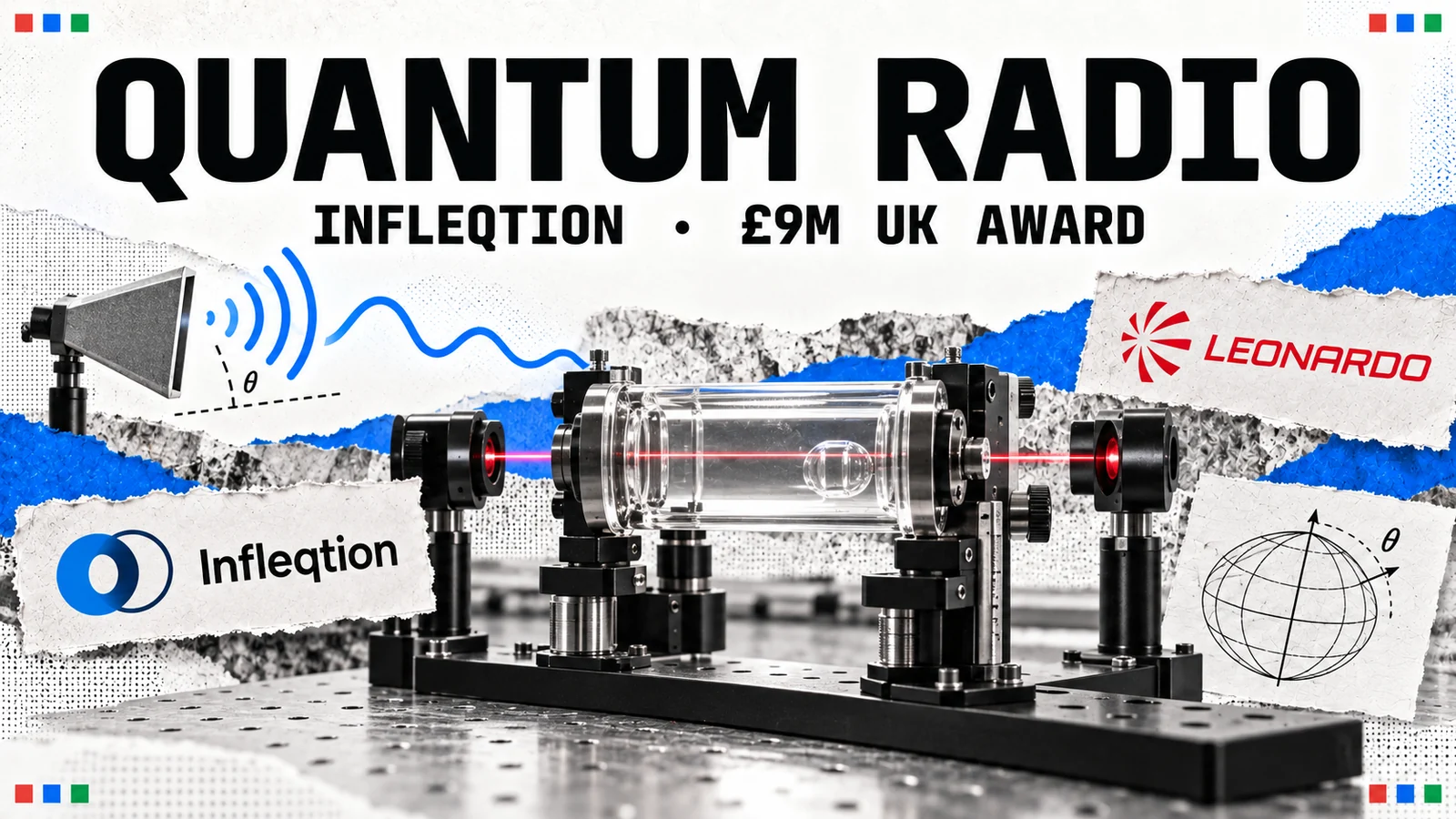
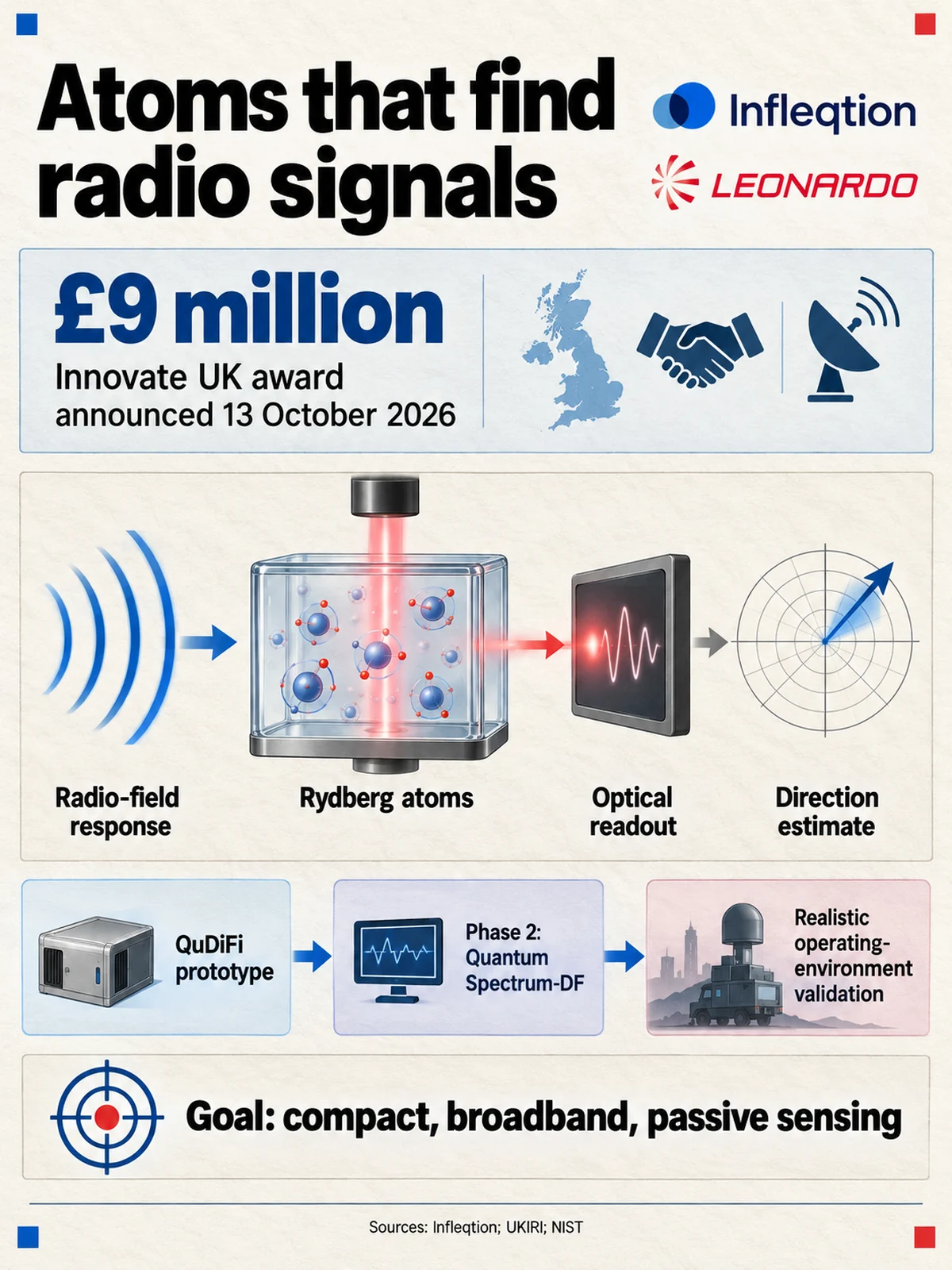
Infleqtion has won £9 million from Innovate UK to develop deployable quantum equipment for locating the direction of radio signals. The company announced the award on 13 October, with Leonardo collaborating on the project.
The funding announcement covers the second phase of Quantum Direction Finding, or QuDiFi, within the Quantum Missions Primer programme. Infleqtion aims to build a Quantum Spectrum-DF product suited to realistic operating environments.
The award takes a prototype towards field use
The next QuDiFi phase focuses on turning a tested prototype into robust equipment. Infleqtion describes work on performance, reliability, usability and validation in conditions representative of deployment.
UKRI’s November 2025 project announcement set out the earlier prototype programme under the lead name Coldquanta UK Limited. It covered sensor-head design, signal processing and integration with existing radio-frequency platforms, with a pathway towards smaller equipment and field trials.
The new award continues that progression. A laboratory measurement can establish the sensing principle; a deployable product also has to keep working when its surroundings, platform and operator change.
Highly excited atoms sense the radio field
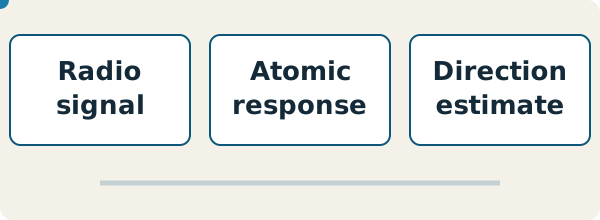
Rydberg-atom sensors use atoms in highly excited states whose response to an electric field can be measured optically. Lasers probe the atomic response, providing information about an incoming radio signal.
Radio direction-finding adds a spatial question: where is the signal coming from? A sensor can infer direction by comparing measurements taken at different positions or by analysing the field’s pattern.
A 2021 NIST demonstration measured the phase of a 19.18 GHz signal at two locations inside a caesium vapour cell. The phase difference allowed researchers to calculate its direction of arrival and compare it with a model. That earlier experiment illustrates the sensing principle behind this wider field of research.
Compact sensors could fit on more platforms
Infleqtion aims to reduce the size of radio direction-finding equipment, particularly where conventional low-frequency systems require large antenna structures. Its proposed product uses optical measurements of atoms to support compact, broadband, passive sensing.
That is relevant to platforms with limited space for antennas and associated electronics. The funded development will test whether the sensing approach can deliver useful performance in a practical package.
The company’s Quantum Spectrum product information describes its broader atomic radio-sensing approach. The new direction-finding project applies it to detecting and locating signals, with future applications including spectrum surveillance, passive radar and resilient navigation.
Leonardo brings operational sensing requirements
Leonardo is collaborating with Infleqtion on the development programme. The award announcement includes Oliver Sims, Leonardo’s electronic-warfare chief technologist, describing the potential to reduce the physical footprint of direction-finding systems.
Innovate UK, part of UK Research and Innovation, is funding the work. The £9 million is an award for continued product development, with Infleqtion giving an approximate US-dollar equivalent of $12 million.
The next test is whether the prototype’s sensing capability can be retained in equipment that is reliable, usable and suited to its intended operating environment. That transition is the focus of the funded second phase.