Google researchers cut simulated quantum errors over 1,000-fold
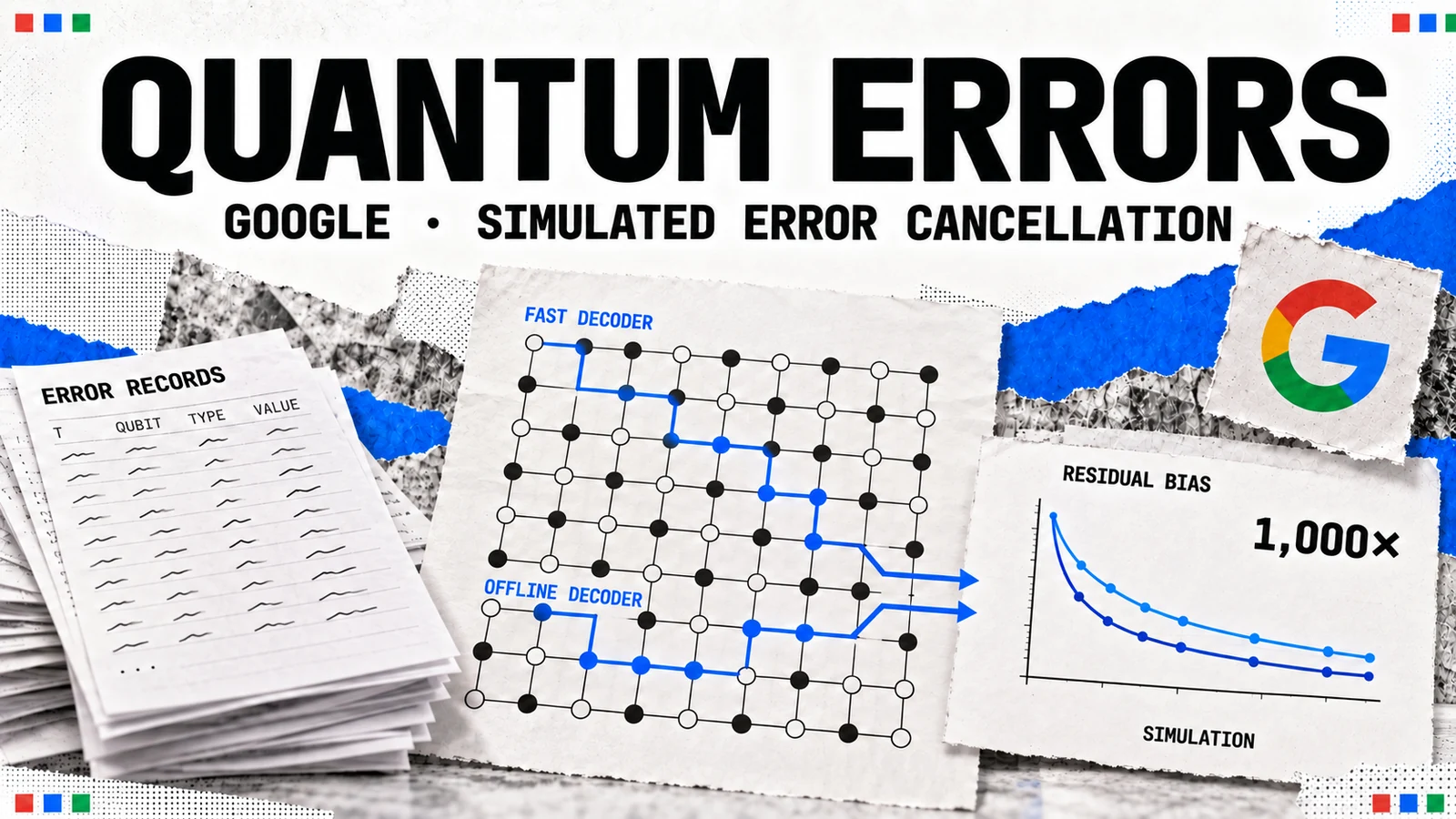
Google Quantum AI researchers propose using saved error records and two decoders to reduce statistical bias after quantum execution. The headline result comes from simulations.
Listen to this articleListen
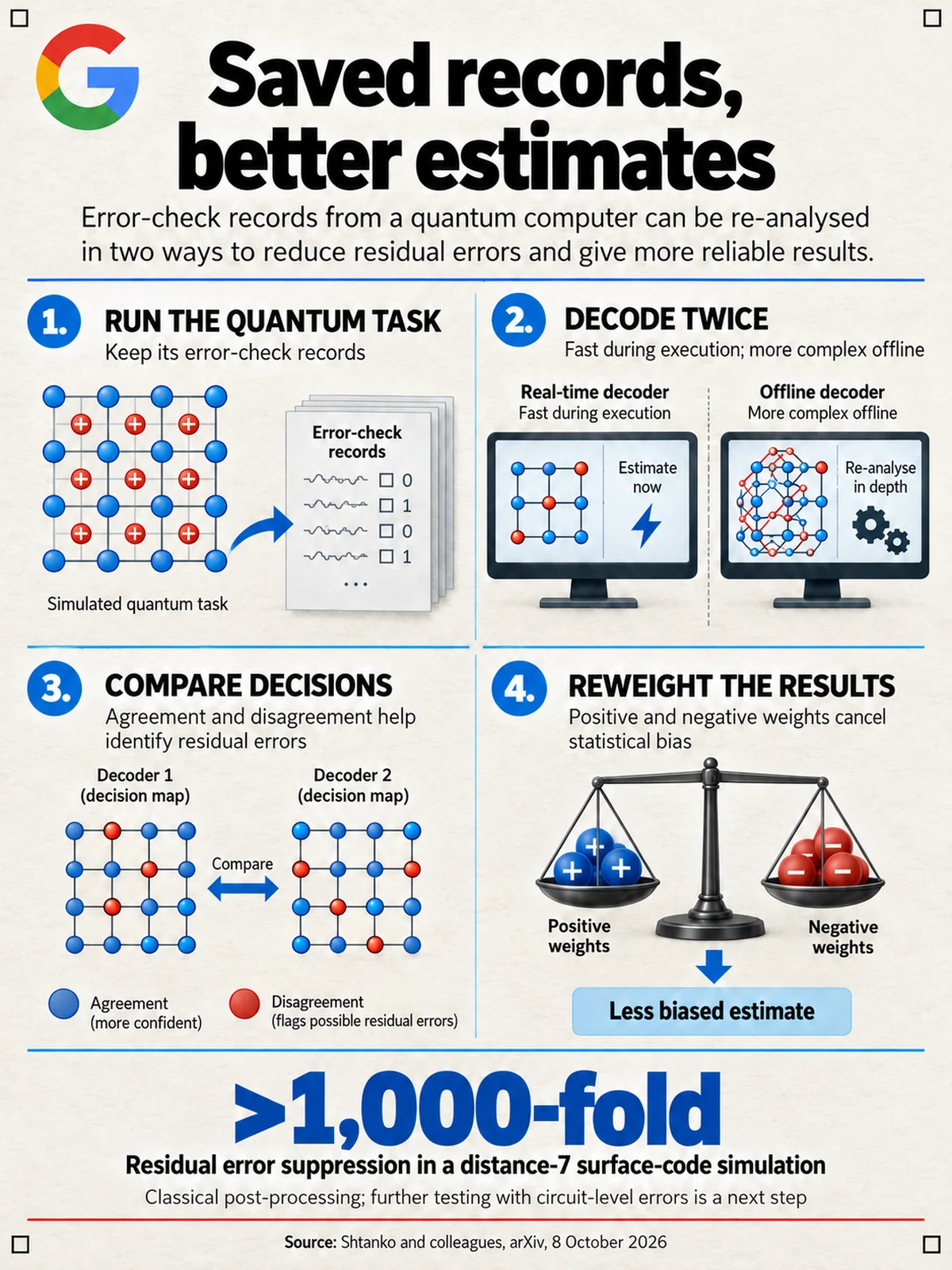
Google Quantum AI researchers have described a way to improve quantum-computing estimates after a calculation has finished, using the error-check records it already produced. Their method, virtual error cancellation, combines two classical decoders with statistical reweighting.
The preprint submitted on 8 October, by Oles Shtanko, Saswata Roy, Shashwat Kumar and Zlatko Minev, reports more than 1,000-fold suppression of residual logical error compared with ordinary decoding in a distance-7 surface-code simulation.
Error-check records retain useful information
Quantum error correction uses measurements that reveal patterns of errors without directly reading out the protected calculation. These records, called syndromes, help a decoder infer the correction needed.
A logical qubit spreads quantum information across several physical qubits. This redundancy helps protect it, but a decoder can still make a wrong decision. The remaining errors affect the results estimated from repeated runs.
Google’s earlier account of quantum error correction explains the practical constraint: decoding must keep up with the processor, and delays can slow error-corrected operations. The new proposal uses an additional analysis after execution, when the same timing constraint has eased.
Two decoders compare their decisions
Virtual error cancellation pairs a fast decoder used during execution with a more complex offline decoder. The full paper groups runs according to whether the decoders agree and how they disagree.
Agreement is informative, but some wrong decisions can persist even in that group. The method learns error information from the saved records and assigns statistical weights to the calculation’s outcomes. Positive weights amplify certain results; negative weights subtract estimated error contributions.
An average formed from those weighted outcomes can have less systematic bias. The improvement is in the computational estimate reconstructed from many runs. The quantum execution follows its original circuit.
The 1,000-fold result comes from simulations
The numerical study tests rotated surface codes under a code-capacity depolarising error model. That model applies errors to data qubits and provides a controlled way to assess the classical analysis.
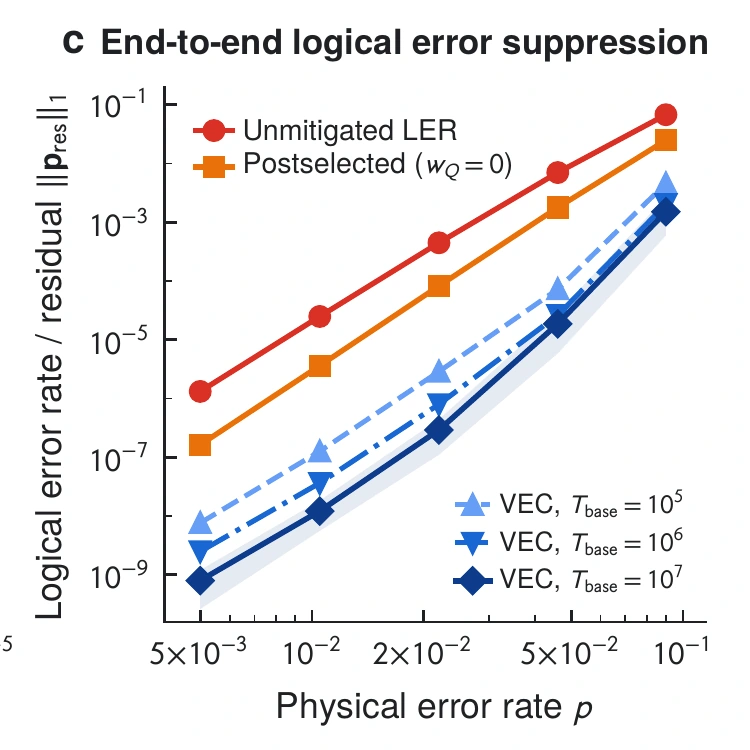
The paper’s highlighted distance-7 example uses 49 data qubits to encode one logical qubit. It reports residual-error suppression exceeding three orders of magnitude against the ordinary decoded rate as the number of samples increases.
The figure below compares ordinary decoding, selecting runs on decoder agreement, and virtual error cancellation. It also shows that the result depends on the amount of data used to learn the error model.
Better estimates still require enough samples
The method trades additional classical processing and sampling for more accurate estimates. Negative-weight methods can increase statistical variation, so both the residual bias and the number of repeated runs are relevant when assessing the result.
The authors identify testing under realistic circuit-level errors as a next step. Such testing would include faults occurring throughout gates, measurements and other operations. The current preprint establishes a simulated result and a method for reusing recorded information.
Decoding is part of the wider error-correction effort
Classical decoding already plays a central role in Google’s quantum hardware experiments. Its earlier Willow work combined physical qubits, repeated error checks and a real-time decoder to protect a logical qubit.
Virtual error cancellation explores another use of that measurement record. The practical prospect is to extract more accurate estimates from an error-corrected calculation by retaining and analysing information that the calculation has already generated.