Google Willow produces 99.99% fidelity quantum magic states
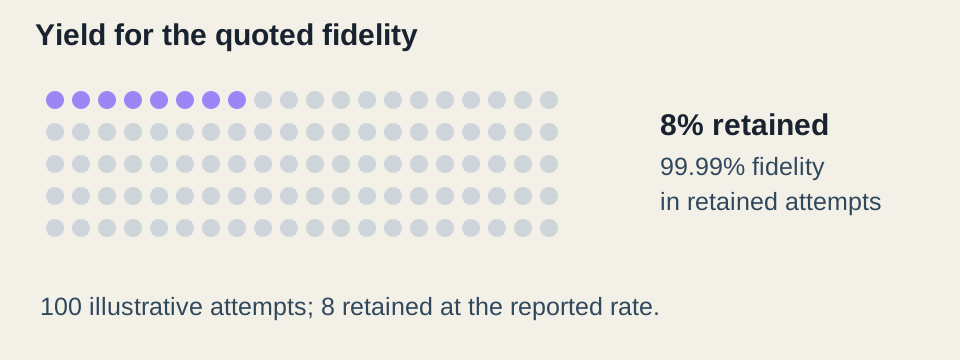
Google's Willow experiment reduced magic-state errors 40-fold. Its 99.99% fidelity result retained 8% of attempts, making yield central to the engineering picture.
Listen to this articleListen
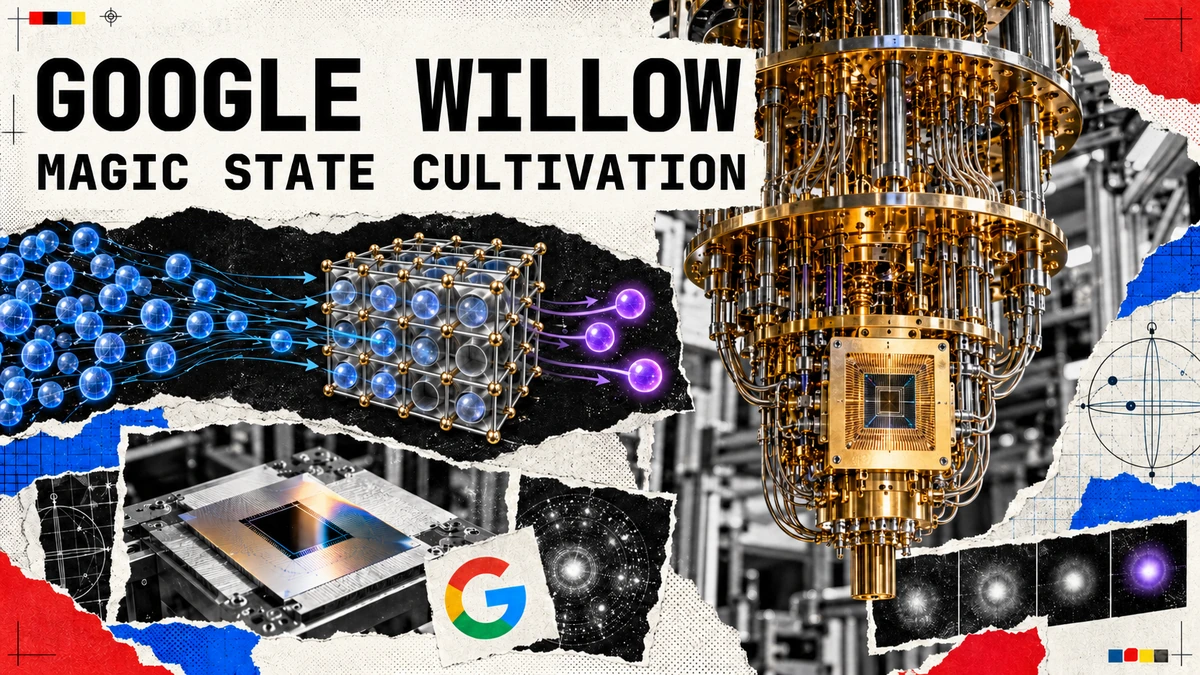
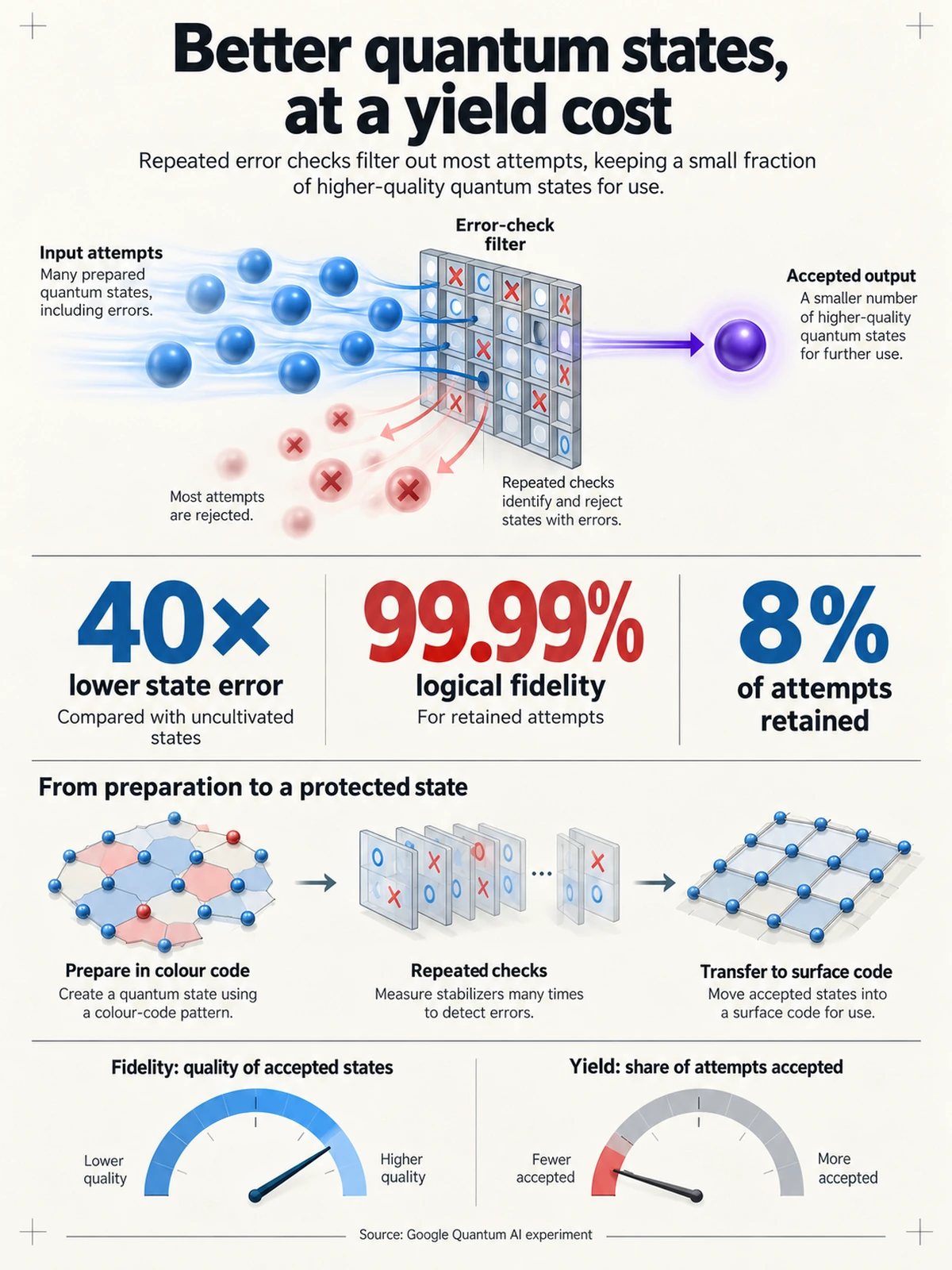
Google Quantum AI has demonstrated a way to prepare high-quality quantum magic states on its Willow processor, reducing their error by a factor of 40. The experiment reports approximately 99.99% logical fidelity, with 8% of attempts retained after error checks.
Google announced the Science publication on 15 October. The experimental preprint first appeared in December 2025. The result concerns a resource that error-corrected quantum computers must repeatedly prepare and consume to run useful algorithms.
Magic states supply an essential kind of operation
A magic state is a specially prepared quantum state that enables operations needed for universal quantum computation. Error-corrected machines can perform some operations relatively directly, but useful algorithms also require operations outside that easier set.
T-states provide one such resource. A machine prepares the state, checks its quality and consumes it to carry out an operation in the calculation. Preparing a steady supply can take a substantial share of a future machine’s resources.
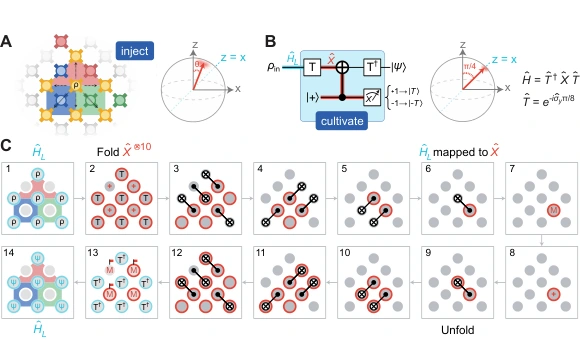
Google’s cultivation approach repeatedly checks and improves an encoded state. It begins in a small colour code, then transfers the state into a surface code suited to the wider error-corrected computation. Google describes the process as progressively filtering out faulty preparations.
The best result keeps eight attempts in a hundred
The experimental paper reports a state fidelity of 0.9999(1), retaining 8% of attempts for that result. The uncertainty is part of the reported value. Its 40-fold improvement compares the cultivated state error with the starting, uncultivated state error.
The full paper also demonstrates transferring the cultivated state from a distance-3 colour code to a distance-5 surface code. Code distance describes how much protection an encoding provides against errors.
A preparation process has two costs to track: resources spent on each attempt, and the fraction of attempts that deliver a usable output. At 8% retention, roughly 92% are discarded. That arithmetic explains why a fidelity figure alone cannot describe the cost of supplying states to a long calculation.
Using the state changes the engineering test
An independent preprint posted on 5 October examines the practical cost of preserving cultivated states for later use. Its authors focus on how error checks at the end of a preparation connect to the computation that needs the state.
The practical cost of magic state cultivation argues that some resource estimates rely on an idealised destructive final measurement for selecting successful runs. A state that will be consumed by an algorithm has to remain available. The authors propose Caliper, using mid-circuit syndrome information to make that selection without destroying the output.
Their analysis finds regimes where the efficiency can be recovered, and others where reaching a lower logical error requires larger codes or longer transfer stages. It is a separate resource study with its own assumptions.
Together, the hardware experiment and the cost analysis define a practical target: reliable states, enough accepted outputs and an affordable path into the calculation that consumes them.