Address-swapping malware reached 178 organisations' websites, including Ledger's
Malicious code served through Optimizely, a website testing service, reached the websites of 178 organisations on 16 November 2026. It was built to swap crypto wallet addresses for the attacker's and to skim card numbers, and it was cleaned up the same night.
Listen to this articleListen
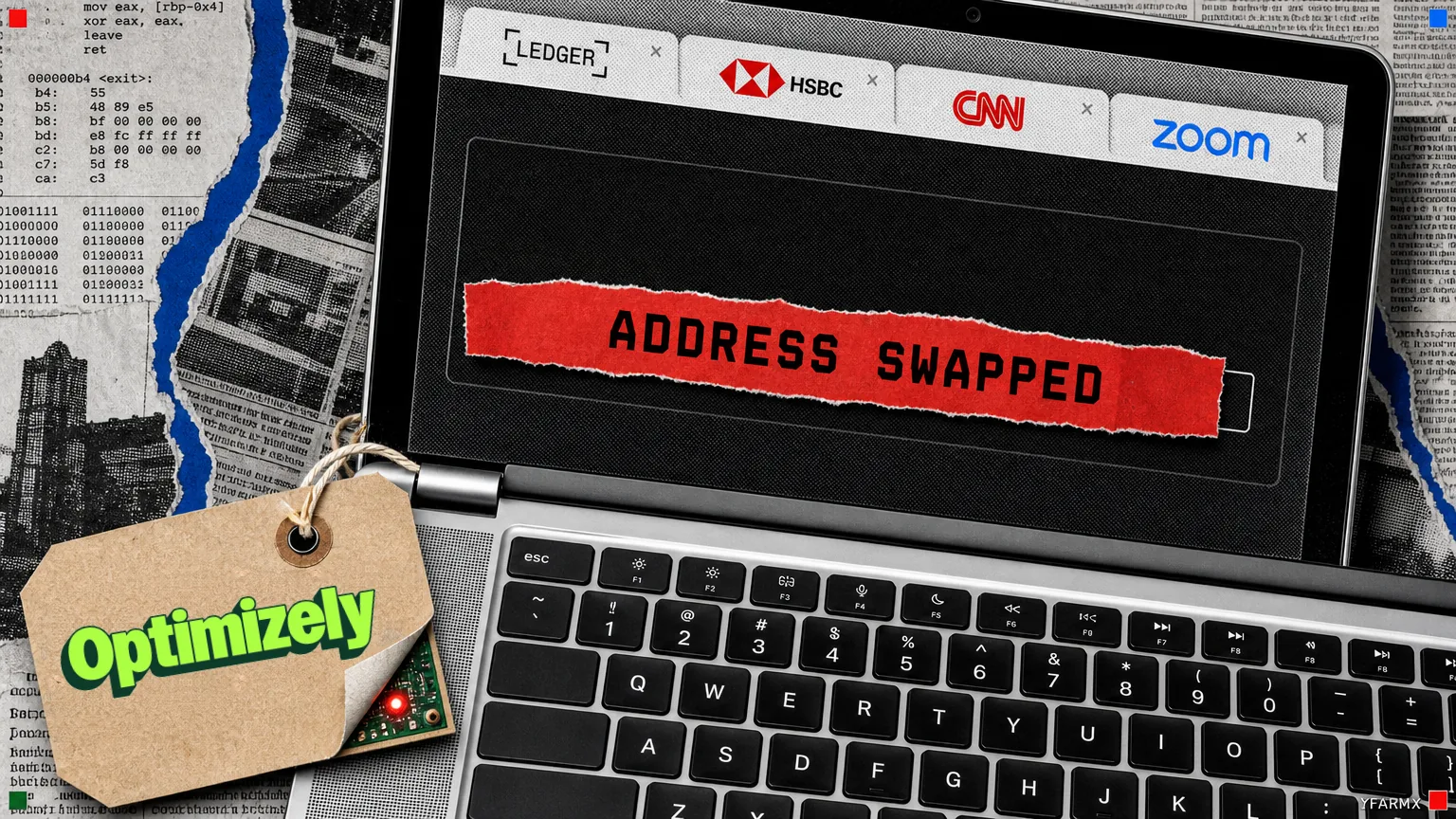
Malicious code delivered through Optimizely, a service large companies use to test changes to their websites, was served to the websites of 178 organisations on 16 November 2026, built to swap crypto wallet addresses for the attacker’s own. The sites belonged to HSBC, Zoom, CNN, the BBC and Ledger, the hardware wallet maker, among many others. Scott Helme of Report URI, a web security monitoring company, tracked and documented the attack, and by 23:11 UTC every infected file he was tracking was clean.
Optimizely confirmed the breach early on 17 November. It said “an unauthorized party exploited a vulnerability in Experimentation and used it to add malicious JavaScript to some customer projects”, and that it had fixed the vulnerability, removed the injected code and taken steps to secure affected user accounts.
How did the code reach so many sites?
The attacker wrote its own code into the Project JavaScript of Optimizely customers’ projects, a custom-code field that runs on every page where a customer has installed Optimizely’s script. Optimizely’s content delivery network then sent the altered files to every visitor, from Optimizely’s own domain and under its own security certificate. Optimizely’s network “served exactly what it was given”, Helme wrote.
The first injection Helme recorded was at 04:21 UTC on 16 November, in a script used by the BBC. Over the day he found 188 infected scripts belonging to 178 organisations. His evening sweep, between 19:24 and 19:59 UTC, checked 1,611 Optimizely scripts.
What did the code do?
The code searched each page for crypto wallet addresses and replaced them with the attacker’s, on eight networks: Bitcoin, Ethereum and other compatible chains, Tron, Solana, TON, Litecoin, Bitcoin Cash and Dogecoin. It checked that each address was valid before swapping it, and StepSecurity, a security company that analysed the code, found it targeted addresses that appeared near payment words.
The swap worked almost everywhere a visitor might meet an address: in page text, form fields, links and images, on the clipboard when someone copied an address, and in outgoing requests, new windows and the iPhone share sheet. Once per page, after a swap, the code sent a screenshot of the page, its address and any cookies it could read to the attacker’s server.

From 13:43 UTC the code also captured card numbers typed into the page. Card fields that payment companies such as Stripe and Adyen host in their own secure frames stayed out of its reach. On iPhones and iPads it went further, loading exploit kits that Helme identified as Coruna, aimed at iOS 13 to 17, and DarkSword, aimed at iOS 18. A third chain for iOS 26 only fingerprinted the device. The kits’ own code marks iOS 18.7.3 and iOS 26.3 as patched.
Which organisations were affected?
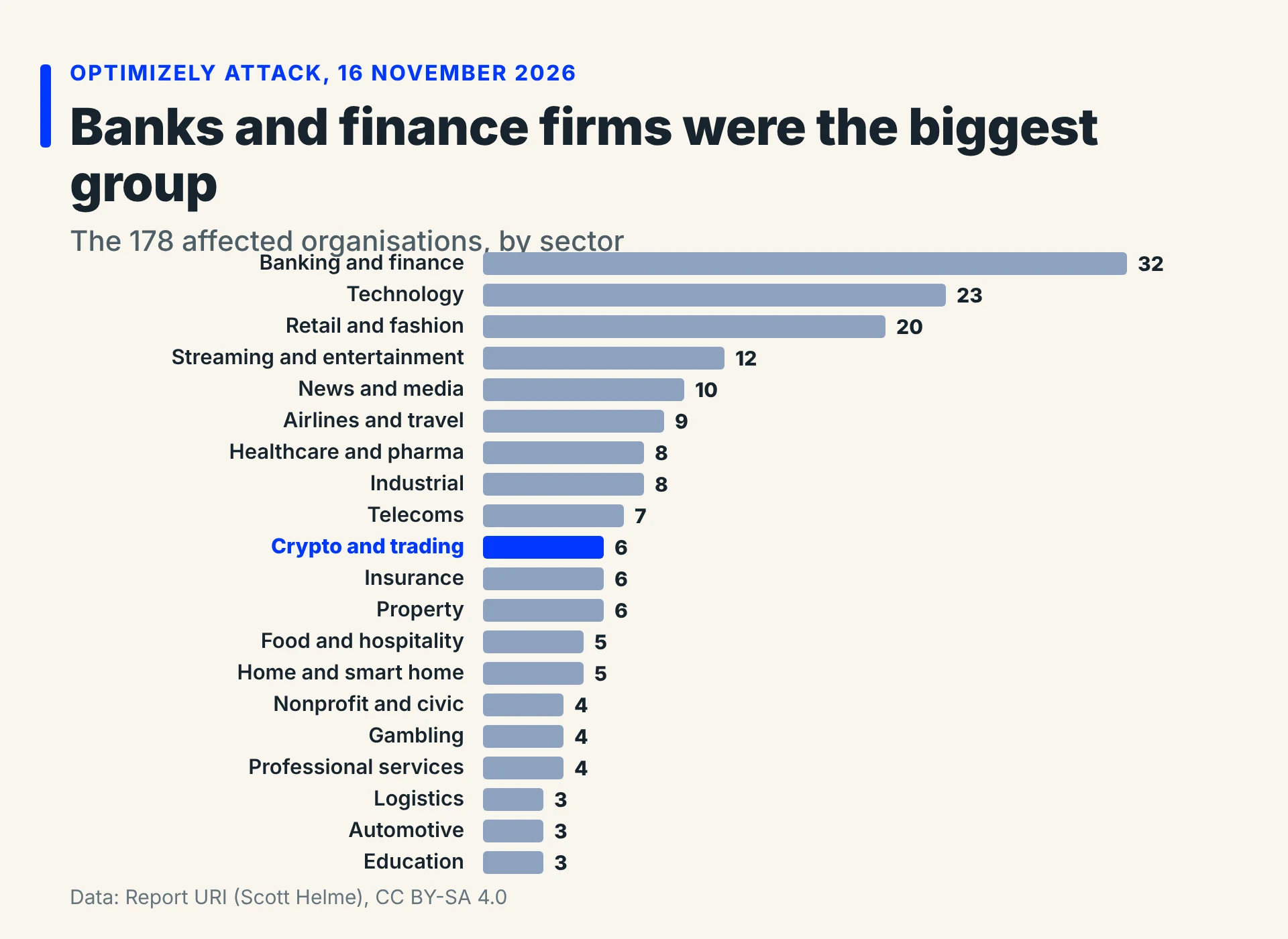
Banks and financial firms made up the largest group, 32 of the 178 organisations, followed by 23 technology companies and 20 retailers, on Report URI’s count. Six were crypto and trading firms: Ledger, IG, OANDA, interactive investor, TMS Brokers and Betashares.
| Sector | Organisations | Examples |
|---|---|---|
| Banking and finance | 32 | HSBC in 11 markets, Equifax, ABN AMRO |
| Technology | 23 | Zoom, Salesforce, GitLab, Optimizely |
| Retail and fashion | 20 | IKEA, ASOS, Levi’s |
| Streaming and entertainment | 12 | Peacock, NOW TV, Starz |
| News and media | 10 | CNN, BBC, Fox News, NPR |
| Airlines and travel | 9 | Air France-KLM, Alaska Airlines |
| Crypto and trading | 6 | Ledger, IG, interactive investor |
| Thirteen other sectors | 66 | Virgin Media, Admiral, UNICEF USA |
How much reached the attacker’s wallets?
The attacker’s wallets received crypto worth about $7,150 on the values in Report URI’s update of 17 November, most of it in bitcoin. StepSecurity found the wallets on Bitcoin, Litecoin, Ethereum and Tron emptied between 04:11 and 05:39 UTC on 17 November.
| Network | Received | Value (Report URI) |
|---|---|---|
| Bitcoin | 0.08528 BTC, in 5 payments | about $5,489 |
| Litecoin | 17.02 LTC, in 3 payments | about $760 |
| Tron | 662.9 USDT and 183.7 TRX | about $719 |
| Ethereum | 0.0553 ETH | about $101 |
| BNB Chain | 82 USDT | about $82 |
| Total | about $7,150 |
Some of that arrived before the attack: the Ethereum figure includes 0.0192 ETH, about $35 at Report URI’s rate, received on 12 November, StepSecurity notes. StepSecurity also relays a lower estimate from Alex Thorn of Galaxy Digital, who puts the total victims sent at about $2,300. “The money is a small part of the damage,” StepSecurity wrote, because the screenshots, cookies and card numbers went straight to the attacker’s server.
How quickly was it cleaned up?
Most of the infected scripts were cleaned between about 20:40 and 21:10 UTC on 16 November, and Helme found every one clean at 23:11 UTC. Ledger’s site was clean at 20:41 UTC, among the first.
| Time (UTC) | What happened |
|---|---|
| 16 November, 04:21 | First injection, in a script used by the BBC |
| 16 November, 13:43 | Card skimmer added to the code |
| 16 November, 20:41 | Ledger’s script clean |
| 16 November, 21:52 | One infected script left, TalkTalk’s |
| 16 November, 23:11 | Every infected script clean |
| 17 November, 01:02 | Optimizely confirms the incident on its status page |
| 17 November, 07:42 | Ledger’s security team posts its statement |
Ledger’s security research team, Donjon, said on 17 November: “Our team has remediated the issue, and the malicious code is no longer being served through our website.” It added: “Your private keys remain protected by your Ledger device.”
The attacker’s two main domains, 1688360.cc and webshell.lol, were put on hold at 00:37 and 03:37 UTC on 17 November, Report URI’s update records.
Check addresses, cards and iPhones from 16 November
Report URI tells anyone who visited an affected site on 16 November to check every crypto transfer they made against the address they meant to pay, and to watch their card statements if they paid by card. It also tells iPhone and iPad owners to update to iOS 18.7.3 or later, or iOS 26.3 or later. StepSecurity advises anyone who entered card details or copied a wallet address on an affected site between about 04:00 and 21:00 UTC on 16 November to treat the card and the wallet as compromised, replace the card and check wallet addresses on a hardware wallet’s own screen.
For the companies, Report URI’s advice is to check every Optimizely Project JavaScript field for unknown code, review who can write to the account and rotate credentials. It also crawled 256 hosts run by the affected organisations to test their Content Security Policy, the browser rules that limit which scripts can run and where data can go, and graded 159 of the organisations on the result.
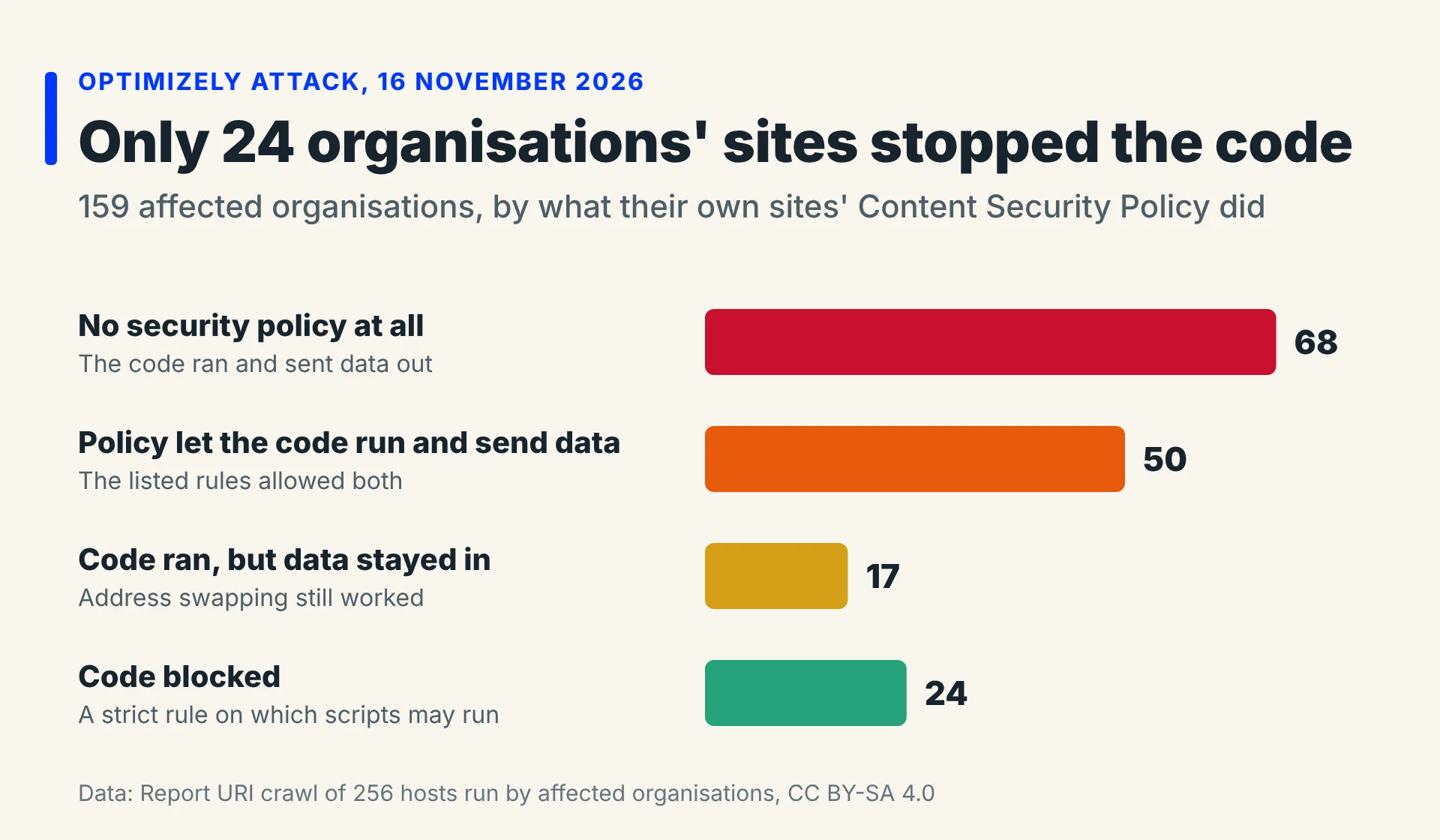
At 68 of those organisations there was no policy at all, and at 50 the policy let the code run and send its data out. At 17 the code ran but the policy stopped data leaving, so address swapping still worked. The 24 organisations whose sites blocked the code outright all had a strict rule on which scripts may run.
Sources
- Report URI (Scott Helme): World's largest brands infected with malware via Optimizely, 16 and 17 November 2026blog.report-uri.com
- Optimizely status page: Web Experimentation security incident, 17 November 2026status.optimizely.com
- Optimizely on X: security incident contained, 17 November 2026x.com
- Ledger Donjon on X: statement on the Optimizely incident, 17 November 2026x.com
- StepSecurity: Optimizely-hosted scripts carried a crypto clipper and card skimmer, 17 November 2026stepsecurity.io