Binance wins $6.5 billion freezing order to recover stolen crypto
Binance says an Abu Dhabi court has granted it a $6.5bn freezing order as it chases crypto stolen in the 29 October hack. The court also told 18 companies, including Circle and World Liberty Financial, to keep the tokens they froze, pending a further hearing on 1 December 2026.
Listen to this articleListen
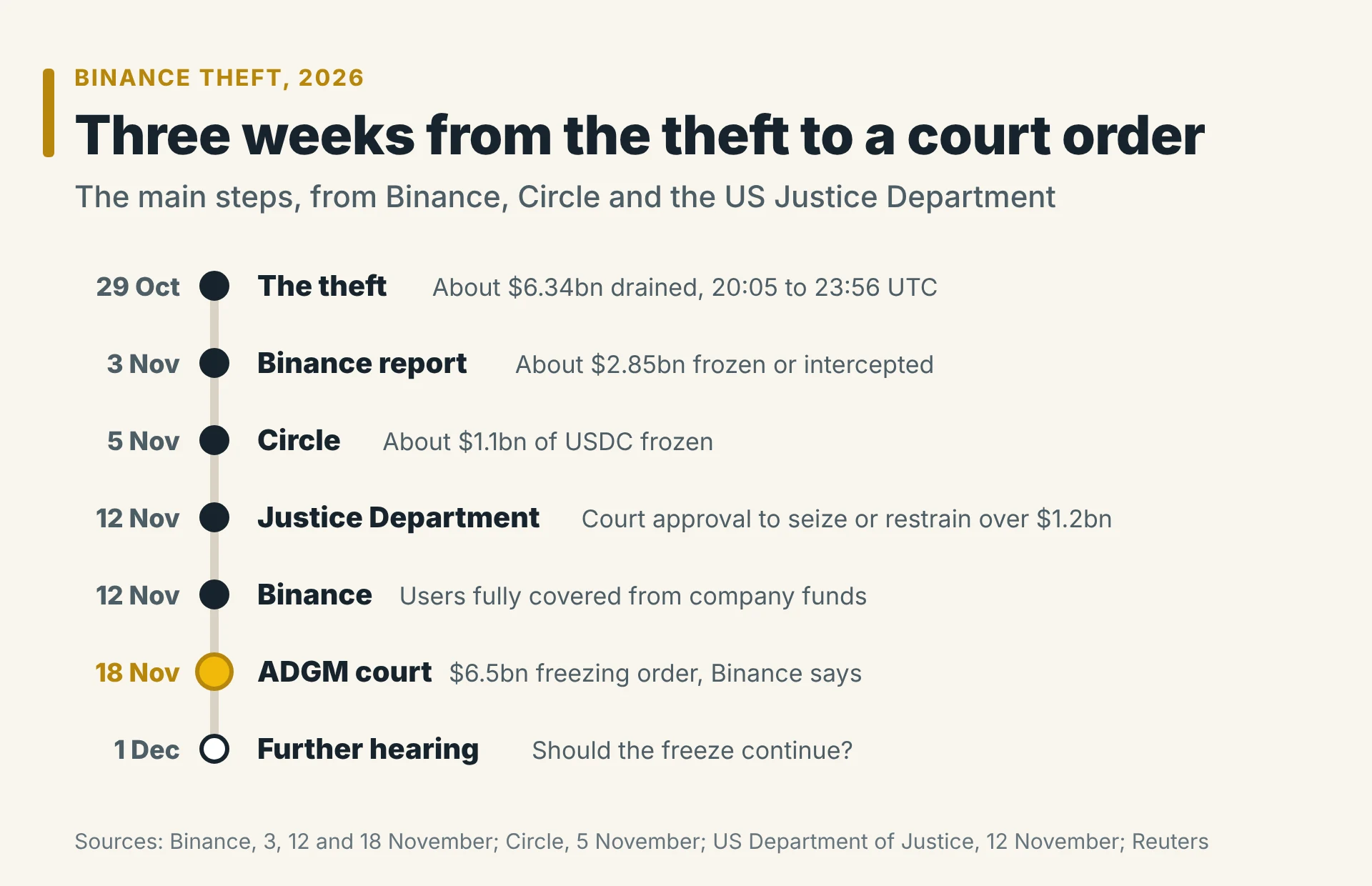
Binance says an Abu Dhabi court has granted it a $6.5 billion freezing order as it tries to recover the crypto stolen from the exchange on 29 October, the largest theft the crypto industry has recorded. Binance announced the court action on Wednesday 18 November 2026, and Reuters reported that the court also told 18 companies holding frozen tokens from the theft to keep them frozen, among them the USDC issuer Circle and World Liberty Financial.
Binance has already covered its users’ losses from its own funds. The order is meant to open a route to getting back the stolen tokens that other companies have frozen. “The court order Binance has obtained assists in creating that pathway,” the exchange said.
What does the court order do?
The court ordered 18 companies holding frozen tokens from the theft to keep them frozen pending further court proceedings, and barred them from lending, swapping or mixing those tokens with other assets, Reuters reported. The court said the companies are not accused of wrongdoing. A lawyer at Gibson Dunn, the firm representing Binance, called that order “one of, if not the, largest publicly known freezing orders ever made”, Reuters reported. Binance put its freezing order at $6.5 billion, Bloomberg reported.
The order comes from the courts of Abu Dhabi Global Market (ADGM), the financial centre where Binance has its global base. Reuters described the order over the 18 companies’ tokens as a proprietary injunction, a freeze on specific assets that the claimant says belong to it. The court will consider at a further hearing on 1 December whether the injunction should continue, and on what terms.

Why does Binance need a court order?
Binance says some token issuers, exchanges and partners release frozen assets only when a court orders it, and the Abu Dhabi order is meant to help create that route. Its announcement says the process “will take time”.
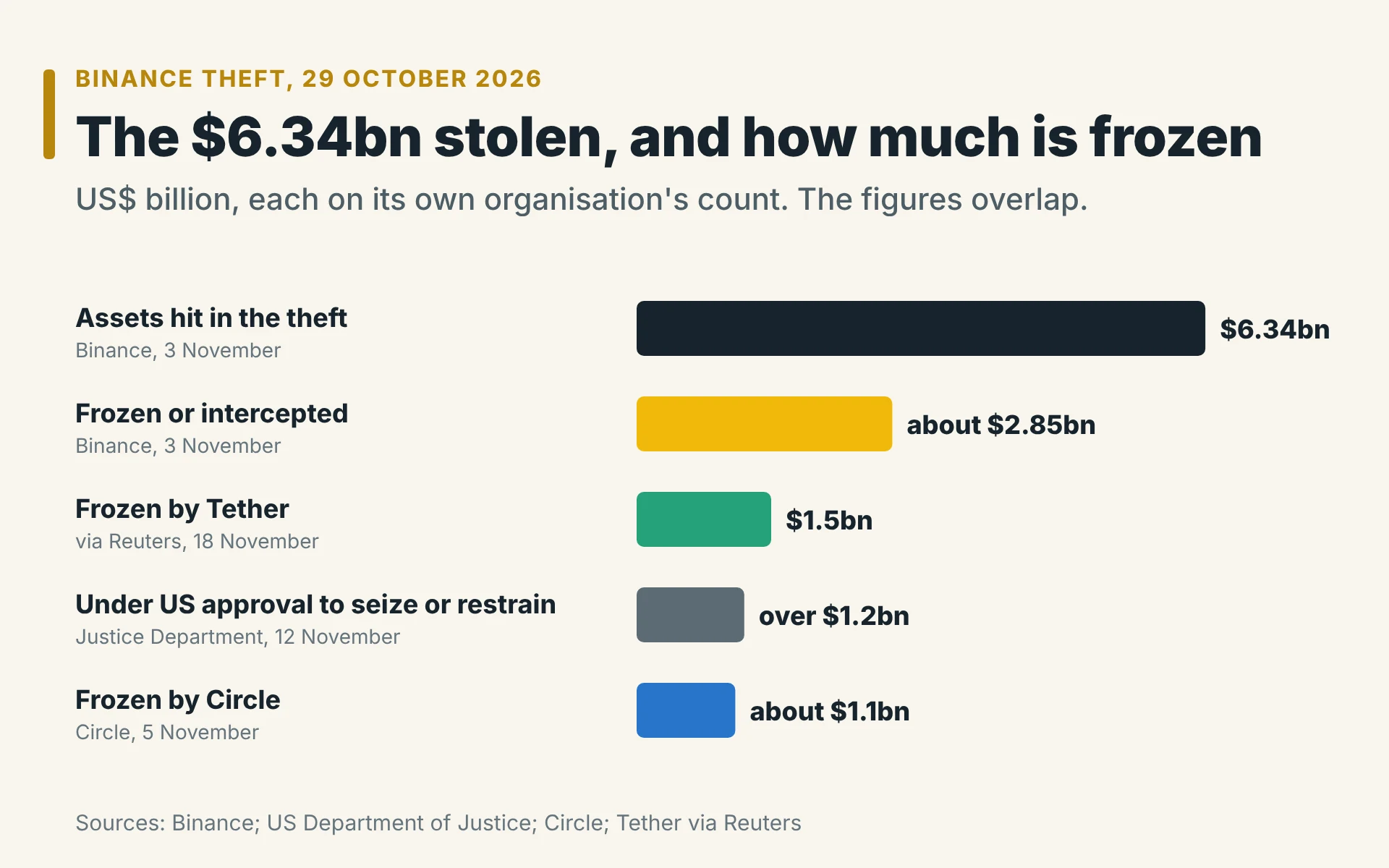
Stablecoin issuers such as Circle can freeze their own tokens at a given address. Circle said on 5 November that it had frozen about $1.1 billion of USDC tied to the theft, in coordination with law enforcement. Its policy, in its own words: “When law enforcement obtains a valid court order to freeze a USDC wallet address, Circle freezes that address, preventing USDC from moving in or out of that address.”
Tether, which had said it froze $1.5 billion, is working with Binance outside the order. “In consultation with the relevant authorities, we will work directly with Binance in respect of reissuing the tokens,” a Tether spokesperson told Reuters. World Liberty Financial’s spokesman, David Wachsman, said: “We acted decisively to protect our users and our partners.”
| Who | Frozen or restrained | Reported by |
|---|---|---|
| Tether (USDT) | $1.5bn frozen | Tether, via Reuters, 18 November |
| Circle (USDC) | about $1.1bn frozen | Circle, 5 November |
| US Justice Department | court approval to seize or restrain over $1.2bn of the more than $2.7bn frozen | Justice Department, 12 November |
| Binance’s own count | about $2.85bn frozen or intercepted | Binance, 3 November |
Each row is its own organisation’s count, made on a different date, so the figures overlap and cannot be added together.
Binance has already covered its users’ losses
Binance completed coverage of the assets hit in the theft on 12 November, committing more than $6.34 billion of company money. The money came from part of its SAFU emergency fund, part of its futures insurance fund and its corporate treasury, and Binance has promised to rebuild SAFU to about $1 billion.
“Binance has absorbed the financial impact of the stolen funds and continues to ensure users do not bear the cost,” the exchange said on 18 November, adding: “Binance will not stop at reimbursing users.” Dugan Bliss, its deputy general counsel, said in a statement: “We will continue using every lawful tool available to trace, freeze and recover stolen assets.”
How did the attackers get in?
The attackers spent months working their way onto Binance engineers’ computers, then used that access to drain about $6.34 billion between 20:05 and 23:56 UTC on 29 October, Binance’s own investigation found. In June an engineer installed a tampered copy of Homebrew, a common developer tool, while looking for an AI coding tool. In September a second engineer was approached with fake job interviews and told to download an “assignment” carrying malicious code.
On 20 October the attacker used the second engineer’s computer and an internal AI tool to gain control of the first engineer’s machine and a third engineer’s. On the evening of 29 October it logged on to the third engineer’s computer, used credentials taken from the first and set off a malicious script. That gave it access to an internal wallet signing service, which it used to send transactions outside the normal withdrawal process. It also used an Ethereum feature called EIP-7702 to give its own smart contract partial control of a Binance hot wallet, and Binance cleared that at 00:10 UTC on 30 October.
The US Justice Department says members of North Korea’s military, the group the FBI calls TraderTraitor, carried out the theft. YFarmX’s trace of the stolen funds follows where the money went in the days after.
Binance is back in court on 1 December
The ADGM court holds a further hearing on 1 December 2026, when it will consider whether the injunction should continue and on what terms. Until then, the 18 companies named in the order must keep the tokens frozen, pending further court proceedings.
In the United States, the Justice Department holds separate court approval to seize or restrain more than $1.2 billion of the frozen funds. A. Tysen Duva, the Assistant Attorney General who leads its Criminal Division, said the division had used its expertise “to immediately halt about half of this historic breach.”
Sources
- Binance: Binance has been granted a court order in the ADGM Courts to support asset recovery, 18 November 2026binance.com
- Bloomberg: Binance secures $6.5 billion freezing order from Abu Dhabi court, 18 November 2026bloomberg.com
- Reuters: UAE court orders freeze on crypto tokens stolen from Binance wallets, 18 November 2026 (via Yahoo Finance)finance.yahoo.com
- Binance: 29 October 2026 security incident, initial findings and response update, 3 November 2026binance.com
- Binance: Binance completes coverage of assets impacted in security incident, 12 November 2026binance.com
- US Department of Justice: actions to disrupt North Korea's massive theft of cryptocurrency, 12 November 2026justice.gov
- Circle: The Binance incident, collective defense must move at machine speed, 5 November 2026circle.com