EU quantum draft favours European suppliers in public contracts
MLex reports draft supplier restrictions and quantum-safe purchasing provisions. The Commission’s published strategy uses procurement to build European industrial capacity.
Listen to this articleListen
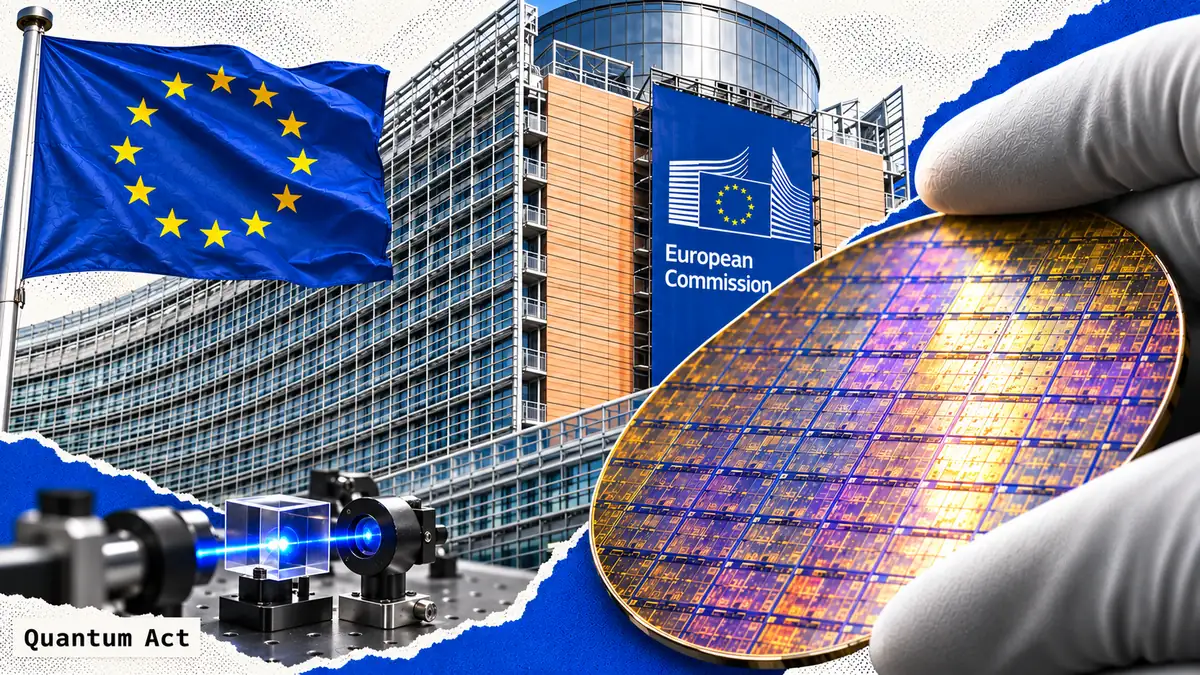
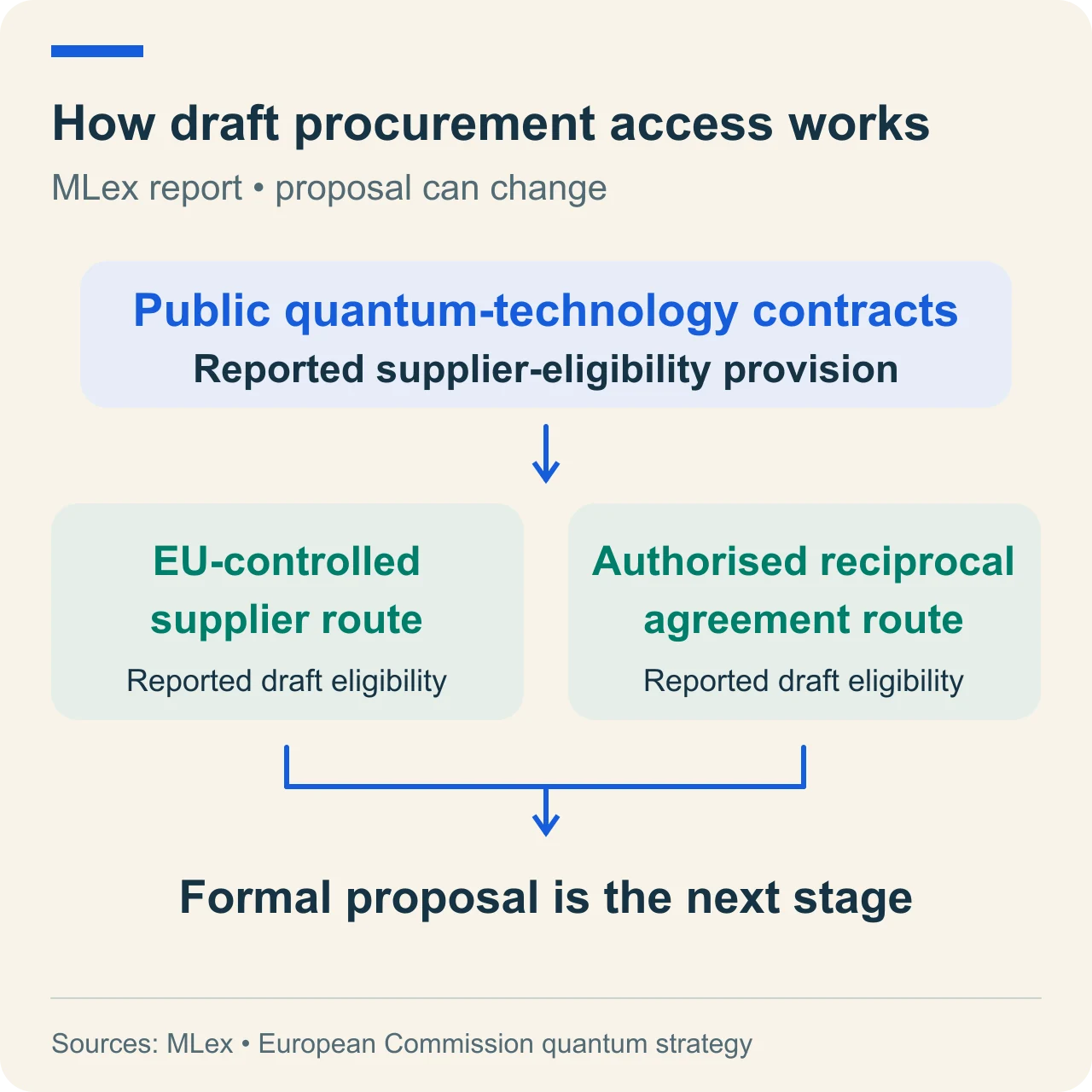
A reported draft of the EU Quantum Act would reserve public quantum-technology contracts for EU-controlled suppliers and companies authorised under reciprocal international agreements. MLex reported the leaked provisions on 28 October, describing a proposal that would also introduce quantum-resistant encryption requirements for some public purchases in critical sectors.
The procurement idea sits within the Commission’s published Quantum Europe Strategy, which makes public institutions early customers for European quantum technology. The draft would take that industrial-policy approach into rules about who can supply particular public projects. Its provisions remain proposals as the Commission prepares the legislation.
Public buyers could shape which suppliers reach the market
MLex’s account describes an EU-control test and a route for companies covered by reciprocal international agreements. That would make supplier eligibility a commercial issue alongside a system’s technical capabilities, price and maintenance arrangements.
Public contracts can be especially influential in quantum technology. Early machines and specialist instruments are expensive, their development takes years, and initial customers often include national laboratories, universities and publicly supported computing centres. A contract can finance a supplier’s next stage of development while creating a reference installation for later customers.
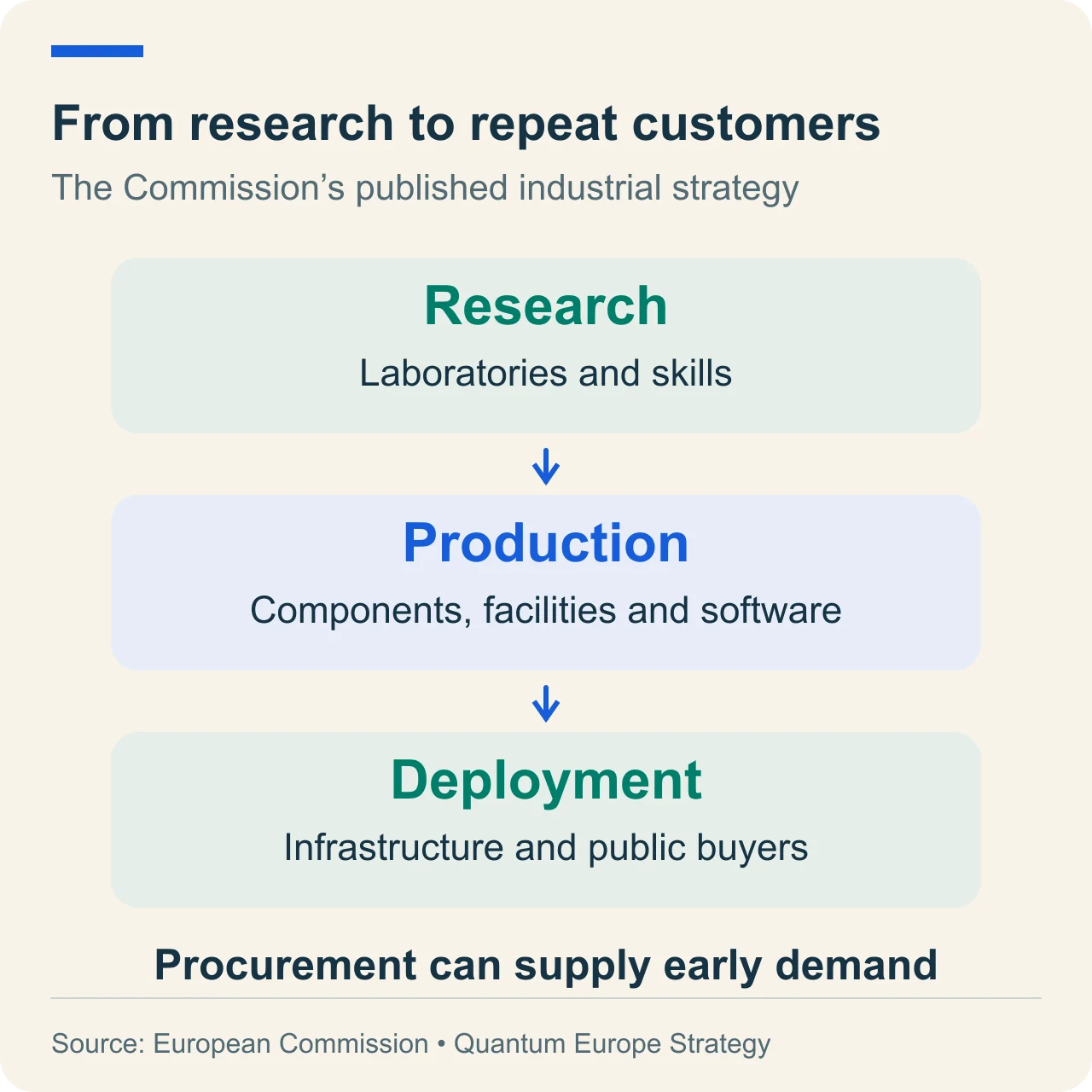
The Commission’s strategy document explicitly describes public procurement as a way to drive early adoption. It envisages hospitals, infrastructure operators, critical public services and government agencies acting as launch customers for quantum-enabled products.
Europe wants research to become production capacity
The Quantum Europe Strategy identifies the conversion of research into market-ready products as a central industrial challenge. Its five areas cover research and innovation, shared infrastructure, the supplier ecosystem, space and dual-use capabilities, and skills.
That structure reflects the breadth of a quantum supply chain. Computing needs processors, control electronics, refrigeration, software and integration with classical machines. Other quantum applications involve communications, sensing and precise measurement, bringing in different specialist components and customers.
The strategy calls for coordination across national programmes to reduce duplicated effort and gaps in capacity. It also proposes support for startups and scaleups, including finance and access to early customers. A supplier-preference provision would affect that commercial environment by influencing who can compete for publicly funded demand.
Control, supply resilience and technical performance are separate questions
The Commission’s strategy links industrial growth with secure supply chains and European production capacity. It describes assessing dependencies across components and software, and responding through diversification, expanded local capability and international partnerships.
A purchaser still needs a machine or service that performs its intended task. Processor quality, calibration, error correction, maintenance, software compatibility and long-term availability can all affect whether an installation delivers useful results. Procurement policy determines access to the competition; technical assessment determines which eligible solution meets the buyer’s requirements.
The distinction also helps explain the international-partner route reported by MLex. Reciprocal access could connect supplier eligibility with agreements that open corresponding opportunities abroad. The applicable control and authorisation tests would be defined through the legislative framework and any agreements used under it.
Quantum-safe purchasing reaches beyond quantum computers
MLex also reports draft requirements for public purchases in critical sectors to be ready for encryption that withstands future quantum attacks. That brings conventional digital infrastructure into the policy discussion alongside the quantum machines being developed.
Post-quantum cryptography uses mathematical algorithms designed for this threat. Procurement can support migration by requiring suitable products and the ability to change cryptographic methods over a system’s life. That is a separate engineering task from purchasing a quantum processor or building a quantum communication link.
The Commission’s quantum policy programme sets the broader objective of turning scientific capability into deployable technology. The reported supplier rules would give public purchasing a more direct role in that transition, shaping both the companies that obtain early contracts and the security requirements those contracts carry.
Sources
- MLex: reported draft Quantum Act procurement provisions, 28 October 2026mlex.com
- European Commission: Quantum Europe Strategydigital-strategy.ec.europa.eu
- European Commission: full strategy communicationec.europa.eu
- European Commission: quantum policy programmedigital-strategy.ec.europa.eu